Category: Shell
The oil industry has succumbed to a dangerous new climate denialism

Opec predicts oil demand will be 10% higher by the 2040s.
IuriiAdi Imsirovic, University of Surrey
If we have not been warned of the dangers of climate change this summer, we never will be. Extreme heat, forest fires and floods have been all over news reports. Yet the oil and gas industry remains largely in denial.
The International Energy Agency (IEA) says steep cuts in oil and gas production are necessary to reach the Paris (COP 21) goal of keeping global warming at 1.5℃. However, only a tiny fraction of the industry, accounting for less than 5% of oil and gas output, has targets aligned with the IEA’s “net zero” requirements.
The current secretary general of production cartel Opec, Haitham al-Ghais, expects global oil demand to rise by about 10% to 110 million barrels a day by 2045, a volume incompatible with the Paris goals. The UK government has just offered a helping hand, granting around 100 new North Sea licences. What are we to make of this mismatch?
The new denialism
Typical of the new breed of climate denialism is a recent report by the Energy Policy Research Foundation (ERPF), a body funded by the US government and various undisclosed corporate interests and foundations. It sees the IEA’s requirements as a “seal of approval … to block investment in oil and gas production by western companies”. The report views meeting the targets as too costly, too harsh on poor countries and too bad for the energy security of the west.
In fact, it is wrong on each account. Many eminent economists and scientists use the concept of the social cost of carbon (SCC), which is defined as the cost to society of releasing an additional tonne of CO₂. Expert estimates from 2019 put this at between US$171 and US$310 (£133 to £241). If we go with, say, US$240 per tonne, the social cost of continued carbon equivalent emissions comes out at almost US$8.5 trillion every year.
A recent study has factored into the calculation climate feedback loops. This is where one problem caused by global warming leads to others, such as melting permafrost unleashing stores of methane.
When the study estimated the economic damage that this could cause, it produced an SCC in excess of US$5,000. That implies annual costs of more like US$170 trillion a year, which makes the US$4 trillion investment into clean energy that the IEA thinks necessary to meet the Paris climate goals look like a drop in the ocean.
It may help to break this down to one barrel of oil. A special IEA report for COP28 estimates that on average, each barrel of oil emits 0.53 tonnes of CO₂ equivalent in greenhouse gas across its life cycle, 20% of which comes from production.
Going back to our average SSC per tonne of US$240, that points to a social cost of US$126 per barrel. With oil currently at US$85 per barrel, the societal damage from producing, transporting, refining and consuming it is far greater – and that’s before including climate feedbacks.
Meanwhile, the arguments by the EPRF and like-minded supporters about energy security are laughable. The history of the oil and gas industry is a history of wars and geopolitical tensions. Transitioning to cleaner fuels can only increase our energy security and reduce the need to police remote autocracies.
The argument that poor countries need to continue burning carbon for development reasons is no better. In its latest report from 2022, the Intergovernmental Panel on Climate Change (IPCC) said climate change would probably see an increase in “losses and damages, strongly concentrated among the poorest vulnerable populations”.
Equally, the World Health Organization estimates that: “Between 2030 and 2050, climate change is expected to cause approximately 250,000 additional deaths per year from malnutrition, malaria, diarrhoea and heat stress.”
How to respond
The denialists offer no alternatives to cutting carbon emissions, and often simply ignore climate change altogether. The recent ERPF report mentions climate change only four times. It is as if heatwaves, forest fires, flooding, rising sea levels and the demise of natural habitat caused by climate inaction were happening on another planet.
We still have time to limit global warming below 1.5℃. It is true that we will need oil and gas for many years, and that there are currently no alternatives for certain sectors such as air travel, shipping and some industries. Nonetheless, there is still much that can be done now to make a substantial difference.
To incentivise the transition to cleaner energy, governments need to end fossil fuel subsidies, which the IMF estimates amounted to US$5.9 trillion in 2020 alone. We also need to put a proper price on carbon – only 40 countries have attempted this so far, and none has it anywhere near the estimated social cost of emitting carbon.
Countries that resist charging their own polluters should face a carbon border adjustment mechanism, which is a tariff that effectively puts the polluter on the same footing as local players. If all the actors in the fossil fuel supply chain had to face the cost of the damage they cause, the need to phase out long-term investments in fossil fuels would become more obvious.
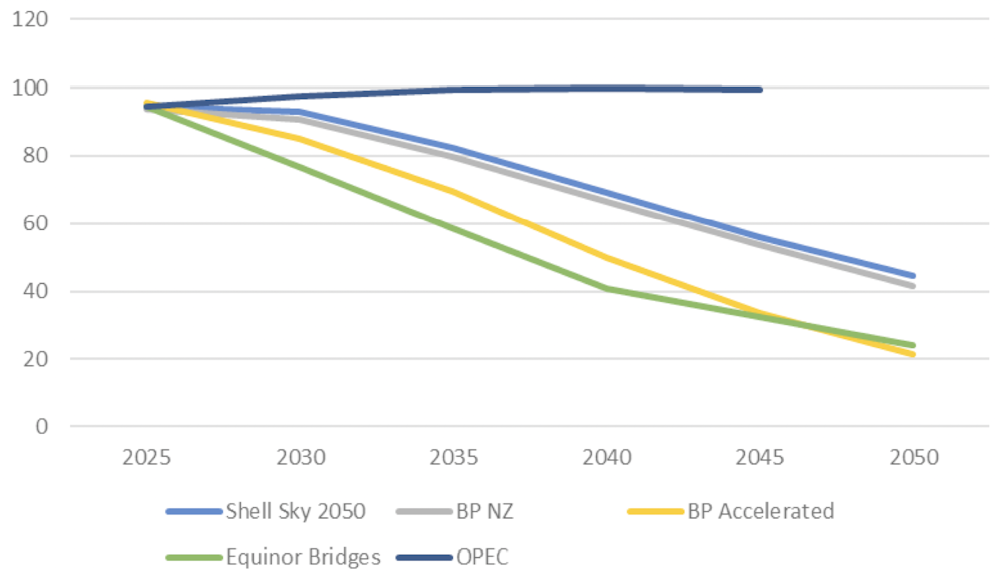
The IEA requirements for “net zero” are just one of the pathways towards meeting the Paris goal of 1.5℃ warming. Others are explored by some of the more credible actors in the petroleum industry, such as Shell, BP and Norway’s Equinor, but all require a substantial decline in oil demand and production by 2050.
Required production cuts
I left the IEA’s scenario off the graph because it published so few datapoints, but it is broadly in line with the others. Meanwhile, the Opec data is for reference and not a net zero scenario.
BP, Shell, Equinor and OpecInstead of criticising efforts to slow climate change and sponsoring ridiculous reports calling for more fossil fuels, the oil industry should eliminate leakages, venting and flaring of methane, and electrify as many processes as possible using renewable power. It should also employ carbon capture, usage and storage technologies over the next ten years – yes this will increase the price of fossil fuels, but that is exactly what we need to make clean sources of energy competitive across the board and speed up the energy transition.
The sooner the industry starts facing up to the realities of climate change, the more chance it has to survive. The companies and even countries that produce fossil fuels will have to face and pay the cost for the damage they cause. Those costs are already massive and will grow. Those that survive will do so only as a provider of clean and sustainable energy.
Don’t have time to read about climate change as much as you’d like?
Get a weekly roundup in your inbox instead. Every Wednesday, The Conversation’s environment editor writes Imagine, a short email that goes a little deeper into just one climate issue. Join the 20,000+ readers who’ve subscribed so far.

Adi Imsirovic, Fellow, University of Surrey
This article is republished from The Conversation under a Creative Commons license. Read the original article.
Science shows the severe climate consequences of new fossil fuel extraction
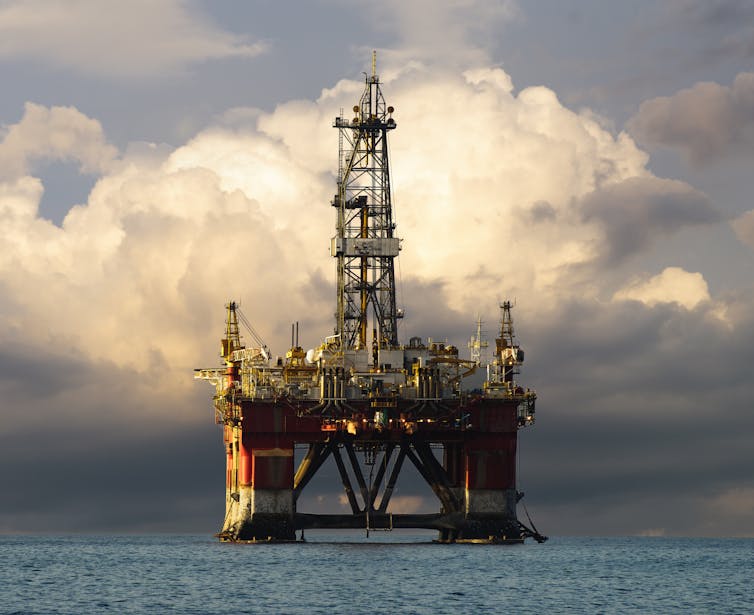
An offshore drilling platform.
Mike Mareen/ShutterstockEd Hawkins, University of Reading
The world has just suffered through its warmest month ever recorded. Heatwaves have swept across southern Europe, the US and China, breaking many temperature records in the process.
Climate scientists have been sounding the alarm for decades that this type of event will become more frequent as the world continues to warm. The major culprit behind this is the burning of fossil fuels. So it’s extremely concerning that the UK government has announced its intention to grant hundreds of licences for new North Sea oil and gas extraction.
Although burning fossil fuels to generate power and heat has enabled society to develop and flourish, we are now experiencing the unintended side effects. The carbon dioxide that has been added to the atmosphere is leading to a rise in global temperatures, causing heatwaves to become hotter and downpours more intense. The resulting large-scale disruption and suffering is becoming ever more visible.
This warming will continue, with worsening climatic consequences, until we reduce global carbon dioxide emissions to “net zero”. After that, we will still have to live and suffer in a warmer climate for generations. The collective choices we make now will matter in the future.
The small-scale, but high-profile, disruptions caused by Just Stop Oil protesters in the UK are extremely frustrating for many. But their single demand – for no licenses for new UK coal, oil and gas projects – is consistent with the science underpinning the international agreements that the UK has signed.
Temperatures are rising
Since the 1860s, the scientific community has understood that adding more carbon dioxide to the atmosphere would warm the climate. And as long ago as 1938, the burning of fossil fuels was linked to the observed rise in both carbon dioxide levels and global temperatures. Fast forward to now and global temperatures are warmer, and increasing faster, than at any point in human civilisation.
In response to the overwhelming scientific evidence, the UK and 193 other nations came together in 2015 to ratify the Paris agreement on climate change. One of the agreed goals is to limit global warming to well below 2℃, and even aim for 1.5℃, compared to the pre-industrial era.
However, the latest synthesis report from the Intergovernmental Panel on Climate Change, which all governments explicitly endorsed, paints a stark reality. If we burn all of the fossil fuels that we currently have access to, then global warming will exceed 1.5℃ and may reach 2℃.
To avoid breaching the limits set out by the Paris agreement, some of the coal, oil and gas that we can already extract must remain unburnt. New fossil fuel extraction projects will make it even harder to stop further global warming.
Build up renewable infrastructure
There are other options. The UK government’s official advisers, the Climate Change Committee, have put forward a vision for UK power generation consistent with a net zero future. They say that the UK could provide all of its energy needs by 2050 through a combination of renewables, bioenergy, nuclear, hydrogen, storage and demand management, with some carbon capture and storage for fossil gas-based generation in the meantime.
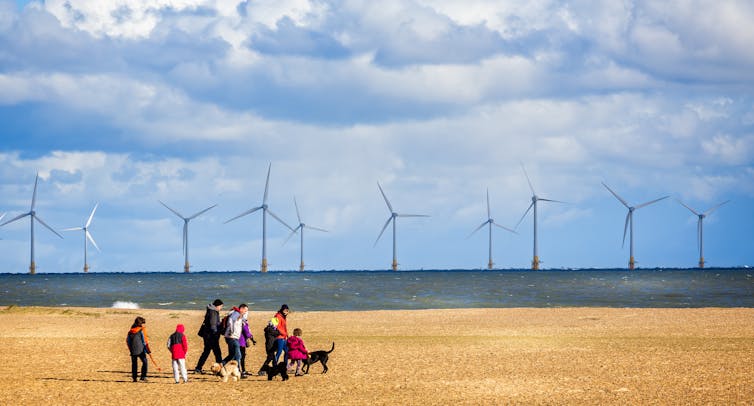
The UK can achieve energy security without causing additional global warming.
Nigel Jarvis/ShutterstockIf the UK followed the example of China and rapidly increased its investments in renewable energy, then it could achieve energy security without causing additional global warming. China emits the most carbon dioxide of any country in the world. But it is installing more renewable energy generation than the rest of the world combined.
Rapidly reducing our reliance on fossil fuels, and not issuing new licenses to extract oil and gas, is the most effective way of minimising future climate-related disruptions. The sooner those with the power to shape our future recognise this, the better.
Don’t have time to read about climate change as much as you’d like?
Get a weekly roundup in your inbox instead. Every Wednesday, The Conversation’s environment editor writes Imagine, a short email that goes a little deeper into just one climate issue. Join the 20,000+ readers who’ve subscribed so far.
Ed Hawkins, Professor of Climate Science, University of Reading
This article is republished from The Conversation under a Creative Commons license. Read the original article.
‘The World Burns as Our Dangerous Age of Unreason Fuels the Flames’

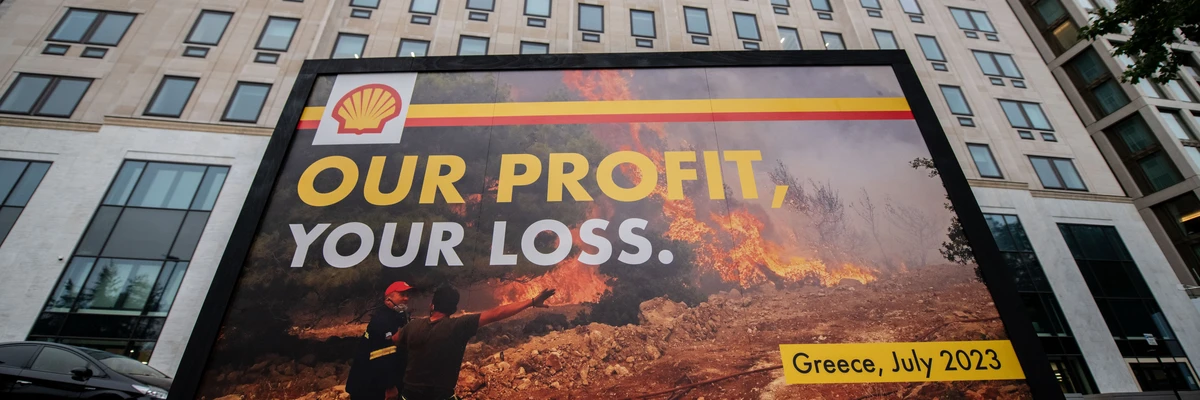
Greenpeace activists display a billboard during a protest outside Shell headquarters on July 27, 2023 in London. (Photo: Handout/Chris J. Ratcliffe for Greenpeace via Getty Images) Every political system has its share of charlatans or nutcases who deliberately try to stir up division, embrace conspiracy theories, deny reality or advocate dangerous policies for short-term advantage. But what do you do when such views are not just held on the political fringe, but are embraced at the heart of government, as is currently happening in the UK?
There are plenty of immediate challenges facing the Government – inflation, housing shortages, crumbling infrastructure, struggling public services and immigration. Internationally, conflicts rage in many parts of the world, Iran and North Korea continue to pursue nuclear weapons, and democracy itself is under threat from hostile regimes, such as Russia and China.
But by far the biggest long-term threat, which will only make all of these immediate problems harder to tackle, is climate change.
Climate change is not only already devastating animal and plant life, and exacerbating poor health, famine and poverty in some parts of the world, but also fuelling more conflict within and between states for scarce resources. It is driving migration levels higher and, through melting the polar ice cap, opening up new areas of strategic competition with Russia and China.
Climate change is not just a long-term survival threat, but an ongoing, immediate, security, political and economic threat. The evidence is all around, plain to see.
According to the UN’s World Meteorological Organisation, July was the hottest month on record, possibly the warmest month humanity has ever experienced. The planet’s temperature has surpassed the crucial threshold of limiting global warming to 1.5°C above pre-industrial temperatures. Swathes of the American South, the Mediterranean and China have endured devastating heatwaves this summer. Only last week, we saw on our TV screens thousands of desperate British tourists fleeing devastating fires on Greek islands.
…
Conservatives are the ‘political wing of the fossil fuel industry’ as Sunak invites BP and Shell to Downing Street

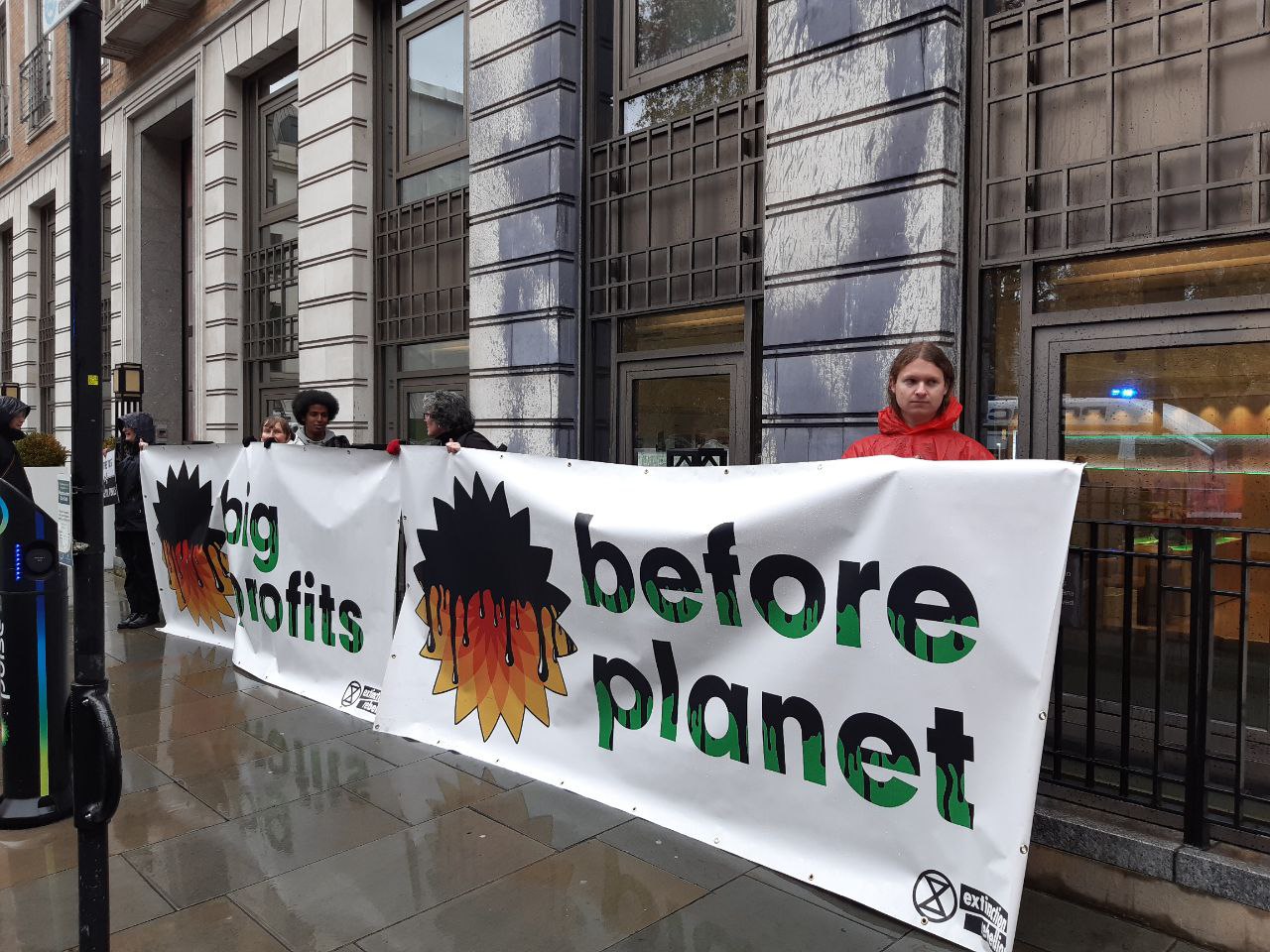
Extinction Rebellion protests at BP. Banner reads big profits before planet New Global Witness analysis shows that government ministers met with fossil fuel companies 54 times between January and March.
London, August 1st, 2023 – Between January and March of this year, Prime Minister Rishi Sunak and climate and energy ministers met with fossil fuel companies 54 times, on average more than once every two days, according to new Global Witness analysis of UK government data. This amounts to around 20 per cent of all lobbying meetings they held in that period. (1)
This analysis comes as the Times reports that Sunak will meet with fossil fuel bosses on Wednesday, just two days after announcing that the Government would grant 100 new oil and gas licenses in the North Sea.
Scientists and campaigners have denounced the Government’s plans to U-turn on its climate commitments and “max out” North Sea oil and gas. This would lock the country deeper into a fossil fuel dependency that has left the UK with the highest energy bills in Western Europe.
…
(1) See Transparency International UK’s database on UK government lobbying, available at openaccess.transparency.org.uk.