Just a coincidence?
The firm founded by Rishi Sunak’s father-in-law signed a billion-dollar deal with BP just months before the Prime Minister gave the go ahead for new oil and gas licences in the North Sea.
…
It’s since come to light that in May, Infosys, the company founded by Sunak’s father-in-law, bagged a huge deal from the global energy company, BP. Byline Times also reported in July 2022 that: “Sunak and his family are intimately linked to the fossil fuel industry through his wife Akshata Murty’s stake in the transnational IT services firm Infosys, one of whose top clients is oil giant Shell.”
…
Category: Shell
Rishi Sunak’s family firm signed billion-dollar deal with BP before he announced new oil and gas licences
As Planet Burns, Shell Reports $5 Billion in Profits and Plans to Ramp Up Fossil Fuels
Original article by JAKE JOHNSON republished from Common Dreams under Creative Commons (CC BY-NC-ND 3.0).

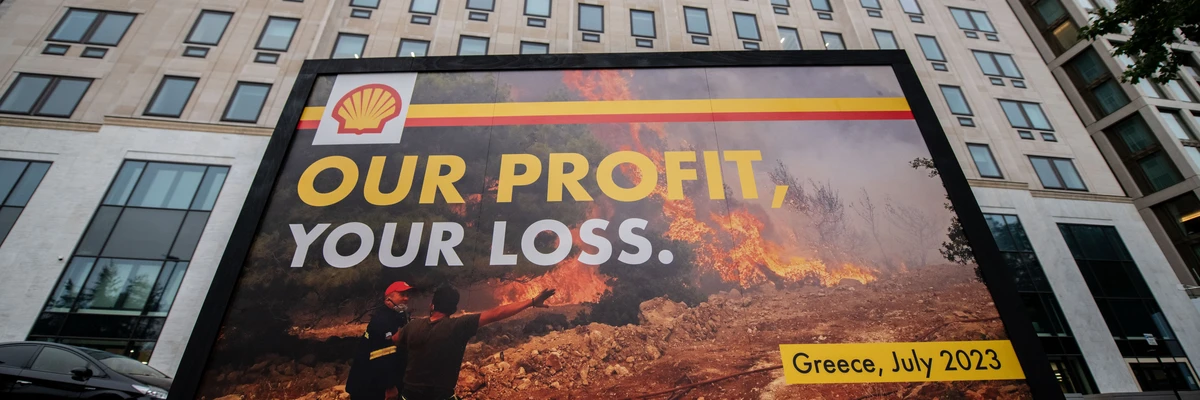
Greenpeace activists display a billboard during a protest outside Shell headquarters on July 27, 2023 in London. (Photo: Handout/Chris J. Ratcliffe for Greenpeace via Getty Images) “Every house burnt to the ground, every town forced to evacuate, every ecosystem lost to a wildfire is a necessary consequence of a business model like Shell’s.”
With much of the world reeling from record-shattering heat and devastating wildfires, the London-based oil giant Shell is poised to ramp up its investments in planet-warming fossil fuels after ditching its plan to cut oil production.
An analysis released Thursday by the rights group Global Witness estimates that Shell’s investments in oil and gas projects are set to surge to around $14.5 billion this year, a 10% increase over 2022. The company is expected to spend far less on what it defines as “renewables and energy solutions.”
“Fossil fuels are the number one cause of climate breakdown, which is stoking extreme heatwaves, forest fires, and drought,” said Jonathan Noronha-Gant, a senior campaigner at Global Witness. “Every house burnt to the ground, every town forced to evacuate, every ecosystem lost to a wildfire is a necessary consequence of a business model like Shell’s, which prioritizes short-term cash grabs over the safety and survivability of our societies.”
The new analysis came as Shell reported $5.1 billion in second-quarter profits, a major decline compared to the company’s record-setting $11.5 billion in profits during the same period last year. Despite the profit dip, which Shell blamed on falling oil and gas prices, the company announced a 15% quarterly dividend increase and $3 billion in stock buybacks.
“CEO Wael Sawan’s fossil fuel direction continues to be solely aimed at profit for shareholders,” Nine de Pater, a campaigner with Friends of the Earth Netherlands, said in a statement. “This is immoral and completely irresponsible. We are seeing the impact of the climate crisis around the world this summer: the wildfires in Greece and heat records in southern Europe, Algeria, and India, among others, and the floods in Italy and Afghanistan.”
“Shell’s profits clearly show that the company chooses profits over human lives,” she added.
Shell, which has known about the climate impacts of burning fossil fuels since the 1970s, announced last month that it intends to boost gas production in the coming years while abandoning its plan to reduce oil production by up to 2% per year.
In an interview weeks after the announcement, Sawan claimed it would be “dangerous and irresponsible” to curb oil and gas production even as scientists say that’s exactly what’s needed to avert catastrophic warming.
Global Witness recently estimated that Shell’s reversal on oil production could generate an average of “29 million tonnes of extra carbon per year, almost as much as Denmark emits annually.”
“By 2030,” the group added, “Shell’s extra estimated emissions would be as much as Spain—one of Europe’s largest polluters—produces in one year.”
Original article by JAKE JOHNSON republished from Common Dreams under Creative Commons (CC BY-NC-ND 3.0).
Student paints University of Exeter during graduation ceremony

Just Stop Oil activist Eddie Whittingham arrested following protest at University of Exeter graduation ceremony. A Just Stop Oil activist has disrupted his graduation ceremony at the University of Exeter as a call for students to take action against the UK Government’s plans to licence new oil and gas projects.
At 1:15pm, Eddie Whittingham, 25, was tackled by security as he sprayed a university courtyard orange with a paint-loaded fire extinguisher, while his graduating cohort looked on. Shortly beforehand he had received his BA in Philosophy, Politics, and Economics. He was arrested at the scene.
Eddie is known for high-profile Just Stop Oil actions, including the interruption of the World Snooker Championship in April 2023, where he climbed a snooker table at The Crucible Theatre and released orange-coloured powder.
Speaking before his action today, he said:
“My name’s Eddie, I’m 25 years old and I’m about to disrupt my own graduation ceremony. Exactly 3 months ago, I disrupted the snooker world championship. I’m taking these actions because our government has failed young people like me.”
“They have failed to cut greenhouse gas emissions in line with science. They have failed to prepare us for the inevitable disruption that they have caused. They’re driving our society towards collapse by continuing to allow new oil, gas and coal. This is a violation of the advice of the International Energy Agency, the United Nations and thousands and thousands of climate scientists all around the world, who have been warning us for years: new fossil fuels means death.”
“As a result, 1 billion people may be displaced from their homes by 2030. That’s 7 years away. We face a future of mass-starvation and unimaginable suffering, including here in the UK. And all of this is happening so a small handful of extremely rich people can carry on getting even richer.”
“Universities, rather than preparing young people for this inevitable disruption, are instead upholding a status quo that is going to kill millions, if not billions of people. That’s why I’m calling on students everywhere to join us in resistance against this criminal government.”
“What use is a university degree if you can’t feed yourself? What use is an “education” if society is collapsing around you? Each one of us has a choice: die quietly or get into resistance. It’s now or never.”

Also arrested was Kostja Junglas, 27, a PhD student at Oxford University. They were tackled by University of Exeter security for attempting to hold up a banner to the crowd of graduates.
In 2022, the University of Exeter began a new partnership with Shell Oil, building on decades of collaboration between the university and the company. The stated aim of the project is ‘Carbon Sequestration’, a speculative technology that would allow Shell to continue producing fossil fuels whilst reducing their carbon emissions. However, experts that don’t stand to gain from Shell profits have declared carbon sequestration unviable: “Many international bodies and national government are relying on carbon capture in the fossil fuel sector to get to net zero, and it simply won’t work,” according to Bruce Robertson, the author of an Institute for Energy Economics and Financial Analysis report on the topic. Students are campaigning for the university to cut ties with Shell under the name ‘Shell Out’.
The first week of July 2023 is believed to have been the hottest in the history of humanity, according to the European Union’s Copernicus Climate Change Service. The highest temperature in recorded history has been set repeatedly in the last few weeks, and this pattern is expected to continue. “We are in uncharted territory and we can expect more records to fall as El Niño develops further and these impacts will extend into 2024,” said Christopher Hewitt, World Meteorological Organisation director of climate services, adding “This is worrying news.” The impacts of this climate crisis are already devastating, and will only multiply in the short term.
Since the Just Stop Oil campaign launched on 14th February 2022, there have been 2,200 arrests and 138 people have spent time in prison, many without trial. Just Stop Oil supporters Morgan Trowland and Marcus Decker are serving three year prison sentences for resisting new oil, gas and coal.
Just Stop Oil is calling on everyone to get off the sidelines and join in civil resistance against new oil, gas and coal.
‘Ancient Heat Records Will Be Broken’: Southern Europe Braces for Unprecedented Temperatures
Original article by JAKE JOHNSON republished from Common Dreams under Creative Commons (CC BY-NC-ND 3.0).
“If the disasters we’re seeing this month aren’t enough to shake us out of that torpor, then the chances of our persevering for another hundred and twenty-five thousand years seem remote.”
Southern Europe faced dangerously high temperatures on Sunday amid a continent-wide heatwave that’s expected to get worse in the coming days, potentially shattering longstanding records as the climate crisis rages.
Reuters reported that a “new anticyclone dubbed Charon, who in Greek mythology was the ferryman of the dead, pushed into the region from north Africa on Sunday and could lift temperatures above 45°C (113°F) in parts of Italy early this week,” prompting Italian officials to issue heat advisories for more than a dozen cities on Sunday.
Meteo.it, Italy’s weather news service, said Sunday that the country must “prepare for a severe heat storm that, day after day, will blanket the whole country.”
“In some places,” the service added, “ancient heat records will be broken.”
The fastest-warming continent on the planet, Europe has been facing scorching heat over the past several weeks as scientists warn that the fossil fuel-driven climate crisis is making such heatwaves more likely and increasingly intense. Last summer was Europe’s hottest season on record, and extreme heat killed more than 61,000 people on the continent between late May to early September of 2022.
But the current heatwave appears on track to be even more severe than last summer’s.
As CNN reported Sunday, “Climate scientists at the European Space Agency (ESA) say temperatures could reach 48°C (118.4°F) on the islands of Sicily and Sardinia, ‘potentially the hottest temperatures ever recorded in Europe.’”
“The ESA warned that Europe’s heat wave has only just begun with Spain, France, Germany, and Poland expected to see extreme weather, just as the continent welcomes what is expected to be a record-breaking number of tourists coming for the first time since the Covid-19 pandemic,” the outlet added.
Giulio Betti, an Italian meteorologist and climate expert, told the BBC that “temperatures will reach a peak between 19 and 23 July—not only in Italy but also in Greece, Turkey, and the Balkans.”
“Several local heat records within these areas may well be broken during those days,” Betti added.
Europe’s intensifying heatwave comes in the context of globally high temperatures fueled by El Niño conditions—which the climate crisis has likely made worse and more frequent.
Large swaths of the U.S., Asia, and Africa have experienced sweltering temperatures and other extreme weather—including deadly flooding—in recent weeks, heightening the urgency of coordinated climate action at the upcoming COP28 conference in the United Arab Emirates.
“It was probably the Earth’s hottest week in history earlier this month, following the warmest June on record, and top scientists agree that the planet will get even hotter unless we phase out fossil fuels,” The Guardian‘s Dharna Noor wrote Sunday. “Yet leading energy companies are intent on pushing the world in the opposite direction, expanding fossil fuel production and insisting that there is no alternative. It is evidence that they are motivated not by record warming, but by record profits, experts say.”
In February, after reporting a record-shattering $28 billion in 2022 profits, the London-based oil giant BP announced that it was walking back its emission-reduction goals and planning to produce more fossil fuels than expected.
Shell, which posted $40 billion in profits last year, followed suit last month, ditching its plans to reduce oil production by up to 2% per year.
In a New Yorkercolumn on Sunday, author and climate advocate Bill McKibben noted that the BBC aired an interview with Shell CEO Wael Sawan on July 6, the day scientists believe may have been the hottest on record.
During the interview, Sawan claimed that cutting oil and gas production would be “dangerous and irresponsible,” drawing swift backlash.
McKibben noted that Sawan “told the BBC that, while there are not currently any plans, Shell wouldn’t rule out moving its headquarters from the United Kingdom to the United States, where oil companies get higher market prices for their shares.”
“This suggested to him that the U.S. is more supportive of oil and gas companies, and, as he has told investors, he wants to ‘reward our shareholders today and far into the future,’” McKibben added. “That is pretty much the definition of ‘business as usual,’ and it’s precisely what has generated this completely unprecedented heat. If the disasters we’re seeing this month aren’t enough to shake us out of that torpor, then the chances of our persevering for another hundred and twenty-five thousand years seem remote.”
Original article by JAKE JOHNSON republished from Common Dreams under Creative Commons (CC BY-NC-ND 3.0).
Big oil quietly walks back on climate pledges as global heat records tumble
https://www.theguardian.com/us-news/2023/jul/16/big-oil-climate-pledges-extreme-heat-fossil-fuel
Energy firms have made record profits by increasing production of oil and gas, far from their promises of rolling back emissions

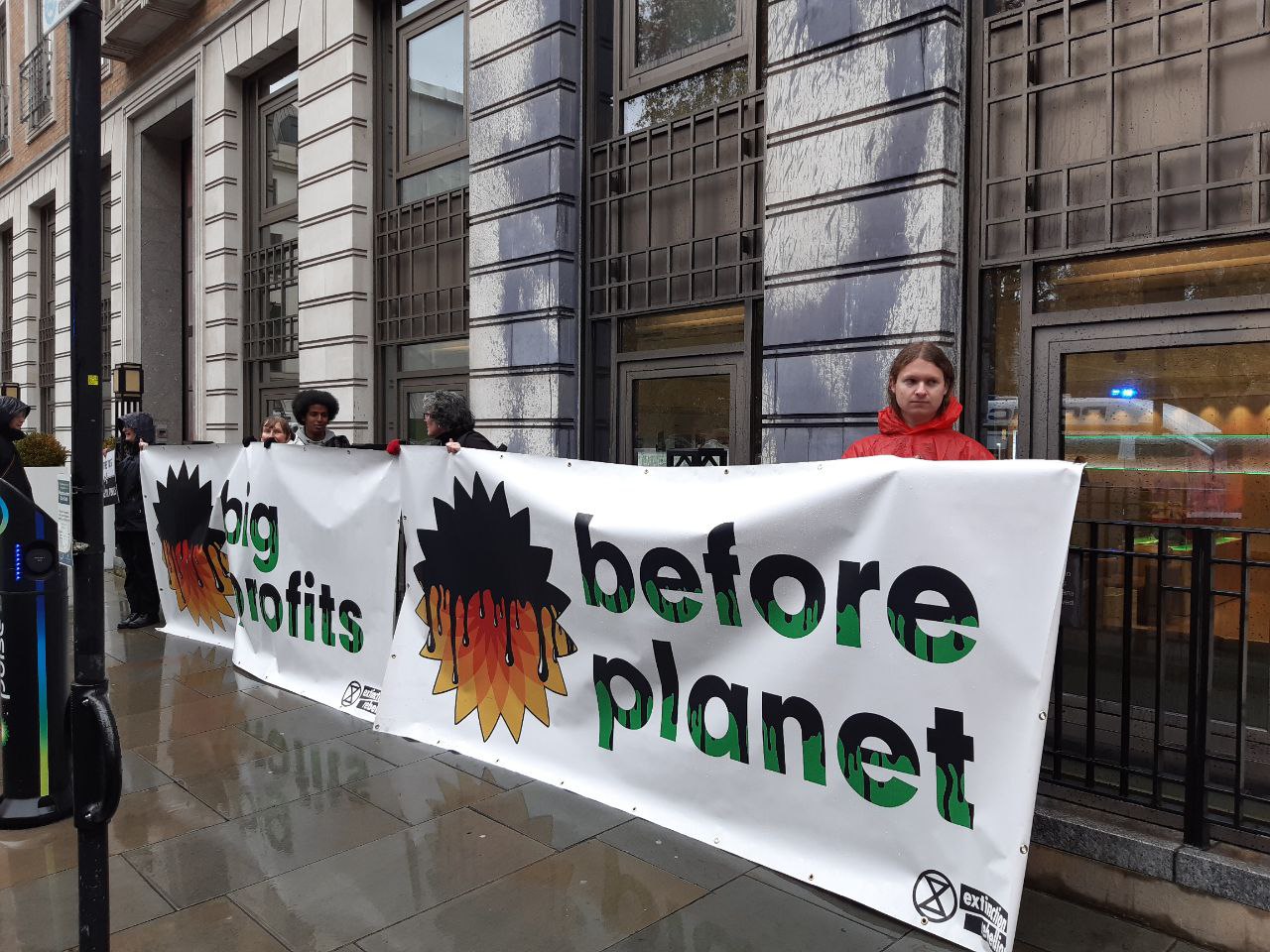
Extinction Rebellion protests at BP. Banner reads big profits before planet …
Oil majors have, over the past several years, rolled out pledges to decrease oil and gas production and slash their emissions, citing concerns about the climate crisis. But more recently, many have walked those plans back.
Amid record-shattering warmth this February, BP scaled back an earlier goal of lowering its emissions by 35% by 2030, saying it will aim for a 20 to 30% cut instead. ExxonMobil quietly withdrew funding for a heavily publicized effort to use algae to create low-carbon fuel. And Shell announced that it would not increase its investments in renewable energy this year, despite earlier promises to dramatically slash its emissions.
Climate-fueled extreme weather persisted through spring and summer. But fossil fuel companies have only doubled down on their oil- and gas-filled business models. Shell promised to cut oil production by 20% by 2030, but then this year said it already met that goal by selling off some operations to another oil company –thereby not reducing emissions in the atmosphere. BP has also expanded gas drilling. And Exxon’s CEO, Darren Woods, told an industry conference last month that his company plans to double the amount of oil produced from its US shale holdings within the next five years.
…
https://www.theguardian.com/us-news/2023/jul/16/big-oil-climate-pledges-extreme-heat-fossil-fuel