Campaigners call for polluters’ tax as oil firms make record gains
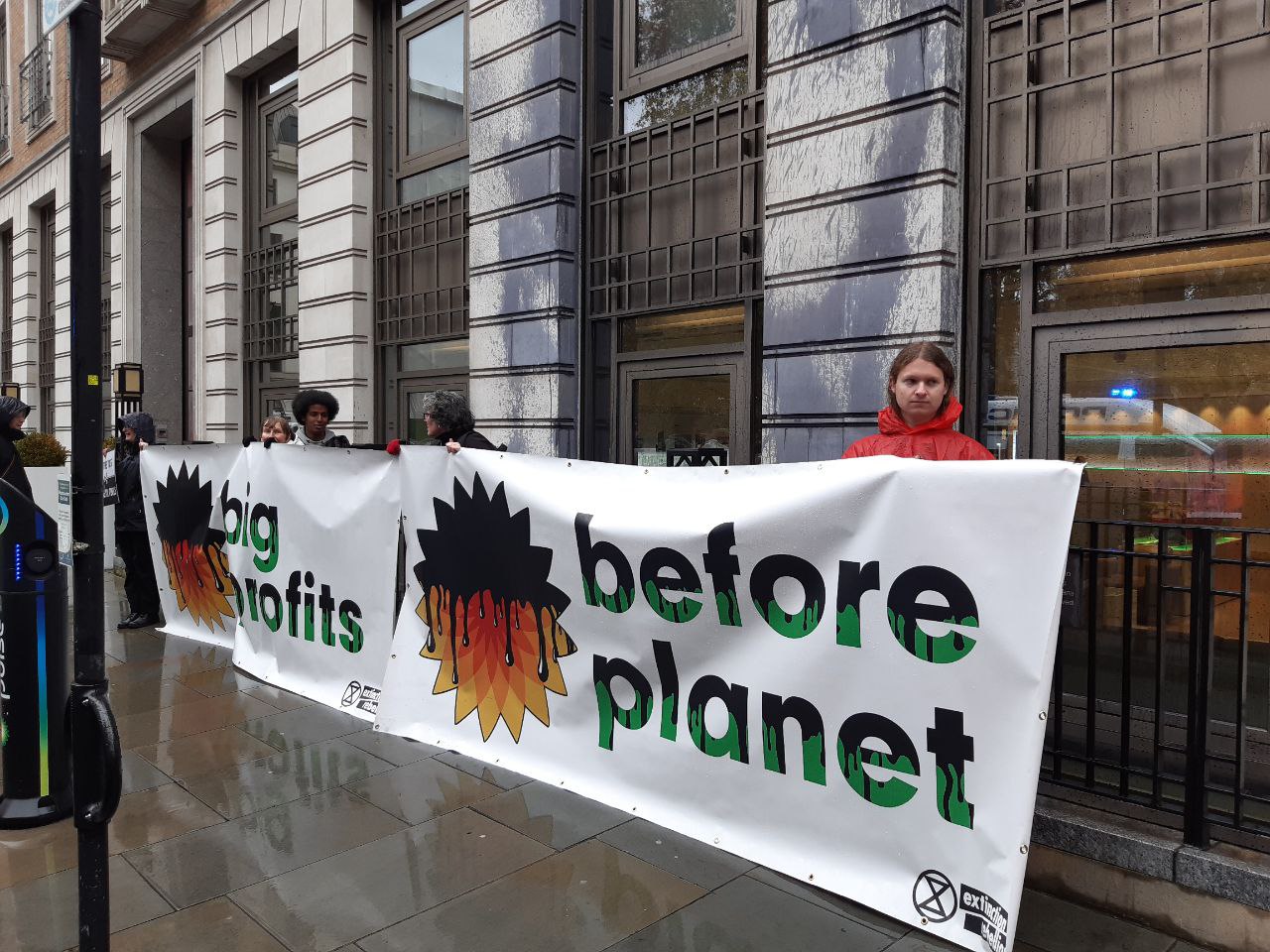
UNION leaders have attacked Tory weakness on taxing big oil companies after BP announced record-high profits off the back of the energy crisis.
As millions struggle to heat their homes across the UK, the energy giant revealed it raked in $27.7bn (£23bn) in profit in 2022 — more than double the previous year.
The firm also admitted that it will miss its carbon emissions pledge, saying it was now aiming to reduce emissions by 20-30 per cent by 2030, down from 35-45 per cent, and will continue to invest in oil and gas.
It comes after oil firm Shell also reported bumper profits last week, totalling an eye-watering $40bn (£33bn) — the highest in the company’s 115-year history — with both firms benefiting from the sharp rise in energy prices linked to the war in Ukraine.
The obscene profits have sparked renewed calls for PM Rishi Sunak to toughen the government’s “inadequate windfall tax on energy firms.”
Unions call on government to ‘expand windfall tax on energy producers’ as public face 40% hike in bills from April
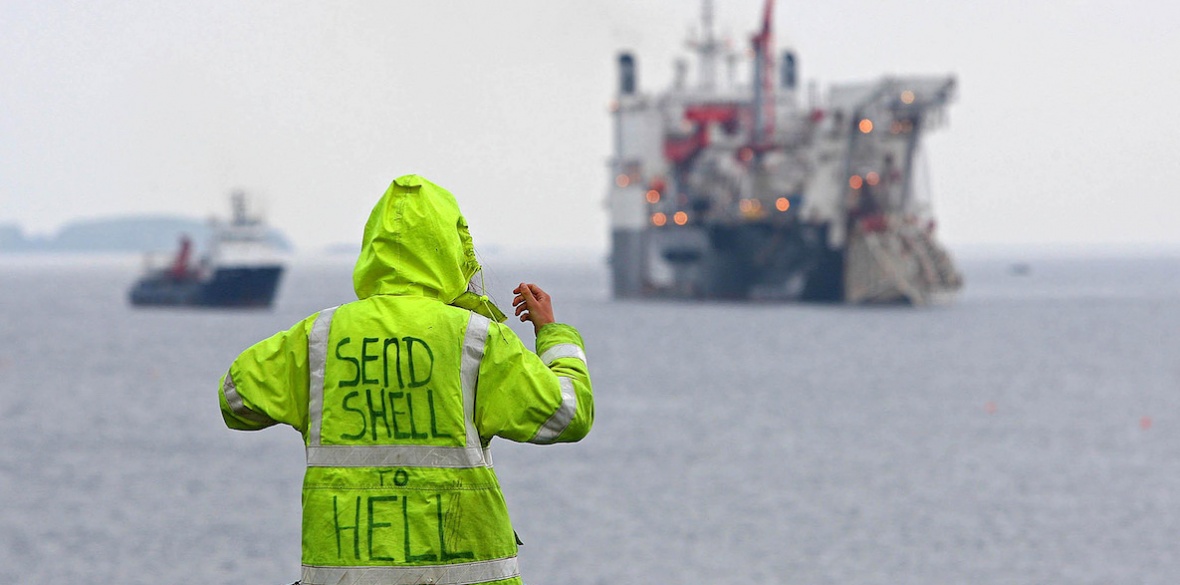
Activists gather at Glengad Beach in Co Mayo as the pipe laying vessel the Solitaire makes its way into Broadhaven Bay
THE government must “get real” on profiteering and increase windfall taxes on oil and gas companies, campaigners and unions urged today as Shell revealed its highest profits in its history.
The oil giant said that core profits rocketed to $84.3 billion (£68.1bn) in 2022 in what is one of the highest gains ever recorded by a British company.
The public face a 40 per cent hike in energy bills from April on top of soaring bills and the cost-of-living crisis.
Following pressure, the government launched a windfall tax, called the energy profits levy, on bumper profits made by producers last year.
Shell said it was due to pay $134 million (£109m) through the levy for 2022, representing just a fraction of its mammoth profit.
This is the second report this month to call for a ban on flaring in the next two years. A cross-party report by the House of Commons environmental audit committee made the same recommendation on 5 January.
Mr Skidmore was commissioned by the former prime minister, Liz Truss, to review UK proposals to reach net zero emissions by 2050.
Last year, the government accepted a ruling by the High Court that its net zero strategy was unlawful. The landmark judgement agreed with arguments by Friends of the Earth, ClientEarth and Good Law Project that the strategy failed to show how the UK’s legally-binding carbon budgets would be met.
…
The review ran to 340 pages and had 129 recommendations.
It said flaring was responsible for 22% of carbon emissions on oil and gas fields. About 70% of oil and gas field emissions were from powering equipment on platforms, it said.
The offshore industry published a Methane Action Plan in 2021 to reduce emissions and flaring. This committed the industry to a 50% methane emission reduction by 2030, compared with 2018 levels. Shell has committed to zero routine flaring by 2025.
…
Net zero: Tory MP warns government must take urgent action to meet climate goals
Four years ago, I traveled around America, visiting historical archives. I was looking for documents that might reveal the hidden history of climate change – and in particular, when the major coal, oil and gas companies became aware of the problem, and what they knew about it.
I pored over boxes of papers, thousands of pages. I began to recognize typewriter fonts from the 1960s and ‘70s and marveled at the legibility of past penmanship, and got used to squinting when it wasn’t so clear.
What those papers revealed is now changing our understanding of how climate change became a crisis. The industry’s own words, as my research found, show companies knew about the risk long before most of the rest of the world.
Surprising discoveries
At an old gunpowder factory in Delaware – now a museum and archive – I found a transcript of a petroleum conference from 1959 called the “Energy and Man” symposium, held at Columbia University in New York. As I flipped through, I saw a speech from a famous scientist, Edward Teller (who helped invent the hydrogen bomb), warning the industry executives and others assembled of global warming.
“Whenever you burn conventional fuel,” Teller explained, “you create carbon dioxide. … Its presence in the atmosphere causes a greenhouse effect.” If the world kept using fossil fuels, the ice caps would begin to melt, raising sea levels. Eventually, “all the coastal cities would be covered,” he warned.
1959 was before the moon landing, before the Beatles’ first single, before Martin Luther King’s “I Have a Dream” speech, before the first modern aluminum can was ever made. It was decades before I was born. What else was out there?
In Wyoming, I found another speech at the university archives in Laramie – this one from 1965, and from an oil executive himself. That year, at the annual meeting of the American Petroleum Institute, the main organization for the U.S. oil industry, the group’s president, Frank Ikard, mentioning a report called “Restoring the Quality of Our Environment” that had been published just a few days before by President Lyndon Johnson’s team of scientific advisers.
“The substance of the report,” Ikard told the industry audience, “is that there is still time to save the world’s peoples from the catastrophic consequences of pollution, but time is running out.” He continued that “One of the most important predictions of the report is that carbon dioxide is being added to the earth’s atmosphere by the burning of coal, oil, and natural gas at such a rate that by the year 2000 the heat balance will be so modified as possibly to cause marked changes in climate.”
Ikard noted that the report had found that a “nonpolluting means of powering automobiles, buses, and trucks is likely to become a national necessity.”
As I reviewed my findings back in California, I realized that before San Francisco’s Summer of Love, before Woodstock, the peak of the ’60s counterculture and all that stuff that seemed ancient history to me, the heads of the oil industry had been privately informed by their own leaders that their products would eventually alter the climate of the entire planet, with dangerous consequences.
Secret research revealed the risks ahead
While I traveled the country, other researchers were hard at work too. And the documents they found were in some ways even more shocking.
By the late 1970s, the American Petroleum Institute had formed a secret committee called the “CO2 and Climate Task Force,” which included representatives of many of the major oil companies, to privately monitor and discuss the latest developments in climate science.
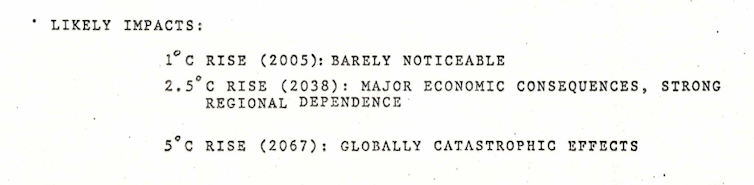
In 1980, the task force invited a scientist from Stanford University, John Laurmann, to brief them on the state of climate science. Today, we have a copy of Laurmann’s presentation, which warned that if fossil fuels continued to be used, global warming would be “barely noticeable” by 2005, but by the 2060s would have “globally catastrophic effects.” That same year, the American Petroleum Institute called on governments to triple coal production worldwide, insisting there would be no negative consequences despite what it knew internally.
A slide from John Laurmann’s presentation to the American Petroleum Institute’s climate change task force in 1980, warning of globally catastrophic effects from continued fossil fuel use.
Exxon had a secretive research program too. In 1981, one of its managers, Roger Cohen, sent an internal memo observing that the company’s long-term business plans could “produce effects which will indeed be catastrophic (at least for a substantial fraction of the earth’s population).”
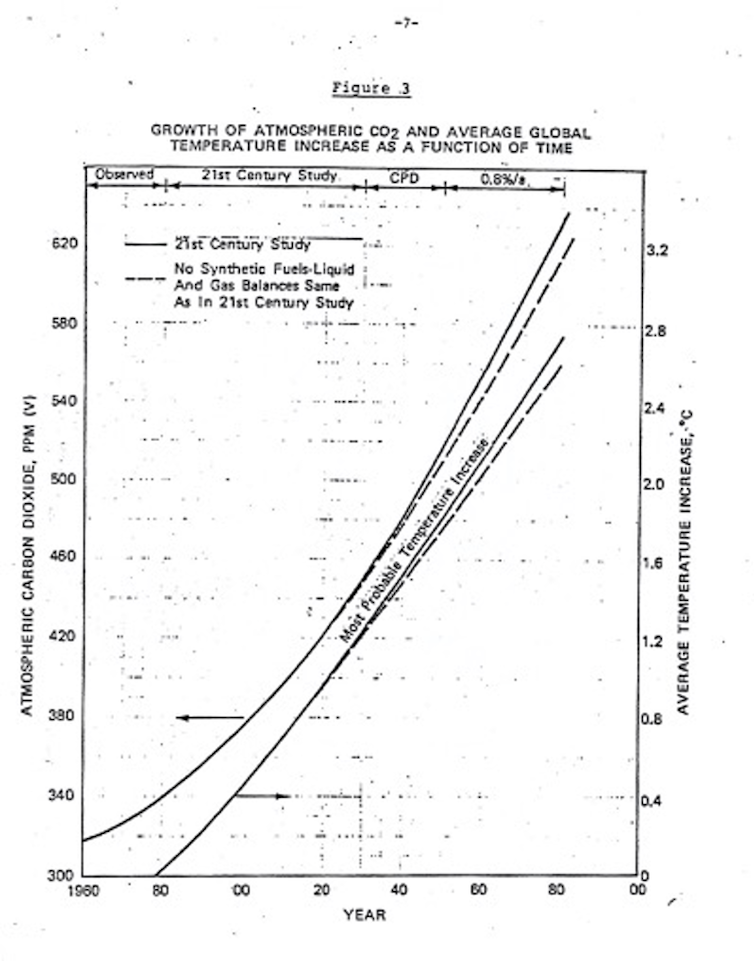
The next year, Exxon completed a comprehensive, 40-page internal report on climate change, which predicted almost exactly the amount of global warming we’ve seen, as well as sea level rise, drought and more. According to the front page of the report, it was “given wide circulation to Exxon management” but was “not to be distributed externally.”
And Exxon did keep it secret: We know of the report’s existence only because investigative journalists at Inside Climate News uncovered it in 2015.
A figure from Exxon’s internal climate change report from 1982, predicting how much carbon dioxide would build up from fossil fuels and how much global warming that would cause through the 21st century unless action was taken. Exxon’s projection has been remarkably accurate.
Other oil companies knew the effects their products were having on the planet too. In 1986, the Dutch oil company Shell finished an internal report nearly 100 pages long, predicting that global warming from fossil fuels would cause changes that would be “the greatest in recorded history,” including “destructive floods,” abandonment of entire countries and even forced migration around the world. That report was stamped “CONFIDENTIAL” and only brought to light in 2018 by Jelmer Mommers, a Dutch journalist.
In October 2021, I and two French colleagues published another study showing through company documents and interviews how the Paris-based oil major Total was also aware of global warming’s catastrophic potential as early as the 1970s. Despite this awareness, we found that Total then worked with Exxon to spread doubt about climate change.
Big Oil’s PR pivot
These companies had a choice.
Back in 1979, Exxon had privately studied options for avoiding global warming. It found that with immediate action, if the industry moved away from fossil fuels and instead focused on renewable energy, fossil fuel pollution could start to decline in the 1990s and a major climate crisis could be avoided.
But the industry didn’t pursue that path. Instead, colleagues and I recently found that in the late 1980s, Exxon and other oil companies coordinated a global effort to dispute climate science, block fossil fuel controls and keep their products flowing.
We know about it through internal documents and the words of industry insiders, who are now beginning to share what they saw with the public. We also know that in 1989, the fossil fuel industry created something called the Global Climate Coalition – but it wasn’t an environmental group like the name suggests; instead, it worked to sow doubt about climate change and lobbied lawmakers to block clean energy legislation and climate treaties throughout the 1990s.
For example, in 1997, the Global Climate Coalition’s chairman, William O’Keefe, who was also an executive vice president for the American Petroleum Institute, wrote in the Washington Post that “Climate scientists don’t say that burning oil, gas and coal is steadily warming the earth,” contradicting what the industry had known for decades. The fossil fuel industry also funded think tanks and biased studies that helped slow progress to a crawl.
Today, most oil companies shy away from denying climate science outright, but they continue to fight fossil fuel controls and promote themselves as clean energy leaders even though they still put the vast majority of their investments into fossil fuels.
A Congressional subcommittee on Oct. 28, 2021, questioned executives from Exxon, BP, Chevron, Shell and the American Petroleum Institute about industry efforts to downplay the role of fossil fuels in climate change. Exxon CEO Darren Woods told lawmakers that his company’s public statements “are and have always been truthful” and that the company “does not spread disinformation regarding climate change.”
Will the world experience the global catastrophe that the oil companies predicted years before I was born? That depends on what we do now, with our slice of history.
This article was updated Oct. 28, 2021, with details from a Congressional hearing.
From software giants to soft drinks makers, the vast majority of partners at climate talks in Egypt are enmeshed with the oil and gas industry, researchers find.
Eighteen of the 20 companies sponsoring U.N. climate talks in the Egyptian resort of Sharm El-Sheikh either directly support or partner with oil and gas companies, according to a new analysis shared with DeSmog.
The findings underscore concerns over the role of the fossil fuel industry at the negotiations, known as COP27, which have become a focal point for deals to exploit African natural gas.
“These findings underline the extent to which this COP has never been about the climate: It’s been about rehabilitating the gas industry and making sure that fossil fuels are on the agenda,” said Pascoe Sabido of Brussels-based Corporate Europe Observatory, which co-produced the analysis with Corporate Accountability, a nonprofit headquartered in Boston.
“These talks are supposed to be about moving us away from fossil fuels, phasing them out,” Sabido told DeSmog.
A previous analysis by the two organisations and research and advocacy group Global Witness identified at least 636 fossil lobbyists who have been granted access to COP27 – an increase of more than 25 percent compared to the previous COP26 talks held in Glasgow a year ago; and twice the number of delegates from a U.N. body representing indigenous peoples.
“This is part of the bigger problem which is linked to the overall corporate capture of the U.N. climate talks,” Sabido said. “We need to kick big polluters out.”
Social license
As documented in the latest edition of DeSmog’s Gaslit column, fossil fuel sponsorship of COP27 represents an extension of a decades-long effort by oil and gas companies to buy social legitimacy by bankrolling sports, arts, and education around the world.
COP27 partner Hassan Allam Holding, one of the largest privately owned corporations in Egypt, has announced plans to invest $17.1 billion to turn North Africa into a regional natural gas hub, and $830 million in oil projects over the next two years, the analysis found.
Sponsors also include Cairo-based Afreximbank, which plans to finance new oil and gas projects through the creation of a multi-billion dollar “energy bank”, and Mashreq, the oldest private bank in the United Arab Emirates, which refinances oil and gas projects.
Microsoft, which uses cloud-based artificial intelligence to help companies such as Chevron optimize oil and gas extraction, is a partner at COP27, along with rival Google.
Google says it has cracked down on climate misinformation on its platforms. But the company is still taking money from oil and gas companies to place adverts in search results that present their industry as environmentally friendly, a report found.
German engineering company Siemens, another COP27 sponsor, services firms such as Cairo-based Orascom Construction, which built one of the world’s biggest gas power plants in Egypt in 2018. IBM, also a sponsor, works with pesticide and fertiliser companies to promote “carbon farming” – a carbon offsetting technique that generates carbon credits for storing carbon in soils. Many climate groups believe such practices will provide an excuse for big companies to continue polluting.
Conflict of interest
The predominance of fossil fuel sponsorship at COP27 cuts a stark contrast with demands from countries facing an existential threat from climate change for urgent action to cut emissions.
Last week, the island states of Vanuatu and Tuvalu became the first countries to back calls to cut greenhouse gas emissions at source by developing a treaty modeled on Cold War-era nuclear arms control agreements to wind down oil, gas and coal production.
Advocates of the campaign for such a Fossil Fuel Non-Proliferation Treaty, including a growing number of cities and municipalities, also want to ban fossil fuel advertising and sponsorship.
“We’ve got numerous countries calling for a Fossil Fuel Non-Proliferation Treaty and yet COP27 is sponsored by the same companies either directly funding them [fossil fuels], facilitating the extraction of oil and gas, or using their products,” Sabido said.
The Boston Consulting Group, an American consulting firm and one of the main COP27 partners, works with Anglo-Dutch oil major Shell. COP27 lead partner Coca-Cola, which relies on plastic bottles derived from hydrocarbons, was named the world’s top plastic polluter for five years in a row by the Break Free From Plastic movement in its annual brand audit. The oil industry is banking on expanding production of plastics and other petrochemicals for its future growth.
Only two out of the 20 COP27 sponsors, renewable energy provider Infinity Power and real estate developer Sodic, have no strong ties to the fossil fuel industry, the analysis found.
Corporate Europe Observatory and Corporate Accountability are calling for the U.N. body that organises the annual climate negotiations to adopt a conflict of interest policy that would exclude fossil fuel companies and their partners from attending or sponsoring the events.
More than 450 organizations have already supported a campaign to Kick Big Polluters Out of COP27.
“What we need to do is end big polluter sponsorships of the talks, they shouldn’t be allowed to bankroll this process,” Sabido said. “They shouldn’t be allowed to greenwash their image through their presence at COPs.”