Stories of conflict continue at Your Party’s Founding conference. Zarah Sultana has apparently boycotted the first day over exclusions. This appears quite bizarre but take a look at this video – it appears that exclusions are made on spurious grounds. The party doesn’t – or perhaps hardly – exists, who is making these exclusions?
Statement of interests: I signed up to receive emails and made a donation to Your Party when it was announced. I’ve not been getting emails now I mention it … I am not a member but of course interested in the founding of a new Socialist party and also want to report on it here.
Zarah Sultana, MP for Coventry South, addresses protesters during a Stop Trump Coalition protest in Parliament Square, London, on day one of the US President’s second state visit to the UK, September 17, 2025
Morning Star political reporter Andrew Murray speaks to ZARAH SULTANA on the mass party of the left holding its inaugural conference this weekend
ZARAH SULTANA is up for the fight. After a bruising few months which would have broken many a political veteran, the young Muslim socialist is still brimming with hope for the new party she has co-founded.
As Your Party heads for its debut conference in Liverpool, she believes that the left is on the brink of something historic, trials and tribulations notwithstanding.
Sultana’s theme, speaking to the Morning Star two days ago, is empowerment — of the members in the new party, and of the working-class communities they seek to serve in society.
Her measure of a successful conference is one where “members feel that it is being shaped by them, not MPs.”
It will also be about “putting a structure in place where they can organise in their communities and win seats in May’s elections.” The basic pitch remains clear: “The government serves the interests of the Elon Musks of this world. It is the working class bearing the burden, as it has for 15 years.
“People want a challenge to the status quo, they need a party that will be fighting for workers’ rights, on climate change, on challenging those who have enabled a genocide, on fighting for civil liberties.”
…
“I see no evidence that the government has changed its course. They are still passing PFI deals, still attacking disabled people, changing the rules to make it harder for asylum-seekers. The government is still on a trajectory of attacking the most vulnerable while rolling out a red carpet for Nigel Farage.”
Sultana wants delegates to leave Liverpool with a spring in their step, “feeling empowered, believing that conference was a healthy democratic event, that they have made new connections with people in their communities and regions, and part of a party that is going to win in May and beyond.”
Jeremy Corbyn, with Zarah Sultana (right) speaking at a discussion on Your Party, their new political party, at The World Transformed conference, at Niamos Radical Arts Centre in Hulme, Manchester, October 10, 2025
THOUSANDS are set to gather in Liverpool on Saturday for the eagerly awaited inaugural Your Party conference.
Delegates selected through a sortition process, designed to ensure fair representation, will travel from around the country to debate the party’s founding documents at the ACC arena.
With a membership of 50,000, the party is the largest socialist party in Britain in 80 years.
There are hopes the conference will draw a line under the disputes and infighting that have marred the party’s launch.
These included the launch of rival membership systems, disputes over funds, and saw two of the original six MPs involved walk away from the project.
This weekend, members will agree on a founding statement asserting the party’s principles, a constitution and an organisational strategy.
They will also vote on a new leadership model for the party, and decide whether it will be led by a single leader until late 2027, or a “collective leadership model.” No option for co-leadership will be on the ballot.
Zarah Sultana spoke to Socialist Worker ahead of the Your Party conference
‘Your Party must be explicitly socialist, anti-imperialist and anti-Zionist—and also as maximally democratic,’ she told Socialist Worker
Zarah Sultana issued a rallying call for the left to unite and fight ahead of the Your Party founding conference in Liverpool this weekend.
She told Socialist Worker, “Labour is plummeting in the polls because this government has failed the working class.
“It has failed to help people here at home—and it has alienated thousands if not millions by materially participating in the genocide in Gaza.
“Reform UK is exploiting that anger, but it’s just the establishment in disguise.
“Farage scapegoats migrants to distract from his neoliberal economic agenda.
“We have a duty to offer a real alternative. Your Party must be explicitly socialist, anti-imperialist and anti-Zionist—and also as maximally democratic.
“We must build a party robust enough to take on entrenched power and win.
“No more tinkering at the edges—we need to reconstruct our society from first principles. We need socialism.
“History will not forgive us if we fail to capitalise on this moment. The options are socialism or barbarism.
“We must fight, we must unite and we must win.”
Orcas discuss the formation of UK’s new Socialist party and ask if the killer apes have finally come to their senses.
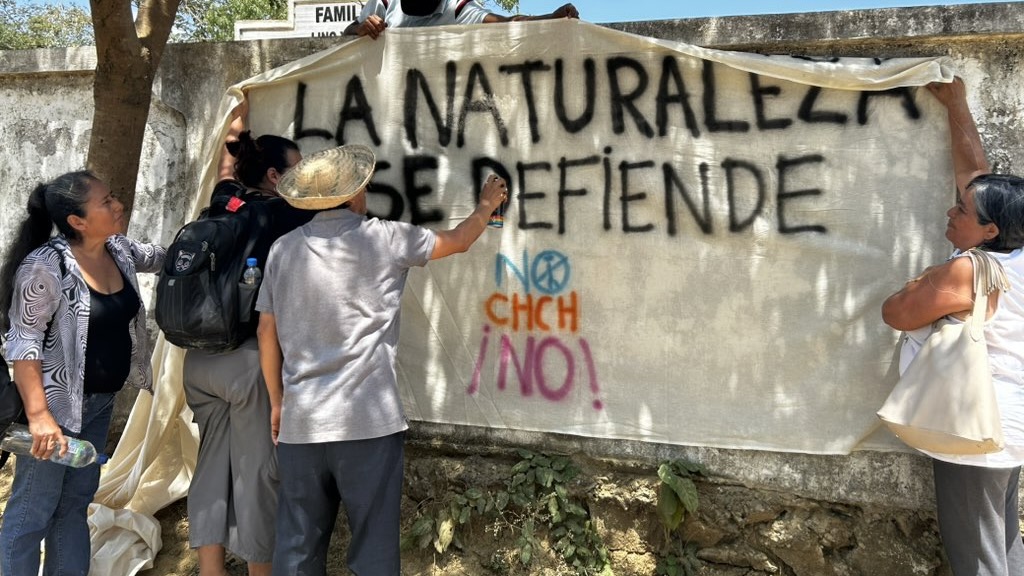
Community members in Santa Elena, Ecuador, painting a banner reading “Defend nature, VOTE NO”. The grassroots nature of the “NO” campaign appears to have given it greater success. Photo: NOchchNO / X
The government has suffered a harsh and resounding defeat to its political and economic plans. In this article, we present the results and offer some explanations for the outcome of November 16.
In a massive defeat for President Daniel Noboa’s neoliberal program, Ecuador overwhelmingly voted “No” on all four questions in the national referendum held on November 16. The result is a crushing blow for the government, who had hoped a victory would help pave the way for a structural transformation of the Ecuadorian state.
The election was organized at the request of right-wing President Noboa who called for a referendum in September of this year, hoping to achieve the economic elites’ long-awaited dream of converting Ecuador’s legal framework into a neoliberal one.
What were the referendum’s four questions?
The first question asked Ecuadorians whether foreign military bases should be allowed in Ecuador, something that is prohibited by the current constitution. Noboa appealed to the deep sense of insecurity felt by people in the country as a result of the historic crisis of violent crime, in which drug trafficking gangs are fighting over territory.
The government claimed that the installment of foreign military personnel would help reduce insecurity, although the opposition argued that it was an excuse to align the country with Washington’s geopolitical interests.
The next two questions were called “bait questions” by the opposition. They argued that the questions were less overtly ideological and employed a kind of electoral populism to exploit the widespread dissatisfaction with the political class, with the hope of garnering support for the more extreme parts of the referendum. The “bait questions” had to do with reducing the number of legislators and eliminating state funding for political parties.
The opposition, however, claimed that both measures would have benefited the ruling party, as they would have reduced the representation of small provinces and prevented political parties without wealthy contributors from running election campaigns.
Finally, the most important question had to do with the creation of a constituent assembly to draft a new neoliberal constitution, which is the great desire of the country’s economic elites.
Though the government was not particularly vocal about this, its silence about its intentions only provoked anxiety among voters, who saw this obscurity as a sign that the new constitution would reduce rights won in past decades.
The results
After the initial results were announced, several media outlets repeated the phrase “No one expected these numbers.” The latest polls had predicted that Noboa would win on all four questions, although it was known that the gap between the YES and NO votes had narrowed on the questions about military bases and the convening of a constituent assembly.
However, the president’s defeat was crushing. Not even on the so-called “bait questions” did Noboa manage to win over the majority of Ecuadorians, who clearly said “No” to the executive branch’s neoliberal project.
The government had prepared celebrations in Quito and Guayaquil, but the YES campaign headquarters were empty and the few Noboa supporters present were clearly shocked. Many expected the president to make statements to the press and his supporters, but Noboa did not appear.
He left only a brief message on X: “We consulted the Ecuadorian people, and they have spoken. We fulfilled our promise: to ask them directly. We respect the will of the Ecuadorian people. Our commitment remains unchanged; it is strengthened. We will continue to fight tirelessly for the country you deserve, with the tools we have.”
Thus, some analysts have claimed that Noboa is announcing his refusal to back down from his plan to neoliberalize the economy and the state, although he’s been forced to do so by other means. Currently, the ruling party has a majority in the National Assembly, but it will now be more difficult for it to carry out the reforms it proposes due to the votes of the independents who support it and who may hesitate to give their support to the government, as well as a Constitutional Court that has already put a stop to several of the president’s laws that undermine the legal structure of the state.
However, it is important to consider that if all the votes had been against the government, the results between one question and another would not have fluctuated so much. This is because there was a difference in voting, especially between questions 1 and 4, compared to questions 2 and 3. In this regard, some analysts have highlighted a flawed political communication strategy and the ruling party’s election campaign.
Questions loomed regarding, which foreign armed troops would come to the country to go where (there was much speculation that it would be in the Galapagos, one of the natural treasures most cherished by Ecuadorians). Also murky was the content of the constitution that the government wanted (Noboa literally said that the day after winning the referendum he would reveal the structure of the new constitution, not before).
However, attributing the government’s defeat solely to its communication failures is insufficient and dangerous, as it overshadows the enormous efforts of various political groups, social movements, and citizen collectives that campaigned for the NO vote.
Thus, the NO campaign had to be carried out in an almost artisanal manner. No political party (not even Correísmo) took the lead in the NO campaign, so funding was almost non-existent. The various videos on social media, discussions, interviews, etc., were produced by civil society, which did what it could with the little it had.
However, this accidental strategy proved to be fundamental, because, as it was “ordinary people” who ran the campaign, many undecided Ecuadorians felt that their “peers” were speaking directly to them, and not on behalf of a political party that would probably have been stigmatized by the ruling party.
Several government spokespeople began to suggest possible constitutional changes if the yes vote won, such as labor flexibility, the elimination of some rights of Indigenous peoples’ (such as Indigenous justice), the elimination of the rights of nature (something in which the country is a pioneer), and the elimination of free tuition for university students, among others. This, coupled with Noboa’s silence, allowed the opposition to organize a successful political campaign that appealed to an anti-neoliberal spirit that remains in the country.
Ecuador does not yield to neoliberalism: a historic struggle
Similarly, national workers’ strikes in the 1980s, Indigenous mobilizations in the 1990s, and in the last six years have stopped attempts to neoliberalize the country in the streets, a historical trend that continues to be confirmed today.
Faced with enormous popular rejection, the 1998 Constitution, with its clear neoliberal slant, was drafted in a military barracks, behind closed doors, with the almost exclusive participation of the Ecuadorian right.
That constitution, which opened the door to the dollarization of the country and the infamous bank holiday (in which thousands of Ecuadorians lost their savings to save the banks in crisis) was replaced by the 2008 Constitution, in which more than 150 social and political organizations went to the Assembly to demand that their claims be included.
Thus, this constitution, now clearly endorsed with full popular legitimacy, brought together a series of rights that had been demanded and won over decades by various groups of citizens. Perhaps this is why the government’s strategy of calling the current constitution “Correísta,” “Castro-Chavista,” etc., did not have the expected impact. People recognized that the country’s poor administration does not mean that the constitution is negative.
On the contrary, they saw in the ruling party’s plans something more dangerous than political antipathy toward Correísmo, which is why several people on the right and left who oppose the return of Correísmo voted NO in the 2025 referendum, which the government did not expect.
What will happen now?
For now, it remains to be seen how this sharp defeat will impact the country’s governability. Several right-wing intellectuals have called on the government to change its strategy, namely to start delivering clear results to Ecuadorians beyond advertising spots and smokescreens.
For now, changes are expected in the ministries and spokespersons of a government that, despite having been elected twice to govern, has lost in the referendums it has called and which have sought to introduce neoliberal changes.
This was the case in the 2024 referendum, also called by Noboa, in which he won on several questions to increase his power over security, but lost on the two economic questions, which sought to approve hourly work and subject Ecuador to international arbitration by international courts.
However, the defeat in 2025 is much deeper, as it implies a widespread rejection of a government that has lost much of the support of voters who trusted its administration but do not see results, which has increased mistrust. Today, the government has come to better understand sociologist Max Weber’s famous phrase: “Politics is a matter of faith and responsibility.”

 Zarah Sultana, MP for Coventry South, addresses protesters during a Stop Trump Coalition protest in Parliament Square, London, on day one of the US President’s second state visit to the UK, September 17, 2025