Green Party MP for Brighton Pavilion Siân Berry. Image by Kelly Hill, Wikimedia CC BY-SA 4.0.
Reacting to news that Kemi Badenoch’s Conservatives would scrap the 2030 cut-off date for the sale of petrol and diesel vehicles, Green MP Siân Berry said:
“This proposal from the Conservatives would set the car industry backwards, creating turmoil right when it needs continued certainty from Government that we want a better future than communities plagued by air pollution, and one where lower carbon industries matter.
“The Green Party is fully committed to a fair transition to a cleaner, greener economy, and Labour must not be pushed into backsliding by this move, driven as it is by desperate fossil fuel lobbying.”
The right to trial by jury dates back to at least the 12th century. The government’s proposals to limit it in England and Wales, many argue, run counter to the UK’s core democratic principles. And as others have pointed out, scrapping jury trials for some crimes is unlikely to solve the massive backlog in the crown courts.
Our research suggests that there is another reason why it is a bad idea to scrap jury trials. They can play a vital role in reducing racial discrimination in the criminal justice system.
The proposals laid out by justice secretary David Lammy would have a disproportionately negative impact on people of colour – both defendants and victims – for whom jury trials give a glimmer of hope in a criminal justice system where “ethnic minorities (excluding white minorities) appear to be over-represented”.
Government datarepeatedly shows black, Asian and minority ethnic defendants are less likely to plead guilty than white defendants, and more likely to take their cases to trial. Lammy’s own 2017 review of racial inequality in the justice system suggests this is driven by a perception that the plea-bargaining process is unfair to defendants of colour, and that only a jury of peers will give them a fair trial.
Once black defendants choose a jury trial, research shows they are “more likely … to obtain acquittals or reductions in charges as a result”, compared to black defendants who plead guilty without opting for a trial.
A jury of 12 people brings a broader array of diverse perspectives and opinions which enhance the quality of discussions in deliberations, particularly in cases involving an ethnic minority defendant. Defendants should have their fate decided by people who might better understand their experiences, backgrounds and motivations.
Lammy’s 2017 review emphasised the importance of juries in making the criminal justice system more legitimate, particularly for people of colour: “Juries deliberate as a group through open discussion. This both deters and exposes prejudice or unintended bias: judgements must be justified to others.”
Sentencing is also disproportionate for defendants of colour when compared to white defendants, following both jury trials and plea agreements. Research has found that explicit or implicit judicial biases – whether judges stereotype the defendant, how they interpret sentencing recommendations from prosecutors and defence counsel, or how they apply aggravating and mitigating factors – may all contribute to these disparities.
The UK’s Contempt of Court Act limits this type of research with live juries. But there is enough evidence from other jurisdictions to suggest that retaining juries, and ensuring those juries are diverse, is essential for protecting the fair trial rights of people of colour generally, and black people in particular.
Justice for victims
Jury trials are also essential for black victims and their families. Since 2022, we have worked with the family and friends of Dea-John Reid, a 14-year-old black boy who was racially abused and chased through the streets of Birmingham by a group of white boys and men who fatally stabbed him in broad daylight.
In their 2022 trial, the perpetrators were acquitted of racially aggravated murder, with only the principal offender found guilty of manslaughter by a jury of one Asian and 11 white members. Dea-John’s family felt that the lack of diversity on the jury, which did not have a single black member, could have meant they were less likely to see Dea-John as a worthy victim. Research shows that black men and boys are stereotyped as suspects – even when they are victims of crime.
Since 2022, we have worked with the family’s campaign, which supports retaining jury trials, but wants them to be more ethnically diverse, particularly in cases involving black victims. Our research has documented the campaign and is addressing critical gaps in UK research on jury diversity.
Diversity in the judiciary
Lammy’s proposals for reform include expanding the use of bench trials. This means that more cases would be heard by a single judge alone.
The judiciary in England and Wales is neither sufficiently diverse nor representative of the population. While black, Asian or minority ethnic people make up around 22% of the population, as of 2025, they make up only 11% of all court judges.
Lammy’s proposal also goes against what the public wants. In 2024, we surveyed 1,000 members of the public, 75% of whom stated explicitly that they believed the UK should have jury trials.
While most of our respondents believed that jury trials were fair (51%) and trustworthy (60%), they also felt strongly that more diverse juries were fairer (61%). Around half of people (51%) believed juries should look like the communities they serve. We found that for people of colour, taking part in jury service was viewed as even more important than for white respondents.
When it comes to perceptions of fairness and trust in the courts, we found important racial differences. Our research found that people of colour trust judges and the courts at lower rates than white people. People of colour in our survey were also more likely than white people to believe that judges treat them more unfairly compared to white people. And most of our respondents believed that more diversity in the judiciary is needed.
If Lammy remains committed to reducing inequality in the criminal justice system for people of colour, rather than reducing jury trials, he should be increasing them, and the diversity on them, to ensure justice for all.
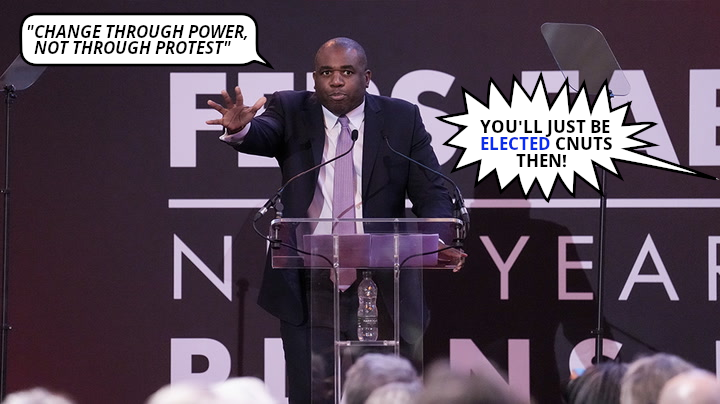
UK Labour Party Foreign Secretary David Lammy repeatedly heckled at a speech to the Fabian Society over his and the Labour Party’s support for and complicity in Israel’s genocide of Gaza.
Workers march through Lisbon on Thursday, Dec. 11, as part of the Portuguese general strike. | Photo via Portuguese Communist Party – Lisbon Branch
Tens of thousands of Portuguese workers walked off the job this week, dressed in workers’ red, in the country’s first general strike in 12 years. This massive show of force is a direct challenge to the right-wing government’s aggressive assault on labor rights, wages, and collective bargaining.
The nationwide strike action halted ports, grounded flights, shuttered schools, and stalled public transport. Workers from every sector said they will no longer accept a return to deeper exploitation and austerity.
The General Confederation of the Portuguese Workers (CGTP-IN) underscored that the attack on workers’ living standards comes not during an economic crisis but amidst growth and steep rises in corporate profits. The union federation said the government’s labor package is “an assault on the rights of all workers.”
“The great and expressive scale of today’s General Strike is an enormous statement of the workers’ strength and unity,” declared the Portuguese Communist Party (PCP), which hailed the mobilization. The party condemned the legislative package as a direct weapon at the service of capital designed to suppress wages, normalize precarious work, dismantle collective contracts, and restrict the right to strike.
The PCP saluted the CGTP-IN for its initiative and the thousands of union leaders and rank-and-file workers who organized the historic general strike.
“The path that is needed is one that increases wages, that fights against precariousness, that values collective bargaining, that defends and strengthens public services,” the party said. “This path is in the hands of the workers, of the people and of the youth, with the immense strength that was on display today.”
The impact of the strike has been immediate and widespread. Autoeuropa, the country’s largest automotive plant, now stands idle. Lisbon’s public transit system ceased operations. Major ports closed. Airlines canceled most flights. Hospitals functioned with skeleton crews, and trash went uncollected in cities nationwide.
From the Panasqueira Mines to the fisheries, from Coca-Cola bottlers to the Super Bock brewery, the work stoppages demonstrated the economy’s total reliance on the very workers the government now seeks to devalue.
“We do not accept unjust laws,” said Conceição Lobo, who has worked 44 years at the Lameirinho textile mill. She voiced widespread rejection of the proposed plan to force workers to work until age 70 before retirement. “We are in the street, together, defending dignity, respect, and a future for those who work,” she said.
At a Lisbon Metro picket line, PCP General Secretary Paulo Raimundo addressed the strikers. “Do not underestimate the workers,” he stated. “When this force unites, as will happen, around their objectives, they are capable of standing up to everything.”
The World Federation of Trade Unions (WFTU), which represents 110 million workers across 134 countries, expressed its “undivided solidarity” with the strikers. The WFTU condemned the “brutal attacks” in Portugal that “undermine essential social and labor rights,” and demanded the immediate withdrawal of the anti-worker policies.
The Portuguese government attempted to minimize the strike’s impact through legally imposed “minimum services” and a media campaign to downplay and discourage broad participation. Their tactics failed. The streets of cities like Braga and Porto filled with demonstrations, while picket lines at factories and depots showed a resilient, multi-generational fightback that included strong participation from women, young workers, and migrant laborers.
For workers in the United States who face similar corporate-driven attacks on their standards of living, the Portuguese struggle offers a valuable lesson. The necessity for unity across sectors and militant mass action remains the most effective weapon against the endless greed of the capitalist class.
As calls for general strikes gain steam in the U.S., particularly after the No Kings protests and the revival of May Day, workers and their unions should pay close attention to their siblings in Portugal. In the end, it is working-class unity and collective action that delivers the goods.
We hope you appreciated this article. At People’s World, we believe news and information should be free and accessible to all, but we need your help. Our journalism is free of corporate influence and paywalls because we are totally reader-supported. Only you, our readers and supporters, make this possible. If you enjoy reading People’s World and the stories we bring you, please support our work by donating or becoming a monthly sustainer today. Thank you!
Indiana Lt. Governor Micah Beckwith speaks during a Remembering Charlie Kirk vigil hosted by Turning Point USA at Indiana University at the Indiana Memorial Union on September 14, 2025 in Bloomington, Indiana. (Photo by Jeremy Hogan/Getty Images)
Some Indiana Republicans vocally objected to the president’s pressure campaign, with one saying Hoosiers “don’t like to be bullied in any fashion.”
Republican Indiana Lt. Gov. Micah Beckwith posted and subsequently deleted a claim that President Donald Trump had threatened to cut off funding to his state unless its legislators approved a mid-decade gerrymander that would have changed the composition of its congressional map to further favor the GOP.
Just over four hours after the Republican-led Indiana state Senate on Thursday voted down the Trump-backed gerrymander—which would have changed the projected balance of Indiana’s current congressional makeup from seven Republicans and two Democrats to a 9-0 map in favor of the GOP—Beckwith took to X to warn that the Hoosier State would soon be feeling the president’s wrath.
“The Trump admin was VERY clear about this,” he wrote, referring to threats to take away federal funding for Indiana. “They told many lawmakers, cabinet members, and the [governor] and I that this would happen. The Indiana Senate made it clear to the Trump admin today that they do not want to be partners with the [White House]. The WH made it clear to them that they’d oblige.”
Although Beckwith deleted his post, he also confirmed to Politico reporter Adam Wren that the White House said that Indiana could lose out on funding for projects if the state did not approve the map, although Beckwith insisted that this was not a “threat” but merely “an honest conversation about who the White House does want to partner with.”
Earlier on Thursday, the X account for right-wing advocacy group Heritage Action, a sister organization of the Heritage Foundation think tank, claimed that Trump had threatened to decimate Indiana’s state finances unless the state Senate approved his proposed gerrymander.
“President Trump has made it clear to Indiana leaders: if the Indiana Senate fails to pass the map, all federal funding will be stripped from the state,” Heritage Action wrote. “Roads will not be paved. Guard bases will close. Major projects will stop. These are the stakes and every NO vote will be to blame.”
Trump has not yet publicly threatened to cut off Indiana’s federal funds, and it’s not clear that the administration actually plans to punish the state for defying the president.
According to a Thursday report from CNN, the Trump White House pressure campaign against Republican Indiana state senators backfired because many legislators resented being subjected to angry threats from Trump supporters, including some incidents in which lawmakers were swatted at their homes.
Republican Indiana state Sen. Jean Leising told CNN that the all-out pressure campaign waged by the president ended up pushing more people into opposing his agenda.
“You wouldn’t change minds by being mean,” Leising said. “And the efforts were mean-spirited from the get-go. If you were wanting to change votes, you would probably try to explain why we should be doing this, in a positive way. That never happened, so, you know, I think they get what they get.”
Fellow Republican Indiana state Sen. Sue Glick echoed Leinsing’s assessment, and said that blunt-force threats against legislators were doomed to failure.
“Hoosiers are a hardy lot, and they don’t like to be threatened,” Glick said. “They don’t like to be intimidated. They don’t like to be bullied in any fashion. And I think a lot of them responded with, ‘That isn’t going to work.’ And it didn’t.”
Indiana’s rejection of the proposed gerrymander this week was a major blow to Trump’s unprecedented mid-decade redistricting crusade, which began in Texas and subsequently spread to Missouri and North Carolina.
This image from video posted on Attorney General Pam Bondi’s X account, and partially redacted by the source, shows an oil tanker being seized by U.S. forces off the coast of Venezuela, December 10, 2025. Photo: U.S. Attorney General’s Office/X via AP
VENEZUELA has lodged a complaint to the International Maritime Organisation (IMO) about the US seizure of an oil tanker in the Caribbean.
The Venezuelans filed the complaint on Thursday to the London-based IMO over what many observers have labelled an act of piracy by the US on Wednesday.
The country’s Vice-President Delcy Rodriguez said she had communicated with IMO executive secretary Arsenio Dominguez, with the aim of “formally and legally addressing this serious situation.”
VP Rodriguez described the incident as a blatant robbery and said the action “exposed the true interests of the US in its ongoing aggression against Venezuela.”
Donald Fuhrump says that Amerikkka doesn’t bother with crimes or charges anymore, not being 100% Amerikkkan and opposing his real estate intentions is enough.






 This image from video posted on Attorney General Pam Bondi’s X account, and partially redacted by the source, shows an oil tanker being seized by U.S. forces off the coast of Venezuela, December 10, 2025. Photo: U.S. Attorney General’s Office/X via AP