Israel’s secret trips to British cyber warfare base exposed | IDF leak latest


Original article by Thom Hartmann republished from Common Dreams under Creative Commons (CC BY-NC-ND 3.0).

People take part in a protest against the deportation of alleged Venezuelan criminals from the USA to a high-security prison in El Salvador in Caracas, Venezuela on April 9, 2025. (Photo: Jesus Vargas/picture alliance via Getty Images)
The American people just got a taste of authoritarianism wrapped in judicial robes. In a stunning 6-3 ruling this week, the Supreme Court green-lit the mass deportation of immigrants, not to their home countries but to third nations where they have no legal status, no family, and often no hope.
In her dissent, Justice Sonja Sotomayor, calling the shadow docket ruling “inexcusable,” pointed out how destructive this is to the rule of law (both U.S. and international law largely prohibit this) and to the lives of the people who may be deported without due process:
The Government has made clear in word and deed that it feels itself unconstrained by law, free to deport anyone anywhere without notice or an opportunity to be heard. The episodes of noncompliance in this very case illustrate the risks.
The Due Process Clause represents “the principle that ours is a government of laws, not of men, and that we submit ourselves to rulers only if under rules.” By rewarding lawlessness, the court once again undermines that foundational principle.
In matters of life and death, it is best to proceed with caution. In this case, the government took the opposite approach. It wrongfully deported one plaintiff to Guatemala, even though an Immigration judge found he was likely to face torture there. Then, in clear violation of a court order, it deported six more to South Sudan, a nation the State Department considers too unsafe for all but its most critical personnel.
This ruling by six corrupt Republican justices allows Donald Trump or any future president to designate any country they choose as a “safe third country” and deport people there without meaningful review, even if they’ve committed no crime and have a valid asylum claim.
If that sounds familiar, it should. It echoes one of the most cold-blooded decisions made by Adolf Hitler’s Nazi regime: to locate their extermination camps not within Germany, but in the foreign lands of occupied Poland.
Let’s be clear: Deportation is not genocide. But both decisions—then and now—are grounded in the same logic of moral evasion through geographic displacement.
When regimes want to commit acts that would stir conscience or provoke backlash at home, they find ways to outsource the cruelty.
The decision wasn’t just about deportation. It was about moral laundering, washing the blood off our hands by putting it on someone else’s tarmac.
The Nazi leadership understood that while Germany’s public had been bombarded with antisemitic propaganda for years, they still might balk at the wholesale slaughter of millions of people inside German borders. So they built Auschwitz, Treblinka, Sobibor, and Belzec far away, deep in Poland, where there were no German newspapers, no prying eyes, and no courts to second-guess their machinery of death.
As Raul Hilberg and other Holocaust historians have documented, Nazi leaders like Heinrich Himmler and Reinhard Heydrich made this decision deliberately to preserve the illusion of “moral cleanliness” at home while carrying out genocide abroad.
Today’s Trump version of this practice is more sanitized, but no less cynical.
By permitting the U.S. government to deport asylum-seekers and noncriminal undocumented immigrants to random third countries—often places they’ve never even set foot in—the Supreme Court has granted the executive branch a license to erase moral responsibility.
As long as the suffering happens somewhere else, we’re told, it’s not our fault. It’s not our soil. Not our responsibility.
That kind of logic is the death of democracy, human rights, and the rule of law. As Federal Judge Patricia Millett said of Trump’s deportation of Venezuelan prisoners to a concentration camp in El Salvador, compared with FDR’s actions in WWII, “Nazis got better treatment under the Alien Enemies Act.”
A future president with dictatorial ambitions could cite this ruling to round up political dissidents, journalists, or whistleblowers and ship them off to “safe third countries” that are anything but.
The Trump administration argued—and the court’s on-the-take, Republican-appointed majority agreed—that migrants have no right to American judicial processes once they’re transferred elsewhere. In other words, we can dodge our legal obligations under both U.S. and international law simply by putting someone on a plane.
This is the same loophole thinking that allowed George W. Bush’s administration to kidnap terror suspects and ship them to places like Egypt and Syria, where they were tortured out of view. That policy was called “extraordinary rendition.” Today, we might call this new policy extraordinary rejection: a way to deny asylum without confronting its human cost.
And here’s the truly chilling part: Once someone has been deported to a third country, they are functionally outside the U.S. legal system. They can’t sue. They can’t appeal. They may not even survive. And, to Trump’s delight, it’ll all be outside the reach of American courts and U.S. media.
This obscene policy isn’t about safety, it’s about displacement as punishment and the creation of a pseudo-legal infrastructure of indifference to the humanity of the people we’re “processing.”
Whether it’s a camp outside Kraków or a deportation center in Guatemala, the strategy is the same: create a zone of moral invisibility. A legal no-man’s-land where acts that would outrage decent people become routine, because they happen far away, beyond the reach of media, law, and conscience.
That’s not how democracies behave: That’s how authoritarian regimes insulate themselves from dissent.
And like all authoritarian tools, once it exists, it will be used again.
You may think this only affects immigrants. But consider: The legal precedent now exists for the government to forcibly remove someone from U.S. soil and drop them in another country without due process. Today it’s asylum-seekers. Tomorrow, who knows?
A future president with dictatorial ambitions could cite this ruling to round up political dissidents, journalists, or whistleblowers and ship them off to “safe third countries” that are anything but.
You think that’s paranoid? So did people in 1932 Berlin.
The genius of the American system—at least in theory—is that it puts checks on state power. The executive cannot act like a king. The courts must protect the vulnerable. And the public must have visibility into the actions done in our name.
This week, though, the Supreme Court abdicated that role. And in doing so, the six Republicans on the bench handed a dangerous tool to a man most inclined to abuse it.
Let’s not kid ourselves. The decision wasn’t just about deportation. It was about moral laundering, washing the blood off our hands by putting it on someone else’s tarmac.
The Nazis did it. So did the Bush administration. Now Trump’s backers on the court have opened the door once more.
History doesn’t repeat, but, as Mark Twain said, it rhymes. And if we’re not careful, we may soon find that rhyme turning into a full verse we’ve heard before.
Original article by Thom Hartmann republished from Common Dreams under Creative Commons (CC BY-NC-ND 3.0).



Original article by Stephen Prager republished from Common Dreams under Creative Commons (CC BY-NC-ND 3.0).

The Associated Press reported Wednesday that 580 premature infants are at risk of death, according to the Gaza Health Ministry, due to a shortage of medical-grade formula entering the strip.
Despite a recent policy change by Israeli Prime Minister Benjamin Netanyahu to allow “minimal aid” into the strip following a total blockade of food, water, shelter, and medication, it has proven far too little to keep hospitals running and keep people fed. It has proven especially deadly for children.
The AP report quotes Dr. Ahmed al-Farah, head of the pediatrics and obstetrics department at Nasser Hospital in Khan Younis, one of the few functional medical facilities left in Gaza.
Last week, al-Farah warned that the hospital’s stock of milk was “completely depleted,” and that unless aid was delivered immediately, the babies would face “an avoidable disaster.” The widely publicized call was answered with the shipment of 20 boxes of formula from the U.S. aid group Rahma Worldwide.
Al-Farah said this was enough to meet the needs of 10 babies for two weeks, but warned that in the long run it would be far too little, especially with no guarantee of aid in the future.
“This is not enough at all,” he told the AP. “It solved the problem temporarily, but what we need is a permeant solution: Lift the siege.”
Many other hospitals reported shortages of formula that had not been answered, such as Al-Rantisi Hospital in Gaza City, which was completely out of stock.
Fortified milk has become increasingly necessary in Gaza due to the increasing number of premature births. In May, the United Nations Children’s Fund (UNICEF) reported that as a result of widespread hunger, 1 in 5 children is now born pre-term or underweight. That malnutrition has also left many new mothers unable to breastfeed.
Dr. Asaad Nawajha, a pediatric specialist at Nasser Hospital, told Middle East Eye that the blockade has proven catastrophic for the health of both children and their mothers.
“This all goes back to the [harsh] conditions mothers endure amid this vicious war on the Gaza Strip,” Nawajha said. “Due to the lack of nutritious items entering the Gaza Strip, both mothers and children have been exposed to illnesses resulting from malnutrition.”
The Israeli government’s Coordinator of Government Activities in the Territories (COGAT) has insisted that the amount of aid allowed into Gaza is sufficient to provide for the population.
On June 22, COGAT announced that 430 aid trucks had been allowed to enter the strip during the preceding week. However, this is but a fraction of the more than 600 trucks per day that the United Nations is necessary to meet their needs.
Many people who have come to aid sites administered by the Gaza Humanitarian Foundation (GHF), to obtain the meager supplies available, have been met with deadly violence from the Israeli military.
Since May 27, at least 549 Palestinians have been killed and more than 4,000 injured by Israeli forces at these sites, according to the U.N. Office for Coordinated Humanitarian Affairs (OCHA) and the Gaza Ministry of Health. The Gaza Media Office reports at least 19 fatal incidents at these GHF sites over the span of just one month.
Many of the victims have been children. According to a study released Thursday by the humanitarian group Save the Children, children have been killed at 10 of those 19 incidents.
“No child should be killed searching for food,” said Ahmad Alhendawi, Save the Children’s regional director for the Middle East, North Africa, and Eastern Europe. “This is not a humanitarian operation—it’s a death trap.”
Original article by Stephen Prager republished from Common Dreams under Creative Commons (CC BY-NC-ND 3.0).
Original article by Eloise Goldsmith republished from Common Dreams under Creative Commons (CC BY-NC-ND 3.0).
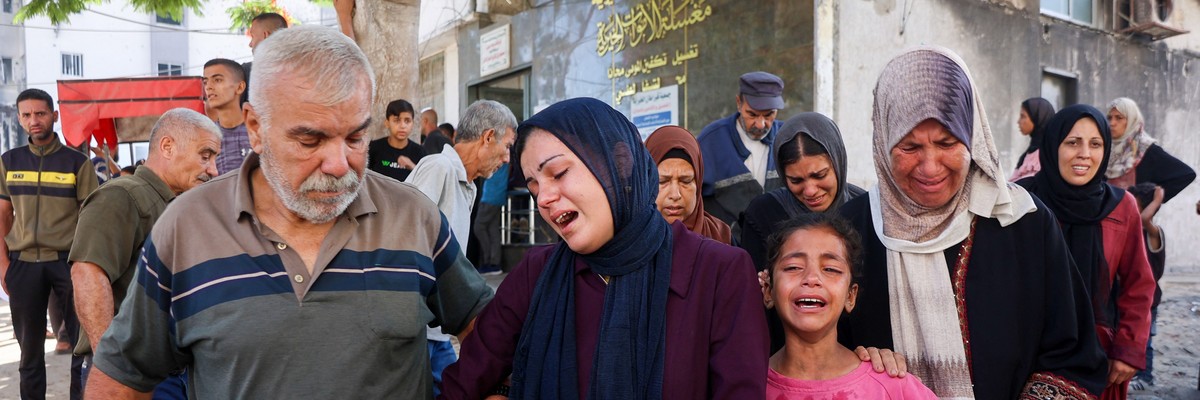
The anti-poverty group Oxfam America has issued a forceful response to reporting that the Trump administration plans to give tens of millions dollars to the Gaza Humanitarian Foundation, an Israeli-backed aid organization which uses private U.S. military firms and whose rollout the United Nations and international aid groups have strongly objected to.
Reuters was first to report on Tuesday that the Trump administration plans to give $30 million to the Gaza Humanitarian Foundation (GHF). A document reviewed by the outlet shows that the amount was authorized last week under a “priority directive” from the White House and the U.S. Department of State. Per Reuters, $7 million has already been dispersed. Sources told the outlet that the administration may approve separate monthly grants for the entity.
Oxfam America president and CEO Abby Maxman said in a statement on Tuesday that the Trump administration is poised to shell out for an aid organization “formed to distribute food parcels without any grounding in the reality of the crisis in Gaza.”
Maxman accused GHF of delivering only a fraction of the number of meals that the population needs and alleged the group is distributing food that families can’t prepare without fuel and clean water. She also said the organization has pushed aid further out of reach for the vulnerable populations who can’t walk long distances to its distribution sites.
“We urge the Trump administration and Congress to instead put its full support behind funding and ensuring safe access for established humanitarian organizations to do the work that is proven to save lives,” added Maxman.
She also highlighted that the distribution sites have been marred by violence.
The U.N.’s human rights office said on Tuesday that at least 410 Palestinians have been killed by Israeli forces “while trying to fetch from controversial new aid hubs in Gaza—a likely war crime,” according to a U.N. News article posted that same day.
Jonathan Whittall, the head of U.N. Office for the Coordination of Humanitarian Affairs in the Occupied Palestinian Territory, told journalists on Monday that since Israel’s total blockade was partially lifted in late May, “people have been killed almost daily while trying to get food.”
In a statement shared with CBS on Tuesday, GHF pushed back on what it called “false allegations of attacks near aid distributions sites.” The group also said that the “Hamas-affiliated Gaza Health Ministry is not a credible source of information, as it fails to report any U.N. convoys or distribution sites that are linked to violent incidents,” according to CBS, whose story focused on comments from the U.N. Relief and Works Agency for Palestine Refugees in the Near East commissioner general decrying GHF.
In that same story, CBSreported that the Gaza Ministry of Health said 79 people had been killed in Gaza over the last day. Fifty-one of those people had died near GHF sites, per CBS, citing the Gaza Ministry of Health.
And on Monday, over a dozen human rights organizations sent a letter to GHF calling for an end to the “privatized, militarized” GHF aid model and urging any parties involved with GHF and the international community in general to press for aid to be distributed through established international relief operations.
“Individuals and corporate entities involved in the planning, financing, or execution of the GHF scheme may incur criminal liability—including under universal jurisdiction statutes—for aiding and abetting war crimes such as the forcible displacement of civilians, starvation as a method of warfare, and denial of humanitarian access,” the letter warned.
The groups behind the letter include the Palestinian Center for Human Rights, the Center for Constitutional Rights, the Center for Applied Legal Studies, and others.
Original article by Eloise Goldsmith republished from Common Dreams under Creative Commons (CC BY-NC-ND 3.0).