BANNING Of Palestine Action In UK Should TERRIFY You


Original article by Eloise Goldsmith republished from Common Dreams under Creative Commons (CC BY-NC-ND 3.0).
The anti-poverty group Oxfam America has issued a forceful response to reporting that the Trump administration plans to give tens of millions dollars to the Gaza Humanitarian Foundation, an Israeli-backed aid organization which uses private U.S. military firms and whose rollout the United Nations and international aid groups have strongly objected to.
Reuters was first to report on Tuesday that the Trump administration plans to give $30 million to the Gaza Humanitarian Foundation (GHF). A document reviewed by the outlet shows that the amount was authorized last week under a “priority directive” from the White House and the U.S. Department of State. Per Reuters, $7 million has already been dispersed. Sources told the outlet that the administration may approve separate monthly grants for the entity.
Oxfam America president and CEO Abby Maxman said in a statement on Tuesday that the Trump administration is poised to shell out for an aid organization “formed to distribute food parcels without any grounding in the reality of the crisis in Gaza.”
Maxman accused GHF of delivering only a fraction of the number of meals that the population needs and alleged the group is distributing food that families can’t prepare without fuel and clean water. She also said the organization has pushed aid further out of reach for the vulnerable populations who can’t walk long distances to its distribution sites.
“We urge the Trump administration and Congress to instead put its full support behind funding and ensuring safe access for established humanitarian organizations to do the work that is proven to save lives,” added Maxman.
She also highlighted that the distribution sites have been marred by violence.
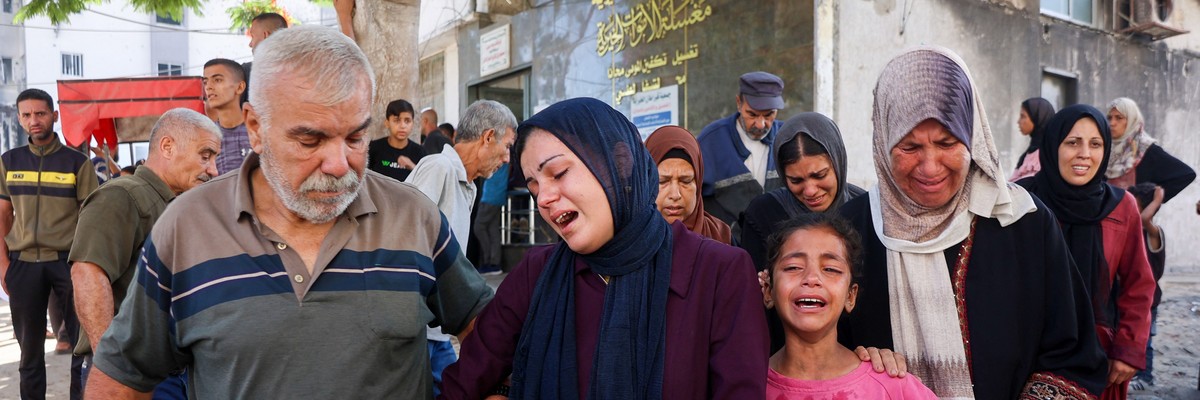
The U.N.’s human rights office said on Tuesday that at least 410 Palestinians have been killed by Israeli forces “while trying to fetch from controversial new aid hubs in Gaza—a likely war crime,” according to a U.N. News article posted that same day.
Jonathan Whittall, the head of U.N. Office for the Coordination of Humanitarian Affairs in the Occupied Palestinian Territory, told journalists on Monday that since Israel’s total blockade was partially lifted in late May, “people have been killed almost daily while trying to get food.”
In a statement shared with CBS on Tuesday, GHF pushed back on what it called “false allegations of attacks near aid distributions sites.” The group also said that the “Hamas-affiliated Gaza Health Ministry is not a credible source of information, as it fails to report any U.N. convoys or distribution sites that are linked to violent incidents,” according to CBS, whose story focused on comments from the U.N. Relief and Works Agency for Palestine Refugees in the Near East commissioner general decrying GHF.
In that same story, CBSreported that the Gaza Ministry of Health said 79 people had been killed in Gaza over the last day. Fifty-one of those people had died near GHF sites, per CBS, citing the Gaza Ministry of Health.
And on Monday, over a dozen human rights organizations sent a letter to GHF calling for an end to the “privatized, militarized” GHF aid model and urging any parties involved with GHF and the international community in general to press for aid to be distributed through established international relief operations.
“Individuals and corporate entities involved in the planning, financing, or execution of the GHF scheme may incur criminal liability—including under universal jurisdiction statutes—for aiding and abetting war crimes such as the forcible displacement of civilians, starvation as a method of warfare, and denial of humanitarian access,” the letter warned.
The groups behind the letter include the Palestinian Center for Human Rights, the Center for Constitutional Rights, the Center for Applied Legal Studies, and others.
Original article by Eloise Goldsmith republished from Common Dreams under Creative Commons (CC BY-NC-ND 3.0).


Original article by Brett Wilkins republished from Common Dreams under Creative Commons (CC BY-NC-ND 3.0).
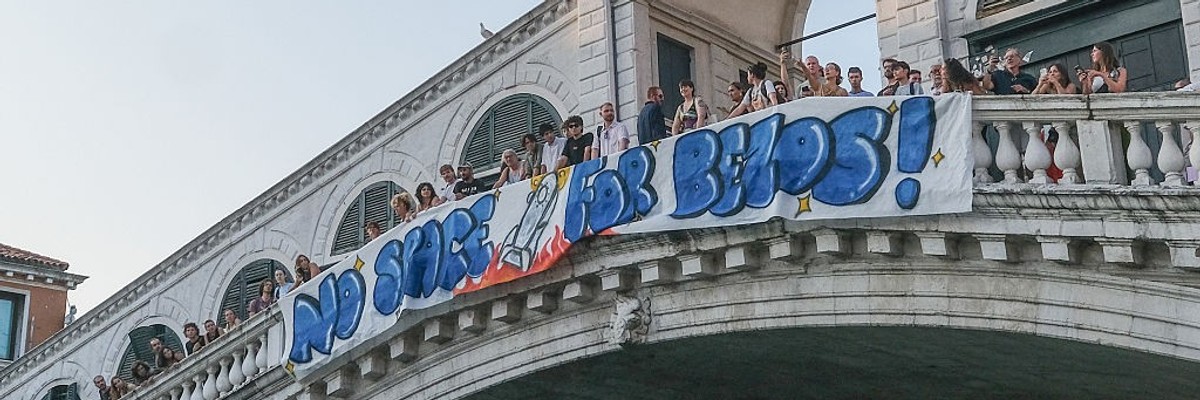
Amazon.com founder Jeff Bezos and Lauren Sánchez on Tuesday relocated their upcoming lavish Venice wedding celebration, a move cheered as an “enormous victory” by protesters whose recent demonstrations in the northeastern Italian city have highlighted the socioeconomic and climate damage caused by billionaires.
Bezos—who is currently the world’s fourth-richest person, according to lists published by Bloomberg and Forbes—is set to marry Sánchez, a journalist, later this week, and the couple is planning to celebrate the occasion with a three-day extravaganza costing an estimated $46-56 million, according to Reuters.
Around 90 private jets are scheduled to land in area airports and local yacht harbors are fully booked, underscoring the climate and environmental impact on a city struggling to survive on one of myriad frontlines of the planetary emergency.
“We are very proud of this! We are nobodies, we have no money, nothing!”
The nuptial celebration has been relocated from the Scuola Grande della Misericordia to the Arsenale di Venezia, a historic fortified palace about 3 kilometers (1.8 miles) away from the original location. Officials cited concerns for the security of guests including several members of U.S. President Donald Trump’s family.
Members of groups including No Space for Bezos, Greenpeace Italy, and Everyone Hates Elon—which targets Elon Musk, the world’s richest person—have staged a series of demonstrations, including one on Monday at which protesters laid out a massive banner with Bezos’ face and the message “If You Can Rent Venice for Your Wedding You Can Pay More Tax” in Piazza San Marco.
Responding to the celebration’s relocation, Tommaso Cacciari of No Space for Bezos told the BBC Wednesday: “We are very proud of this! We are nobodies, we have no money, nothing!”
“We’re just citizens who started organizing and we managed to move one of the most powerful people in the world,” Cacciari added.
Wedding-related festivities are set to kick off Thursday evening, and city officials have blocked off parts of central Venice. While some residents have welcomed the money and fanfare the event will bring to a city with a long and storied history of oligarchs and opulence, others bristle at what they see as the transformation of their home into a playground for the superrich.
“There’s only one thing that rules now: money, money, money, so we are the losers,” Venice resident Nadia Rigo told Reuters. “We who were born here have to either move to the mainland or we have to ask them for permission to board a ferry. They’ve become the masters.”
In the United States, critics contrasted the stratospheric cost of Bezos’ celebration with the multicentibillionaire’s history of personal and corporate tax dodging—and the hyper-capitalist system that enables it.
“Jeff Bezos is worth $230 billion and is reportedly spending $20 million on a three-day wedding in Venice while sailing around on his $500 million yacht,” former U.S. Labor Secretary Robert Reich said Wednesday on the social media site X. “If he can afford to do that, he can afford a wealth tax and to pay Amazon workers a living wage. Hello?”
While No Space for Bezos organizers are celebrating their victory and have canceled plans to fill Venice’s canals with inflatable crocodiles in a bid to block celebrity guests from accessing the Scuola Grande della Misericordia, they said they still plan on protesting the festivities by holding a “No Bezos, No War” rally and march.
“It will be a strong, decisive protest, but peaceful,” Federica Toninello of the Social Housing Assembly network toldEuronews Wednesday. “We want it to be like a party, with music, to make clear what we want our Venice to look like.”
Original article by Brett Wilkins republished from Common Dreams under Creative Commons (CC BY-NC-ND 3.0).
Original article by Katy Watts republished from openDemocracy under a Creative Commons Attribution-NonCommercial 4.0 International licence.

Two years ago, Suella Braverman made a law she had no power to make.
The then Conservative home secretary ignored normal parliamentary process to sneak unlawful anti-protest measures in by the back door.
Her new law fundamentally changed the threshold at which police could impose conditions on a protest in England and Wales. It went from anything that caused ‘serious disruption’ – itself a vague phrase that Braverman was asked to define but didn’t – to anything that caused ‘more than minor’ disruption.
Now, finally, those laws have been quashed. We at Liberty launched legal action against the government in June 2023, and five judges over two hearings have since agreed with us that the measures were unlawful and should never have been introduced in the first place.
This week, the Labour government quietly dropped its appeal over those court rulings. The law now reverts back to what it originally was. Police can no longer intervene in protests on trivial grounds, such as a person blocking the entrance to a hotel where a fossil fuel conference is taking place for a matter of minutes – an act for which Greta Thunberg was arrested and later acquitted.
At Liberty, we took action against these laws not just because they were undemocratic and unlawful, but because of the real human impact they had on protesters and non-protesters across the country.
Take Susan* for example, who was wrongly arrested in January. Susan had gone to a vigil for Palestine in the morning, but left to go for lunch. As she was on her way to the shops with friends, she asked the police which way to go, and they directed her back into the protest area. A few minutes later, Susan was caught up in a kettle as the area had conditions imposed on it under these laws.
Susan was arrested, held in custody first on a coach for three hours, and then in a cell for the rest of the 24-hour period that a person can be detained for without charge. She was unable to even call home to tell her son she wouldn’t be allowed home that evening until 10pm.
Eventually, Susan was told that no further action would be taken against her, as was the case for dozens of others who got caught up in this injustice. Despite this, there have been long-lasting effects. In her own words, this has had a huge impact on her mental health. She feels scared for her family’s safety. She has lost all optimism, when she did nothing wrong in the first place.
What makes Susan’s case even worse is that the legislation had already been ruled unlawful at the point she was arrested. Just a few months earlier, the Labour government had chosen to appeal the court’s original decision that the Conservatives acted unlawfully. This is despite Labour’s home secretary, Yvette Cooper, having vocally opposed these same laws when she was in opposition.
Now, the government has finally accepted defeat and has decided to drop its appeal. This is a huge victory for democracy and our right to protest.
It’s important to note that these laws are just one in a long line of anti-protest legislation introduced over the past few years to crack down on our rights to protest.

How the UK’s ‘free speech’ government banned protest
19 May 2025 | Sian Norris
Conservative ministers loudly championed free speech – right up until they outlawed it. Now, we’re all at risk
Through successive government acts and rhetoric, the ways in which we can protest have been narrowed. Restrictions have been placed on how we protest, and even how noisy a protest can be. And as we’ve seen recently, the sentences given out to protesters have only got longer and harsher.
This cannot go on. We need a reset on the way protest is treated, because it is leading to situations like Susan’s, where vague laws are causing very real damage.
If we’ve learnt anything from our legal action, it is that justice is possible. But, as Susan’s experience shows, there is still further justice that needs to be gained.
These laws should never have been made, and so, quite clearly, every incident under them must be looked at. There has to be an urgent review of every arrest and conviction made under these regulations.
Original article by Katy Watts republished from openDemocracy under a Creative Commons Attribution-NonCommercial 4.0 International licence.

https://www.bbc.com/news/articles/c0rvzqxyglro

Private flights at the Scottish government-owned Glasgow Prestwick Airport increased by more than a third last year, according to figures from Oxfam Scotland.
The charity says there were more than 12,000 private flights in and out of Scottish airports in 2024, with the busiest being Edinburgh, Glasgow Prestwick and Inverness.
Oxfam says that if an Air Departure Tax had been in place, and applied at the highest possible rate, that would have generated an extra £29m in tax revenue.
The Scottish government says it is reviewing rates and bands and is open to introducing a higher tax on private jets.
The rise reflects a global trend in private jets being used increasingly by the super-rich, with climate scientists warning that they can be up to 30 times more damaging for the planet than scheduled flights.
…
Article continues at https://www.bbc.com/news/articles/c0rvzqxyglro