Starving Gaza into Submission: Chris Hedges on the Final Chapter of Genocide
Article by Chris Hedges republished from MPN under a Creative Commons Attribution-NonCommercial-ShareAlike 3.0 International License.
This is the end. The final blood-soaked chapter of the genocide. It will be over soon. Weeks. At most. Two million people are camped out amongst the rubble or in the open air. Dozens are killed and wounded daily from Israeli shells, missiles, drones, bombs and bullets. They lack clean water, medicine and food. They have reached a point of collapse. Sick. Injured. Terrified. Humiliated. Abandoned. Destitute. Starving. Hopeless.
In the last pages of this horror story, Israel is sadistically baiting starving Palestinians with promises of food, luring them to the narrow and congested nine-mile ribbon of land that borders Egypt. Israel and its cynically named Gaza Humanitarian Foundation (GHF), allegedly funded by Israel’s Ministry of Defense and the Mossad, is weaponizing starvation. It is enticing Palestinians to southern Gaza the way the Nazis enticed starving Jews in the Warsaw Ghetto to board trains to the death camps. The goal is not to feed the Palestinians. No one seriously argues there is enough food or aid hubs. The goal is to cram Palestinians into heavily guarded compounds and deport them.
What comes next? I long ago stopped trying to predict the future. Fate has a way of surprising us. But there will be a final humanitarian explosion in Gaza’s human slaughterhouse. We see it with the surging crowds of Palestinians fighting to get a food parcel, which has resulted in Israeli and U.S. private contractors shooting dead at least 130 and wounding over seven hundred others in the first eight days of aid distribution. We see it with Benjamin Netanyahu’s arming ISIS-linked gangs in Gaza that loot food supplies. Israel, which has eliminated hundreds of employees with the United Nations Relief and Works Agency for Palestine Refugees in the Near East (UNRWA), doctors, journalists, civil servants and police in targeted assassinations, has orchestrated the implosion of civil society.
I suspect Israel will facilitate a breach in the fence along the Egyptian border. Desperate Palestinians will stampede into the Egyptian Sinai. Maybe it will end some other way. But it will end soon. There is not much more Palestinians can take.
We — full participants in this genocide — will have achieved our demented goal of emptying Gaza and expanding Greater Israel. We will bring down the curtain on the live-streamed genocide. We will have mocked the ubiquitous university programs of Holocaust studies, designed, it turns out, not to equip us to end genocides, but deify Israel as an eternal victim licensed to carry out mass slaughter. The mantra of never again is a joke. The understanding that when we have the capacity to halt genocide and we do not, we are culpable, does not apply to us. Genocide is public policy. Endorsed and sustained by our two ruling parties.
There is nothing left to say. Maybe that is the point. To render us speechless. Who does not feel paralyzed? And maybe, that too, is the point. To paralyze us. Who is not traumatized? And maybe that too was planned. Nothing we do, it seems, can halt the killing. We feel defenseless. We feel helpless. Genocide as spectacle.
I have stopped looking at the images. The rows of little shrouded bodies. The decapitated men and women. Families burned alive in their tents. The children who have lost limbs or are paralyzed. The chalky death masks of those pulled from under the rubble. The wails of grief. The emaciated faces. I can’t.
This genocide will haunt us. It will echo down history with the force of a tsunami. It will divide us forever. There is no going back.
And how will we remember? By not remembering.
Once it is over, all those who supported it, all those who ignored it, all those who did nothing, will rewrite history, including their personal history. It was hard to find anyone who admitted to being a Nazi in post-war Germany, or a member of the Klu Klux Klan once segregation in the southern United States ended. A nation of innocents. Victims even. It will be the same. We like to think we would have saved Anne Frank. The truth is different. The truth is, crippled by fear, nearly all of us will only save ourselves, even at the expense of others. But that is a truth that is hard to face. That is the real lesson of the Holocaust. Better it be erased.
In his book “One Day, Everyone Will Have Always Been Against This,” Omar El Akkad writes:
Should a drone vaporize some nameless soul on the other side of the planet, who among us wants to make a fuss? What if it turns out they were a terrorist? What if the default accusation proves true, and we by implication be labeled terrorist sympathizers, ostracized, yelled at? It is generally the case that people are most zealously motivated by the worst plausible thing that could happen to them. For some, the worst plausible thing might be the ending of their bloodline in a missile strike. Their entire lives turned to rubble and all of it preemptively justified in the name of fighting terrorists who are terrorists by default on account of having been killed. For others, the worst plausible thing is being yelled at.
You can see my interview with El Akkad here.
You cannot decimate a people, carry out saturation bombing over 20 months to obliterate their homes, villages and cities, massacre tens of thousands of innocent people, set up a siege to ensure mass starvation, drive them from land where they have lived for centuries and not expect blowback. The genocide will end. The response to the reign of state terror will begin. If you think it won’t you know nothing about human nature or history. The killing of two Israeli diplomats in Washington and the attack against supporters of Israel at a protest in Boulder, Colorado, are only the start.
Chaim Engel, who took part in the uprising at the Nazis’ Sobibor death camp in Poland, described how, armed with a knife, he attacked a guard in the camp.
“It’s not a decision,” Engel explained years later. “You just react, instinctively you react to that, and I figured, ‘Let us to do, and go and do it.’ And I went. I went with the man in the office and we killed this German. With every jab, I said, ‘That is for my father, for my mother, for all these people, all the Jews you killed.’”
Does anyone expect Palestinians to act differently? How are they to react when Europe and the United States, who hold themselves up as the vanguards of civilization, backed a genocide that butchered their parents, their children, their communities, occupied their land and blasted their cities and homes into rubble? How can they not hate those who did this to them?
What message has this genocide imparted not only to Palestinians, but to all in the Global South?
It is unequivocal. You do not matter. Humanitarian law does not apply to you. We do not care about your suffering, the murder of your children. You are vermin. You are worthless. You deserve to be killed, starved and dispossessed. You should be erased from the face of the earth.
“To preserve the values of the civilized world, it is necessary to set fire to a library,” El Akkad writes:
To blow up a mosque. To incinerate olive trees. To dress up in the lingerie of women who fled and then take pictures. To level universities. To loot jewelry, art, food. Banks. To arrest children for picking vegetables. To shoot children for throwing stones. To parade the captured in their underwear. To break a man’s teeth and shove a toilet brush in his mouth. To let combat dogs loose on a man with Down syndrome and then leave him to die. Otherwise, the uncivilized world might win.
There are people I have known for years who I will never speak to again. They know what is happening. Who does not know? They will not risk alienating their colleagues, being smeared as an antisemite, jeopardizing their status, being reprimanded or losing their jobs. They do not risk death, the way Palestinians do. They risk tarnishing the pathetic monuments of status and wealth they spent their lives constructing. Idols. They bow down before these idols. They worship these idols. They are enslaved by them.
At the feet of these idols lie tens of thousands of murdered Palestinians.
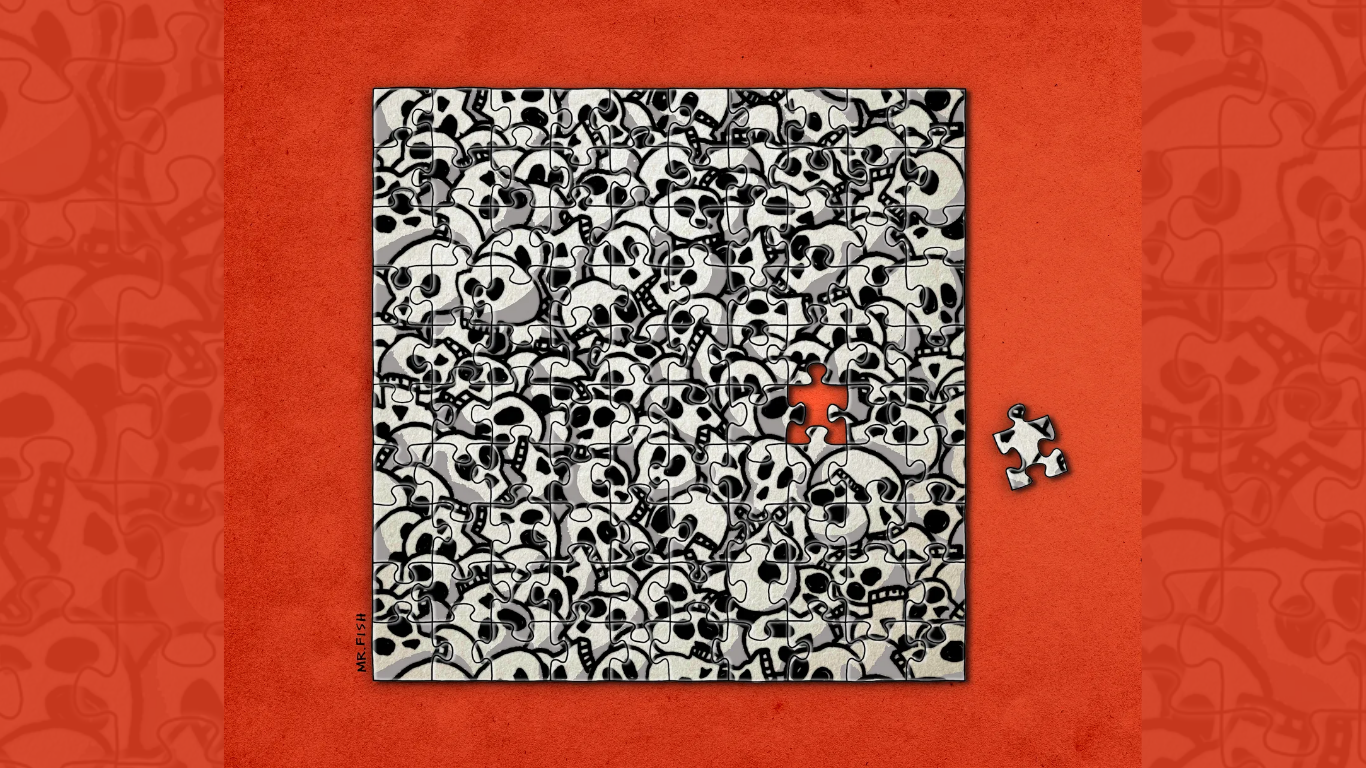
Feature photo | The Last Piece | Artwork by Mr. Fish
Chris Hedges is a Pulitzer Prize–winning journalist who was a foreign correspondent for fifteen years for The New York Times, where he served as the Middle East Bureau Chief and Balkan Bureau Chief for the paper. He previously worked overseas for The Dallas Morning News, The Christian Science Monitor, and NPR. He is the host of show The Chris Hedges Report.
Stories published in our Daily Digests section are chosen based on the interest of our readers. They are republished from a number of sources, and are not produced by MintPress News. The views expressed in these articles are the author’s own and do not necessarily reflect MintPress News editorial policy.
The views expressed in this article are the author’s own and do not necessarily reflect MintPress News editorial policy.
Article by Chris Hedges republished from MPN under a Creative Commons Attribution-NonCommercial-ShareAlike 3.0 International License.