The political opportunism behind Reform UK’s support for abolition of the two-child limit on benefits
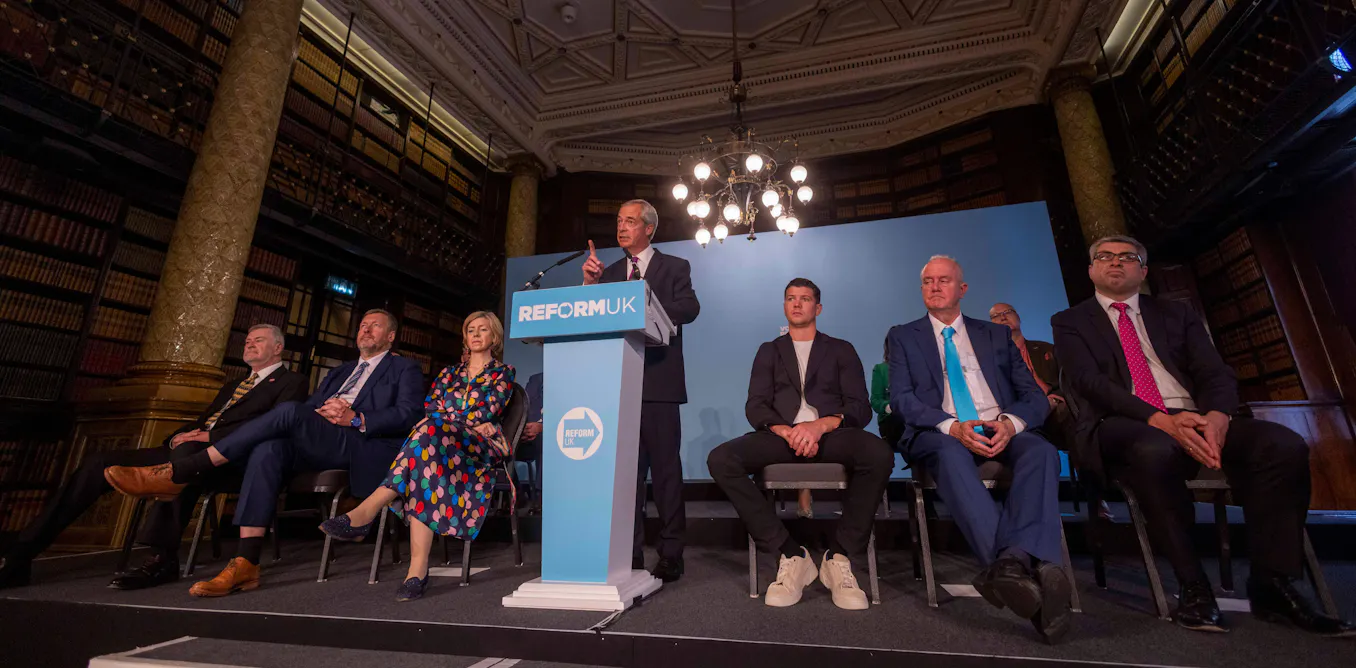
Nigel Farage speaks at a Reform UK press conference in London in May 2025. Karl Black / Alamy Stock Photo

Chris Grover, Lancaster University

The leader of Reform UK, Nigel Farage, recently announced that if in government, his party would abolish the two-child limit on benefits. This social security policy restricts the payment of means-tested benefits to the first two children of a family.

Farage explained the announcement as being pro-natalist – intended to encourage a higher birth rate – as well as being “pro-worker”. Farage said that the abolition of the two-child limit “makes having children just a little bit easier” for “lower paid workers”.

He noted that Reform wanted “to encourage people to have children”. Such arguments are familiar in the European political right, although the UK’s Conservative opposition criticised Reform’s proposal.

To be in government, Reform has two possible routes: to build a coalition of voters for it, or to split left-leaning voters. Its proposal to abolish the two-child limit may be aimed at both.

On the one hand, it might be supported by left-leaning voters who are able to accept Reform’s broader policy agenda. On the other hand, it might be aimed at encouraging left-leaning voters who find Reform’s agenda problematic to move to parties (such as the Greens and Liberal Democrats) who are less equivocal in their commitment to abolishing the two-child limit than the Labour government.

Social security policies winning votes

Social security policies have long been used as part of political strategising. The situation with the two-child limit is complicated, though, because both anti- and pro-natalist views of social security (and it predecessors) have been popular at particular moments.

Political and popular arguments have long been made that supporting the poorest families leads to them having too many children. This, so the argument goes, reproduces, rather than addresses, the poverty they face. Examples can be found, for instance, in the 1834 poor law commission report in relation to “bastardy” and large families, Sir Keith Joseph’s 1970s focus upon the “cycle of deprivation”, as well as “underclass” arguments in the 1980s and 1990s.

The two-child limit was announced in the 2015 budget and introduced in 2017 with the reasoning that “those in receipt of tax credits should face the same financial choices about having children as those supporting themselves solely through work.”

Three children playing
The two-child limit on benefits restricts welfare payments for children to the first two children in a family. Len44ik/Shutterstock

In contrast, the architect of the British welfare state, William Beveridge, noted in 1942 that children’s allowances (now child benefit) would help “housewives as mothers” in their “vital work in ensuring the adequate continuance of the British race and of British ideals in the world.” The 1945 Labour election victory in support of the welfare state suggests pro-natalist policies can contribute to electoral success.

The expansion of tax credits in the 1990s and 2000s were partly explained in pro-natalist terms. Tony Blair, for instance, noted: “The working tax credit enables half a million mothers to choose to stay at home.” That, in other words, tax credits enabled women to choose having and raising children over paid work.

Recent polling, however, suggests that the anti-natalist two-child limit polls well among voters, especially Reform voters. In 2024, for example, YouGov found 60% of Britons thought the two-child limit should be kept. The figure was 84% for Reform voters.

Targeting voters

The abolition of the two-child limit may have been adopted to increase Reform’s appeal to left-leaning voters. Providing additional support for families through social security may be attractive to voters concerned with social injustice. The two-child limit increases child poverty. Affected families are unable to provide even the most basic needs, such as food, clothing and heating.

Nevertheless, Reform’s proposal is also embedded in caveats and would be paid for through means appealing to its existing voters. So, for example, Farage emphasised that the abolition of the two-child limit would be restricted to only British families. It would not be extended to families “who come into the country and suddenly decide to have a lot of children”.

By keeping the two-child limit for migrant families, Reform’s proposals are consistent with existing immigration and asylum policies. It has been observed in an inquiry by All Party Parliamentary Groups on poverty and on migration that policies like this are, at least in part, “designed to push people into poverty in the hope that it will deter others from moving to the UK.” And, therefore, the abolition of the two-child limit can be seen as part of Reform’s pledge to severely curtail immigration.

Farage also argued that the abolition of the two-child limit would be paid for by other policies that are central to Reform’s electoral agenda. These include stopping asylum seekers being housed in hotels and the abolition of net zero policies. It is also consistent with Reform’s view that jobs in Britain should be filled by British people. This, it believes, will help reduce reliance on migrant labour from overseas.

There is little evidence that the introduction of the two-child limit had the desired impact on lowering poorer households’ birth rates. And it is unclear whether the proposed abolition of the two-child limit rooted in a British-only, pro-natalist agenda is enough to attract left-leaning voters.

These voters might, for example, be more concerned with Reform’s position on immigration and asylum seeking, as well as the social injustice of the undoubted poverty in which families subjected to the two child limit on benefits live.

Reform’s strategy then may be to further encourage those voters to turn from its closest rival – the Labour party – to other political parties. Whichever is the case, the situation will undoubtedly shift if the Labour government does take the step of abolishing the two-child limit.

Chris Grover, Professor in Social Policy, Lancaster University

This article is republished from The Conversation under a Creative Commons license. Read the original article.

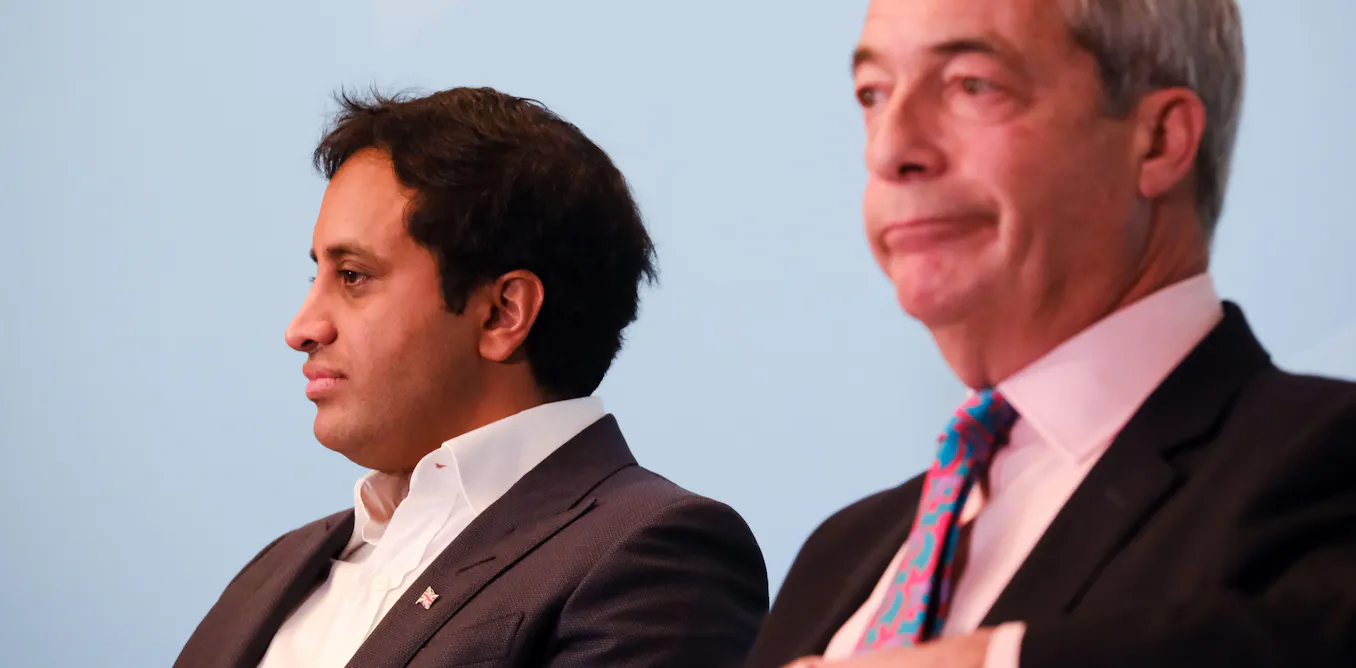
Nigel Farage explains the politics of Reform UK: Racism, Fake anti-establishmentism, Deregulation, Corporatism, Climate Change Denial, Mysogyny and Transphobia.
Continue ReadingThe political opportunism behind Reform UK’s support for abolition of the two-child limit on benefits

Why ultra wealthy donors like Elon Musk and Zia Yusuf may just be fundamentally incompatible with the politics of the radical right

Alamy/Matthew Chattle

Sam Power, University of Bristol

Former chairman Zia Yusuf has rejoined Reform after quitting days previously. Yusuf had said he no longer wanted to work to get the party into government when new MP Sarah Pochin called for a ban on burqas in the UK. However, he seems to have had a change of heart and will return, ostensibly to lead the party’s “department of government efficiency”.

Donald Trump and Elon Musk’s bromance, however, is on much rockier ground. There’s no sign of the world’s richest man reconciling with the US president, his former employer.

These spats, at first glance, might seem like little more than, put politely, teething problems in (relatively) new political operations. Or, a little less politely, the unedifying spectacle of people in or seeking power being completely unable to act like adults.

However, it also points to something more akin to a canary in the coalmine for radical right parties around the world. Their increasing reliance on an ultra-wealthy donor class presents an ideological puzzle that may not be solvable.


Want more politics coverage from academic experts? Every week, we bring you informed analysis of developments in government and fact check the claims being made.

Sign up for our weekly politics newsletter, delivered every Friday.


Reform currently operates on what has been described as vibes alone. That is to say, there’s very little meaningful common ground between the people who vote for Reform and the party elite. The only continuity is their sense of anger at the current political system.

This, as we are seeing in election after election, is an incredibly powerful (and compelling) force. The problem is, of course, that you can’t oppose forever. You often end up having to actually do something. All boxers, Mike Tyson will be glad to tell you, have a plan – until they get punched in the face.

And what makes them such a powerful force at the moment, is precisely that which may cause challenges further down the line. At least for me, given it’s my bread and butter research-wise, I see this when I follow the money.

And I’m increasingly asked a lot of questions about the kind of people who are either giving money to Reform – or who Reform are courting (and at the moment it is decidedly the latter which is the case).

My position is that they very broadly fit into three categories. First are disaffected traditional Conservatives who are increasingly seeing a party – in the words of Farage – “worth investing in”. In the donations figures released on June 10, these are represented by bussinessmen Bassim Haidar and Mohammed Amersi.

Then you have a Silicon Valley-reared tech-bro libertarian. This group already runs on a “move fast and break things” philosophy so the idea of an insurgent party which proclaims, on entering parliament, that “the fox is in the henhouse” naturally appeals.

The final pot of money is filled via small donations, ballooning membership and a whole chunk of votes from a disaffected white working-class population to whom the language of economic and cultural grievances resonates.

There are some places where the interests of these groups align – most notably a distaste for government interference and red tape (though not necessarily a smaller state in terms spending on public services). They also share a sense that progressive politics, broadly defined, ought to be pegged back a bit (but with an emphasis on a bit).

They differ on a great deal else, to the extent that you can only really please two out of the three, but never everybody. And, unfortunately, without all three the project starts collapsing. This is what we have been seeing in the fractious relationships between Trump and Musk and Farage and Yusuf.

Two out of three ain’t bad – but it’s not enough

Yusuf (and Musk) are very much representative of the new tech-bro class. And, when Yusuf called questions about banning the burqa “dumb” he was speaking at both an ideological and organisational level.

At the ideological level it is, frankly, a bit rich for his blood, because “philosophically I am always a bit uneasy about banning things which, for example, would be unconstitutional in the United States”.

Organisationally, it pushes Reform much closer to what journalist Fraser Nelson calls “a tactic more akin to the old BNP”. Indeed, Reform started “just asking questions” about burqas at the same time as it started twisting footage to claim that Anas Sarwar, leader of Scottish Labour, wants to prioritise the needs of Pakistanis.

This kind of dog-whistle politics appeals to some, but puts off a lot more, including, I think, some of the (saner) tech-bro right.

Indeed, Ian Ward at Politico perceptively notes that if we want to explain the current Musk-Trump meltdown we should look back to Christmas 2024, when cracks first started appearing over immigration policy.

The tech-bro right are, generally speaking, much less hardline on the flow of people than the Maga-populist right (think Steve Bannon and Tommy Robinson). In fact, they are pro-high skilled immigration as it tends to benefit them and their business interests.

Tech-bros also like the idea of moving fast and breaking things in theory. But when things start moving fast and actually breaking in practice (or Tesla stocks start to plummet), they tend to get a bit freaked out.

In other words, it’s not just that they don’t like government, they don’t like governing and the inevitable compromise that comes with it. When they say move fast and break things, I get the sense what they really mean is “leave me alone so I can make billions in peace”.

This, of course, is quite appealing to traditional hedge-fund conservatives, but is also the politics that literally built the economic grievances that much of the white-working class support for the populist radical right is, in turn, built on.

Two out of three ain’t bad, but you do need all three. So, don’t be surprised if despite Farage’s seemingly genuine affection for Yusuf, it all falls apart again before long.

Ultimately, Reform will need to decide how they are going to spin these plates. The good news is that it might well be that they can, indeed, get by on vibes alone until the next general election. The bad news, unfortunately, is that winning an election is the easy bit. Just ask Boris Johnson and Keir Starmer. After all, everyone has a plan.

Sam Power, Lecturer in Politics, University of Bristol

This article is republished from The Conversation under a Creative Commons license. Read the original article.

Nigel Farage explains the politics of Reform UK: Racism, Fake anti-establishmentism, Deregulation, Corporatism, Climate Change Denial, Mysogyny and Transphobia.
Continue ReadingWhy ultra wealthy donors like Elon Musk and Zia Yusuf may just be fundamentally incompatible with the politics of the radical right

Spending review: Rachel Reeves is about to make a £600 billion gamble on growth

Steve Schifferes, City St George’s, University of London

UK chancellor Rachel Reeves faces her biggest test with the government’s departmental spending plans for the three years from next April until the general election. With nearly £600 billion a year to spend, her decisions will impact on every aspect of public life and shape the political weather for years to come.

She believes the key to reviving Labour’s fortunes as its poll ratings tumble lies in boosting economic growth.

So the government has promised that its policies will increase the UK’s anaemic growth rate and enhance productivity. Reeves is looking to capital spending on big projects that will boost the economy, such as the £14.2 billion government investment in a new nuclear power plant at Sizewell in Suffolk.

Last year she revised the government’s fiscal rules to give herself the space to borrow an extra £113 billion over three years to transform Britain’s ageing infrastructure. She has already made it clear that she wants to boost transport investment outside of London, as well as invest in research and development, including green energy.

But there are challenges ahead. In the first place, the effect of infrastructure investment takes a long time to feed through. This is partly because of the lag between planning the projects and when they come on-stream.

It will take time before the full effect will be felt on productivity, which has been growing more slowly than expected. The Office for Budget Responsibility (OBR) suggested in March that the latest government plans for planning reform might increase productivity by just 0.2% in the longer term.

There are also some real trade-offs as to where the increased capital investment will go – and which sectors will benefit most. The chancellor has emphasised her commitment to putting more money into projects outside London and south-east England that have had less public investment in the past.

But London and the south-east is where productivity is highest and where further investment might have a bigger effect on economic growth.

It appears that there may be less funding for social housing, which may threaten the government’s ambitious target of building 1.5 million homes over the parliament. There may also be less available to repair schools and hospitals.

And the plans to boost defence spending on expensive military equipment – such as frigates and fighter planes – will also count as capital spending. As such, it could further reduce the amount available for infrastructure investment.

The departmental trade-offs

Despite the relative abundance of cash for infrastructure, the tighter fiscal rules on day-to-day spending mean that many departments are facing a squeeze on their budgets. The government plans to allow total day-to-day departmental spending on average to rise by just 1.2% per year in real terms during the next three years. This probably spells a real-terms cut for some “unprotected” departments.

This is because the money will not be distributed equally. The Department of Health and Social Care gets 40% of all departmental spending and is likely to be the big winner.

It has already received a big increase in the last spending round, with an 11% increase in capital spending is likely to get even more to realise an ambitious ten-year plan for improving services in the NHS in England.

If health spending were to go up by 2.5% (well under its historic average), this could mean very little increase for many other government departments. And if it is increased by 3.5% this will imply real-terms cuts for other areas.

The situation is made more difficult by the government’s decision to prioritise two other areas: defence and schools. For defence, it is committed to raising spending to 2.5% by 2027 and to 3% in the next parliament.

And for education, Reeves has pledged an extra £4.5 billion per year for more teachers, childcare places and free school meals. The decisions have a strong political dimension, as health and education tend to be the most popular spending priorities among the public.

two primary-aged schoolgirls sitting at their desks.
Boosting the education spend tends to play well with the UK public. Monkey Business Images/Shutterstock

The spending review, however, only covers half of total government spending. The more unpredictable part is annually managed expenditure, mainly on benefits and interest payments on government debt.

The Treasury sets an overall target (known as the spending envelope) on how much will be spent in these areas. But it now faces a crunch point over the unpopular decisions to cut disability benefits and keep the two-child benefit cap.

Reeves’ partial U-turn on the winter fuel payment, which will now be paid to 9 million pensioners, will cost an additional £1.25 billion a year but may have been a political necessity.

But a full U-turn on the two other issues will be much more expensive. Taken together, such a change might breach the fiscal rules, which give only £10 billion of “headroom” in a total government budget of more than £1.2 trillion. So while there will be some rowing back, the finances suggest any more major U-turns are unlikely.

To make matters worse, these spending plans are based on an economic forecast made by the OBR in March. This did not include the effect of US president Donald Trump’s tariff plans. Since then, both the IMF and the OECD downgraded their UK growth forecasts for both 2025 and 2026, and despite a recent small upgrade by the IMF, growth is still significantly lower than previously expected.

Even though Britain seems to have secured a deal with the US, the effect of tariffs on global growth will still damage the UK’s prospects as a trading nation.

This will make it harder for the government to meet its fiscal targets in the autumn budget while sticking to the departmental spending plans. The chancellor will then have three options. She can look for more cuts in benefits spending.

She could try to find other sources of tax revenue, for example by tweaking the rules on taxing pensions or extending the freeze on upgrading tax bands. Or, more radically, she could modify the fiscal rules to give herself more flexibility – for example by having only one economic forecast a year, as the IMF has suggested.

Ultimately Labour’s electoral prospects will depend on whether it has succeeded in boosting living standards. While the productivity drive could work, the UK economy remains at the mercy of wider global economic forces.

Steve Schifferes, Honorary Research Fellow, City Political Economy Research Centre, City St George’s, University of London

This article is republished from The Conversation under a Creative Commons license. Read the original article.

Continue ReadingSpending review: Rachel Reeves is about to make a £600 billion gamble on growth

1,800+ ‘No Kings’ Rallies Planned Across US as Trump Deploys Military to Crush Protests

Original article by Eloise Goldsmith republished from Common Dreams under Creative Commons (CC BY-NC-ND 3.0).

Protesters hold a large banner during an anti-ICE protest in downtown Los Angeles, California, on June 8, 2025.
 (Photo: Benjamin Hanson/Middle East Images/AFP via Getty Images)

“We’ll rise together and say: We reject political violence. We reject fear as governance. We reject the myth that only some deserve freedom,” wrote the coalition behind “No Kings” rallies planned for June 14.

U.S. President Donald Trump on Saturday ordered the deployment of National Guard troops to quell anti-U.S. Immigration and Customs Enforcement protests in Los Angeles, prompting a response from the coalition behind upcoming nationwide protests planned to counter Trump’s Washington, D.C. military parade on June 14.

The coalition organizing the “No Kings” national day of action accused the Trump administration of “escalating tensions” in a statement released Sunday.

Generally, the U.S. military is not supposed to take part in civilian law enforcement except in times of emergency. Trump on Saturday invoked a federal law that, according to The Guardian, empowers the president to call part of California’s National Guard into federal service. California’s Democratic Gov. Gavin Newsom objected to this move.

Protests began on Friday following reports that federal immigration agents were carrying out raids in Los Angeles.

In their statement, the coalition denounced Trump’s decision to call National Guard members into federal service, and wrote that “people are peacefully and lawfully protesting the administration’s abuses of power and the abduction of their neighbors by ICE.”

“Instead of listening, the Trump administration is escalating tensions,” the coalition wrote. “Against the guidance of local leaders, they are deploying military force to suppress free speech. They do not care about our safety—it’s about silencing opposition. It’s a blatant abuse of power designed to intimidate families, stoke fear, and crush dissent.”

Law enforcement has acted with force against protestors, including using tear gas and flash bangs, according to CNN. And according to the Los Angeles Times, overnight into Monday businesses were vandalized and burglarized, capping a period of unrest that saw protestors set cars on fire, in addition to other acts of vandalism.

Los Angeles Mayor Karen Bass on Sunday denounced the lawbreaking, but also laid blame on the Trump administration, according to the LA Times.

“What we’re seeing in Los Angeles is chaos that is provoked by the administration,” Bass said, according to the outlet. “When you raid Home Depot and workplaces, when you tear parents and children apart, and when you run armored caravans through our streets you cause fear and you cause panic.”

In concluding their statement about Trump’s deployment of the National Guard, the coalition behind “No Kings” struck a defiant tone. “From major cities to small towns, we’ll rise together and say: we reject political violence. We reject fear as governance. We reject the myth that only some deserve freedom,” they wrote.

The groups say that more than 1,800 rallies are planned for Saturday and that the events are guided by a commitment to nonviolent protest. In the statement, the group also said that organizers with “No Kings” are trained in de-escalation tactics and plan to work closely with local partners to ensure actions are peaceful.

Leah Greenberg, co-executive director of Indivisible, one of the groups behind “No Kings,” has said that the aim is to “create contrast, not conflict.”

Over 150 progressive organizations, watchdogs, climate groups, and other entities are partners on the “No Kings” rallies.

See the full list of planned events and locations here.

Original article by Eloise Goldsmith republished from Common Dreams under Creative Commons (CC BY-NC-ND 3.0).

Elon Musk urges you to be a Fascist like him, says that you can ignore facts and reality then.

Continue Reading1,800+ ‘No Kings’ Rallies Planned Across US as Trump Deploys Military to Crush Protests

At Least 14 More Palestinians Killed at Aid Points as Israel Detains Humanitarian Volunteers

Original article by Julia Conley republished from Common Dreams under Creative Commons (CC BY-NC-ND 3.0).

Palestinians go to an aid distribution point in the Netzarim Corridor in the central Gaza Strip on June 8, 2025. (Photo: Moiz Salhi/Anadolu via Getty Images)

“The almost daily massacres of starving Palestinian families desperately seeking food denied to them by the Israeli-imposed campaign of intentional starvation are crimes against humanity,” said one advocate.

As activists who had been headed for Gaza with humanitarian aid remained in Israeli custody Monday, Palestinian rights advocates condemned reports that the death toll at aid distribution points set up by a private Israel-backed company continued to grow.

The Associated Pressreported that “Israeli forces and allied local gunmen” were behind gunfire that killed at least 14 Palestinians who were taken to local hospitals on Monday, and roughly 100 people were injured.

The people killed were the latest among a total of at least 127 Palestinians who have been killed as they’ve approached distribution points set up by the Gaza Humanitarian Foundation, a private group staffed by U.S. defense contractors and supported by the Israeli and U.S. governments—but rejected by the United Nations and groups that have long provided aid in Gaza, who say the GHF is not a neutral party and is endangering Palestinians by forcing them to walk several miles through their war-torn enclave to retrieve food boxes weighing 44 pounds each.

At Al Jazeera, Hind Khoudary reported that as Palestinians have approached the aid points in recent days, “the Israeli army starts opening fire, Israeli quadcopters hover above their heads, and Israeli tanks proceed to bear down on the aid seekers.”

Among the people killed at a distribution point in Rafah near al-Mawasi was “a woman named Hanan who was solely responsible for feeding her kids and family,” reported Khoudary.

“These distribution sites are in the middle of nowhere, where Israeli bulldozers destroyed residential homes,” Khoudary added. “It’s totally chaotic. Israeli forces have been firing live ammunition as well as tear gas canisters to disperse starving Palestinians.”

The Israel Defense Forces (IDF) have previously admitted to opening fire on Palestinians at GHF sites, but have claimed “shots were directed near individual suspects who advanced toward the troops.”

The APreported that men from a local militia called the Popular Forces, led by Yasser Abu Shabab, opened fire at a distribution site in Khan Younis after the men tried to organize the crowd and people “pushed forward.”

Israeli Prime Minister Benjamin Netanyahu said last week that his government has armed Abu Shabab’s militia as part of an effort to undermine Hamas. Abu Shabab denied the claim. Aid workers have said the Popular Forces have long looted trucks carrying humanitarian relief—something Israel has repeatedly accused Hamas of doing as it has entirely cut off aid to Gaza since March.

An eyewitness named Hussein Shamimi told the AP that his 14-year-old cousin was killed in the attack on Monday.

“There was an ambush,” said Shamimi, “the Israelis from one side and Abu Shabab from another.”

At least four people were shot in the neck, another witness told the outlet.

Nihad Awad, national executive director of the Council on American Islamic Relations in the U.S., called for an “immediate end” to the U.S. government’s “complicity” in Israel’s assault on Gaza, which has killed more than 54,000 Palestinians since October 2023, and in the attacks on people at GHF aid points.

“The almost daily massacres of starving Palestinian families desperately seeking food denied to them by the Israeli-imposed campaign of intentional starvation are crimes against humanity carried out with the complicity of our own government,” said Awad. “Food and other humanitarian supplies must enter Gaza unimpeded, without Israel being allowed to use starvation as a weapon of war and a tool for ethnic cleansing.”

Also in Khan Younis on Monday, a Palestinian child became the latest to die of malnutrition at the Children’s and Maternity Hospital.

At least 58 children in Gaza have died of malnutrition since Israel began its total blockade of aid in early March.

Meanwhile, organizers with the Freedom Flotilla Coalition reported Monday they had been unable to contact 12 international activists and volunteers who were aboard the Madleen, bound for Gaza, for 19 hours.

The activists, including Swedish climate leader Greta Thunberg, had been sailing to Gaza to deliver humanitarian aid.

“These citizens were sailing peacefully under international law, in international waters, and Israel went and forcibly abducted them,” Huwaida Arraf toldAl Jazeera. “This was done, as Israel puts it, to ‘maintain a maritime closure of Gaza’—which it has no authority to do.”

Original article by Julia Conley republished from Common Dreams under Creative Commons (CC BY-NC-ND 3.0).

Experiencing issues with this image not appearing. I suspect because it's so critical of Zionist Keir Starmer's support of and complicity in Israel's genocides.
Genocide denier and Current UK Prime Minister Keir Starmer is quoted that he supports Zionism without qualification. He also confirms that UK air force support has been essential in Israel’s mass-murdering genocide. Includes URLs https://www.declassifieduk.org/keir-starmers-100-spy-flights-over-gaza-in-support-of-israel/ and https://youtu.be/O74hZCKKdpA
UK Labour Party government ministers Keir Starmer, Angela Rayner and Rachel Reeves explain that they are partners complicit in Israel's Gaza genocide. The UK has provided Israel with arms, military and air force support. They explain that they don't do gas chambers but do do forced marches, starvation, destroy hospitals, mass-murders of journalists and healthcare workers.
UK Labour Party government ministers Keir Starmer, Angela Rayner and Rachel Reeves explain that they are partners complicit in Israel’s Gaza genocide. The UK has provided Israel with arms, military and air force support. They explain that they don’t do gas chambers but do do forced marches, starvation, destroy hospitals, mass-murders of journalists and healthcare workers.
Continue ReadingAt Least 14 More Palestinians Killed at Aid Points as Israel Detains Humanitarian Volunteers