Elon Musk’s Embrace of Far-Right Energizes Transatlantic Climate Denial 

Spread the love

Original article by Adam Barnett republished from DeSmog.

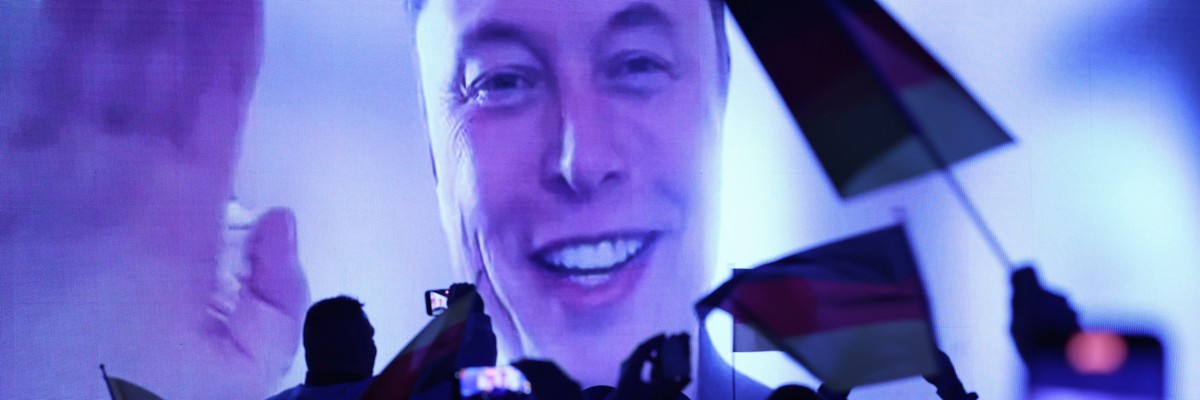
“I think you really are the best hope for Germany,” Elon Musk told the thousands attending the far-right Alternative for Germany party’s rally on January 25. France 24 English/YouTube

The tech billionaire is invigorating groups in the U.S. and Europe aiming to sabotage climate action, a DeSmog media analysis shows.

In December, a Chicago-based organization called the Heartland Institute, which for decades has attempted to undermine the scientific consensus on climate change, devoted an episode of its daily podcast to Elon Musk. 

As recently as 2022, Heartland figures had ridiculed the Tesla CEO as a member of the “billionaire climate elite” based on Musk’s claim that as a top manufacturer of electric vehicles, his company was “doing the most to solve climate change.”

But perhaps, the podcast guests speculated, Musk was finally “abandoning the climate cult.” 

The episode was recorded after Musk had given upwards of $277 million to get Donald Trump elected president, argued that “we don’t need to rush” on addressing climate change, and vowed to cut $2 trillion of federal government spending. One guest on the show was cautiously optimistic, saying: “I’m coming around on Musk.” 

Heartland, which didn’t respond to a request for comment, isn’t the only anti-climate group embracing Musk these days. 

DeSmog journalists in the European Union, the UK and the United States reviewed public materials from prominent climate deniers referencing Musk over recent months. Taken as a whole, these podcasts, opinion pieces, social media posts, newsletters, YouTube videos, and interviews with legacy media reveal an unmistakable trend: Musk’s public embrace of right-wing populists is invigorating a transatlantic movement aiming to spread doubt about the reality of climate change and sabotage action on the crisis.

His interventions ahead of Germany’s elections on Sunday have energized the far-right Alternative for Germany, or AfD, which says that climate policy “threatens our freedom,” a January poll suggests

His courtship, along with Trump, of hardline leaders in Europe threatens to torpedo hopes of progressive climate action by the EU, think tanks warn

And in the U.S., Musk’s ongoing war against the federal bureaucracy “erodes our collective ability to adapt to climate impacts,” Amanda Fencl, director of climate science for the nonprofit Union of Concerned Scientists, has warned.

Some longtime climate deniers are thrilled, however, recognising that even a brief endorsement from Musk to his 217.9 million followers on X — the social media platform formerly called Twitter, which he bought in 2022 — can confer instant visibility and excitement. 

“We welcome Elon Musk into the climate red pill group,” Climate Depot executive director Marc Morano stated in December, using a phrase popular among Trump supporters that refers to rejecting liberal viewpoints.  

Musk, contacted via Tesla, did not respond to a detailed list of questions about his shifting climate views.

‘Windmills of Shame’ 

When Germans vote for a new government on Sunday, the EU’s most populous country is widely predicted to shift to the right. Leading the polls at about 29 percent of voters is the centre-right Christian Democratic Union, or CDU, which intends to prioritise economic growth over accelerated climate measures endorsed by the ruling Greens and Social Democrats, or SPD.

Less certain is the influence that the surging far-right AfD will have on the next German government. On X, Musk has openly endorsed and platformed the party, which wants to ditch Germany’s climate commitments.

As migration and economic stagnation dominate German politics, the AfD is now polling close to 21 percent — potentially doubling the 10 percent of votes it won in the last national elections in 2021. The party states that the level of human contribution to global warming is “not scientifically proven,” and opposes state support for renewable energy and electrification of heat and transport, while advocating for Germany’s gas and coal power sectors.

The CDU says that it will not form a coalition government involving the AfD, and maintains its commitment to Germany’s 2045 net-zero emissions target. But despite its opposition status, the AfD is already shaping national political discourse — and even decision-making. 

While the CDU and Germany’s other mainstream parties have traditionally refused to vote with the AfD due to its extreme stances on immigration and Germany’s Nazi past, the CDU broke this so-called “firewall” last month by voting with the AfD on a resolution to restrict migration. 

Musk has sided with the AfD on its hard-line immigration stance and nationalist messaging. In December, Musk openly endorsed the party, shocking liberal Germans by writing on X that “only AfD can save Germany.” He went on to join a 9 January livestream with the AfD co-leader Alice Weidel, who has attracted controversy for Islamaphobic remarks, such as in a 2018 Bundestag speech when she said “burqas, headscarf girls, publicly-supported knifemen, and other ‘good-for-nothings’ will not secure our prosperity, economic growth, and the social state.” 
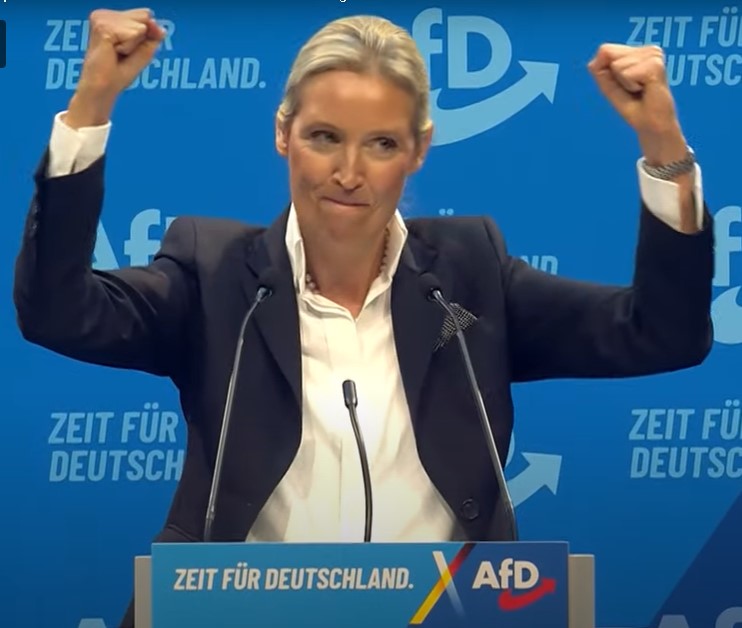
AfD co-leader Alice Weidel. Credit: France 24 English/YouTube

In terms of climate policy, Weidel has suggested that if the AfD takes power in Germany, it could dismantle wind turbines, recently calling them “windmills of shame,” The wind sector produced a third of the country’s electricity last year. 

During their conversation, both Musk and Weidel expressed support for nuclear power — with Musk also saying he was a “big fan” of solar energy — and Weidel stating that Germany’s CO2 footprint was “obnoxiously very very high.” Both steered clear of the AfD’s official climate-denialist party platform

Then, less than two weeks later, Musk sparked a global furore by raising his arm to the crowd at Trump’s January 20 inauguration in a gesture that many likened to a Nazi salute. The Amadeu Antonio Stiftung, a German organisation which advocates against right-wing extremism and anti-Semitism, saw no ambivalence in Musk’s move, describing it as a “Hitler salute.” Musk responded to the outpouring of criticism by posting on X: “The ‘everyone is Hitler’ attack is sooo tired.”

Five days after Trump was sworn-in, Musk ramped up his support for the AfD by addressing a party rally via videolink. He urged supporters to “take pride” in being German over “some sort of multiculturalism that dilutes everything”, and told them that there’s “too much of a focus on past guilt” — remarks condemned by Polish prime minister Donald Tusk. 

YouTube Influencer

Musk had previously enjoyed support from Germany’s centrist parties. When Tesla opened a multi-billion dollar electric car factory in the State of Brandenburg in 2022, the move was billed as a boost to both the country’s manufacturing sector and climate credentials. But during his January livestream with Weidel, Musk expressed his disdain for the bureaucratic procedures needed to build the Tesla factory, which he said amounted to “25,000 pages”.

Musk’s public support for the AfD can be traced back to his interactions with Naomi Seibt, a 24-year-old German influencer who built a sizeable social media following attacking “climate alarmism” and cultivating a brand as the anti-green doppelganger of Swedish climate activist Greta Thunberg. Her rise to prominence was aided by the Heartland Institute, which featured her in a YouTube video it published in February 2020. Seibt has since told Reuters that the organisation had paid her $4,000 a month for three months as a “scholarship.” (Seibt no longer appears to be affiliated with the group). 

German influencer Naomi Seibt appears on the Heartland Institute’s YouTube channel on February 11, 2020. Credit: Heartland Institute/YouTube

When Seibt posted on X last June that she’d voted for the AfD in the EU elections, which saw the formerly fringe party rise to 16 percent of the total vote — its best-ever result — Musk began sending her private messages asking for more information, according to Seibt. “And then he started following me,” Seibt told the BBC, noting that “it took him many months to decide to support the AfD.”

Musk’s backing could boost a party that’s heavily critical of the country’s decarbonization efforts. A January poll of German voters from the U.S.-based Democracy Institute think tank suggested that 28 percent of respondents say they are “more likely” to vote AfD due to Musk’s support, while 23 percent said it made their support “less likely.”

Germany’s center-right and center-left leadership have condemned Musks’s interventions. Friedrich Merz, head of the CDU, told The Wall Street Journal last week that Musk would face consequences for boosting the AfD. Chancellor Olaf Scholz, a member of the centre-left SPD, last month called Musk’s support for European far-right parties “disgusting.”   

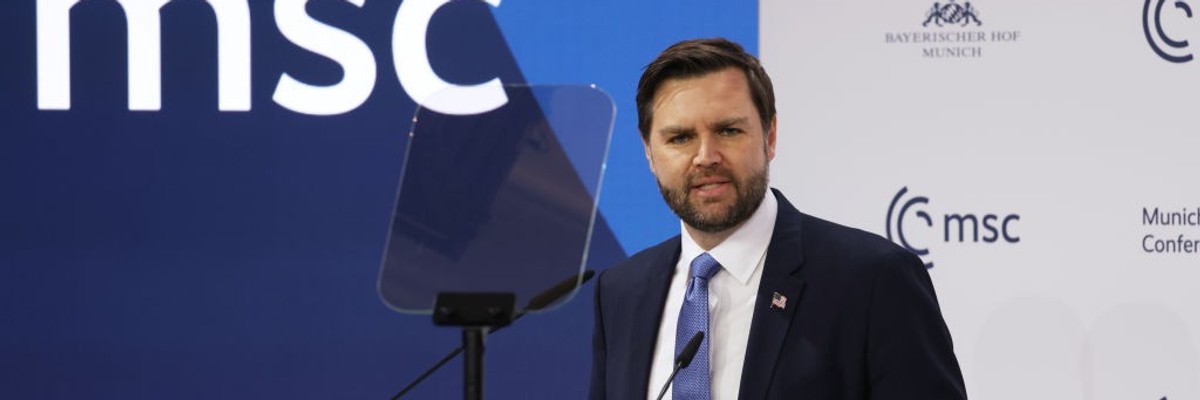
The new Trump administration is already mirroring the billionaire’s embrace of the AfD. Last week, U.S. Vice-President JD Vance met with Weidel, the AfD co-chief, on the sidelines of a security conference in Munich, while snubbing Scholz. 

With the U.S. playing a major role in German trade and security, this budding transatlantic alliance could bode poorly for climate action in Europe’s biggest economy.

Neither Seibt nor the AfD responded to questions.

Courting the European Far-Right

Musk’s electrifying impact on the AfD builds on his years of dabbling in far-right politics in other European countries. 

In December 2023, Musk appeared as a guest of honour at an annual convention in Rome hosted by the Brothers of Italy, the right-wing populist party of Italian Prime Minister Giorgia Meloniwho had said earlier that year that “ultra-ecological fanaticism” was an economic threat. 

Santiago Abascal, leader of Spain’s far-right Vox party, also attended the 2023 convention. He had recently predicted that Spanish citizens would hang their current Socialist Prime Minister, Pedro Sánchez, by his feet, remarks that were so controversial that some Brothers of Italy members asked for his invitation to be withdrawn, the Spanish newspaper El País reported.

But whereas Abascal’s presence threatened to create divisions at the event, “Elon Musk’s case is somewhat different, arousing only enthusiasm and selfie fervor,” noted El País. “The tycoon is nowadays the darling of almost all those on the ultra-right who seek media and economic backing, and a cutting-edge image.”

A month later, in January 2024, Musk again signalled his interest in European politics.

With German farmers protesting the end of government diesel fuel subsidies and a new tax on agricultural vehicles, Anthony Lee, who had stood for the European Parliament as a candidate for Free Voters, a German conservative populist party, gave an interview to right-wing Dutch influencer Eva Vlaardingerbroek. Lee told Vlaardingerbroek that politicians “want our land to build industry, houses. Houses for refugees, whoever, I don’t care what for.” 

After Musk reacted to the video on X, writing “Support the farmers!” Lee said in a video message that “I think it’s just awesome that Elon Musk himself tweeted this…This is only possible because we stand together.” The video was viewed over 200,000 times. Lee did not respond to a request for comment.

A year later, Musk was rubbing shoulders at Trump’s inauguration with a who’s-who of right-wing European politicians, including Spain’s Abascal, France’s Éric Zemmour and Reform UK leader Nigel Farage, all of whom have questioned the science and urgency of climate change. 

Analysts with the independent European Policy Center think tank in Brussels sees the inauguration guestlist as a worrying sign that Trump and Musk are helping strengthen “ideological ties between significant radical forces on both sides of the Atlantic.” They are concerned about the impact a second Trump administration may have on a host of EU-wide initiatives, including a raft of climate reforms known as the European Green Deal. 

“The most concerning possibility,” the analysts argue, is “Trump’s probable exploitation of far-right leaders or governments to block EU policies or advance his agenda.” 

Musk’s Shift to ‘Climate Skeptic’ 

For years, Musk enjoyed a reputation as a crusading green energy entrepreneur on a mission to render the internal combustion engine obsolete, celebrated by climate activists and cleantech investors alike — despite growing signs of his right-ward political leanings. As recently as last August, the online news outlet E&E News ran a story speculating that “Musk might be the only person Trump listens to on climate.”

But Musk’s politics and business interests seemed to decisively converge during a 2024 meeting of Tesla executives in Palo Alto, California, where he shelved plans to develop a more budget-friendly compact car that could be marketed to lower-income customers around the world, according to a report in the Washington Post. This had previously been a key part of Tesla’s plan to “accelerate the world’s transition to sustainable energy.” 

Instead, Musk approved a plan worth billions of dollars to purchase computer chips that could improve Tesla’s luxury vehicles, the Washington Post report said. Musk had shifted from calling for “a popular uprising” against the fossil fuel industry in 2016 to stating that there were more important global problems to address. 

In a livestream with Trump last year, Musk stated that ​​“we don’t need to rush” in fixing climate change.

This also happens to be the message of Bjørn Lomborg, a longtime Danish climate crisis denier (and apparent “friend” of Trump administration energy secretary Chris Wright) whose 2023 book Best Things First argued that there were more important global priorities to address than climate change. According to a recent edition of Lomborg’s newsletter, the Canadian conservative influencer Jordan Peterson shared a copy of Lomborg’s book with Musk in 2024.

Within U.S. denial networks, some leaders link Musk’s shift to the flourishing of anti-climate messages on Twitter after the billionaire purchased the platform, and renamed it X. “I mean, there are thousands, if not hundreds of thousands of climate skeptics on X/Twitter, and they’re constantly posting content that we put out here,” the Heartland Institute’s Anthony Watts argued on the group’s podcast. “Musk has had to have seen some of this stuff.”

Musk’s former critics in climate denial circles now see him as the best bet for implementing their most extreme ideas. Musk’s so-called Department of Government Efficiency has been attempting to shut down key climate-related agencies like the United States Agency for International Development, or USAID. 

On the website of the conservative group CFACT, prominent denier Paul Dreissen — who previously accused Musk of holding “sanctimonious” views on “the alleged climate crisis” — has offered policy suggestions to the billionaire as he wages war on the federal bureaucracy: End subsidies for renewable energy; terminate funding for environmental and climate justice programs; and require applicants for climate research funding to “provide computer codes and analyses so that reviewers can view and evaluate their work.”

Parts of Musk’s plan seem to rely on two recentpro-industry Supreme Court decisions to unwind regulatory authority long held by federal agencies — an overarching goal of the Heritage Foundation’s Project 2025 initiative, retooled with Musk’s Silicon Valley spin. 

If successful, these cuts will dismantle decades of clean air and water protections, and hamstring the country’s ability to respond proactively to the worsening climate crisis, said Fencl, the director of climate science at the Union of Concerned Scientists. 

Hurricane Helene made landfall in Florida in October 2024, but caused deadly and destructive flooding hundreds of miles from the coast due to extreme rain. At least 219 people died, and the damages are estimated at $78.7 billion. Credit: PBS NewsHour/YouTube.

“Our infrastructure systems are not going to withstand the climate impacts we’re expecting, and taking away the government’s spending in these spaces really erodes our collective ability to adapt to climate impacts,” Fencl said.

Raising the UK’s Political Temperature

Since throwing his fortune and social media influence behind Trump, Musk has teased the possibility of attempting a similar campaign in the UK.

In December, Musk met with Reform UK leader Farage, who also co-founded and formerly led the Brexit Party, at Trump’s Mar-a-Lago resort in Florida. 

The two were in talks about Musk offering a £100 million (over $125 million) donation to Reform, The Times of London reported. Farage has said he finds it “extraordinary that people call carbon dioxide a pollutant, and Reform UK’s latest party manifesto recycles a long-debunked claim that “scientists disagree as to how much” human activity is causing climate change. So such a donation would have been a major investment by Musk in transatlantic climate denial.

Then, in January, Musk used X to call for the release of Tommy Robinson, a far-right British influencer serving an 18-month contempt of court sentence for making false accusations about a Syrian schoolboy. When Farage rejected his calls to join forces with Robinson, Musk tweeted that, “the Reform Party needs a new leader. Farage doesn’t have what it takes.” 

Farage was not sufficiently swayed by Musk’s comments to support Robinson’s return, although he struck a conciliatory note by saying the tech mogul didn’t know “the full story” about the provocateur’s criminal past. By the end of January, Farage was signalling to the press that his rift with Musk was over, telling The New York Times that the billionaire was still open to donating to Reform UK. “We’ve got very similar goals on some areas, slightly different emphases in others,” Farage said, adding that Musk was sharing valuable information about how Trump won over swing voters during the U.S. election. 

Farage is also collaborating with the Heartland Institute, which has claimed credit for working with hard-right parties in Austria and Hungary to attempt to stall the EU’s Nature Restoration Law, which sets targets for restoring damaged ecosystems, as well as other green policies. Farage helped  launch the pro-Trump institute’s new UK-Europe branch in December.

Farage’s newly formed Reform UK won just five of the 650 seats in the lower house of parliament in last year’s elections, and  was unsuccessful  in generating a backlash against the country’s net-zero emissions goal. Nevertheless, the party appears to be pushing the historically weakened Tories to the right on climate change — echoing Farage’s previous strategy to rally support for the 2016 Brexit referendum. 

Regardless of how much tangible backing Musk might provide to right-wing figures in the UK, his winning bet on Trump, and assault on federal government spending, has inspired Farage and his allies with a sense of the possible. “There’s a heck of a lot we’ve learned from that we will implement over the next few years,” Farage told The New York Times.

Some European leaders are looking for ways to neutralize Musk’s efforts to sway voters. 

In January, as Musk posted false allegations that UK Prime Minister Kier Starmer had let child sex abusers escape justice, France called on the European Commission to take action against Musk and X for election interference. According to The Financial Times, Musk was also investigating how to get Starmer out of office before the country’s next election, and replace his center-left government with right-wingers.

Members of the European Parliament, who are elected representatives of their respective nations, are also criticizing the Commission for failing to use its authority under the EU’s Digital Services Act to investigate and fine Musk and X, as well as other major social media platforms, for spreading disinformation.

Asked about Musk’s tirade during a public event in January, Starmer did not name the billionaire directly in his response. “Those that are spreading lies and misinformation as far and as wide as possible, they’re not interested in victims,” said Starmer. “They’re interested in themselves.”

Additional reporting by Emily Gertz

Original article by Adam Barnett republished from DeSmog.

Nigel Farage explains the politics of Reform UK: Racism, Fake anti-establishmentism, Deregulation, Corporatism, Climate Change Denial, Mysogyny and Transphobia.
Elon Musk urges you to be a Fascist like him, says that you can ignore facts and reality then.
Continue ReadingElon Musk’s Embrace of Far-Right Energizes Transatlantic Climate Denial 

Vance Faces Backlash Over Embrace of Germany’s Far-Right Just Ahead of Election

Spread the love

Original article by Jake Johnson republished from Common Dreams under Creative Commons (CC BY-NC-ND 3.0). 

U.S. Vice President JD Vance speaks at the Munich Security Conference on February 14, 2025. (Photo: Sean Gallup/Getty Images)

Rebuking the U.S. vice president, German Chancellor Olaf Scholz said that “a commitment to ‘never again’ is not reconcilable with support for the AfD.”

U.S. Vice President JD Vance faced growing backlash on Saturday after scolding the European political establishment for shunning far-right parties and subsequently meeting with the leader of the neo-Nazi Alternative for Germany, just a week ahead of the country’s general election.

While Vance did not explicitly mention Alternative for Germany, or AfD, during his remarks Friday at the Munich Security Conference, he declared that “there is no room for firewalls”—a reference to mainstream German political parties’ refusal to work with AfD or include it in governing coalitions.

The Guardianreported that “a whisper of ‘Jesus Christ’ and the squirming in chairs could be heard in an overflow room” during the U.S. vice president’s remarks, which he delivered a week after hundreds of thousands took to the streets of Munich to protest far-right extremism.

Following his speech, Vance met with AfD leader Alice Weidel, who praised the vice president’s Munich address as “excellent” in a post on X—a social media platform owned by billionaire Elon Musk, who has also expressed support for AfD as he works to dismantle agencies throughout the U.S. government.

Reutersreported that Weidel—whose grandfather was a Nazi judge appointed directly by Adolf Hitler—met with Vance at his hotel “for about 30 minutes and discussed the Ukraine war, German domestic policy, and freedom of speech.”

Vance was the highest-ranking U.S. official to ever meet with the leader of the AfD, which is seen as the most extreme of Europe’s far-right parties.

On Saturday, German Chancellor Olaf Scholz rebuked Vance and said that “we will not accept outsiders intervening in our democracy,” even “friends and allies.”

“Never again fascism, never again racism, never again aggressive war,” Scholz said in his speech at the Munich Security Conference. “That is why an overwhelming majority in our country opposes anyone who glorifies or justifies criminal National Socialism.”

“A commitment to ‘never again’ is not reconcilable with support for the AfD,” said Scholz.

Original article by Jake Johnson republished from Common Dreams under Creative Commons (CC BY-NC-ND 3.0). 

Elon Musk urges you to be a Fascist like him, says that you can ignore facts and reality then.
Climate Science Denier Donald Trump says Burn, Baby, Burn.
Continue ReadingVance Faces Backlash Over Embrace of Germany’s Far-Right Just Ahead of Election

The far-right is rising at a crucial time in Germany, boosted by Elon Musk

Spread the love
Sebastian Willnow/dpa/AP

Matt Fitzpatrick, Flinders University

With only a few weeks until Germany’s election, Elon Musk has unambiguously thrown his support behind the far-right Alternative for Germany (AfD) party. In a video address to a party rally last week, he appeared to urge Germans to “move on” from any “past guilt” related to the Holocaust.

It’s good to be proud of German culture, German values, and not to lose that in some sort of multiculturalism that dilutes everything.

Troublingly, the AfD is now firmly entrenched as Germany’s second-most popular political party, behind the centre-right Christian Democratic Union (CDU). Like all parties in German elections, however, it cannot win an outright majority. It is also unlikely to be invited to join any ruling coalition that emerges from the February 23 election.

But the AfD’s anti-migrant, anti-government sloganeering has already seriously distorted Germany’s public debate and democratic culture, leaving many to ask whether it even needs to win elections to see its policies implemented.

This was evident following a dramatic week in Germany’s Bundestag.

First, in a radical break with Germany’s political norms, opposition leader Friedrich Merz deliberately drew on the votes of the AfD on Wednesday to ram a radical anti-asylum seeker motion through the parliament.

It was the first time in the history of the Bundestag that a parliamentary majority was reached with the help of the far right. Merz’s action was widely condemned as a “taboo-breaking” step towards legitimising the AfD.

The so-called ‘firewall’ was broken this week between mainstream German political parties and the far right. Clemens Bilan/EPA

Merz tried to take this a step further with a far-reaching bill to tighten immigration controls on Friday. Although the bill narrowly failed, all of the AfD voted with Merz. Twelve members of his own CDU party refused to back him.

Merz’s courting of the far right is widely seen as politically unnecessary, given his conservative CDU is already leading the national polls, making him the favourite to succeed the Social Democratic Party (SDP)‘s Olaf Scholz as chancellor.

This raises a couple crucial questions heading into the election. Is it insiders or outsiders that are playing the biggest role in bringing the far right into the mainstream? And just how big a role will the AfD play after the election?

The Musk effect

Musk’s embrace of the AfD should come as no surprise, given the integral part he played in Donald Trump’s election victory in the United States. In the German context, however, his behaviour and statements have taken on darker hues.

Germans know only too well what is at stake when democracy is eroded by those who abuse its freedoms to attack it. Had Musk’s now notorious Nazi salutes following Trump’s inauguration been performed in Berlin, for example, he might have faced up to three years in prison.

The catchphrase “never again” has underpinned German politics since the second world war. Yet, the response to Musk’s recent provocations was oddly muted in some sections of the German media.

The German tabloid Bild made embarrassing excuses for his Hitlerian salute, while others spoke vaguely of a “questionable gesture”.

With a few notable exceptions, it was left to activists to remind Germans of the severity of this gesture – projecting an image of Musk’s salute on a German Tesla plant, alongside the word “heil”.

Given the seriousness with which Germany patrols representations of its Nazi past, it was surprising just how few journalists were prepared to state without equivocation that “a Hitler salute is a Hitler salute is a Hitler salute”.

Merz’s embrace of the far right

Initially, there were some signs Germany’s main political leaders would decry Musk’s attempts to normalise far-right politics in the country.

When Musk called the AfD the “last spark of hope” in December, both Scholz and Merz quickly condemned his meddling.

Scholz has continued to label Musk’s blatant attempts to influence German politics as “unacceptable” and “disgusting”.

Merz claims to be keeping his distance from Musk. But it appears his strategy for winning the election is not far from what Musk is suggesting – mimicking AfD policies and collaborating with the party on anti-immigration votes.

https://twitter.com/KALTBLUTMAG/status/1883223893860860032?ref_src=twsrc%5Etfw%7Ctwcamp%5Etweetembed%7Ctwterm%5E1883223893860860032%7Ctwgr%5E0df8df75beda3443f02034e8f5cf913cd258b528%7Ctwcon%5Es1_c10&ref_url=https%3A%2F%2Ftheconversation.com%2Fthe-far-right-is-rising-at-a-crucial-time-in-germany-boosted-by-elon-musk-247895

In his most radical break with the centrism that characterised the CDU under former Chancellor Angela Merkel, Merz cracked the “firewall” against working with the far-right this week. Knowing just what it meant, he used the AfD’s support to pass the starkly worded nationalist border protection motion in the Bundestag.

The AfD publicly celebrated their good fortune, calling it a “historic day for Germany”.

Democratic party leaders, meanwhile, registered their shock and dismay. Merkel herself spoke out against Merz, saying it was “wrong” to “knowingly” work with the AfD.

Her intervention appears to have been critical to the immigration bill failing on Friday, with many of her former supporters in the CDU withholding their votes.

A defaced election poster for the Christian Democratic Union (CDU) showing leader Friedrich Merz smeared with a Hitler moustache. Martin Meissner/AP

What AfD’s rise could mean

Given the two votes in the past week and Musk’s high-profile intervention, many in Germany now fear a CDU victory in the election could signal more collaboration with the AfD.

The Left Party has denounced Merz as an AfD puppet and demanded Musk be forbidden from entering Germany.

The Greens’ Robert Habeck, Germany’s vice chancellor, has said Merz’s nationalist coalition would “destroy Europe”. He has also warned Musk to keep his “hands off our democracy”, prompting Musk to label Habeck “a traitor to the German people”.

People attend the election campaign launch of the Alternative for Germany (AfD) party on Jan. 25. Hannibal Hanschke/EPA

Musk is by no means the cause of the AfD’s popularity, but his embrace of the extremist party has given it a global profile and credibility in circles that might not have otherwise considered supporting it.

Musk has been a controversial figure in Germany ever since his Tesla “gigafactory” arrived in Brandenburg and was promptly accused of felling 500,000 trees and irreparably damaging precious groundwater reserves. Accusations of Tesla breaching German labour laws and even conducting surprise checks on sick workers have also not endeared him to progressive Germans.

As some commentators have suggested, it is probably not coincidental the AfD’s plans for the German economy would benefit Musk’s business interests. Economic self-interest alone seems insufficient, however, to explain why Musk has gravitated to the extreme right.

The same might be said of Merz. Electoral calculations alone cannot explain his risky courting of the far right. He has long been the frontrunner to win the next election. Cosying up to the AfD will only make it harder to form a coalition with either Scholz’s Social Democratic Party or the Greens.

If these two parties refuse to deal with Merz, the only other bloc large enough to deliver his party control of the government would be the AfD. Would he go so far?

Whether it is formally part of the next government or not, the AfD and its camp followers (such as Musk) could be set to have a much bigger influence on German politics. How this will change Germany in the long term remains to be seen.

Matt Fitzpatrick, Professor in International History, Flinders University

This article is republished from The Conversation under a Creative Commons license. Read the original article.

Elon Musk urges you to be a Fascist like him, says that you can ignore facts
and reality then.
Elon Musk urges you to be a Fascist like him, says that you can ignore facts and reality then.

What happened in the German parliament and why is the far right hailing it as a ‘historic’ moment?

Why Trump’s meme coin is a cash grab

Argentina’s president is vowing to repeal ‘woke’ femicide law. It could have ripple effects across Latin America

‘Aliens’ and ‘animals’ – language of hate used by Trump and others can be part of a violent design

Continue ReadingThe far-right is rising at a crucial time in Germany, boosted by Elon Musk

Elon Musk Expresses Support for Germany’s Far-Right AfD Party—Again

Spread the love

Original article by Eloise Goldsmith republished from Common Dreams under Creative Commons (CC BY-NC-ND 3.0). 

Tech billionaire Elon Musk speaks live via a video transmission during the election campaign launch rally of the far-right Alternative for Germany (AfD) political party as AfD supporters wave German flags on January 25, 2025 in Halle, Germany. (Photo by Sean Gallup/Getty Images)

“All the people who were shrugging and equivocating over Elon and whether he was aligning with Nazi, far-right forces should be launched into the sun,” wrote one observer.

Billionaire Elon Musk made virtual appearance at a Saturday campaign event for the far-right Alternative for Germany party—known by the initials AfD—ahead of a snap federal election in Germany next month. The campaign appearance comes less than a week after Musk was accused of performing a Nazi salute twice on stage at a post-inauguration celebration for U.S. President Donal Trump.

“A nazi speaking at a nazi rally. It’s really not deeper than that,” wrote the independent journalist Marisa Kabas on Saturday.

Musk has endorsed the AfD, known for it’s strong anti-immigrant stance, and earlier this month hosted AfD co-leader Alice Weidel—who was also at Saturday’s campaign event—for an interview on his platform X. Members of the AfD have been accused of downplaying the crimes of Nazi Germany and using Nazi slogans.

Musk told onlookers at the event, which took place in Halle, that he thinks AfD is the best hope for Germany and said that it’s good to be proud of German culture, according to Reuters andThe Guardian.

“It’s good to be proud of German culture, German values, and not to lose that in some sort of multiculturalism that dilutes everything,” Musk said, according to Reuters, addressing the crowd via a live video.

“Children should not be guilty of the sins of their parents, let alone their great grandparents,” Musk also said, which, per Reuters, apparently referred to Germany’s Nazi past.

Musk’s “Nazi-like salutes” earlier this week drew sharp rebuke from some, but not all. The Anti-Defamation League, an organization whose mission is to combat antisemitism, called the move “an awkward gesture” and “not a Nazi salute.”

For his part, Musk wrote on X that the reaction was an example of Democratic “dirty tricks.” He also said that “the ‘everyone is Hitler’ attack is sooo tired.”

Washington Post columnist Karen Attiah, reacting to the news of Musk’s appearance at the rally, wrote that “all the people who were shrugging and equivocating over Elon and whether he was aligning with Nazi, far-right forces should be launched into the sun. May they never be taken seriously again.”

Original article by Eloise Goldsmith republished from Common Dreams under Creative Commons (CC BY-NC-ND 3.0). 

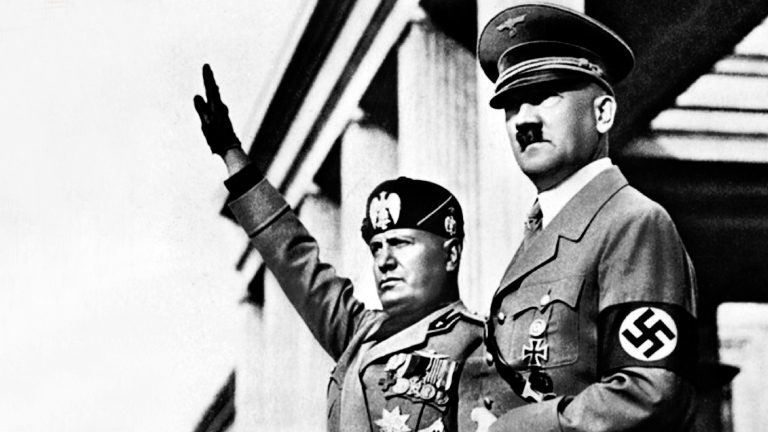
Image of Fascists Mussolini and Hitler
Fascists Mussolini and Hitler
Continue ReadingElon Musk Expresses Support for Germany’s Far-Right AfD Party—Again

Morning Star Editorial: Return to the real history and real lessons of the Holocaust

Spread the love

https://morningstaronline.co.uk/article/return-real-history-and-real-lessons-holocaust While the Morning Star’s copyright on this article is respected, I hope that they will excuse me fully quoting it.

Nazi soldiers separate Hungarian Jews on the ramp at Auschwitz-II-Birkenau in German-occupied Poland, May/June 1944, during the final phase of the Holocaust

HOLOCAUST Memorial Day, the anniversary of the liberation of the Nazis’ Auschwitz death camp by the Red Army, is one of the most solemn days in the labour movement calendar.

The industrialised effort to exterminate Europe’s Jews, Roma and Sinti, alongside others the fascists deemed unworthy of life like gay, disabled or mentally ill people, remains the most systematic and calculated genocide in history. It must never be denied or downplayed.

Yet the meaning of Holocaust Memorial Day is increasingly obscured. Partly this is due to the rewriting of history.

Holocaust relativism presents the Nazis’ programme of racist mass murder as just one among many crimes of “totalitarianism,” postulating a false equivalence between Nazi Germany and the country which played the biggest part in its defeat, the Soviet Union.

The result is an equivocation between those who ran the death camps and those who liberated them — something masked in much British media discourse by referring vaguely to Auschwitz’s liberation by “the Allies” rather than the Soviets.

This has already regressed in some quarters into implied support for the Nazis or their local auxiliaries as anti-Russian freedom fighters, as we saw when a Ukrainian Waffen-SS veteran was applauded by MPs in the Canadian parliament, or when Estonia’s Foreign Ministry posted tweets denouncing the 80th anniversary of the Soviet assault on Tallinn, not mentioning the context that Tallinn was under Nazi occupation. Calling out such distortions of history should not, of course, blind us to the manipulation of the memory of the second world war by the present Russian government for its own purposes either.

The removal of context allows the memory of the Holocaust to be deployed cynically by Britain’s rulers too.

The UN resolution establishing Holocaust Memorial Day is clear that its message is a universal one: “The Holocaust, which resulted in the murder of one third of the Jewish people, along with countless members of other minorities, will forever be a warning… of the dangers of hatred, bigotry, racism and prejudice.” It also “condemns without reserve all manifestations of religious intolerance, incitement, harassment or violence against persons or communities based on ethnic origin or religious belief.”

This text calls on us to apply the lessons of the Holocaust to all instances of racist persecution and all genocides.

It is disregarded by a British government which will not call out the Islamophobia of the far-right rioters who attacked mosques last summer, and which has been complicit in an assault on the people of Gaza recognised as a genocide by Amnesty International and Human Rights Watch, and as plausibly amounting to one by the International Court of Justice.

Indeed, the memory of the Holocaust is misused to shield the state of Israel from accountability for its acts of war and ethnic cleansing, and it will be interesting to see which British politicians have the courage to condemn Donald Trump’s call this weekend to “clean out” “probably a million-and-a-half people” from Gaza to facilitate its colonisation by Israel.

So far removed are some self-appointed authorities from the reality of the Holocaust as a product of fascism and war that the Anti-Defamation League, quick to accuse Palestine solidarity campaigners of anti-semitism, could only admit to an “awkward hand gesture” when confronted by evidence of a fascist salute by Trump ally and tech tycoon Elon Musk.

Both anti-semitic and Islamophobic hate crimes are on the rise. Confronting that means returning to the real lessons of the Holocaust, as thousands will do at local trade union and political meetings this week, though our government will not.

That does not mean depoliticising it. The Holocaust was political, emerging from the ideology of fascism. When we say “never again,” we must commit ourselves to anti-fascism — which is sadly once again an urgent political cause.

https://morningstaronline.co.uk/article/return-real-history-and-real-lessons-holocaust While the Morning Star’s copyright on this article is respected, I hope that they will excuse me fully quoting it.

Elon Musk urges you to be a Fascist like him, says that you can ignore facts and reality then.

dizzy: While Musk is correct that Germans should not feel guilt about their ancestors’ actions that’s not reason to erase history, to ignore facts and reality. He is a Neo-Fascist supporting Neo-Fascism.

Elon Musk Expresses Support for Germany’s Far-Right AfD Party—Again

Continue ReadingMorning Star Editorial: Return to the real history and real lessons of the Holocaust