This work by Middle East Monitor is licensed under a Creative Commons Attribution-NonCommercial-ShareAlike 4.0 International License.
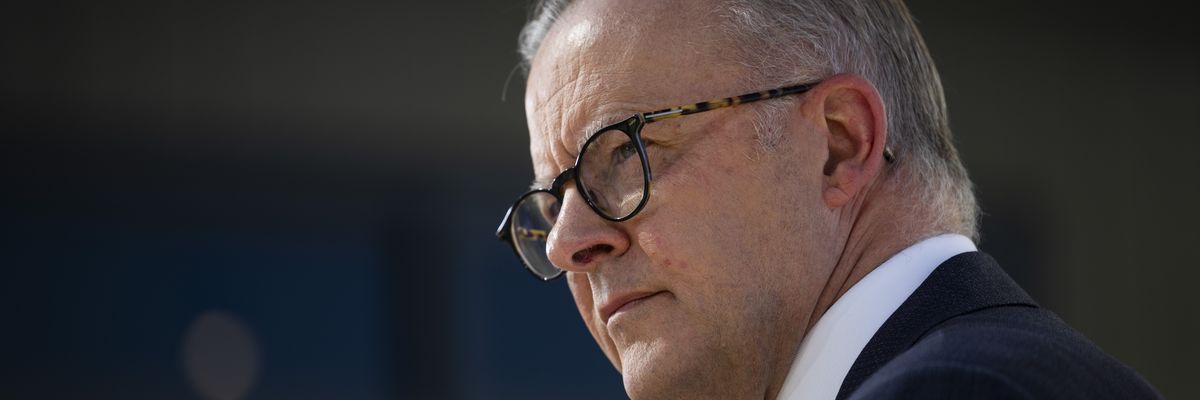
Anthony Albanese, Australia’s prime minister, during an address at the National Press Club in Canberra, Australia, on Tuesday, June 10, 2025. [Hilary Wardhaugh/Bloomberg/Getty Images]
Australian Prime Minister Anthony Albanese has rejected claims by Israeli Prime Minister Benjamin Netanyahu that Australia’s recognition of a Palestinian state was linked to the deadly armed attack in Sydney’s Bondi district.
Speaking in an interview with the Australian Broadcasting Corporation (ABC), Albanese said such assertions were unfounded and risked politicising a tragic act of violence. He stressed the importance of relying on verified facts and avoiding inflammatory narratives while authorities continue their investigation.
Australian Prime Minister Anthony Albanese visited Ahmed al-Ahmad, a Syrian man who disarmed a gunman during a shooting at Sydney’s Bondi Beach, at the hospital where he is being treated on Tuesday, Dec. 16, Anadolu reports.
“The fight against terrorism must not be exploited for political purposes,” Albanese said, adding that drawing connections between foreign policy decisions and domestic acts of violence was “unacceptable”.
The Australian prime minister warned that the simultaneous rise of antisemitism and far-right extremism posed a serious threat to social cohesion in Australia. He said the government’s responsibility was to unite the country and confront ideologies that fuel hatred and division.
Albanese also emphasised the need to support the entire Australian Jewish community, not only those directly affected by the attack, and to ensure that communal tensions were not inflamed by misleading claims.
His remarks came in response to comments by Netanyahu, who accused the Australian government of “pouring fuel on the fire of antisemitism” by supporting recognition of a Palestinian state. Netanyahu suggested that such policies encouraged hostility towards Jewish communities.
Albanese firmly rejected this characterisation, saying that counter-terrorism efforts required serious security coordination and legislative action, rather than political rhetoric. He added that Australia’s position on Palestinian statehood was grounded in international law and long-standing diplomatic principles, and should not be conflated with acts of violence carried out by individuals.
The Bondi attack left at least 15 people dead and more than 40 injured, prompting renewed debate in Australia over public safety, extremism and the responsibilities of political leaders during periods of national trauma.
This work by Middle East Monitor is licensed under a Creative Commons Attribution-NonCommercial-ShareAlike 4.0 International License.
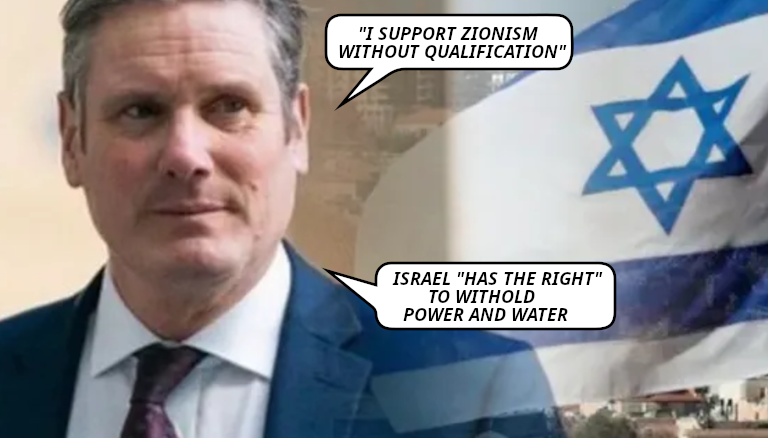
Orcas discuss Genocide-supporting and complicit Zionists. Donald Trump, Keith Starmer, David Lammy, Rachel Reeves, Angela Rayner and Wes Streeting are acknowledged as evil genocide-complicit and supporting cnuts.Keir Starmer objects to criticism of the IDF. He asks how could anyone object to them starving people to death, forced marches like the Nazis did, bombing Gaza’s hospitals and universities, mass-murdering journalists, healthworkers and starving people queuing for food, killing and raping prisoners and murdering children. He calls for people to stop obstructing his genocide for Israel.Orcas discuss Donald Trump and the killer apes’ concept of democracy. Front Orca warns that Trump is crashing his country’s economy and that everything he does he does for the fantastically wealthy.
Today, in a surprise development likely weeks in the planning, WikiLeaks founder Julian Assange was able to leave the United Kingdom for the first time in more than a decade after reaching a plea deal with the US government.
In the past several months, momentum has been building towards this moment. There was increasing bipartisan support in both the Australian parliament and the US Congress for the Australian citizen’s release. Australian Prime Minister Anthony Albanese has made repeated statements on his behalf, and in April, US President Joe Biden said he was “considering” a request from Australia to drop its prosecution of Assange.
This all contributed to the sense the matter might be resolved before Assange’s final UK hearing date, previously scheduled for July 9 and 10. The timing of the deal is also a welcome prelude to Albanese’s visit to Washington next week.
Such a resolution, however, was not inevitable. And it is not over yet.
A relentless, years-long pursuit
The United States’ pursuit of Assange has seemingly been relentless since WikiLeaks posted hundreds of thousands of classified military documents in 2010. It wasn’t until 2019 under the then President Donald Trump, however, that he was finally indicted on 17 counts of violating the 1917 Espionage Act.
The charges against Assange were not just considered unprecedented, they raised significant First Amendment concerns.
The apparent desire to punish Assange for the embarrassment caused by the leaks – and to deter others from taking similar action – was apparently so strong the CIA allegedly discussed plans to kidnap and even assassinate Assange during the Trump administration, according to US media reports.
In the UK courts, the US Department of Justice had argued Assange should be subject to US law and extradited to face trial for his actions. However, as a non-citizen, there were questions over whether he could rely on the legal protections afforded by those same laws – particularly the constitutional right to free speech.
The successful extradition of Assange could have set a precedent by which the US could pursue journalists anywhere in the world for publishing information it did not like, while potentially denying them their fundamental First Amendment rights.
In a crucial election year in the US that President Joe Biden is framing as an existential fight for the soul of US democracy, the continued pursuit of Assange was as inconsistent as it was ultimately untenable. Viewed from the outside, it appeared the case was causing the Biden administration international embarrassment.
Biden has been careful to maintain an appropriate distance between the presidency and the Department of Justice. He came into office promising to restore faith in the rule of law following the Trump years, and has meticulously avoided any appearance of interference in the department’s work as it has investigated and indicted his predecessor.
Assange’s case, however, is wholly different to the charges on which Trump has been indicted. It is certainly possible to interpret Biden’s comment that he was “considering” dropping the charges as a gentle public rebuke of the Department of Justice’s pursuit of the case, given its global implications for a free press.
Broader implications for the alliance
The continued pursuit of Assange was also becoming problematic in the context of Australia’s alliance with the US. That relationship is always described as one based on shared democratic values, in contrast to what Biden has repeatedly framed as the coercive and repressive instincts of “authoritarian” powers.
The decision by the US to pursue a citizen of one of its closest allies for the publication of information, while simultaneously condemning authoritarian states for doing much the same, was both hypocritical and damaging to American standing in the world.
In the context of growing concern in Australia about the terms of the AUKUS submarine deal and the Australian government’s willingness to go “all-in” with the US militarily, the continued pursuit of Assange gave the impression that Australia’s most important security ally did not take its concerns seriously. Australia appeared simply to be snapping at America’s heels.
It also added to the sense that the “capital-A Alliance” between the two countries was increasingly dominated by security concerns, often at the expense of democratic accountability.
Because of the international campaign to free Assange and the support it received in both Australian and American democratic institutions, there appears to be have been a reconsideration of this focus on security interests over democratic values.
It should be noted, though, that the US didn’t drop its prosecution in the end; Assange has agreed to plead guilty to a felony charge of violating the Espionage Act, which in itself may set a concerning precedent for press freedom.
And the fact this saga happened at all – and that it has taken more than a decade to get close to resolution – should prompt deep reflection on the values that underpin both Australia’s relationship with its most important security ally and the United States’ role in the world.
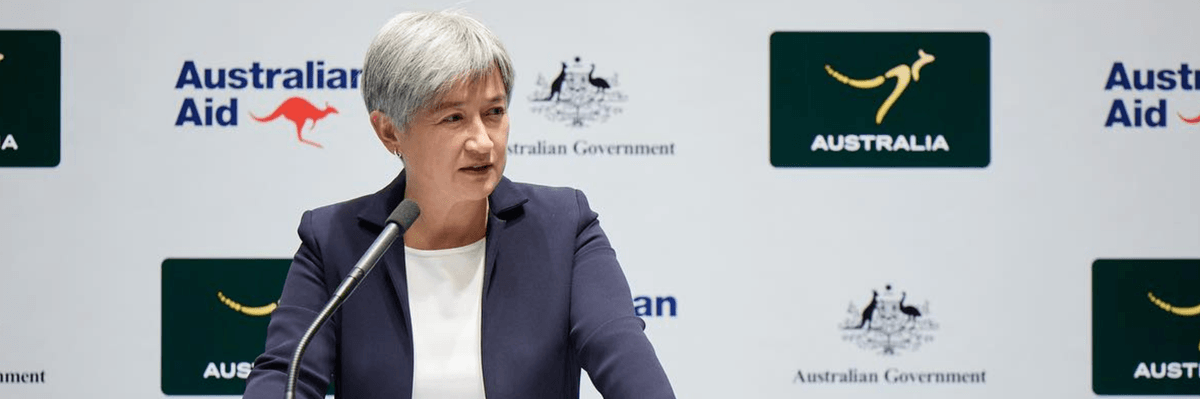
Australian Foreign Minister Penny Wong speaks in Canberra on August 8, 2023. (Photo: Penny Wong/Facebook)
“Restoring UNRWA funding is the bare minimum,” said one Australian Green senator. “The Labor government must publicly pressure Israel to allow aid into all parts of Gaza.”
Australia said Friday that it would reinstate funding for the United Nations United Relief and Works Agency for Palestine Refugees in the Near East, which has lost hundreds of millions of dollars in international financing due to unsubstantiated Israeli claims that UNRWA staff participated in the October 7 Hamas-led attacks on Israel.
“The best available current advice from agencies and the Australian government lawyers is that UNRWA is not a terrorist organization,” Australian Foreign Minister Penny Wong said in Adelaide while announcing a new funding package for the agency, which works to aid Palestinians forcibly displaced during the Nakba, or “catastrophe” through which the modern state of Israel was established in 1948, as well as their descendants.
Australia is lifting the pause on funding for UNRWA following steps to strengthen the integrity of UNRWA operations. pic.twitter.com/RD5FhRH7B2
In addition to restoring $6 million in UNRWA funding, Wong said Australia would contribute another $2 million to the United Nations Children’s Fund and would deploy a C-17 Globemaster transport plane to assist humanitarian airdrops over Gaza.
Sen. Mehreen Faruqi of New South Wales and the Australian Greens welcomed the shift, asserting that “restoring UNRWA funding is the bare minimum” Australia should do.
“The Labor government must publicly pressure Israel to allow aid into all parts of Gaza,” Faruqi stressed. “Starvation is a weapon of war, and Israel is blocking aid to reach the people of Gaza in brazen contravention of the [International Court of Justice’s] ruling” ordering Israel to prevent genocidal acts.
“I hope this is the start of the Labor government breaking away from their unquestioning and immoral support for Israel,” the senator added.
Imagine basically stealing food from starving people, then months later giving it back and expecting gratitude.
Simon Birmingham, leader of the center-right Liberal opposition in the Senate, said his party does not support the Labor government of Prime Minister Anthony Albanese “acting without and ahead of the United States in terms of decisions around this funding.”
Following Israeli claims—reportedly extracted from Palestinian prisoners in an interrogation regime rife with torture and abuse—that 12 of the more than 13,000 UNRWA workers in Gaza were involved in the October 7 attack, Australia and nine other nations including the United States cut off funding to the largest humanitarian aid organization operating in the besieged coastal enclave.
UNRWA subsequently terminated nine employees in response to the unfounded Israeli claims, without any evidence to support their firing. UNRWA Commissioner-General Philippe Lazzarini later called the move an act of “reverse due process.”
Thank you #Australia for joining donor countries who have maintained/increased their funding and those who have recently announced their contribution to @UNRWA at this critical time in #Gaza and the region.
Your support is testament to your commitment to humanitarian principles…
The European Union and nations including Canada and Sweden have also reinstated funding for UNRWA, which Lazzarini said “is facing a deliberate and concerted campaign to undermine its operations.” The agency has been struggling to provide shelter, aid, and other lifesaving services to Gazans facing not only Israeli bombs and bullets but also a genocidal siege and blockade that are starving Palestinians to death.
Australia’s decision came as Israeli attacks on aid convoys, food distribution centers, and desperate, starving Palestinians in Gaza continued. On Thursday, Israeli forces killed at least 20 people and wounded more than 150 others as they awaited delivery of humanitarian aid at the Kuwait Roundabout in Gaza City. The previous day, a UNRWA staffer was among five people killed and more than 20 wounded in an attack on a food distribution center in Rafah, Gaza’s southernmost city. Israeli officials claimed the slain man was a Hamas commander.
According to UNRWA, at least 165 of the agency’s staff members have been killed since October 7. Over 150 UNRWA facilities have been attacked by Israeli forces, while more than 400 Palestinians have been slain while seeking shelter under the United Nations flag.
UNRWA also says its workers have been tortured by Israeli troops trying to force them to falsely confess to participating in the October 7 attacks.
Gaza officials said earlier this week that at least 400 Palestinians seeking humanitarian aid have been killed by Israeli forces since the February 29 “Flour Massacre,” in which at least 118 people were killed and more than 760 others wounded while waiting for an aid convoy in Gaza City.
More than 112,000 Palestinians have been killed or wounded in Gaza since October 7, including people missing and presumed dead and buried beneath the rubble of the strip’s hundreds of thousands of bombed-out buildings. The majority of the dead are women and children. Around 90% of Gaza’s 2.3 million people have been forcibly displaced. Disease and starvation are rampant, and a growing number of Palestinians—mostly children but also elders and other vulnerable people—are starving to death.
After 161 days of near-constant slaughter, there is still no cease-fire in sight.
Australian Prime Minister Anthony Albanese speaks during a press conference on February 20, 2024 in Perth, Australia. (Photo: Matt Jelonek/Getty Images)
More than 100 lawyers endorsed the referral, which points to the military, intelligence, and rhetorical support Prime Minister Anthony Albanese has provided to the Israeli government.
Australian Prime Minister Anthony Albanese is one of several Western leaders who have provided political and material support of the Israeli government and military over the past five months as their bombardment of Gaza has killed more than 30,000 people, but on Monday he became the first to be referred to the International Criminal Court for being an “accessory to genocide.”
More than 100 lawyers supported the referral under Article 15 of the Rome Statute, arguing that Albanese, a member of the Labor Party, as well as members of his Cabinet and of Parliament, have provided Israel with “rhetorical support in their public statements, their press conferences, their speeches” as well as material assistance, as attorney Sheryn Omeri told ABC‘s “News Breakfast.”
Omeri said the aid Australia has “most particularly” provided since Israel began attacking Gaza has been the export of F-35 fighter jet parts as well as military intelligence through the government’s surveillance work at Joint Defense Facility Pine Gap in Australia’s Northern Territory.
While Albanese has recently called on Israel to respect international law, said Omeri, “it’s been months since the 7th of October, 2023, and between then and now there has been very little in the way of urging restraint on Israel and discouraging what the International Court of Justice found on the 26th of January was a plausible case of genocide.”
The 92-page document compiled by the legal team lays out a number of specific ways Albanese and other Australian officials have acted as an accessory to genocide, including:
Freezing $6 million in funding to the United Nations Relief and Works Agency for Palestine Refugees in the Near East amid a humanitarian crisis based on unsubstantiated claims by Israel;
Providing military aid and approving defence exports to Israel, which could be used by the Israel Defense Forces (IDF) in the course of the prima facie commission of genocide and crimes against humanity;
Ambiguously deploying an Australian military contingent to the region, where its location and exact role have not been disclosed; and
Permitting Australians, either explicitly or implicitly, to travel to Israel to join the IDF and take part in its attacks on Gaza.
“The Rome Statute provides four modes of individual criminal responsibility, two of which are accessorial,” Omeri explained in a statement.
Along with Albanese, U.S. President Joe Biden, British Prime Minister Rishi Sunak, and German Chancellor Olaf Scholz are among the Western leaders who have repeatedly defended Israel’s actions in Gaza—despite the genocidal intent expressed in numerous public statements by Israeli leaders.
Biden was sued in federal court in January for alleged “complicity in the Israeli government’s unfolding genocide.” That case is still making its way through the U.S. appeals process.
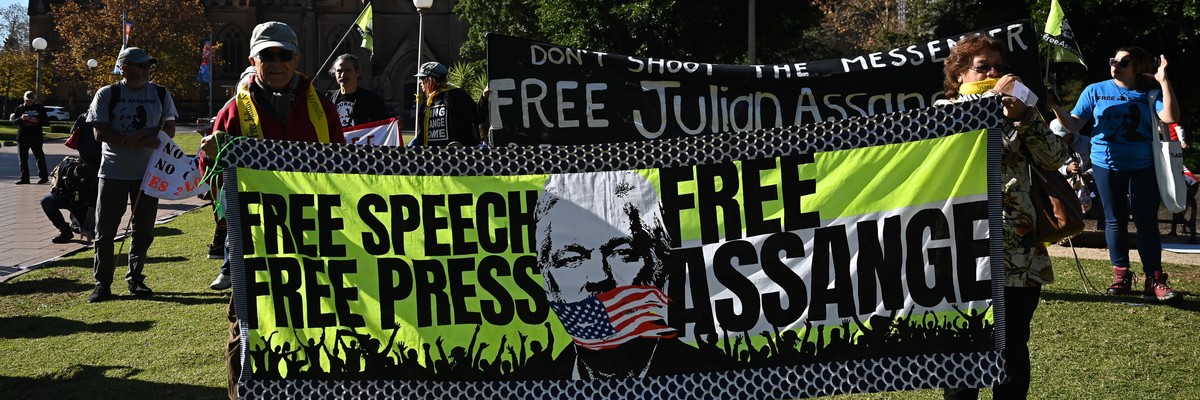
People participate in a rally demanding freedom for imprisoned WikiLeaks founder Julian Assange in Sydney, Australia, on May 24, 2023. (Photo: Steven Saphore/Anadolu Agency via Getty Images)
U.S. and U.K. persecution of Assange has been continuous and severe.
Australian Prime Minister Anthony Albanese said during Prime Minister’s Questions on February 15, “This thing cannot just go on and on and on, indefinitely.”
The Prime Minister was addressing an action he took a day earlier, on Valentine’s Day. No, not his marriage proposal to his partner, Jodie Haydon (she said yes). He was explaining his support for a parliamentary motion that passed overwhelmingly, calling for the release of an Australian citizen, imprisoned WikiLeaks founder Julian Assange.
Albanese’s support builds on a growing demand from Australians across the political spectrum that the United Kingdom not extradite Assange to the United States, and for the U.S. to drop its espionage and hacking charges against him. Assange, who has been imprisoned in London’s notorious maximum-security Belmarsh Prison since 2019, has a court hearing in the UK.
Assange’s counsel, Jennifer Robinson, texted us on Thursday:
“The appeal next week could be Julian’s final appeal against U.S. extradition. If permission to appeal is denied, there are no further appeals available to us in the U.K.” If extradited, Assange faces up to 175 years in prison in the United States. Said Prime Minister Albanese, “Enough is enough.”
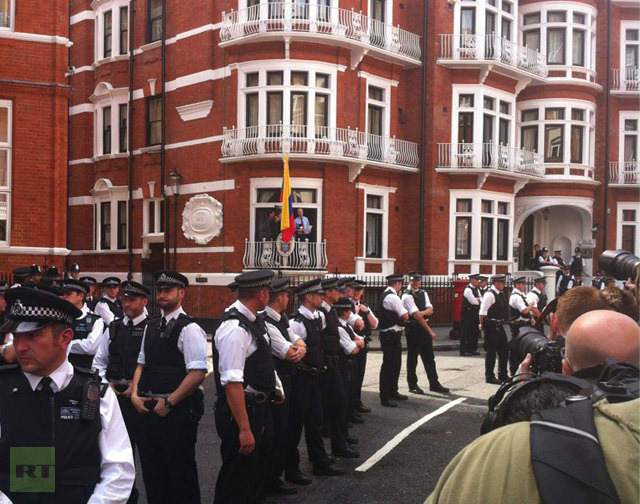
Prior to his imprisonment in Belmarsh, Julian Assange spent seven years cramped inside Ecuador’s small London embassy, where he’d been granted political asylum.
Assange founded WikiLeaks, a website that publishes leaked material while protecting the identity of the whistleblowers. While it launched in 2006, it wasn’t until 2010 that the U.S. government forcefully and publicly targeted Wikileaks and Assange, after Wikileaks made several massive disclosures of leaked documents related to the U.S. invasions and occupations of Iraq and Afghanistan.
On Monday, April 5, 2010, Julian Assange released a shocking video at the National Press Club in Washington, D.C. The video, which WikiLeaks titled “Collateral Murder,” was shot in 2007 from a U.S. military Apache helicopter flying over Baghdad, Iraq. The video shows in grainy black and white detail the gunship’s attack on a group of people on the ground. Twelve civilians, including two Reuters news employees, were mowed down by automatic fire from the helicopter. The voices of the crew were recorded, as they sought permission to “engage” with their targets, and as they laughed and cursed through the slaughter. It was a chilling video, documenting a war crime.
The video’s release was followed by the publication on Wikileaks.org of hundreds of thousands of digital records from the U.S. military, dubbed the Iraq War Logs and the Afghan War Diary. These documents provided further proof that the U.S. was committing war crimes. Some elected officials in the U.S. called for Assange to be assassinated. Then-Vice President Joe Biden called him a “high-tech terrorist.”
Not long after, the U.S. Justice Department convened a secret grand jury which issued a sealed indictment against Assange. Existence of that indictment itself was revealed on WikiLeaks, in a subsequent leak, in 2012. U.S. and U.K. persecution of Assange since then has been continuous and severe. In 2017, as revealed in 2021 by journalist Michael Isikoff and colleagues, the CIA hatched plans to either kidnap Assange from the Ecuadorian embassy or even to assassinate him.
Andrew Wilkie, an independent member of the Australian Parliament from Tasmania, introduced the resolution in support of Assange this week, saying, “This House notes that on 20 and 21 February 2024, the High Court of Justice in the United Kingdom will hold a hearing into whether Walkley Award-winning journalist Julian Assange can appeal against his extradition to the United States of America… both the Australian Government and Opposition have publicly stated that this matter has gone on for too long; and underlines the importance of the U.K. and USA bringing the matter to a close so that Mr Assange can return home to his family in Australia.”
The Australian government is not alone in calling for Assange’s release. In November, 2022, five major newspapers that collaborated with WikiLeaks—The New York Times, The Guardian, Le Monde, El Pais, and Der Spiegel—released a joint letter calling for an end to the prosecution. “Obtaining and disclosing sensitive information when necessary in the public interest is a core part of the daily work of journalists. If that work is criminalized, our public discourse and our democracies are made significantly weaker,” the letter read.
Assange’s attorney Jennifer Robinson will be in the London court for the hearing. She told us, “We have been saying for years: This is a political case which requires a political solution. The unprecedented showing of political support in the Australian Parliament overnight shows that Julian’s case is a priority for the Australian government, our parliament, and the people. The U.S. should listen to the concerns of its ally—and drop the case.”