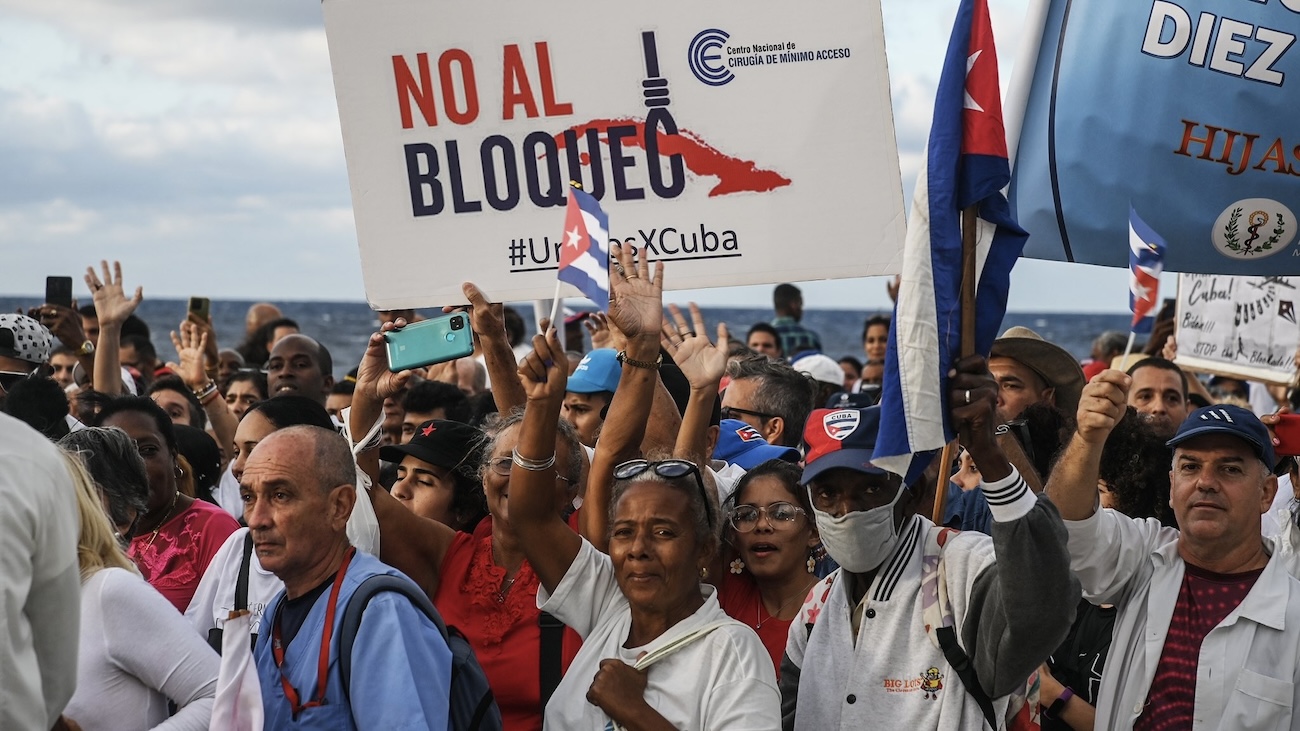
Over half a million Cubans filled the Malecón on Friday December 20 in a massive march against the US blockade. Photo: Presidencia Cuba
Hundreds of thousands of Cuban people participated in the mass demonstration against the six-decade US blockade of Cuba and the inclusion of Cuba on the US state sponsors of terrorism list.
“President Biden, take Cuba off the infamous list!” exclaimed the over half a million Cubans who marched on Havana’s malecón to the US Embassy. The mass march was called for by Cuban President Miguel Díaz-Canel earlier this week to demonstrate the absolute and total rejection of the Cuban people to the six-decade US-imposed blockade on the island as well as the inclusion of Cuba to the US State Sponsors of Terrorism list (SSoT) which together have wreaked havoc on the island’s economy.
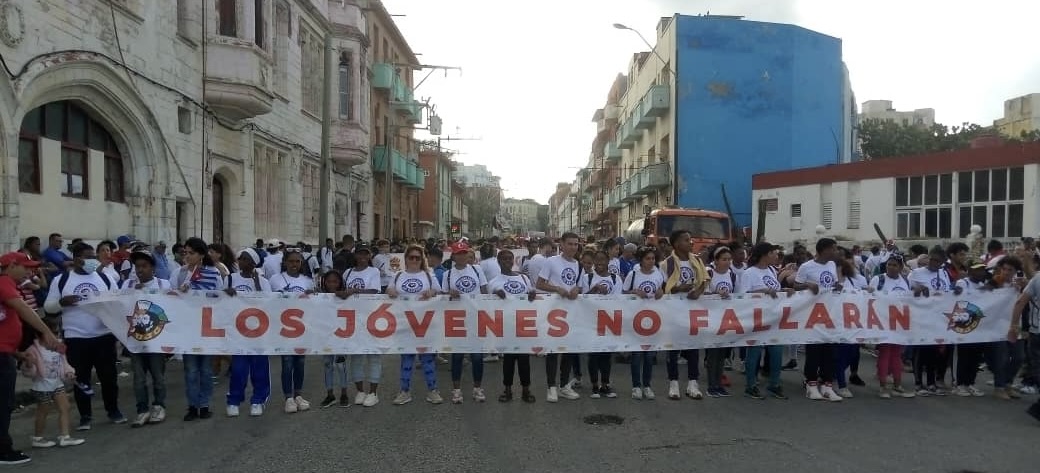
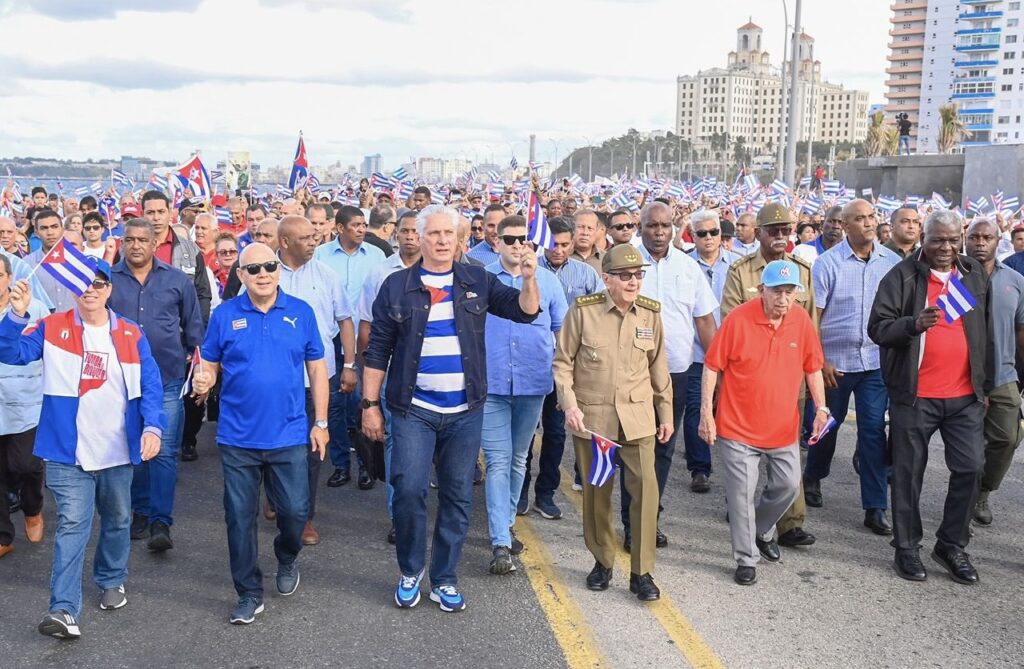
The march was led by Cuban President Miguel Díaz-Canel and General Raúl Castro who were flanked by over half a million Cubans from all sectors of life including students, doctors, construction workers, artists, and more. Cuban youth and students who participated in the massive mobilization carried banners reading “the youth will not fail!” and “this is the revolution!”
“The youth will not fail!” Photo: UJC
The mass mobilization began at the Anti-Imperialist Tribunal José Martí on the malecón, which is located directly in front of the US Embassy. There, the Cuban president delivered an address wherein he condemned the inaction of Joe Biden in reversing the policies of his predecessor Donald Trump which have tightened the economic and financial stranglehold on Cuba. Biden, he said, “has done nothing to move away from the line of reinforced blockade and economic asphyxiation of Cuba left as a legacy by the Republican administration that returns to the Oval Office in January.”
He also highlighted that people from across the US and the world have in the recent period called attention to the inhumane US policy that goes against international law, “In recent weeks and days there have been numerous pronouncements from US leaders and from other parts of the world demanding that Biden make use of his authority to at least remove the name of a nation that should never have been on this spurious list.”
He emphasized that, “When our international trade is persecuted and financial transactions are impeded, the people of Cuba are being denied food, medicine, fuel, goods, supplies and merchandise essential for their survival.”
In addition to condemning the illegal blockade, Díaz-Canel also alerted the Cuban people that there are currently paramilitary groups training in the south of Florida with the intention of carrying out terrorist attacks against Cuba. “They are based in South Florida and do not hide to train. They do it publicly, in plain sight and with the protection of local authorities, even violating their own laws and international treaties.”
The president’s announcement was both a warning and an attempt to expose the deep hypocrisy of calling Cuba a sponsor of terrorism, whilst in plain view of US authorities, these groups, “organize, promote and finance terrorist actions against social and economic structures in Cuba.” This phenomenon is not new and he reminded the people of how the US sheltered “self-confessed terrorists” and CIA agent Luis Posada Carriles and Orlando Bosch who were the architects of numerous criminal attacks against the Cuban people, the worst one being the 1976 bombing of a Cuban aircraft which resulted in the death of 73 people. “Knowing such antecedents,” Díaz-Canel stated, “no US ruler can classify Cuba as a terrorist state.”
Cuban President Miguel Díaz-Canel and General Raúl Castro marching on the malecón. Photo: Presidencia Cuba
The demand to end the over 60-year US blockade on Cuba and remove the country from the SSoT list has become even more urgent in light of the energy crisis on the island. In recent months, Cuba has suffered a series of blackouts due to its major challenge in accessing fuel to keep its power plants operating.
The election of far-right leader Donald Trump as president has also awoken fears that he may intensify existing unilateral coercive measures against Cuba.
However, as manifested in the mass mobilization, the Cuban people have vowed to remain firm in the face of any threat lodged at them by the US government and maintain that they are open to dialogue with any US administration based on mutual respect and equality.
In concluding his address, Cuban President Miguel Díaz-Canel declared, “If the United States persists in its determination to undermine our sovereignty, our independence, our socialism, it will only find rebellion and intransigence! Every administration that has tried has been outlived by the Cuban Revolution, and it will continue to be so. This is a march, yes, a very anti-imperialist march! Against US imperialism and its pretension to impose itself in Cuba by force or seduction, we will march now and always!”
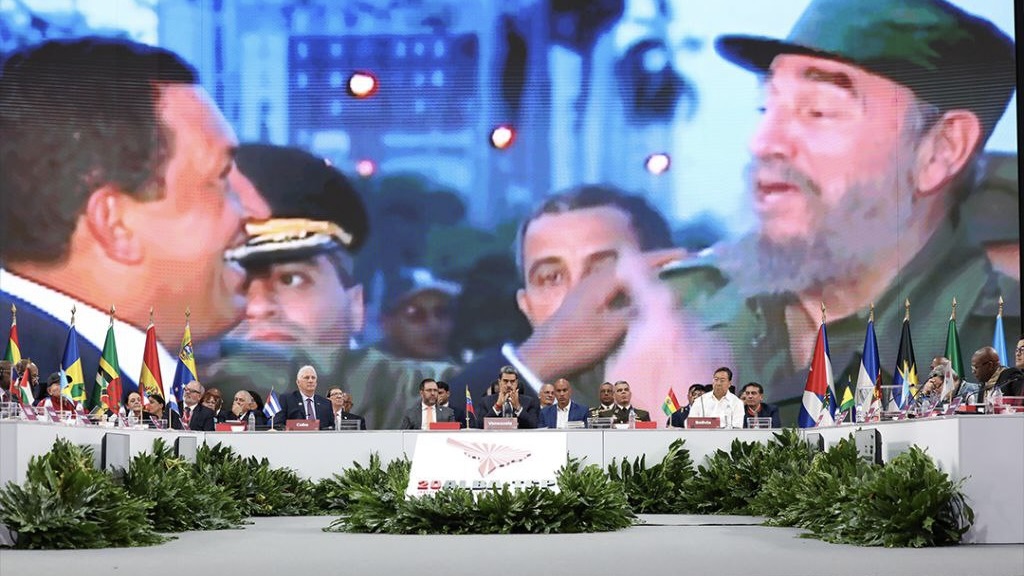
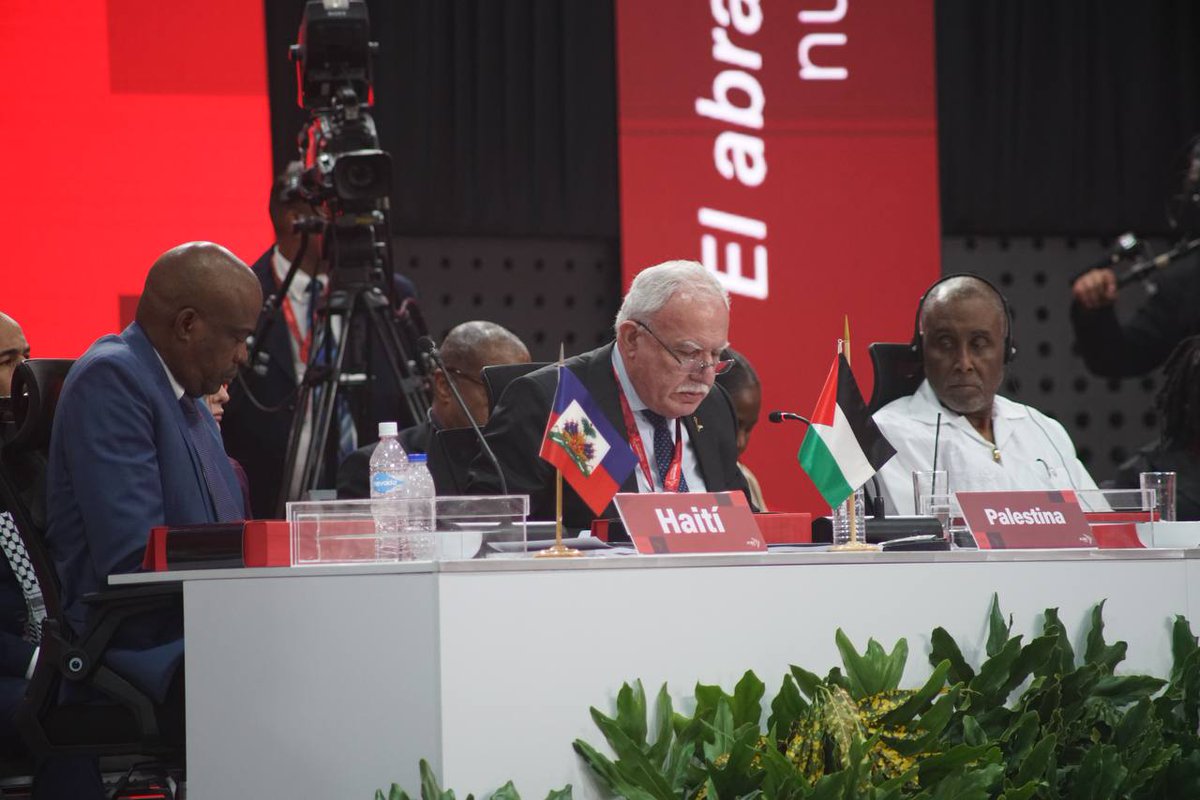
Heads of State Summit of ALBA-TCP in Caracas, Venezuela. Photo: ALBA-TCP
ALBA-TCP was founded in 2004 in an attempt to counter the US proposal of creating a “free trade zone of the Americas
December 14 marked the 20th anniversary of the creation of the Bolivarian Alliance for the Peoples of Our America-People’s-Trade Agreement (ALBA-TCP). ALBA-TCP was created in 2004 as a geopolitical alternative to the devastating advance of neoliberalism in the region.
The project was founded on December 14, 2004, in Havana by Cuban President Fidel Castro and Venezuelan President Hugo Chávez. Currently, the organization has 10 member countries and four countries considered “special guests.” In 2006, Bolivia signed its membership; in 2007, Nicaragua; in 2008, Dominica; in 2009, Antigua and Barbuda and St. Vincent and the Grenadines; in 2014, St. Kitts and Nevis and Grenada; and in 2021, St. Lucia. The special invited countries are Syria, Haiti, Suriname, and now Palestine.
To commemorate the 20 years, social movements, political parties, and heads of state gathered in Caracas, Venezuela for the 24th Heads of State Summit as well as parallel meetings. The event was attended by the host, Venezuelan President Nicolás Maduro; Bolivian President Luis Arce; Cuban President Miguel Díaz-Canel; Nicaraguan President Daniel Ortega; Prime Minister of St. Vincent and the Grenadines, Ralph Gonsalves; Prime Minister of Dominica, Roosevelt Skerrit; and the Prime Minister of Antigua and Barbuda, Gaston Browne.
Independence and solidarity among countries
In their addresses during the Summit on December 14, the heads of state and invited countries stressed the importance of solidarity among countries seeking alternative ways of development and the need for unrestricted solidarity among people struggling against imperialist attacks. They also demonstrated their support for Nicolás Maduro and his victory in the last presidential elections.
Miguel Díaz-Canel said “We reiterate the strongest support for the Bolivarian revolution, led by President Nicolás Maduro…We also call for the elimination of the blockade against Cuba …We cry out for a free Puerto Rico and declare our solidarity with Haiti, our Cuban doctors are there…We reiterate our demand for a ceasefire in Gaza and condemn the attacks perpetrated by Israel against Lebanon, Syria, and Iran.”
The Bolivian President, Luis Arce, highlighted the historical importance of ALBA in its fight against economic projects promoted by the United States such as the FTAA (Free Trade Area of the Americas): “The embrace of Hugo Chávez and Fidel Castro not only marked history but also manifested the defeat of the hegemonic project of the FTAA. ALBA was born, ALBA placed the human being at the center, promoting that a better world is possible. Bolivia reaffirms, once again, its commitment to ALBA-TCP, because it is a resistance that raises its voice against the unjust and criminal blockade against Cuba…ALBA is also a firm voice against the arbitrary and unilateral measures imposed against Venezuela and Nicaragua, which affect the welfare of our peoples.”
Nicolás Maduro said, “We must win the battle of life and truth in the streets, networks, media, and walls, as well as in the conscience and spirituality of the people.” He also added the importance of the struggle of the people to be masters of their destiny without imperial impositions or impositions of any kind. In the same line of discourse, Nicaraguan President Daniel Ortega said “From Nicaragua we reaffirm our commitment to ALBA. We will continue to fight the battle.”
The Prime Minister of Dominica, Roosevelt Skerrit stated “We congratulate the electoral triumph of President Nicolas Maduro on July 28. We wish him all the best…We also want to reaffirm our solidarity with the people of Cuba, a brave people for whom we have our greatest respect and love; we will never cease to lend our voice against the United States to eliminate the blockade against Cuba.”
Ralph Gonsalves, Prime Minister of St. Vincent and the Grenadines, harshly criticized US interference in the development of the past Venezuelan elections “Perhaps [the US government] thinks it is superior,” he said in this regard. He also stressed that the creation of ALBA-TCP was a fundamental invention for the emancipation of the American people, “ALBA is the product of the geniuses of our peoples.”
Inclusion of Palestine to ALBA-TCP
At the current summit, it was announced that Palestine had been included as a “brotherly country” and was included as a “permanent guest”. According to the resolution of the Heads of State, ALBA-TCP condemns the attacks against the Palestinian population and the “illegally occupied territories” and rejects “the merciless and inhuman genocide committed by the State of Israel, the occupying power, as well as its plan of spoliation, invasion, and domination.” Likewise, they denounced the support of several governments currently collaborating with the actions of the Israeli army and called for an “immediate ceasefire…From the heart of the peoples and governments of this alliance, we declare Palestine a brother country of the ALBA-TCP, and reaffirm our commitment to the defense of the Palestinian cause, which is the defense of humanity,” reads the resolution.
In this regard, Riyad al-Malki, advisor to the President of State for International Affairs of Palestine said “History will remember those who stood on the side of justice, ALBA’s lasting solidarity with Palestine is a testimony of freedom and collective resistance.” Furthermore, Malki added “This Alliance is a living testimony of collective integration to challenge imperialism and ensure a just world. These values resonate with the Palestinian struggle, an end to the illegal occupation.”
A call for counter-hegemonic struggle
The joint document signed by all the countries highlights the historical importance of ALBA-TCP in the struggle for a more equitable world: “Twenty years after this giant step, we pay homage to the founding leaders, Hugo Chávez Frías and Fidel Castro Ruz, who adopted that December 14, 2004, in Havana, Cuba, the vision of the future embodied in the founding documents of ALBA, which have allowed us to walk united until the present, animated by the ancestral force that led our peoples to be free and that encourages us to continue integrated in this Alliance for Life.”
Similarly, it was stressed that the existence of this multilateral organization operates as a possibility to create a region that resists the impositions of the most developed countries: “Today, we want to ratify before our peoples, the counter-hegemonic, democratic, anti-imperialist and anti-fascist nature of our Alliance and renew our commitment to help and protect each other, to continue building together a future of shared goals under the founding principles of complementarity, cooperation, social justice, defense of our sovereignty and solidarity.”
In this sense, Luis Arce stressed that “In the face of the challenges of a world threatened by fascism and neo-fascism, ALBA is not an option, ALBA is a necessity that must continue with firm steps, reaffirming the founding principles of solidarity, justice, and cooperation…ALBA is not only an alliance, it is a promise for the future, a living resistance, an instrument for the most dispossessed, and a reminder that together, as peoples, we are invincible.”
Objectives and principles of ALBA-TCP
According to ALBA’s official website, the fundamental objective of the project is “to achieve integral development, ensure social equality and contribute to guaranteeing the quality of life, good living, independence, self-determination and identity of the peoples.” For this very reason, the principles of ALBA-TCP propose that political decisions be made horizontally and take into account the economic differences of its members without meaning that the importance of each of the members is underestimated.
The principles shared by the countries are “trade and investment should not be ends in themselves, but instruments to achieve sustainable development; special and differentiated treatment, according to the level of development of the various countries; economic complementarity and cooperation; cooperation and solidarity; the creation of the Social Emergency Fund; the integrative development of communications and transportation; the sustainability of development; energy integration; the promotion of investments of Latin American capital in the region; the defense of Latin American and Caribbean identity and culture; respect for intellectual property; and the agreement of multilateral positions and in negotiations with countries and blocs in other regions.”
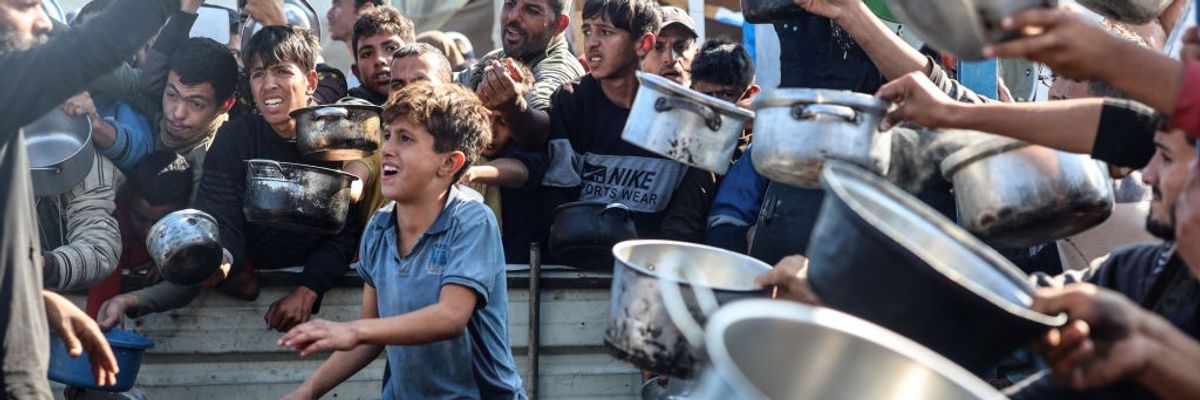
Palestinians gather to receive food cooked by a charity kitchen in Khan Younis, Gaza on December 1, 2024. (Photo: Majdi Fathi/NurPhoto via Getty Images)
“The window of opportunity to deliver assistance is now, today, not tomorrow,” said the deputy director-general of the United Nations Food and Agriculture Organization.
A top official at the United Nations Food and Agriculture Organization said Monday that food availability across Gaza has reached “an all-time low” under Israel’s suffocating blockade, which has heavily restricted the entrance of lifesaving humanitarian assistance and plunged the enclave into famine.
“Food supply has sharply deteriorated,” FAO Deputy Director-General Beth Bechdol said at a conference in Cairo, Egypt. “The window of opportunity to deliver assistance is now, today, not tomorrow. Food, medicine, and fuel are self-evident priorities, but we must also prioritize the ability to grow food locally where it is needed most to ensure survival.”
Bechdol’s grim assessment came weeks after the Biden administration pressuredIsrael to improve conditions on the ground in Gaza, which has been utterly devastated by more than a year of bombing.
Aid organizations say that far from improving, Gaza’s humanitarian crisis has only gotten worse since the Biden administration threatened to cut off the supply of U.S. weapons to Israel. Last month, the U.S. effectively dropped its pressure campaign by concluding that Israel was not violating international law by blocking American humanitarian assistance.
Most of Gaza’s population is currently experiencing “high levels of food insecurity,” according to the latest Integrated Food Security Phase Classification (IPC) figures, and the “risk of Famine persists across the whole Gaza Strip.”
“The catastrophe in Gaza is nothing short of a complete breakdown of our common humanity. The nightmare must stop.”
In addition to obstructing aid deliveries, Israeli forces have decimated Gaza’s agricultural infrastructure and cropland, repeatedly attacked aid workers, and facilitated the looting of humanitarian supplies, fueling desperation among Gaza’s starving population. Last week, as The Associated Pressreported, “two children and a woman were crushed to death… as a crowd of Palestinians pushed to get bread at a bakery in the Gaza Strip amid a worsening food crisis in the war-ravaged territory.”
Amina Mohammed, the U.N.’s deputy secretary-general, said at the Cairo conference on Monday that “conditions for Palestinians in Gaza are appalling and apocalyptic,” with malnutrition running “rampant” and famine “imminent.”
“In the past four months alone, nearly 19,000 children were hospitalized due to acute malnutrition—nearly double the cases in the first half of the year,” Mohammed said. “In the face of the gigantic needs, humanitarian aid is—outrageously—being blocked. This flies in the face of the clear requirements under international humanitarian law to respect and to protect civilians and to ensure their essential needs are met.”
“It’s past time for an immediate cease-fire and the immediate and unconditional release of all hostages,” she added. “The catastrophe in Gaza is nothing short of a complete breakdown of our common humanity. The nightmare must stop. We cannot continue to look away.”
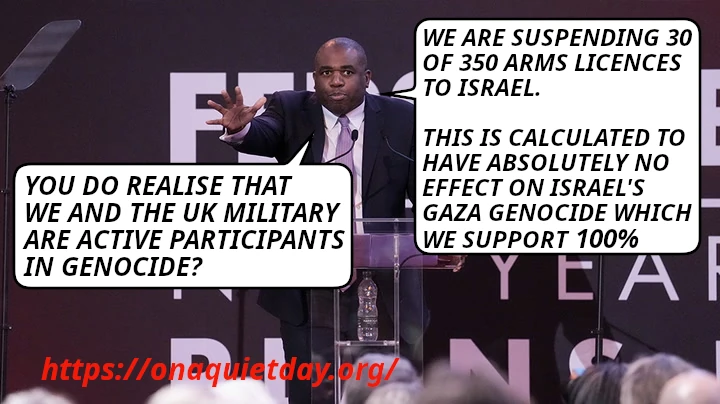
Genocide denier and Current UK Prime Minister Keir Starmer is quoted that he supports Zionism without qualification. He also confirms that UK air force support has been essential in Israel’s mass-murdering genocide. Includes URLs https://www.declassifieduk.org/keir-starmers-100-spy-flights-over-gaza-in-support-of-israel/ and https://youtu.be/O74hZCKKdpAGenocide denying UK Foreign Secretary David Lammy says that UK is suspending 30 of 350 arms licences to Israel. He also confirms the UK government’s support for Israel’s Gaza genocide and the UK government and military’s active participation in genocide.
European movements call for an end to the US-imposed blockade on Cuba, condemning disinformation campaigns that hinder the progress of the socialist project on the Caribbean island
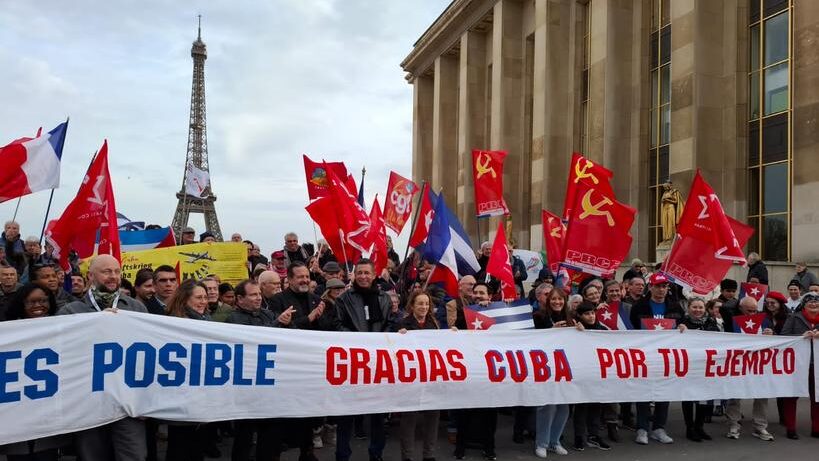
As Cuba continues to face the challenges of a US-imposed blockade and widespread disinformation campaigns, over 300 representatives of social movements, trade unions, and political organizations gathered in Paris during the weekend of November 22-24 for the 19th European Continental Meeting of Solidarity with Cuba. The delegates focused on strengthening ties between the Caribbean island and European countries, addressing the economic consequences of the blockade and everyday realities of life under these pressures.
The meeting produced a declaration outlining guidelines for European networks to counter mainstream defamation of Cuba, such as a campaign to end the country’s classification as a state sponsor of terrorism. In direct contrast to the stance of European leaders who align with the US-imposed blockade, participants expressed “unconditional support for the Cuban Revolution and its right to build the socialist project chosen by the majority of the people,” the Cuban Institute of Friendship with Peoples (Instituto Cubano de Amistad con los Pueblos, ICAP) reported in a statement.
According to Rodrigo Suñe from the International Peoples’ Assembly, the declaration “reaffirms unconditional support for Cuba’s right to continue building its path to socialism in a sovereign manner.” This, Suñe explains, will be achieved by “gradually and collectively” strengthening political solidarity with Cuba’s struggle against attacks led by successive US administrations.
Among these attacks, Suñe highlights the US-imposed blockade, designed to strangle the Cuban economy, and a “permanent media war” aimed at spreading manipulation and misinformation. He emphasizes that those in solidarity with Cuba must actively denounce and counter these campaigns. To achieve this it is essential to raise awareness and exchange information about the everyday realities of life in Cuba under the blockade. Reflecting this priority, part of the meeting focused on analyzing the blockade’s impact on Cuba’s economy, trade, and financial systems.
“We left the meeting with a mission to strengthen material solidarity by financing and implementing new cooperation projects, as well as promoting and organizing campaigns to send priority donations,” says Suñe. “To achieve this, it will be crucial to involve young people and expand their participation in building solidarity.”
On the final day of the conference, participants staged a protest in central Paris, reaffirming their call for solidarity with Cuba and urging European countries to radically change their approach. Currently, European Union member states continue to follow US policy on Cuba, a stance that, according to ICAP, does not reflect the interest – or the will – of the peoples of Europe. As part of the meeting’s conclusions, an appeal was launched for the EU to break away from US interference and remove the obstacles hampering its relations with Cuba, Rodrigo Suñe told Peoples Dispatch.
This work is particularly important given the escalating crises at a global level. “We are facing a very complex situation, with the deepening of the capitalist crisis, wars, and the rise of the far-right and its neofascist ideals. This is why we need to improve the quality of our articulation of internationalist solidarity,” explains Suñe.
The commitment to strengthening solidarity between Europe and Cuba will remain a key focus for ICAP and other organizations as they prepare for the next meeting, scheduled to take place in Turkey in 2026. Leading up to that event, Suñe says, the movements involved will focus on building a unified strategy to strengthen both political and material solidarity with Cuba, addressing the challenges discussed during their meeting in Paris.
Cuba is in the midst of an ongoing humanitarian crisis, and October’s widespread power outages are only adding to the Cuban people’s troubles. For the last six decades, Cuba has been on the receiving end of myriad sanctions by the United States government. This blockade has proved devastating to human life.
Reporting on Cuba’s blackouts have either omitted or paid brief lip-service to the effects of US sanctions on the Cuban economy, and how those sanctions have created the conditions for the crisis. Instead, media have focused on the inefficient and authoritarian Communist government as the cause of the island’s troubles.
Pulping the economy
Michael Galant (The Hill, 1/5/24): “Businesses and financial institutions, including many from outside the United States, often elect to sever all connections to Cuba rather than risk being sanctioned themselves for association with ‘a sponsor of terror.’”
One of President Donald Trump’s final acts in office was to re-designate Cuba as a State Sponsor of Terrorism, after President Barack Obama had removed them from the list in 2015 as a part of his Cuban thaw. Inclusion on the list subjects a country to restrictions on US foreign aid and financing, but, more importantly, the SSoT list encourages third-party over-compliance with sanctions. “Businesses and financial institutions, including many from outside the United States, often elect to sever all connections to Cuba rather than risk being sanctioned themselves,” The Hill (1/5/24) reported.
Trump reportedly added Cuba to the list for harboring members of FARC and ELN, two left-wing Colombian armed movements. However, Colombian President Gustavo Petro later “noted that Colombia itself, in cooperation with the Obama administration, had asked Cuba to host the FARC and ELN members as part of peace talks,” the Intercept (12/14/23) wrote. Indeed, if Cuba deported the dissidents, they would have been in violation of the protocols of the peace talks, which they were bound to by international law (The Nation, 2/24/23).
President Joe Biden has not begun the process of reviewing Cuba’s inclusion on the list, despite his campaign promises to the contrary.
The terror designation, plus the many other sanctions imposed by Trump and continued by Biden, are no small potatoes. Ed Augustin wrote at Drop Site (10/1/24) that
the terror designation, together with more than 200 sanctions enacted against the island since Obama left office, has pulped the Cuban economy by cutting revenue to the struggling Cuban state…. The combined annual cost of the Trump/Biden sanctions, [economists] say, amounts to billions of dollars a year.
Augustin argued that the economic warfare regime is a root cause of the rolling blackouts, water shortages and mass emigration that have plagued Cuba in recent years. Even imports that are ostensibly exempt from sanctions, like medication, are caught in the dragnet as multinational companies scramble to cut ties with the island. Banks are so reluctant to run afoul of US sanctions, Augustin wrote, “that often, even when the state can find the money to buy, and a provider willing to sell, there’s simply no way of making the payment.”
Cuba’s pariah status as a SSoT has put a stranglehold on its economy, and its government’s ability to administer public services. However, US restrictions on Cuba are almost never mentioned in US coverage, and reporting on the recent blackouts is no exception.
Cash-strapped Communists
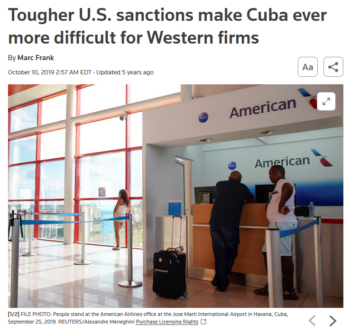
Reuters (10/10/19): “Tougher US sanctions against Cuba have led international banks to avoid transactions involving the island, while prospective overseas investors put plans on hold.”
Coverage has emphasized the inability of Cuba’s government to pay for necessary fuel imports. The New York Times (10/19/24) reported “the strapped Communist government could barely afford” to pay for fuel. Elsewhere, the Times (10/18/24) claimed “a severe economic crisis and the cash crunch it produced made it harder for Cuba to pay for those fuel imports.”
The Washington Post (10/18/24) made broadly similar arguments, chalking the blackouts up to “a shortage of imported oil and the cash-strapped government’s insufficient maintenance of the creaky grid.”
The “cash crunch” referenced by the Times is not just the result of an abstract economic crisis, as is implied. Instead, it is a direct effect of US sanctions on financial institutions. During the Obama administration, European banks, including ING and BNP Paribas, were fined to the tune of over $10 billion for transacting with Cuba (Jacobin, 3/27/22). Even before Cuba was choked further as a result of their SSoT designation, reporting by Reuters (10/10/19) showed the extent to which banks were terminating operations with Cuba and Cuban entities:
Many Western banks have long refused Cuba-related business for fear of running afoul of US sanctions and facing hefty fines.… Panama’s Multibank shut down numerous Cuba-related accounts this year and European banks are restricting clients associated with Cuba to their own nationals, if that.…
Businessmen and diplomats said large French banks, including Societe Generale, no longer want anything to do with Cuba, and some are stopping payments to pensioners living on the Caribbean island.… For the first time in years, the island has had problems financing the upcoming sugar harvest. Various joint venture projects, from golf resorts to alternative energy, are finding it nearly impossible to obtain private credit.
This de-risking by financial institutions manufactures a cash-scarce economy. Cuba’s inability to procure cash for imports is not a function of financial mismanagement, or a lack of credit-worthiness. Instead, it is a deliberate effect of American foreign policy. By omitting the actions of the most powerful government on earth, mainstream coverage allows only that only Cuban failures could be the cause of a shortage of cash.
‘Terrorism’ cuts off tourism
Britain’s ambassador to Cuba told the Telegraph (11/6/23), “Those who come are profoundly shocked at what the SSOT designation is doing to the people here.”
Cuba has historically used tourism as a way of bringing money into the economy, but lately the Cuban tourism industry has been severely depressed. The explanation employed by corporate media for the decline of this industry is to blame the extended effects of the pandemic recession (New York Times, 10/19/24; Washington Post, 10/18/24).
This explanation, however, is incomplete. Cuba has indeed had a lackluster rebound in their tourism industry, but the Times and the Post fail to explain why Cuba has faltered while other Caribbean islands have more than re-achieved their pre-pandemic tourist numbers.
Travelers from Britain, Australia, Japan and 37 other countries do not need to procure a visa for travel to the United States. Instead, they can use ESTA, an electronic visa waiver. This greatly reduces the cost and the annoyance of obtaining permission to visit the US. However, since Cuba’s 2021 listing as a SSoT, any visit to the country by an ESTA passport-holder revokes the visa waiver, for life (Telegraph, 11/6/23). In other words, any Brit (or Kiwi, or Korean, and so on) who visits Cuba must, for the rest of their lives, visit a US embassy and pay $180 before being able to enter the United States. US policy, not a Covid hangover, is hamstringing any possibility of a resurgence in tourism to Cuba.
Blame game
During Cuba’s most recent energy crisis, the New York Times published three stories describing the blackouts. Two of these stories mention the US blockade only as something that the Cuban government blames for the crisis.
The New York Times (10/21/24) presented the idea that the US is punishing Cuba’s economy as a Communist allegation: “The Cuban government blames the power crisis on the US trade embargo, and sanctions that were ramped up by the Trump administration.”
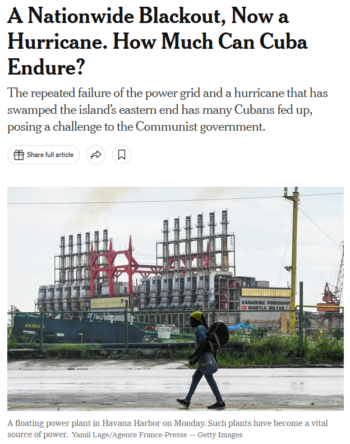
The headline on the Times website (10/21/24) read: “A Nationwide Blackout, Now a Hurricane. How Much Can Cuba Endure?” The paper was right to report on the humanitarian crisis ongoing in Cuba, but it chose to downplay the most important root cause: the decades-long US blockade on Cuba’s economy and its people.
That same story described Cuba as “a Communist country long accustomed to shortages of all kinds and spotty electrical service.” Why is the country so used to shortages? Eleven paragraphs later, the Times gave an explanation, or at least, Cuba’s explanation:
The Cuban government blames the power crisis on the US trade embargo, and sanctions that were ramped up by the Trump administration, which severely restricts the Cuban government’s cash flow. The US Department of the Treasury blocks tankers that have delivered oil to Cuba, which drives up the island’s fuel costs, because Cuba has a limited pool of suppliers available to it.
Earlier coverage by the Times (10/18/24) similarly couched the effects of the blockade as merely a claim by Cuba. The Washington Post (10/22/24) also situated the blockade as something that “the Cuban government and its allies blame” for the ongoing crisis.
To report that Cuban officials blame the US sanctions for the energy crisis is a bit like reporting that fishermen blame the moon for the rising tide. It is of course factual that US trade restrictions–which affect not just US businesses, but also multinational businesses based in other countries–are a blunt weapon, with impact against not just a government, but an entire people.
At the very least, it is incumbent upon journalists to do at least minimal investigation and explanation of the facts concerning the subject of their reporting. None of the coverage in either major paper bothered to investigate whether this was a fair explanation, or even to report generally the effects a 60-year blockade might have on an economy.
Brief—and buried
“Cuban economists and foreign analysts blamed the crisis on several factors,” the New York Times (10/19/24) reported; 18 paragraphs later, the story gets around to mentioning US sanctions.
On October 19, the Times gave its most complete explanation of the relationship between the US sanctions regime and the Cuban blackouts:
Cuba’s economy enjoyed a brief honeymoon with the United States during the Obama administration, which sought to normalize relations after decades of hostility, while keeping a longstanding economic embargo in place. President Donald J. Trump reversed course, leading to renewed restrictions on tourism, visas, remittances, investments and commerce.
This explanation can be found in the 31st paragraph of the 37-paragraph story. Only once the Times has painted a picture of all the ways the Communist government has gone wrong can there be a brief mention of the role of US sanctions. And how brief it is; the Times chose not to detail the extent of blockade against Cuba, nor how Cuba was wrongfully placed on the SSoT list, nor the failure of Biden to reevaluate Cuba’s status as he promised on the campaign trail.
Describing the US starvation of Cuba’s economy in abstract terms like “economic crisis” provides cover for deliberate policy decisions by the US government. By reporting on the embargo only as something that the Cuban government claims, it is easy for readers to dismiss that explanation as simply a Communist excuse. Instead of asking why the United States is choosing to enforce a crippling sanctions regime on another country, outlets like the New York Times find it easier to repeat the line that Cuba’s government has only itself to blame for its problems.
FAIR’s work is sustained by our generous contributors, who allow us to remain independent. Donate today to be a part of this important mission.