China has identified how to fight back against Trump’s tariffs, and is not ready to back down

Spread the love
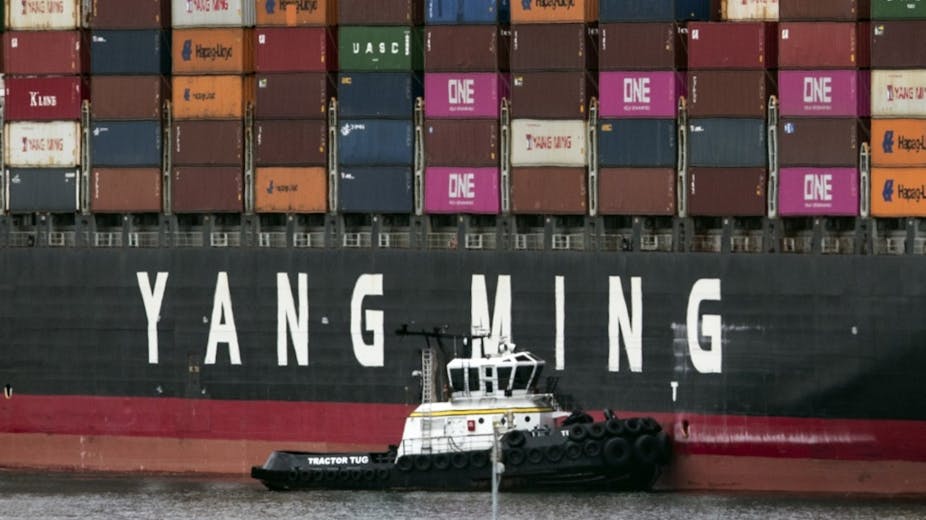
Chinese goods arrive at the Port of Los Angeles. But arrivals from China are decreasing. ETIENNE LAURENT/EPA

Chee Meng Tan, University of Nottingham

US ports are now starting to see scheduled shipments from China decline as the result of Donald Trump’s 145% tariffs on Chinese goods. The port of Los Angeles, the biggest port for Chinese goods in the US, is predicting scheduled shipments in early May to be about a third lower than the same time last year.

Declining numbers of ships arriving stocked with Chinese imports are likely to affect US supermarket shelves soon, and after warnings from US supermarket bosses, Trump responded by saying trade talks between the US and China were under way in the past few days. But Chinese president Xi Jinping quickly denied talks were happening, suggesting he has no intention of backing away from a fight with the US.

As one of the most powerful leaders in the history of the People’s Republic of China, Xi has fashioned himself as a nationalistic icon. So if China perceives Trump’s tariffs as a bully tactic designed to undermine it, backing down from a confrontation with the US would seriously undermine Xi’s strongman image and rhetoric.

This is something that Trump probably hadn’t considered. At a rally marking his 100 days in office, the US president was still suggesting that China would just back down and “eat the tariffs”.

While tariffs appear to be the primary weapon in the trade war, China might have more tactics to hit back at Trump and the US economy. The question is what might they be?

A few weeks ago it seemed like Washington might punish China’s lack of willingness to negotiate with more tariffs, but now it’s clear that Trump is willing to make a deal and is trying to get China to come to the table. Trump is now implying that US tariffs on China could come down substantially. And US treasury secretary Scott Bessent has called the trade war with China “unsustainable”.

Leveraging agriculture and energy

China has reduced its reliance on US farm imports since the trade war began in Trump’s first presidency. This is bad news for Washington as agriculture is one few sectors in the US that actually has a large trade surplus with China. The 125% retaliatory tariffs will harm the sector’s profitability.

But China’s retaliatory tariffs aren’t the only issue American farmers have to contend with. As the trade war escalates, China has been using bureaucratic hurdles to restrict US agricultural products from entering China and as a potential negotiation tool. For instance, China has delayed the renewals of export license renewals of US pig farmers, and refused to renew licenses of poultry farmers for “health and safety” reasons.

Beijing’s actions might be designed to particularly hit the economy in core Trump supporting states. A major part of Trump and the Republican party’s base lies in “red states”, such as Nebraska, Iowa and Kansas, all have significant farming communities. Focusing on agricultural issues is a tactic that Beijing realises will hit home with Trump voters.

Out of the 444 US counties designated by the United States Department of Agriculture (USDA) as farming-dependent, 77.7% voted for Trump during the 2024 US presidential election. So, any hardship faced by the agriculture sector due to Trump’s own actions is likely to lose him support from a major political base. And with mid-term elections in 2026, Trump has to tread carefully when antagonising Beijing.

Another support base that Beijing might seek to undermine is those involved in the fossil fuel sector. In the past, the US has been a top supplier of natural gas to China.

China has not imported natural gas from the US since early February 2025, and has sought its natural gas from Australia, Indonesia, and Brunei. As the trade war continues, it is unlikely that the US would be able to sell its natural gas to China anytime soon, and this will have an impact on the energy industry – one of Trump’s major political support bases.

Restricting minerals

Another huge problem that the US faces stems from China’s restriction of the export of critical minerals. They include seven rare earth minerals namely samarium, gadolinium, terbium, dysprosium, lutetium, scandium and yttrium. While these are used in the clean energy and automobile sectors, the biggest concern would come from the US defence complex.

These critical minerals are used in manufacturing fighter jets, submarines, missiles, and radar systems. China has an effective monopoly on the extraction and processing of rare earths, while the US lacks such capabilities. This means that China’s export restrictions are likely to affect America’s defence industry, while Beijing rapidly expands its ammunition and military technology.

The White House probably anticipated export restrictions of critical minerals from China. After all, Beijing had banned the export of critical minerals to Japan in 2010 over a fishing trawler dispute, and stopped exporting “dual-use” metals that can be used to produce civilian and military technology, such as gallium, germanium and tungsten.

What’s next?

For the last few years, China has been trying to overcome an ailing economy that was primarily fuelled by a real-estate crisis. Trump probably expected China to buckle under pressure and come crawling to the negotiation table. After all, the Chinese Communist Party needs to fix its economy fast. The establishment has long relied on delivering economic prosperity to legitimise its rule over China.

Right now the tit-for-tat battle continues. By April 11, US tariffs on China peaked at 145%, while China’s retaliatory tariffs on US goods reached an unprecedented 125%.

Although it is clearly fighting back, China could go even further by selling off US treasuries and increasing US interest rates and thus borrowing cost. But unlike Trump, Xi often plays the long game. After all, Trump’s term as president will be over in less than four years, while Chinese president Xi has no term limits. All the latter has to do is exercise patience, and a friendlier US president might come around.

Chee Meng Tan, Assistant Professor of Business Economics, University of Nottingham

This article is republished from The Conversation under a Creative Commons license. Read the original article.

Continue ReadingChina has identified how to fight back against Trump’s tariffs, and is not ready to back down

Now Let’s Do the American Oligarchs

Spread the love

What can we do about our oligarchy in the United States? President Biden’s blueprint for ones in Russia is a good place to start.

Republished from Common Dreams under Creative Commons (CC BY-NC-ND 3.0) licence. Note by dizzy: There’s a photo of Jeff Bezo’s superyacht at the original article. He’s got a new one now of course requiring an historic bridge to be dismantled in Rotterdam.

12/3/22 ed: I’ve emphasized one paragraph in red typeface. That part is particularly important showing that we do not live in democracy. 13/3/22 The West is imposing it’s model of oligarchs on Russia by imposing sanctions. Western oligarchs control and dictate to Western governments but that’s not the case in Russia.

RICHARD ESKOWMarch 8, 2022

From President Biden’s State of the Union:

Tonight I say to the Russian oligarchs and corrupt leaders who have bilked billions of dollars off this violent regime: no more.

The U.S. Department of Justice is assembling a dedicated task force to go after the crimes of Russian oligarchs.  

We are joining with our European allies to find and seize your yachts, your luxury apartments, your private jets. We are coming for your ill-begotten gains.

With these words, the president unintentionally laid out a blueprint for responding to the American oligarchs, superpredators who dwarf their Russian counterpoints in wealth and political power.

America’s oligarchs, like their Russian counterparts, have bilked billions—no, make that trillions—from their own regime.

Oligarchs in a Violent Regime

About that “violent regime” business: It’s possible to condemn the violence perpetrated by Russia’s government while at the same time recognizing and condemning of our own. Our direct attacks on Iraq and Afghanistan, among other countries, have been matched by the proxy violence we have funded in nations like Palestine and Syria. Our sanctions have taken countless lives around the world, a form of bloodshed we pretend isn’t warfare.

America’s oligarchs, like their Russian counterparts, have bilked billions—no, make that trillions—from their own regime. Some of their bilking comes directly from its violence, in the form of “defense” contracts to entities like Halliburton, Lockheed Martin, and the Carlyle Group.

A 2014 Princeton political science study showed that government actions nearly always conform to the wishes of wealthy and powerful US elites. “Our central finding was this: Economic elites and interest groups can shape U.S. government policy — but Americans who are less well off have essentially no influence over what their government does,” wrote co-authors Martin Gilens and Benjamin Page.

America’s oligarchical influence extends from healthcare and fossil fuels to the industry of war itself. American companies account for more than half of all arms sales worldwide. The Center for Responsive Politics reports that “in the past two decades, (the arms industry’s) extensive network of lobbyists and donors have directed $285 million in campaign contributions and $2.5 billion in lobbying spending to influence defense policy.”

Arms manufacturers (more commonly known by the Orwellian appellation, “defense industry”) shrewdly concentrate on hiring ex-government officials to advance their agenda and pump up their “ill-begotten gains.” This ensures that their interests are represented by people who know the officials they’re lobbying. Even more importantly, it puts those officials on notice that there is a lucrative future in store for them if they play along. Arms oligarchs have hired more than 200 lobbyists who, in the report’s words, “have worked in the same government that regulates and decides funding for the industry.”

Arms manufacturers played a dominant role under Trump, but are also well-represented in the Biden Administration:

While Biden has touted strict ethics rules that attempt to thwart the influence of lobbyists on the administration, several of his earliest appointees, including Secretary of Defense Lloyd Austin and Secretary of State Antony Blinken consulted for a private equity firmthat emphasized its “access, network and expertise” in the defense industry. Austin also had a seat on the United Technologies and Raytheon board, earning more than $250,000 from the now merged companies.

“Ill-Begotten Gains”

It’s not just the arms industry, of course. Other oligarchs have bilked the people of the United States in more creative ways. Jeff Bezos built his Amazon empire off his ability to sell products online without charging sales tax. This government-granted loophole made him an oligarch, a position he has used to further cement his power and influence. He has purchased the most influential paper in the nation’s capital—an oligarch’s move if there ever was one—while constantly extending his monopolistic power into new markets.

Despite the fact that he already possessed great wealth, Elon Musk has received billions in subsidies and contracts for his automobile and space ventures. Bill Gates parlayed a government contract and some aggressive patent strategies into his own oligarchical status. Insurance executives have bilked billions from the violence of our privatized healthcare system, which takes an estimated 45,000 lives per year.

Money, of course, is only part of an oligarch’s wealth. President Biden also mentioned the property that belongs to Russian oligarchs: “your yachts, your luxury apartments, your private jets. We are coming for your ill-begotten gains.” (He meant “ill-gotten,” but I suppose you could call such malapropisms part of Biden’s charm.)

If a “supertax” were levied against America’s oligarchs by the federal government, it would produce as much as $755 billion in revenue.

Russians own an estimated 7-10 percent of the world’s superyachts, leaving plenty for their American counterparts. Luxury apartments? Check out “New York Condo Sells for Close to $190 Million; Hedge-Fund Billionaire Doubles His Money.”  Private jets? Jeffrey Immelt, job outsourcer and financial predator at GE, used to take two jets when he traveled so that he’d have a spare—and charged it back to GE’s shareholders.

Little Oligarchs, Big Oligarchs

We’re told that the Russians whose yachts have been seized include Alisher Usmanov, whose net worth is $20 billion, and Alexei Mordashov, whose wealth is described as “nearly” $30 billion. Compare that with Elon Musk, who’s worth nearly $300 billion, or Jeff Bezos at $202 billion. These guys are pikers.

Globally, in the US-led world financial order, billionaires have gained $5 trillion in wealth since the pandemic began. Think of our economic leadership as a “global endowment for oligarchy.” Oxfam reports that the ten richest men in the world (yes, they’re all men) own more wealth than the bottom 3.1 billion people (“six times more, in fact”). Oxfam also notes that “if the 10 richest men”—nine of whom live in the US—”lost 99.999% of their combined wealth, they would still be richer than 99% of the world.”

Now that’s oligarchy.

Making a Killing

No industry has taken more advantage of government-granted patent monopolies than Big Pharma. Even when its oligarchs misled the country into an opioid epidemic—one of the largest mass-casualty events in American history—they are able to escape criminal culpability for their actions.

Then came Covid-19. As Forbes reported in January, US billionaires held an estimated $3.5 trillion before the pandemic struck, a figure that reached nearly $5.3 trillion two years later. That’s $1.8 trillion in gains, divided among only twenty oligarchs. Musk led the pack, with Bezos in second place. The billionaires’ list is a cavalcade of monopolists and speculators whose wealth has been fueled by their government’s benign view of their predatory business practices.

Once the pandemic hit, Big Pharma’s oligarchs were able to parlay their political power into exclusive patent rights for Covid-19 vaccines. Moderna made $17.7 billion from its vaccine in 2021 and anticipates making $22 billion this year, from a formula developed with $2.5 billion in funding commitments from the US government. The money from these government-granted profits could vaccinate the entire world, but they’ve been used to enrich shareholders instead. That’s oligarchy.

Restoring the Balance

What can Americans do about their oligarchy? President Biden’s blueprint is a good place to start. A “dedicated task force to go after the crimes of American oligarchs” is an excellent place to start. It could address questions such as:

1. Why have nine American billionaires acquired more than $755 billion during the Covid pandemic, while so many other people struggled?

2. What role did government and central bank policy play in this enrichment?

3. What unethical or illegal actions, if any, were undertaken in amassing this wealth?

4. What effect will these levels of economic inequality have on social justice, political power, social mobility, and the rights of consumers and workers?

5. Is there any reason why this money should not be taxed at 99 or 100 percent?

Item #4 would not be unprecedented. It would revive a proposal from President Franklin D. Roosevelt for a “100 percent war supertax” on extremely high incomes and would echo the 94 percent top tax rate passed during World War II. (The top marginal tax rate stayed above 90 percent for the next two decades.)

We certainly face a World War-level emergency. Oxfam observes that “a 99% windfall tax on the COVID-19 wealth gains of the 10 richest men could pay for enough vaccines to vaccinate the entire world and fill financing gaps in climate measures, universal health and social protection, and efforts to address gender-based violence in over 80 countries, while still leaving these men $8bn better off than they were before the pandemic.”

I don’t hate these oligarchs. I see them.

If a “supertax” were levied against America’s oligarchs by the federal government, it would produce as much as $755 billion in revenue. That’s enough to pay for the original, ten-year “Build Back Better” proposal—twice.

To See, and to Act

It’s striking that the current debate about American democracy ignores its biggest antagonist: the oligarchs who have undermined the political process and drained the nation of its wealth. Restraining the oligarchs would help build true democracy. It would be good politics, too.

“We know from polling that (anti-oligarchical) policies and rhetoric like these are wildly popular,” writes Eleanor Eagan of the Revolving Door Project. “In our deeply divided country, anger at elite impunity and a desire to see it end are among the rare uniting forces that we have left.”

Not that we can expect an anti-oligarchical agenda from this government any time soon. Politicians know that America’s oligarchs, unlike Russia’s, have the ability to crush their careers at any time. But the rest of us are free to speak out and demand an end to oligarchical rule anywhere in the world. Our condemnation of other country’s oligarchs will ring hollow until we do.

Someone once asked me, “Why do you hate billionaires?” The answer is, I don’t. I’ve met a few, and they were always sociable enough (unless you worked for them). I don’t hate these oligarchs. I see them. As we build the anti-oligarchical movement here in the US, Noah Liebman’s handy browser add-on (for Firefox only) helps everyone see them. It replaces the word “billionaire” with “oligarch” on every web page, producing headlines like “Bloomberg’s Oligarch Index,” “Forbes’ Oligarchs 2021,” “Inside the Financial Holdings of Oligarch Betsy DeVos” … you get the idea.

Another headline now reads, “Oligarch investor Bill Ackman says Russia’s attack on Ukraine means World War III has ‘likely already started.'”  Maybe it has, or maybe it will start soon. The best way to prevent it is by eliminating all oligarchies, foreign or domestic, and replacing them with genuine democracy.


Our work is licensed under Creative Commons (CC BY-NC-ND 3.0). Feel free to republish and share widely.

RICHARD ESKOW

Richard (RJ) Eskow is a freelance writer. Much of his work can be found on eskow.substack.com. His weekly program, The Zero Hour, can be found on cable television, radio, Spotify, and podcast media. He is a senior advisor with Social Security Works.

Continue ReadingNow Let’s Do the American Oligarchs