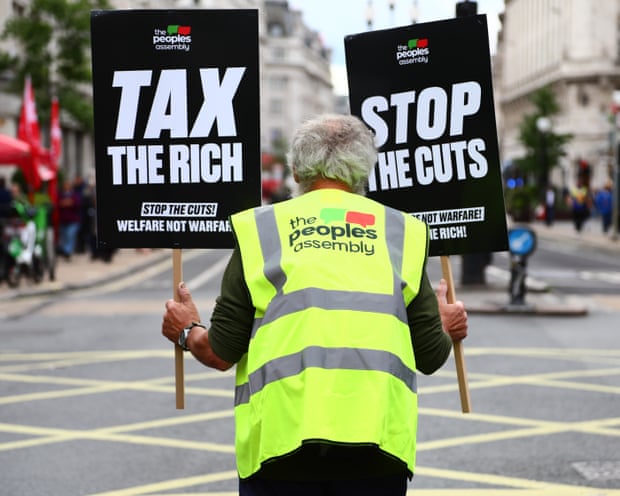
The British Social Attitudes report found that just 7% of respondents backed cuts to disability benefits. Photograph: Andriy Popov/Alamy
Nearly half of respondents say spending on personal independence payments should be increased
There is little appetite for cuts to disability benefits even among Conservative and Reform voters, and proposals to reduce spending could prove politically risky, according to an authoritative national survey.
The British Social Attitudes (BSA) report found that while support for welfare spending as a whole had dipped sharply in recent years, just 7% of respondents backed cuts to disability benefits – and 49% said they should be increased.
Two government-commissioned reviews – of the personal independence payment (Pip) benefit, and support for jobless youngsters – are expected imminently, amid speculation they will seek to restrict spending on disability benefits.
The BSA report notes that any ministerial proposals to axe disability benefits would carry little support among Labour voters, of whom just 5% favoured reduced spending and 57% backed more generous spending.
Support for spending on disabled people remained high among Tory and Reform UK voters of whom 40% supported more spending on claimants who could not work, and just 10% supported less spending.
The suicide of Tamara Jade Logon after her disability benefits were wrongly withdrawn is the latest in a series of deaths in which coroners have cited DWP failings, exposing a pattern of preventable harm, says DYLAN MURPHY
A DAMNING coroner’s report has concluded that the Department for Work and Pensions (DWP) played a significant role in the suicide of a vulnerable young woman, Tamara Jade Logon.
This case is the latest in a deeply disturbing pattern of deaths where the DWP’s actions have been officially cited as a contributing factor, intensifying calls for a full independent inquiry into the department’s systemic safeguarding failures.
…
It is time to end the culture of secrecy and unaccountability that has allowed these tragedies to occur under both Tory and Labour governments.
The Labour government must live up to its obligations under international human rights law and take action to stop the continuing abuses committed by the DWP against disabled people.
The labour movement must help build a social security system based on dignity, trust and compassion, and ensure that the DWP is held responsible for its duty of care to every single claimant. The lives of the most vulnerable members of our society depend on it.
Keir Starmer says that the Labour Party under his leadership is intensely relaxed about assaulting those least able to defend themselves – the very poorest and most vulnerable.
Many Labour MPs still believe these are the wrong reforms and will vote against the bill next week. Photograph: Alishia Abodunde/Getty Images
Sir Keir Starmer’s plans risk creating lasting inequality – and alienating the very voters who once believed his party stood for their protection
…
The upshot is that existing claimants would be protected, but future ones face tougher rules. Two people with identical conditions could receive support, according to the Institute for Fiscal Studies, that differs by up to £6,560 a year – purely due to timing. This, we’re told, is compassion. The savings – halved to £2.5bn a year – come by offloading the cost on to future claimants. MPs rightly fear this locks in a two-tier system that is deliberately harsher on disabled people.
Older Labour MPs will remember denouncing this very playbook. A decade ago, Iain Duncan Smith pioneered a slow, procedural tightening of welfare – hitting new claimants first, then reassessing the rest – precisely to defuse resistance. Labour opposed it then. Today, it is governing by the same method. It feels out of step with a post-pandemic Britain grappling with a cost of living crisis.
Many Labour MPs believe these are still the wrong reforms and will vote against the bill when it comes back to the House of Commons next week. Clearly, tightened eligibility and a two-tier system may exclude many who need support. If the government wants to raise money, it might ask a little more of those with the broadest shoulders – not those with mobility aids, care plans and the audacity to ask for a fair deal. If ministers truly believe they are acting decently, they should publish the impact assessment and be honest about the consequences.
A devastating new 44-page report reveals Labour’s cuts will push 400,000 into poverty and cost disabled people up to £10,000 annually, while the government refuses to make savings by cutting spending on war instead, writes Dr DYLAN MURPHY
THE Citizens’ Advice Bureau (CAB) has just issued a hard-hitting report entitled Pathways To Poverty, which condemns the government’s Pathways To Work green paper. This well-researched 44-page report totally undermines the many flimsy arguments put forward by the “red Tories” to justify their killer cuts.
The report goes through the effects of restricting Personal Independence Payment (PIP) eligibility, cutting the universal credit (UC) health element and making PIP daily living the gateway to UC health. As the CAB points out, over 1.6 million people, which is nearly half of those currently receiving the daily living element of PIP, stand to lose out with an average loss of £4,500 a year.
Its opening paragraph blasts Keir Starmer and company for their sham consultation over the £7 billion worth of proposed cuts: “By refusing to properly consult on its plan to cut billions from disability benefits, the government is choosing not to ask questions it doesn’t want the answers to.
“The cuts will have a devastating impact on disabled people (and their children), sending hundreds of thousands into poverty, and many more into deeper poverty. This will result from a series of arbitrary reforms that have been designed around savings targets rather than improving outcomes, inflicting hardship on people in ways that the government doesn’t yet fully understand.”
…
As the CAB report notes: “A DWP survey of disability and incapacity benefit claimants found that 41 per cent of respondents were on a waiting list for treatment for their health problems, and 50 per cent who were currently out of work felt their ability to work was dependent on receiving treatment.”
Finally, the CAB report makes the point that cutting billions from disability benefits is a false economy as it will merely make many disabled people even more ill, dramatically increasing the demands on the NHS, social services, education and voluntary sector. Besides this, there will be a growing number of disabled people made homeless by these cuts, never mind the increase in the suicide rate which will inevitably follow.
The CAB report concludes with a call on Labour to abandon its cuts, which are a devastating attack on some of the most vulnerable people in our society: “The government must reconsider its current approach. We are calling on the government to cancel proposed cuts to disability benefits.
Keir Starmer confirms that he’s proud to be a red Tory continuing austerity and targeting poor and disabled scum.Keir Starmer explains that he feels no shame or guilt benefitting personally from gifts from the rich and powerful while insisting on policies of severe austerity causing suffering and death.
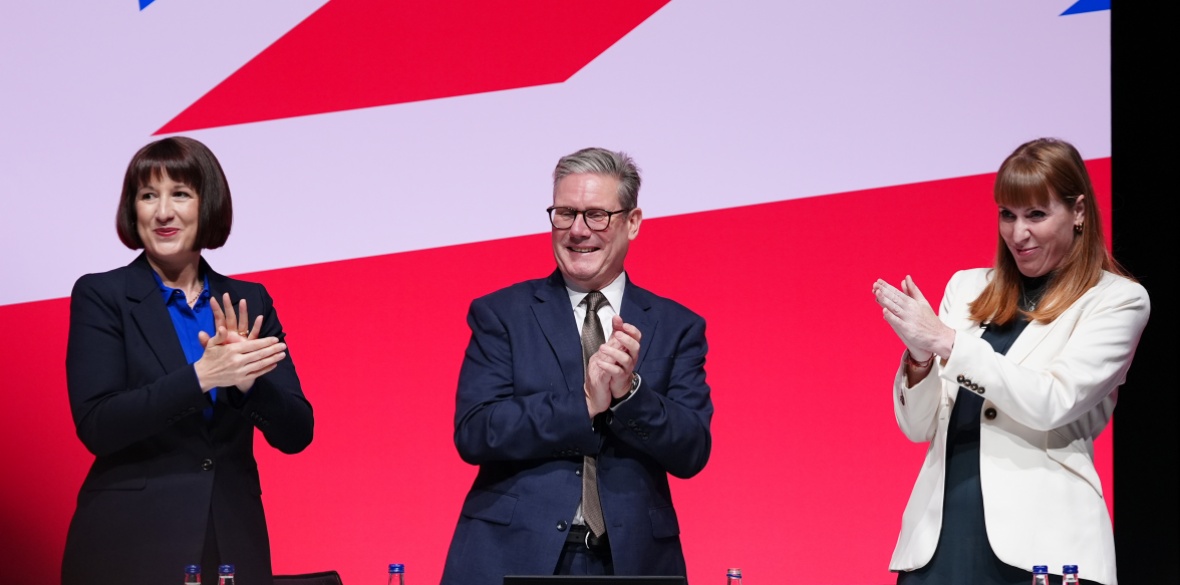
(left to right) Chancellor of the Exchequer Rachel Reeves, Prime Minister Keir Starmer and Deputy Prime Minister Angela Rayner clap their hands during the Labour Party Conference in Liverpool, September 22, 2024
NATIONAL Education Union (NEU) president Sarah Kilpatrick slammed Labour’s renewed austerity today, telling the NEU annual conference that Tory welfare cuts had killed her disabled father.
She accused ministers of “perpetuating and repeating the shameful pattern of punching-down and finger-pointing” by “balancing the books on the backs of the poor.”
On the first day of the conference in Harrogate, North Yorkshire, she described how her father had died at the age of 56 after being stripped of his disability benefits under the Conservative-Liberal Democrat coalition government.
She said that she had experienced poverty as a working-class child in Newcastle upon Tyne and was his carer for a number of years.
“As Iain Duncan Smith gleefully applauded the welfare cuts, I represented my father in a tribunal against the DWP [Department for Work and Pensions] decision to remove his disability benefits,” she told delegates.
“He’d had his gas cut off. Couldn’t afford groceries. His elderly mother was adding tins of food to her shopping to bulk up what I was buying for him, but he isolated himself further still.
“He lost a lot of weight during that time and never really recovered.”
In 2013, her father became one of an estimated 120,000 people who died as a result of the Tories’ austerity programme, she said.
“When Wes Streeting brags to the Tories across the benches that Labour have done what they never could and slashed the welfare bill, this is what they mean,” said Ms Kilpatrick.
“Let’s be clear. Nearly two decades of economic permacrisis has not been caused by disabled people.”
Nor has it been caused by the elderly, refugees, the trans community or children in poverty, she said.