This work by Middle East Monitor is licensed under a Creative Commons Attribution-NonCommercial-ShareAlike 4.0 International License.
President Donald Trump gives opening remarks during a press conference with Israeli Prime Minister Benjamin Netanyahu in the State Dining Room of the White House in Washington, DC on September 29, 2025. [Stringer – Anadolu Agency]
US President Donald Trump said on Sunday that he was unsure whether former British Prime Minister Tony Blair would join the new “Peace Council” planned to oversee the governance of the Gaza Strip, amid ongoing criticism of Blair’s role in the Iraq war.
“I’ve always liked Tony, but I want to find out that he’s an acceptable choice to everybody,” Trump told reporters, without naming specific leaders who might have a say in Blair’s appointment.
The Gaza peace plan, announced by the White House last month, listed Blair as a proposed member of the new council.
Trump made his remarks to journalists aboard Air Force One during his flight to Israel, where he is scheduled to deliver a speech to the Knesset on Monday.
He also plans to attend a world leaders’ summit in Egypt aimed at formally ending the war in Gaza, as the ceasefire enters its fourth day.
Orcas discuss Genocide-supporting and complicit Zionists. Donald Trump, Keith Starmer, David Lammy, Rachel Reeves, Angela Rayner and Wes Streeting are acknowledged as evil genocide-complicit and supporting cnuts.Keir Starmer objects to criticism of the IDF. He asks how could anyone object to them starving people to death, forced marches like the Nazis did, bombing Gaza’s hospitals and universities, mass-murdering journalists, healthworkers and starving people queuing for food, killing and raping prisoners and murdering children. He calls for people to stop obstructing his genocide for Israel.Genocide denier and Current UK Prime Minister Keir Starmer is quoted that he supports Zionism without qualification. He also confirms that UK air force support has been essential in Israel’s mass-murdering genocide. Includes URLs https://www.declassifieduk.org/keir-starmers-100-spy-flights-over-gaza-in-support-of-israel/ and https://youtu.be/O74hZCKKdpA
This work by Middle East Monitor is licensed under a Creative Commons Attribution-NonCommercial-ShareAlike 4.0 International License.
US President Donald Trump disembarks from Air Force One upon arrival at Ben Gurion Airport on the outskirts of Lod near Tel Aviv on October 13, 2025, as he travels to Israel and Egypt. [Jack GUEZ / AFP/ Getty Images]
In a move dense with symbolism and political calculation, President Donald Trump is in Egypt to celebrate the handover of Israeli hostages by Hamas. What is cast as a diplomatic triumph is, in reality, a performance piece designed to salvage reputations rather than achieve peace.
For two brutal years, Israel—with full US backing—pounded Gaza. Despite superior firepower, advanced surveillance, and staunch diplomatic protection, it failed to crush Hamas. The war left thousands dead and Gaza flattened. The final bargain: not conquest, but concession. Hamas is still upright and resilient.
Trump was never a neutral mediator. From weapons to intelligence-sharing to U.N. veto cover, his administration served as Israel’s war partner. His “peace rhetoric” often concealed complicity in Netanyahu’s war logic. He wasn’t brokering peace; he was underwriting Israel’s campaign.
Rebranding defeat as victory
With global attention focused on him, Trump makes his entrance to recast the story. He wants to turn an inconclusive war into a story of triumph. But battlefield assessments suggest otherwise: Hamas, while wounded, remains a wild card.
“Israel misjudged the resilience of the resistance,” recounts Israeli historian Ilan Pappé, noting how the campaign strengthened Hamas’s political identity even as it devastated Gaza. In Israel itself, Haaretz lambastes what it calls Netanyahu’s “strategic blindness,” warning that his military-first obsession has isolated Israel and left it less secure. The critique is no longer fringe; it’s becoming mainstream in Israeli discourse. Netanyahu’s boastful and unachievable goals may ultimately lead to his downfall. He never listened to Machiavelli: “The tongue has destroyed more men than the sword, for words once released can never be recalled”.
A Washington Post analysis frames Trump’s Gaza gambit as risk-laden: he may have coerced a settlement, but sustaining it demands pressure he may lack. The war may be paused, but the contradictions are unresolved.
Trump’s optics of redemption
This Egyptian excursion is more about spectacle than diplomacy. The stage is set; hostages are reunited, arms clasped, a president framed as a peacemaker. Yet touch the surface and you find the fissures.
An article by David Ignatius in The Washington Post praises Trump’s coalition-building but also notes his modus operandi: declare victory first, work out the details later. The inversion of selling the banner of peace before securing the foundation is the key to understanding this visit.
Former CIA analyst Graham E. Fuller warns: “Washington has burned moral capital defending Israel’s conduct—only to offer a ceasefire that everyone expects will collapse.” The optics may dazzle. The substance, however, is brittle.
For Netanyahu, Trump’s arrival is a lifeline. His coalition teeters, public weariness grows, and international patience wanes. With Trump’s arrival, a deadlocked war becomes a shared pageant. A faltering gambit can be reframed as a shared triumph. If loyalty turns to envy, friends can become rivals.
But elites in Israel are whispering about failure. In TheTimes of Israel, a civil commission’s scathing report laments Netanyahu’s “arrogance and inherent blindness” in failing to prepare the country for the 7 October assault. He’s accused of undermining decision-making, sidelining security organs, and overcentralizing power. If very senior officials were barred from dissent, the political house was built on fear, not strategy.
Netanyahu needs Trump to save his skin and help reignite the narrative from gridlock to breakthrough, from defeat to deliverance. However, the miracle is contingent upon the illusions remaining solid. Netanyahu kept Trump in the dark during the war. He knows knowledge is a blade, and when you hand it freely, you place the weapon in your enemy’s hand.
Trump and Netanyahu are inevitably poised to exchange barbed accusations over Gaza’s unresolved chaos. That verbal exchange of blaming each other for Hamas’s survival, strategic missteps, and ignored counsel is looming on the horizon. Beneath the rhetoric simmers a quiet charge of betrayal, as both leaders subtly imply perfidy and failed promises, their alliance fraying under the weight of unmet expectations and diverging ambitions. Throughout the war, Netanyahu underestimated Presidents Biden and Trump, believing he could manipulate them as well as the US. Now he discovers that being underestimated is far safer than being fully known.
The pivot to Iran
The Gaza theatre will soon be over, and both men will pretend it never happened the way it did. Both men share the instinct to pivot—and nothing is more convenient than Iran. With Gaza’s devastation already disputed, Netanyahu is already telegraphing a shift to Tehran as the new existential rival. The script is familiar: rally behind a new threat, reset internal consensus.
Within US defense circles, pressure is mounting for a tougher stance on Iran. Israeli officials reportedly press Trump to re-impose sanctions, reassert deterrence, and prepare renewed confrontation. “Gaza needs to be forgotten. Iran must be next,” said an anonymous defense analyst quoted in strategic coverage. This is not a war of necessity, but a war of distraction: personal survival masquerading as a national imperative. Trump, ever the opportunist, may again be lured into conflict he helped mismanage, chasing legacy on borrowed time.
Conclusion: The mirage of victory
No statue in Cairo will change Gaza’s rubble. No press conference will erase the war’s toll. History judges more slowly than headlines. It is Trump’s turn to quote the author of The Prince: “Power does not belong to the one who speaks loudly, but to the one who withholds”.
Trump may strut down a tarmac, declare peace, and bask in the global applause. However, the pieces left behind—displacement, devastation, silent tunnels, and the political phoenix of resistance—testify to a war that remains unresolved. Until genuine leadership replaces spectacle, peace will remain a prop rather than a policy.
The views expressed in this article belong to the author and do not necessarily reflect the editorial policy of Middle East Monitor.
This work by Middle East Monitor is licensed under a Creative Commons Attribution-NonCommercial-ShareAlike 4.0 International License.
Orcas discuss Genocide-supporting and complicit Zionists. Donald Trump, Keith Starmer, David Lammy, Rachel Reeves, Angela Rayner and Wes Streeting are acknowledged as evil genocide-complicit and supporting cnuts.Keir Starmer objects to criticism of the IDF. He asks how could anyone object to them starving people to death, forced marches like the Nazis did, bombing Gaza’s hospitals and universities, mass-murdering journalists, healthworkers and starving people queuing for food, killing and raping prisoners and murdering children. He calls for people to stop obstructing his genocide for Israel.Genocide denier and Current UK Prime Minister Keir Starmer is quoted that he supports Zionism without qualification. He also confirms that UK air force support has been essential in Israel’s mass-murdering genocide. Includes URLs https://www.declassifieduk.org/keir-starmers-100-spy-flights-over-gaza-in-support-of-israel/ and https://youtu.be/O74hZCKKdpA
This work by Middle East Monitor is licensed under a Creative Commons Attribution-NonCommercial-ShareAlike 4.0 International License.
Egyptian President Abdel Fattah El-Sisi in El Alamein, Egypt on August 05, 2024 [Murat Gök/Anadolu Agency]
Egyptian President Abdel Fattah el-Sisi on Friday reiterated his country’s strong opposition to any attempts to forcibly displace Palestinians from their land during his talks with Dutch Prime Minister Dick Schoof, Anadolu reports.
The two leaders spoke by phone about bilateral relations and the deteriorating situation in the Gaza Strip, according to the Egyptian presidency.
Sisi emphasized the importance of strengthening cooperation between Egypt and the Netherlands.
Sisi also highlighted Egypt’s ongoing efforts to broker a ceasefire in Gaza and ensure the urgent and sufficient delivery of humanitarian aid to the besieged enclave, according to the presidency’s statement. He stressed the need for progress in negotiations to release prisoners on both sides.
Israel currently claims that 50 of its hostages remain in Gaza, including 20 who are still alive. Meanwhile, over 10,800 Palestinians are imprisoned in Israeli jails under conditions widely condemned by rights groups as involving torture, starvation, and medical neglect, practices that have led to numerous deaths.
Negotiations between Israel and Hamas mediated by Qatar and Egypt and backed by the US recently collapsed in Doha after Israel hardened its position on issues including full military withdrawal from Gaza, ending the war, prisoner exchange terms, and aid distribution mechanisms.
While Hamas has signaled readiness to release all Israeli hostages in a single exchange, conditional on a permanent ceasefire and Israel’s withdrawal from Gaza, Israeli Prime Minister Benjamin Netanyahu has continued to impose new demands.
In his call with Schoof, Sisi also reaffirmed Egypt’s commitment to restarting the political process based on a two-state solution.
He further stressed the urgency of launching Gaza’s reconstruction as soon as a ceasefire is achieved.
“Egypt remains firmly opposed to any plans to forcibly displace Palestinians,” the presidency said, reaffirming Cairo’s longstanding position.
In March, Egypt proposed a five-year, $53 billion reconstruction plan for Gaza, adopted at an emergency Arab League summit.
The plan explicitly ruled out any displacement of Palestinians. However, both Israel and the US have rejected the initiative and instead backed an alternative plan promoted by US President Donald Trump that would relocate Palestinians to neighboring countries like Egypt and Jordan.
Both nations have rejected such proposals, alongside other Arab states and international organizations.
Rejecting international calls for a ceasefire, the Israeli army has pursued a brutal offensive on Gaza since Oct. 7, 2023, killing more than 60,300 Palestinians, most of them women and children. The relentless bombardment has destroyed the enclave and led to food shortages.
Last November, the International Criminal Court issued arrest warrants for Israeli Prime Minister Benjamin Netanyahu and his former Defense Minister Yoav Gallant for war crimes and crimes against humanity in Gaza.
Israel also faces a genocide case at the International Court of Justice for its war on the enclave.
This work by Middle East Monitor is licensed under a Creative Commons Attribution-NonCommercial-ShareAlike 4.0 International License.
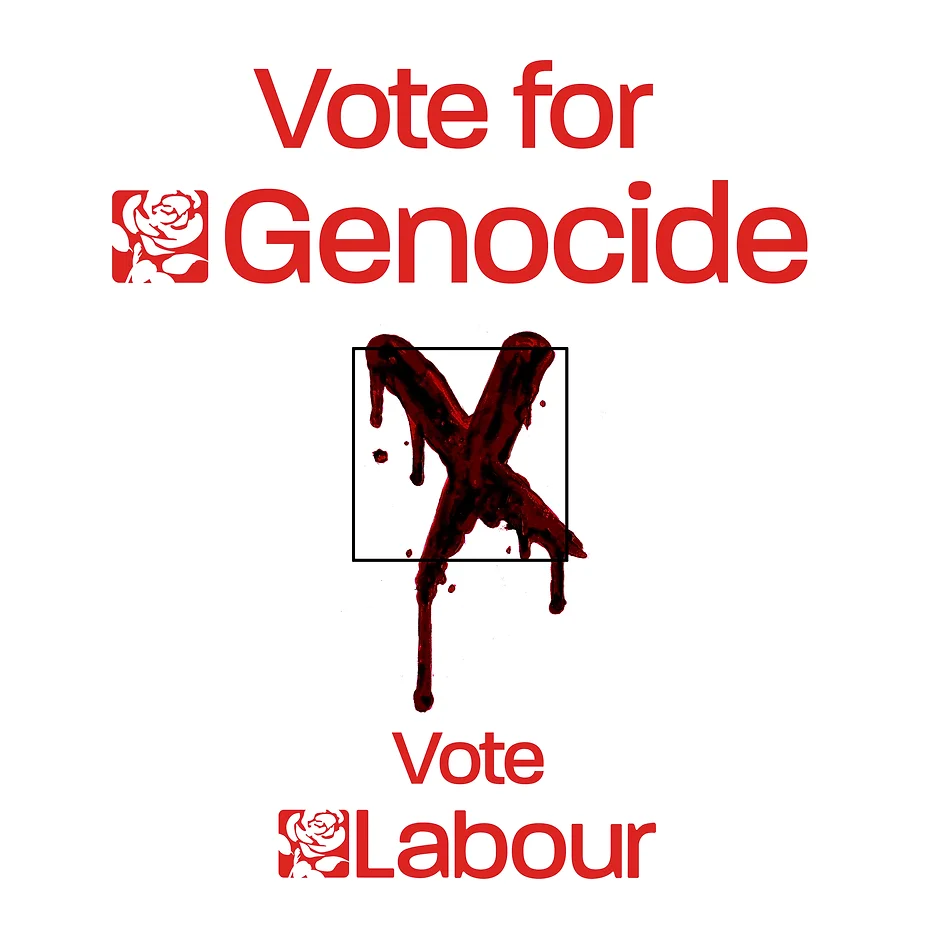
UK Labour Party government ministers Keir Starmer, Angela Rayner and Rachel Reeves explain that they are partners complicit in Israel’s Gaza genocide. The UK has provided Israel with arms, military and air force support. They explain that they don’t do gas chambers but do do forced marches, starvation, destroy hospitals, mass-murders of journalists and healthcare workers.Vote Labour for Genocide.
This work by Middle East Monitor is licensed under a Creative Commons Attribution-NonCommercial-ShareAlike 4.0 International License.
A large crowd gather during a food distribution by a charity organization, as many Palestinians struggle to access food due to Israel’s ongoing attacks on the Gaza Strip, on July 18, 2025. [Abdalhkem Abu Riash – Anadolu Agency]
In Gaza, mornings no longer begin with the sound of explosions — but with the quiet, urgent cries of hunger.
Mothers wake to infants with no milk. Children search for scraps to ease empty stomachs before the bombs return to flatten what little hope remains.
This isn’t exaggeration. It’s a grim, documented reality. Gaza is not only under bombardment — it’s under siege. And the weapon now cutting deepest is starvation. Because hunger is silent, the world looks away, as if a slow death does not count.
For months, Gazans have faced a dual siege: daily airstrikes and international indifference. Border crossings remain closed. Those searching for food are shot. Humanitarian supply lines are systematically broken. Bread has become a fantasy. Water is a daily fight. Medicine, a rare miracle.
“Humanitarian catastrophe” no longer captures it. What’s unfolding now is a deliberate campaign of starvation — one that meets every definition, legal and moral, of genocide.
Footage smuggled out of Gaza shows children collapsing while queuing for bread, families surviving on weeds, mothers dividing a single loaf between four hungry children. It’s not the bombs killing them — it’s the slow wasting of malnourished bodies.
The people of Gaza are not asking for the impossible. They are asking for a shred of global conscience.
But what hurts even more than the hunger is the silence.
In the early days of the assault, Western leaders issued cautious statements: calls for restraint, reminders of international law, expressions of concern. But those voices have since faded. Forgotten. Buried in old press releases. No action followed. No policies changed.
Instead, support for Israel intensified. Some governments even suspended funding to the UN’s main relief agency, UNRWA — in the middle of Gaza’s collapse.
Have you ever heard of a government withdrawing aid from a humanitarian agency while children are starving?
It happened. And it happened quietly.
As Nelson Mandela once said:
“To deny people their human rights is to challenge their very humanity.”
Today, Gaza is being punished not only with bombs, but with hunger — a form of collective punishment enabled by an international consensus too timid to speak out. You won’t find this consensus in official statements, but you’ll see it in every sealed border, every empty bowl, and every child who cries from thirst.
According to UN agencies:
Food insecurity has reached catastrophic levels.
Over 90 per cent of children in Gaza are malnourished.
Infant deaths from starvation and dehydration are now a daily reality.
Yet the world remains still.
Worse still, some governments continue to justify Israel’s actions under the banner of “self-defence” — as if using starvation as a weapon were somehow legitimate.
But it isn’t just the West that bears responsibility.
Egypt too must answer for its role. The Rafah crossing — Gaza’s only exit not controlled by Israel — has been shut for months. Cairo waits for Tel Aviv’s permission to let aid in or patients out. When will we stop pretending this is neutrality? This is complicity.
And what of the Arab governments who have normalised ties with Israel? Some have remained silent. Others have gone further, publicly strengthening relations while Gaza starves. At least the West doesn’t claim kinship. But these regimes do — while doing nothing to stop the suffering of fellow Palestinians.
As former UN Secretary-General Kofi Annan once warned:
“When food becomes a weapon, humanity itself has collapsed.”
Gaza is facing that collapse — and the international system is allowing it to happen.
Yet despite everything, Gaza endures. Its people turn hunger into defiance. They resist, even when stripped of everything. In Gaza, dignity isn’t found in comfort — it’s found in survival.
But let’s be honest: Israel cannot sustain this alone. It relies on silence. On selective outrage. On diplomatic cover. And that is exactly what it gets from world powers who claim to care about human rights — but choose which victims matter.
So who is really standing with Gaza?
Not governments. Not institutions. But ordinary people. Protesters. Citizens. The ones who still have a conscience and refuse to look away.
Gaza doesn’t want pity. It wants justice. It demands an end to the genocide — and accountability for those who enable it.
The question is no longer: What is happening?
We know.
The question is: Who will act?
And when history is written — who will be remembered for their silence?
Because silence, in the face of starvation, is not neutrality.
It is complicity.
The views expressed in this article belong to the author and do not necessarily reflect the editorial policy of Middle East Monitor.
This work by Middle East Monitor is licensed under a Creative Commons Attribution-NonCommercial-ShareAlike 4.0 International License.
Keir Starmer objects to criticism of the IDF. He asks how could anyone obect to them starving people to death, forced marches like the Nazis did, bombing Gaza’s hospitals and universities,mass-murdering journalists, healthworkers and starving people queuing for food, killing and raping prisoners and murdering children. He calls for people to stop obstructing his genocide for Israel.
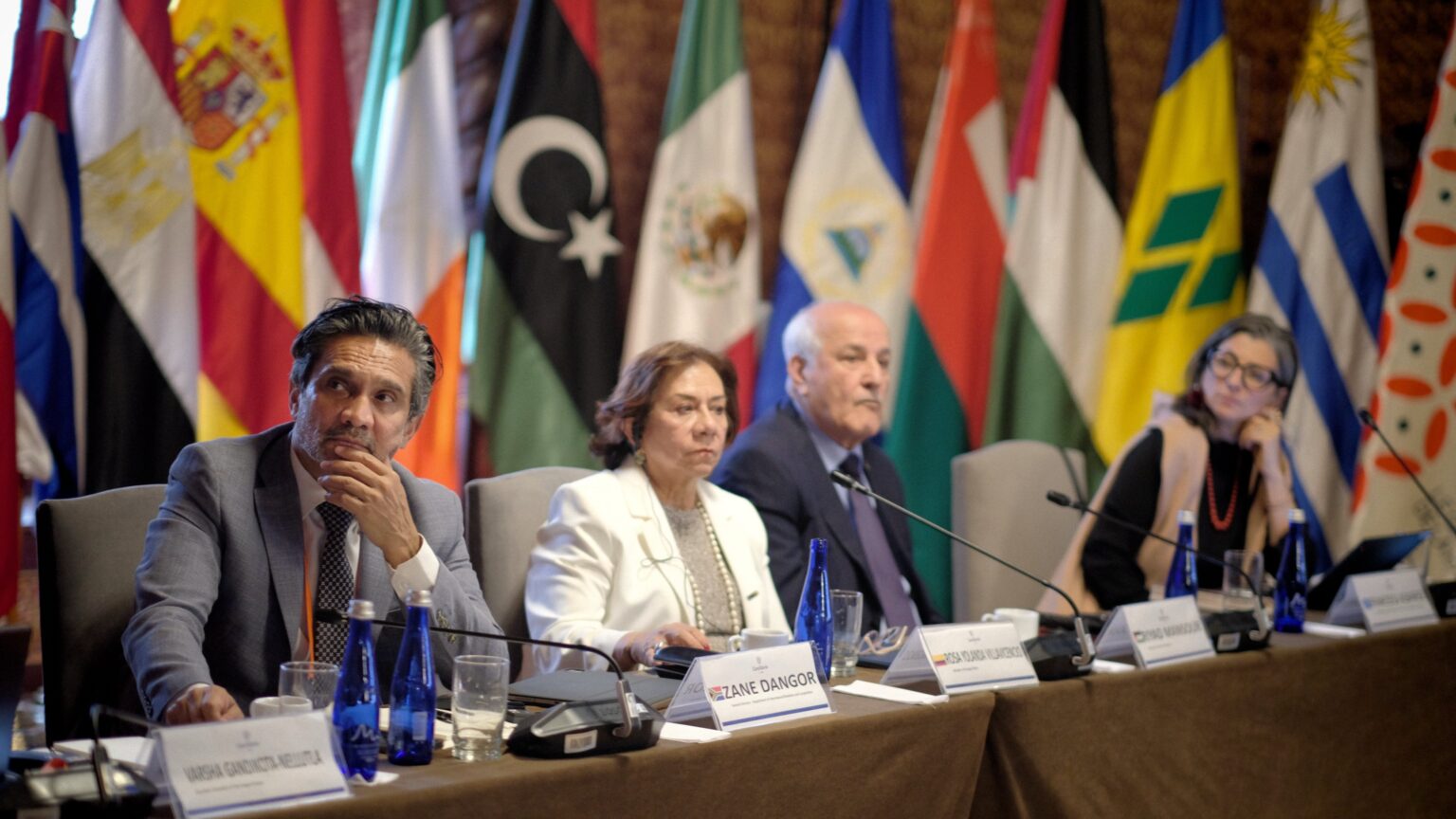
Hague Group Summit in Bogotá, Colombia. Photo: Abby Martin
In the final document, the signatory countries commit, among other things, to cease arms trade with Israel, review public contracts with that country, and seek accountability for war crimes.
Countries of the Global South have expressed their solidarity with the Palestinian people at the Emergency Ministerial Conference on Palestine organized by The Hague Group, which took place on July 15 and 16 in Bogotá, Colombia. The multilateral meeting was attended by representatives from Algeria, Bangladesh, Botswana, Brazil, Chile, China, Djibouti, Egypt, Slovenia, Spain, Honduras, Indonesia, Iraq, Ireland, Lebanon, Libya, Malaysia, Mexico, Namibia, Nicaragua, Norway, Oman, Pakistan, Palestine, Qatar, Saint Vincent and the Grenadines, South Africa, Turkey, Uruguay, and Venezuela.
Regarding the meeting, Colombia’s deputy secretary of state, Mauricio Jaramillo, said: “This conference is being convened by the Hague Group, but it is not an exclusive meeting of this group. Given the urgency of what is happening in the occupied territories, especially in Gaza, where today, for example, we have passed the threshold of 58,000 fatalities, we must commit ourselves to action.”
The conference, which was organized by the governments of Colombia and South Africa and attended by 30 countries, agreed that: “The era of impunity must end – and that international law must be enforced without fear or favor through immediate domestic policies and legislation – along with a unified call for an immediate ceasefire.”
The agreements
According to an official press release, the meeting laid out several measures to stop the genocide in Gaza:
Prevent the provision or transfer of arms, munitions, military fuel, related military equipment, and dual-use items to Israel.
Prevent the transit, docking, and servicing of vessels at any port … in all cases where there is a clear risk of the vessel being used to carry arms, munitions, military fuel, related military equipment, and dual-use items to Israel.
Prevent the carriage of arms, munitions, military fuel, related military equipment, and dual-use items to Israel on vessels bearing our flag … and ensure full accountability, including de-flagging, for non-compliance with this prohibition.
Commence an urgent review of all public contracts to prevent public institutions and funds from supporting Israel’s illegal occupation of the Palestinian Territory and entrenching its unlawful presence.
Comply with obligations to ensure accountability for the most serious crimes under international law, through robust, impartial, and independent investigations and prosecutions at national or international levels, to ensure justice for all victims and the prevention of future crimes.
Support universal jurisdiction mandates, as and where applicable in national legal frameworks and judiciaries, to ensure justice for victims of international crimes committed in the Occupied Palestinian Territory.
Although 30 countries attended the meeting, only 12 countries committed to immediately complying with the agreements outlined in the final declaration: Bolivia, Cuba, Colombia, Indonesia, Iraq, Libya, Malaysia, Namibia, Nicaragua, Oman, Saint Vincent and the Grenadines, and South Africa. The others expected to join them by September 20, 2025 – the date of the 80th UN General Assembly. The group will also be consulting various other states on an ongoing basis for participation in the measures against Israel.
Colombia’s President Gustavo Petro stated: “We came to Bogotá to make history — and we did … Together, we have begun the work of ending the era of impunity. These measures show that we will no longer allow international law to be treated as optional, or Palestinian life as disposable.”
“What we have achieved here is a collective affirmation that no state is above the law … The Hague Group was born to advance international law in an era of impunity. The measures adopted in Bogotá show that we are serious — and that coordinated state action is possible,” said South African Secretary of State Ronald Lamola.
The final agreement is historic as it is the first multilateral agreement that seeks to influence the Israeli government’s actions in its offensive against Gaza. In this sense, it is the first time that several countries have challenged the apparent immunity of the Israeli state in its actions in Gaza, which could have unpredictable diplomatic repercussions. It could also become the starting point for other countries to demand an end to the violence in Palestine jointly.