UK Labour Party government Keir Starmer, Angela Rayner and Rachel Reeves explain that they are participants and complicit in Israel’s Gaza genocide providing Israel with army and air force support. They explain that they don’t do gas chambers but do do forced marches, starvation, destroy hospitals, mass-murders of journalists and healthcare workers.
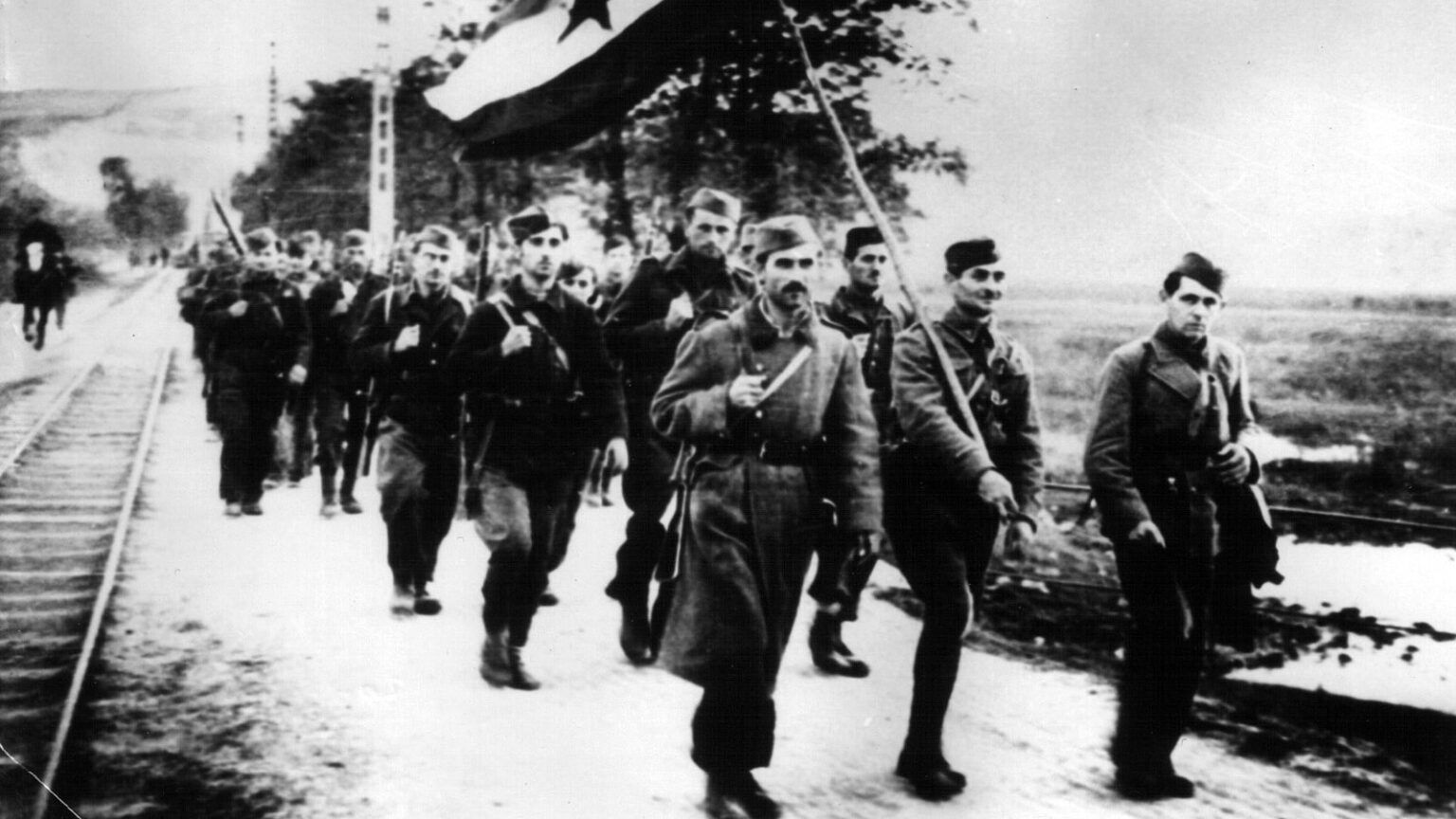
Entrance of the 7th Vojvodina Brigade of Yugoslav partisans in liberated Novi Sad, 23 October 1944. Photo: Wikimedia Commons
Neo-fascism merely adapted, disguised, and reshaped itself according to the times. In some states, we now see historical revisionism – and even glorification of local fascist or Nazi collaborators.
As we approach a major anniversary – 80 years since the defeat of fascism – a strange silence hangs over my country, Macedonia, and the broader region we now call the territory of former Yugoslavia. National authorities have been under sustained external (Western) pressure for years: May 9 must no longer be associated with the victory over fascism. Year after year, in both public memory and the education system, May 9 has been rebranded as Europe Day.
Older generations still remember, but what do younger ones know about Yugoslavia’s enormous human sacrifice, second only to the USSR, in the struggle against Evil? Almost nothing. We, the older ones, might suffer from the absence of dementia – we stubbornly remember the times when our fathers and grandfathers gave their lives for ideals that today’s youth barely even hear about.
This imposed forgetfulness on younger generations, however, goes so far that TV segments show young people unable to answer the simple question: Who was Josip Broz Tito? In Macedonia, more and more students know nothing about October 11, 1941, the Day of the Macedonian Uprising against fascism. Yet they excel in competitions where they display near-perfect knowledge of Europe. The irony is painful: the roots of patriotism and links to the most glorious moments of our not-so-distant past are not only being severed but portrayed as harmful.
A mythical and quasi-religious connection is being nurtured toward a mirage called Europe – meaning, of course, the European Union – which is idealized as a promised land, waiting with open arms. But this is no coincidence. Through its entire state-building apparatus, the EU seeks to rewrite history and implant it in the minds of new generations. In that version of history, any connection to the brutal colonial past is erased. More importantly, a veil is drawn over the fact that Europe’s imperial ambitions led to two world wars. The Second World War, whose anniversary we now mark quietly – even clandestinely, behind the EU’s back – was the anticlimax of capitalism, its degeneration into Nazism and fascism. This was not merely the result of individuals like Hitler or Mussolini, but of structural conditions that emerged from the womb of the post-World War I capitalist crisis.
The EU, falsely presenting itself as the embodiment of “Europe”, has been busy remodeling its image – until the start of the special military operation in Ukraine, it even tried to portray itself as a normative power, winning hearts and minds through soft power. It was even awarded the Nobel Peace Prize for past deeds. Yet its present and future seem to signal the revival of the very seed of evil it once claimed to oppose. The latest deep cycle of capitalist crisis first resulted in a divorce from democratic principles, but now it does not hide its hyper-imperialist and militaristic aspirations – for the sake of “self-defense” from an imagined Russian threat. Colloquially, many of us use the new word “Rusophrenia”: a belief that Russia is about to collapse and to take over the world at the same time. This term describes well the irrational view of Russia that is now entrenched in Western public opinion. It helps legitimize the new wave of militarization, even at the expense of the social well-being of Western citizens.
The rehabilitation of fascism began with its erasure from memory. Then came the glorification of the Euromaidan in Ukraine – the so-called pro-European revolution of 2014. A strange amnesia is spreading through the so-called Western world. As said, May 9 was kidnapped, and with it, textbooks, symbolic acts, and commemorations were gradually stripped of any connection to the true military victors of World War II: the Red Army and the Soviet people, who sacrificed more than 27 million lives. (Yugoslavs sacrificed more than a million people.)
It was the Soviets who liberated Berlin – twice. The final time, it was done by Mikhail Gorbachev, at a cost that Russia continues to pay today. Even the UN Secretary-General now avoids naming the Red Army soldiers who freed prisoners from the most notorious concentration camps.
It is Moscow and its allies who now stand as the only ones acting in the spirit of Orwell’s assertion that “in a time of universal deceit, telling the truth is a revolutionary act”. That truth will ring out loudly during the parade and major celebration on Red Square.
What is happening in what used to be Yugoslavia? In countries where generations were raised on narratives of brotherhood and unity, on the heroism of partisans who fought on the right side of history? First came the erosion of sovereignty and the right to self-determination. As the new religion – NATO and the EU are the only alternative and always right – was internalized, governments began distancing themselves from that part of our history. They turned instead to ancient glories or to painting a glowing future in union with the West.
To be red, to be a partisan, to be anti-fascist – gradually became suspicious, even dangerous. Our government now prides itself on alliances with the West (though it’s increasingly unclear – whose West? America’s or Europe’s?), and in distancing itself from those we once fought alongside. Former occupiers are now called “administrators”. Busts of partisans gather dust.
Anti-fascism has become uncomfortable to display – lest our Western allies recognize themselves in the mirror. So, silence prevails. Europe, the EU, is still celebrated – even as it re-militarizes, tramples basic values and human rights, and tacitly supports genocidal regimes. Confusion reigns over what to celebrate, what to remember, and why. Because, in an Orwellian world, war is peace, and peace is war.
Commemoration and historical memory matter. But just as vital is the ability to see, with eyes wide open, that the serpent’s egg still lives – and could hatch again into what millions across the world gave their lives to defeat eighty years ago. The bitter truth is that fascism was never fully defeated – except on the battlefield in 1945. Social scientists know well that the roots of fascism cannot be destroyed by arms alone. Neo-fascism merely adapted, disguised, and reshaped itself according to the times. In some states, we now see historical revisionism – and even glorification of local fascist or Nazi collaborators.
That is why the Russian initiative at the United Nations is significant. On 17 December 2024, during the 79th session of the UN General Assembly, the Russian Federation proposed a resolution: Combating glorification of Nazism, neo-Nazism and other practices that contribute to fueling contemporary forms of racism, racial discrimination, xenophobia and related intolerance. It was co-sponsored by 39 states from various regions. At last, it received 119 votes in favor, while 53 voted against. Regrettably, my country was among the latter – even though its very right to self-determination and statehood within Yugoslavia was born of the anti-fascist struggle. Perhaps for global politics, it is even more telling to examine who else voted against the resolution: Ukraine, the US, the UK, Germany, Italy, Belgium, Norway, the Netherlands, Finland, Sweden, Japan, Canada… Look at the new geopolitical map of the world, and it all becomes self-evident and telling.
According to some sources, Soviet Marshal Georgy Zhukov said, “We have liberated Europe from fascism, but they will never forgive us for it.”
They haven’t, as we now clearly see.
Biljana Vankovska is a professor of political science and international relations at Ss. Cyril and Methodius University in Skopje, a member of the Transnational Foundation of Peace and Future Research (TFF) in Lund, Sweden, and the most influential public intellectual in Macedonia.
Original article by Alan Macleod republished from MPN under a Creative Commons Attribution-NonCommercial-ShareAlike 3.0 International License.
The Trump administration’s deal to send large numbers of people to prisons in El Salvador has thrust its president, Nayib Bukele, into the international spotlight. Bukele has been praised, especially in conservative media, as a dynamic and popular leader who has saved his country from the grips of gang violence. But beneath this polished image, he has cemented his rule based on assigning himself autocratic powers, jailing and persecuting his political opponents, and overseeing the creation and expansion of the world’s first prison state. MintPress News explores the dark side of the man who calls himself “the world’s coolest dictator.”
Cruelty is the Point
The hundreds of migrant detainees the U.S. sent to Central America should be kept in Salvadoran jails “for the rest of their lives,” according to Homeland Security Secretary Kristi Noem in an April interview. This is despite the fact that a Bloomberg investigation found that around 90% of those deported have no criminal records or charges against them.
Noem’s words reflect an administration eager to find a partner willing to help them outsource America’s prison-industrial complex. In February, Salvadoran President Nayib Bukele offered to use El Salvador’s sprawling and rapidly growing network of jails to receive thousands of “dangerous American criminals” for a fraction of the cost of detaining them in the United States. “No country has ever made an offer of friendship such as this,” said a delighted Secretary of State Marco Rubio, a strong Bukele supporter.
The migrants have been sent to the Terrorism Confinement Center (Centro de Confinamiento del Terrorismo, or CECOT), a $115 million facility widely criticized by human rights groups that opened its doors in October 2023. The 23-hectare site is situated in a rural area of the country, around 70 km (45 miles) from the capital, San Salvador, and is set to house 40,000 people, making it, by quite some margin, the largest prison in world history.
Conditions inside the jail have been widely condemned. Those incarcerated are packed into cells of up to 100 people. Sleeping on metal or concrete bunks, inmates must defecate in front of their cellmates. A 2024 report from the Inter-American Commission on Human Rights found an average of just 0.6 square meters (6.45 square feet) per inmate. Lights are kept on 24 hours a day.
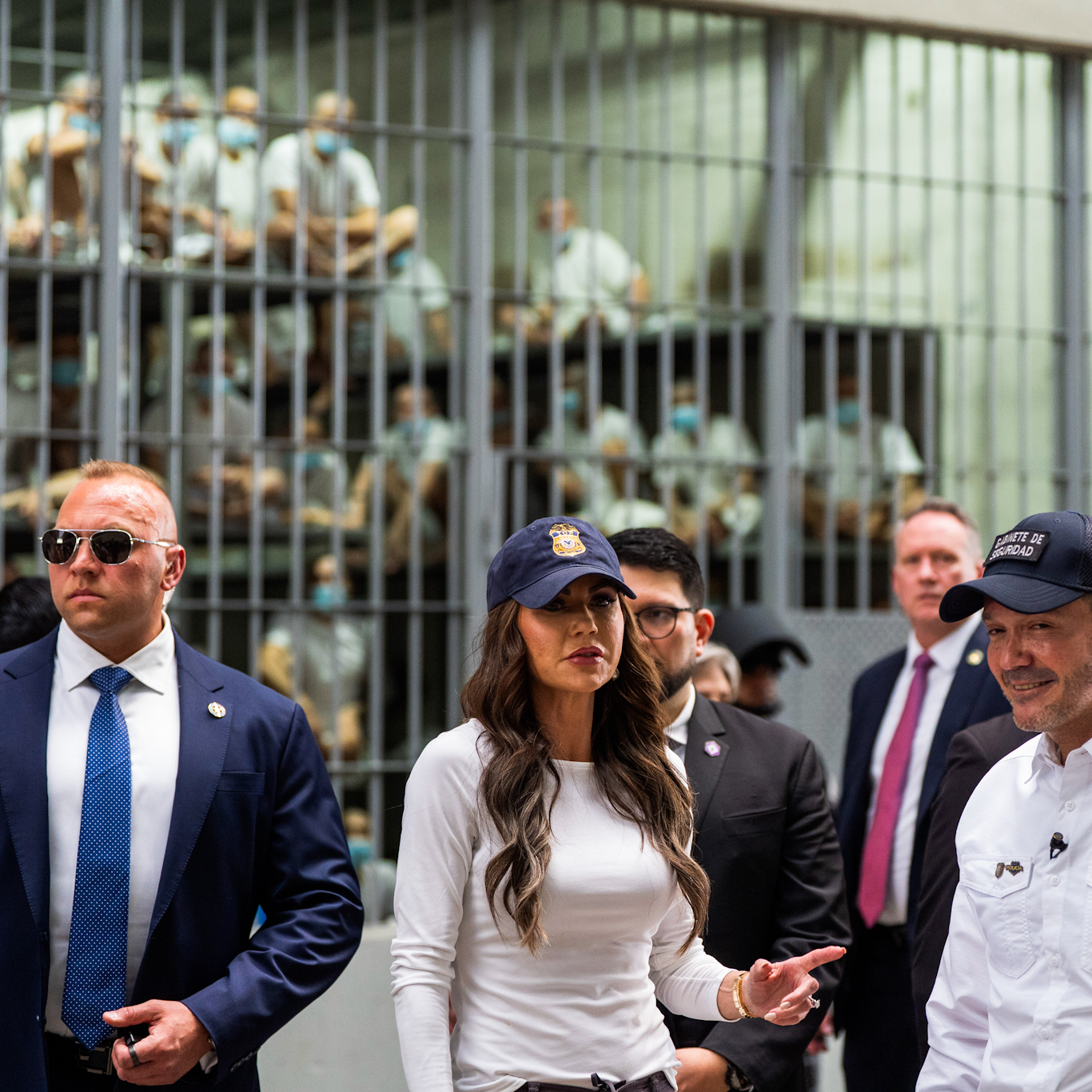
Kristi Noem tours El Salvador’s mega-prison with Minister Héctor Villatoro, March 26, 2025. Alex Brandon | AP
The food is as sparse as the personal space. Detainees are fed just 450 grams of the same meal every day, consisting of beans, pasta and tortillas, along with coffee or another drink. Provided no utensils, they must eat with their hands only.
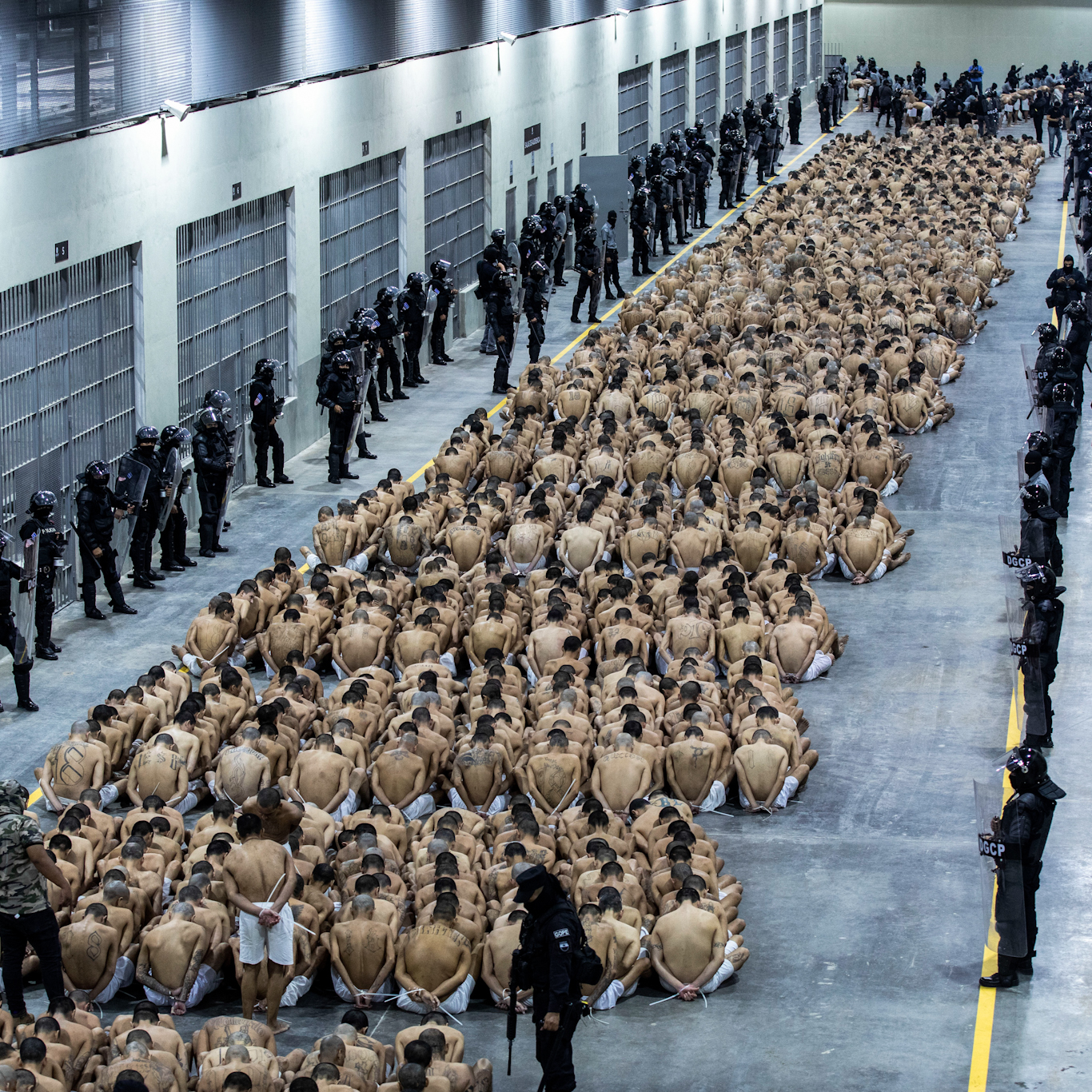
CECOT offers no outside recreation space, and those inside are allowed only 30 minutes per day out of their cells. Upon arrival, prisoners have their heads shaved, and are often forced to sit close together in formations resembling the conditions on trans-Atlantic slave ships. They are not allowed any contact with their friends, family, or lawyers. Often, the first news a family receives of the whereabouts of their disappeared relative is a note explaining that they have died in prison. The Bukele administration has made clear that they intend to make sure those inside CECOT’s walls “will never leave.”
The Trump administration had shown little concern for the reported condition at CECOT. In March, Noem herself traveled to the complex to pose in front of dozens of incarcerated people, warning others that they could be next. The Trump administration has justified its move as legal under an obscure law from 1798, and claimed that those deported were members of Tren de Aragua, a Venezuelan criminal group.
Prison Nation
Yet the conditions at CECOT are actually considerably better than at many other Salvadoran jails, as it is one of the few facilities not (yet) overflowing with inmates. In 2022, under the rubric of fighting gang violence, Bukele declared a state of exception, suspending civil liberties and overseeing the arrest and imprisonment of 85,000 people. The prison population has tripled in just a few years, to the point where around 2% of the country’s adult population is behind bars—equivalent to roughly seven million Americans.
“El Salvador, under the dictatorship of Nayib Bukele, has overtaken the U.S. as the global leader in incarcerating its own people,” Wanda Bertram, a spokesperson for the Prison Policy Initiative, told MintPress News. Today, the country imprisons more than twice as many people per capita as the next highest nation. “As horrific as El Salvador’s mass incarceration program is, we shouldn’t overlook that it had a clear role model in the United States,” she added, pointing out that nearly half of all U.S. adults have an immediate family member who has been incarcerated.
Few of those caught up in Bukele’s massive dragnet have had due process. Unable to prove their guilt or connections to MS-13 or other gangs, prosecutors continue to extend their pretrial detentions. Torture is widespread. “It’s a system that by design is mistreating and torturing people,” said Ana Piquer, Amnesty International’s Americas Director. Hundreds have died in custody.
Since he declared the state of exception, Bukele’s forces have arrested at least 3,000 children. Far from releasing them, in February, the president signed a bill into law transferring child detainees into adult prisons.
The U.S. government is intimately aware of the nature of Bukele’s rule. A 2023 State Department report detailed widespread abuses, including:
[U]nlawful or arbitrary killings; enforced disappearance; torture or cruel, inhuman, or degrading treatment or punishment by security forces; harsh and life-threatening prison conditions; arbitrary arrest or detention; [and] serious problems with the independence of the judiciary.”
It also noted that, even before the massive surge in prisoner numbers, conditions inside Bukele’s jails were “harsh and life-threatening,” and recounted how prison guards beat victims to death and used electric stun guns on the prison’s wet floors to deliver shocks to prisoners en masse.
Osiris Luna, the director of El Salvador’s prison system, had been sanctioned by the U.S. government for his role in “gross human rights abuses.”
Despite the long list of documented abuses, the Trump administration has chosen El Salvador as the location to dump migrants and has promised that this is the beginning of a long partnership between the two nations.
“Salvadoran prisons are the product of the U.S. justice department, Drug Enforcement Agency, and other officials’ work in Latin America over the course of the decades. The United States has aided and abetted the construction of these gulags of the Americas. And so, in a lot of ways, Bukele is a monster made in the U.S.,” Roberto Lovato, a Salvadoran-American writer and professor at the University of Nevada, Las Vegas, told MintPress News.
Accused gang members sit on the floor of El Salvador’s Terrorism Confinement Center, March 15, 2023. Via AP
“The combination of importing U.S. prison and gang culture with U.S. government-funded digital technology applied to politics is how we get Bukele now,” he added. Lovato’s 2020 memoir, “Unforgetting: A Memoir of Family, Migration, Gangs, and Revolution in the Americas,” explores the relationship of violence between the U.S. and El Salvador.
President Bukele has justified the crackdown as a necessary response to the country’s overwhelming organized crime problem, with groups such as MS-13 and Barrio 18 terrorizing the nation. His uncompromising approach has produced results: El Salvador’s official murder rate has fallen dramatically, and many say the country’s streets are safe again. His policies have certainly gained him significant public backing and praise in the West.
“Nayib Bukele’s iron fist has transformed El Salvador,” wrote Time magazine, noting he is “arguably the most popular head of state in the world.” He also has a fan in billionaire turned government official Elon Musk, who met with him in September, describing him as an “amazing leader.” Bukele’s achievements, including the drop in homicides, Musk later stated that such policies, “need to happen and will happen in America.”
One major issue with this narrative, however, is that as soon as the state of exception was declared, the government began radically undercounting homicides by changing the way deaths were recorded. As Foreign Policy noted, unidentified bodies, or those discovered in mass graves, were no longer classified as homicides, nor were prison homicides, or individuals killed by Bukele’s police or security forces, a number known to total in the hundreds.
Persecuting Opponents
El Salvador’s youngest president has used these same security forces to attack those who oppose him, such as union leaders and human rights campaigners.
In January, the spokesperson for the Human Rights and Community Defense Union, along with 20 local leaders fighting the eviction of hundreds of families from their land, were arrested and absorbed into the country’s sprawling prison network. Public union leaders who organized a protest against the government’s failure to pay its workers were also jailed. Likewise, officials and activists from the country’s main left-wing political party, the FMLN (in power between 2009 and 2019), are prime targets.
Journalists unwilling to toe the official line have faced scrutiny and persecution. A 2022 report from Citizen Lab and Amnesty International found Pegasus spyware on the devices of dozens of Salvadoran reporters and civil society leaders.
Outlets critical of Bukele have been subjected to costly audits and other legal measures to financially cripple them. In 2023, El Faro, one of the nation’s leading outlets, moved its operations to neighboring Costa Rica, citing ongoing threats against its staff. “The dismantling of democracy, the lack of checks and balances on the exercise of power of a small group of people, the attacks against press freedom, and the shuttering of all transparency and accountability mechanisms gravely threaten Salvadorans’ right to be informed,” its editorial board lamented.
Another potential check on Bukele’s power is the judiciary, and the president has taken steps to dismantle it, replacing older judges with loyalists and packing the courts. In 2021, in what was widely described as a “self-coup,” he swiftly removed the Attorney General and five judges from the Supreme Court.
With few impediments to his power, Bukele could then concentrate on implementing his agenda of economic shock therapy, which largely consisted of firing tens of thousands of public workers and reducing taxes on the rich and the international business community.
More than 22,000 public sector employees have been laid off in a country of only 6.3 million people. Most of them have not received their legally mandated compensation, and some of those who protested have been arrested.
Bukele has been careful to enrich his backers in El Salvador’s business community. Indeed, he has gone so far as to announce his intent to charge municipal governments who do not lower business taxes with “extortion”—a crime usually associated with organized criminal groups. In a country supposedly fighting an all-out war against gangs, the consequences of being labeled as such could be severe.
Another of Bukele’s projects is to try to turn El Salvador into a tech hub, building data centers and science parks across the country. To much international fanfare, in 2021, he made Bitcoin legal tender, although it failed to gather significant domestic traction. He has also used social media to carefully craft his image as a maverick risk-taker. Lovato was unimpressed by Bukele’s branding, telling MintPress:
El Salvador is a digital dictatorship. It is innovating fascism for the digital age. The country has always been a laboratory for U.S. repression tactics. Both Democrat and Republican administrations would study and experiment with everything from death squads, torture, surveillance technology, and now imprisonment in El Salvador, and then they would bring it back to the U.S.”
Made in the USA
Internationally, Bukele has aligned himself with the Trump administration and the global right-wing movement. This has included Israel.
Despite being a member of El Salvador’s large Palestinian diaspora, Bukele has made pains to associate himself with Tel Aviv. In 2019, he traveled to Jerusalem to meet with local officials and to be photographed at the Western Wall. And in the wake of the October 7 attack, he described Hamas as “savage beasts” and said that the “best thing that could happen to the Palestinian people is for Hamas to completely disappear.”
The conditions that led to El Salvador’s poverty and Bukele’s rise were intimately shaped by the United States. Throughout the late twentieth century, successive administrations provided the cash, weapons, and training for far-right death squads to rampage throughout Central America, in an attempt to suppress the then-armed FMLN guerrillas.
Trade policies, crafted in Washington, locked El Salvador into a dependent relationship with the U.S., turning the country into a source of cheap labor, where American corporations could outsource poorly-paid jobs, like those in textiles. Predictably, millions of Salvadorans attempted to escape this fate. Two and a half million have moved to the United States. Aroundhalf of those living there now are undocumented, meaning that they could be swept up by the very system Bukele is enabling Trump to roll out. Remittances continue to sustain the economy. Furthermore, the insatiable appetite for drugs in the U.S. has left deep scars on the Central American nation, as rival cartels vie for supremacy and control over the lucrative drug trade.
Rather than stop the harm that is triggering it in the first place, Washington’s solution to the predictable migrant wave is to militarize the border, using many of the tactics honed by the same death squads it funded in the 1980s.
Perhaps most ominously, the Trump administration is looking to drastically expand the outsourcing of the carceral state to El Salvador, including sending American citizens to the country.
In a meeting between the two presidents in the Oval Office in April, Trump stated that “Home-growns are next. The home-growns. You have got to build about five more places. It [CECOT] is not big enough.” Bukele appeared delighted by the proposal. “Yeah, we’ve got space,” he replied.
This development has shocked onlookers. “The U.S. system of mass incarceration is already draconian, oppressive, and racist. Sending U.S. citizens to El Salvador would be an extremely dark turn for an already misguided system,” Bertram told MintPress.
“El Salvador serves the U.S. as a laboratory of repression,” Lovato said:
Just as the U.S. provided El Salvador with schools of oppression, like the School of the Americas. And now we see what I call the Salvadorization of the United States. The wealth gap between rich and poor has reached Latin American proportions, and even surpassed them. The dismantling of the welfare state, coup attempts, mass imprisonment, counterinsurgency theory and practice, the militarization of the police. The U.S. is becoming a Latin American country in many ways, and therefore, it is having to learn repression techniques from places like El Salvador.”
It is, therefore, crucial for those wishing to understand American politics to study the Salvadoran model. “If you want to look to the future of the U.S., you can look at the history of El Salvador, and you can see some of the things that are coming our way now. And we should be signaling red alert,” Lovato said.
Follow Alan on Twitter for more of his work and commentary: @AlanRMacLeod.
Original article by Alan Macleod republished from MPN under a Creative Commons Attribution-NonCommercial-ShareAlike 3.0 International License.
Neo-Fascist Climate Science Denier Donald Trump says Burn, Baby, Burn.Elon Musk urges you to be a Fascist like him, says that you can ignore facts and reality then.
The Trump administration is a serious threat to democracy. They’re also laughably incompetent. But the result is no laughing matter.
…
Clown-show fascism describes a regime marked simultaneously by hubristic and defiant assaults on the democratic and constitutional order on the one hand and, on the other, a nearly laughable incompetence in just about every other area of the regime’s activity. The first characteristic certainly applies to the Trump administration, and it’s chilling and frightening and not at all funny. Just ask Mahmoud Khalil.
Yet at the same time, in other areas, the incompetence has been staggering. Trump’s constant about-faces and walk backs on tariffs have been an international embarrassment. Elon Musk’s DOGE has fired federal workers willy-nilly only to turn around and rehire many after the Musketeers realized they weren’t deep-state bloodsuckers and the work they did was kind of essential, after all—you know, like the people who tend the country’s nuclear weapons stockpile.
It can be hilarious to watch. But it carries two consequences that are no laughing matter.
First and more obviously, we have the prospect of the impact of Trump’s tariffs policy on real people. Will they cause inflation and a recession, as most experts now believe? As fate would have it, Trump will go to bed the night of his 100th day in office—Tuesday—and wake up the very next morning to the release of the first-quarter GDP number. Economists expect anemic results. The Atlanta Fed even predicts negative growth, around -2.5 percent. During Trump’s first week in office, its forecast nudged a gaudy 4 percent, but the president’s actions have liberated that figure ever downward.
Second and more insidiously: Even the gross incompetencies take us into treacherous territory because they contribute to making this all about one man, the man who must be in front of the cameras every day. He doesn’t have policies so much as he has urges, which he must announce to the world on a constant basis in a desperate plea that we keep him front of mind at all times. Some of those urges are cruel; some of them are a joke. What unites them is that they make the story entirely about him.
That is not how it’s supposed to work in democracies. Which we still are, for now, as we reach this 100-day mark. Only 1,361 to go.
Neo-Fascist Climate Science Denier Donald Trump says Burn, Baby, Burn.Elon Musk urges you to be a Fascist like him, says that you can ignore facts and reality then.
Source: Potere al Popolo Bologna e provincia/Facebook
On the 80th anniversary of liberation from Nazi-fascism, left forces in Italy mobilize against genocide, armament, and the Meloni government
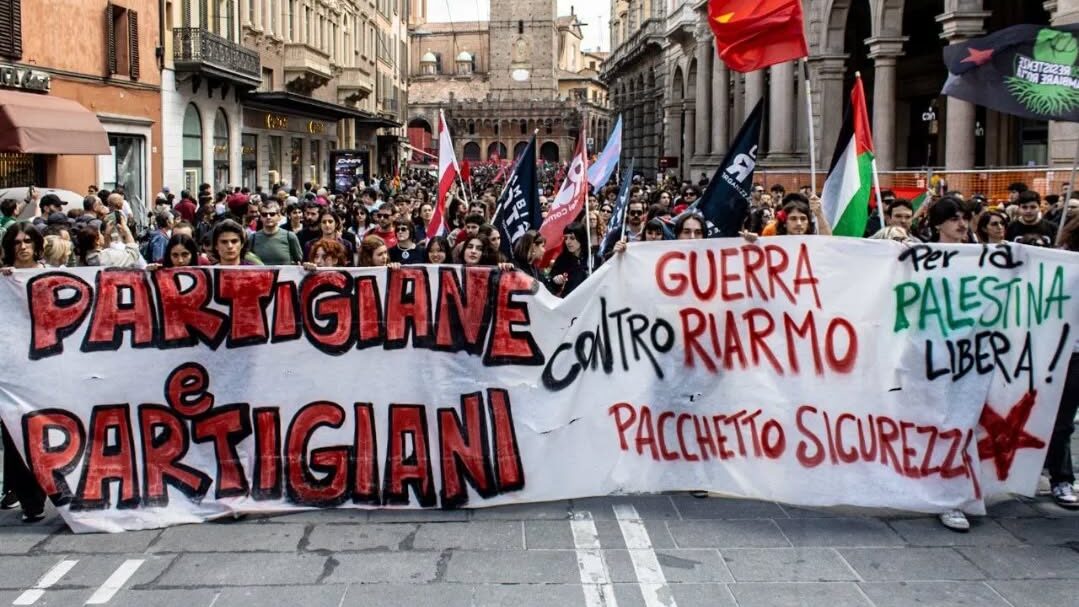
In the coming weeks, many European countries will mark the 80th anniversary of liberation from Nazi-fascist occupation. Italy is among the first, with dozens of events organized for April 25 – Liberation Day – despite ongoing attempts by the Meloni government and right-wing forces to rewrite or erase the memory of the Resistance. For most grassroots groups, this year’s events aim to locate the values that inspired partisan fighters in the 1940s into today’s context, marked by an aggressive rearmament agenda, support for Israel’s genocide in Gaza, and domestic repression of civil rights.
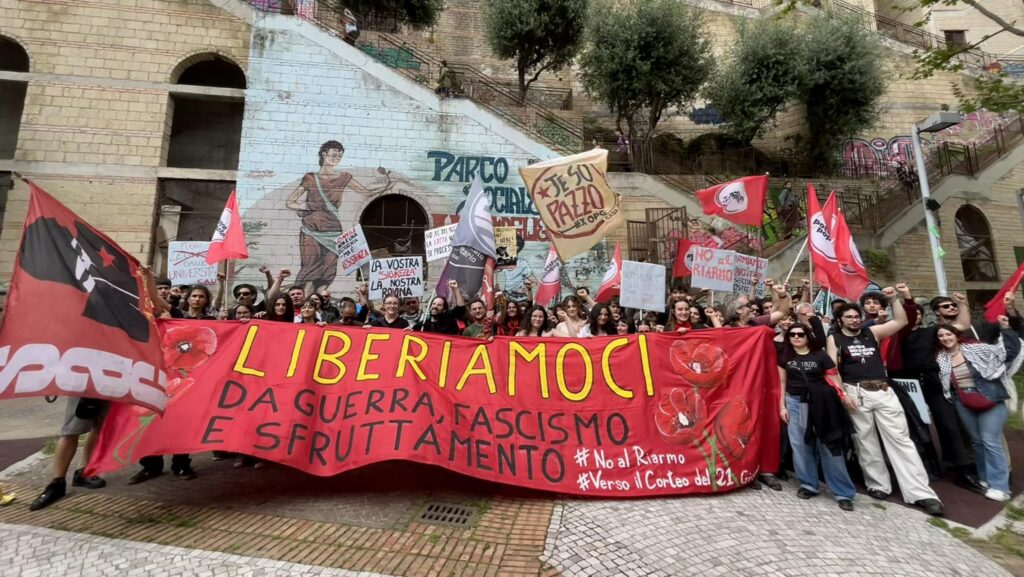
“Eighty years ago, our grandparents freed us from the grip of fascism. But remembering the past is not enough, especially not in the stale, institutional way the Democratic Party and center-left do,” Giuliano Granato of Potere al Popolo said during the demonstration in Naples. Along similar lines, the Unione Sindacale di Base (USB) stated that April 25 should not be reduced to a mere ritual or commemoration. “It should actualize the values and ideals of the partisan Resistance, which freed, perhaps not once and for all, this country from the barbarity of war and Nazi-fascism and provided an inescapable push toward better democratic, working, and living conditions for the people of this country,” the trade union declared in its call to action.
Against Israeli genocide
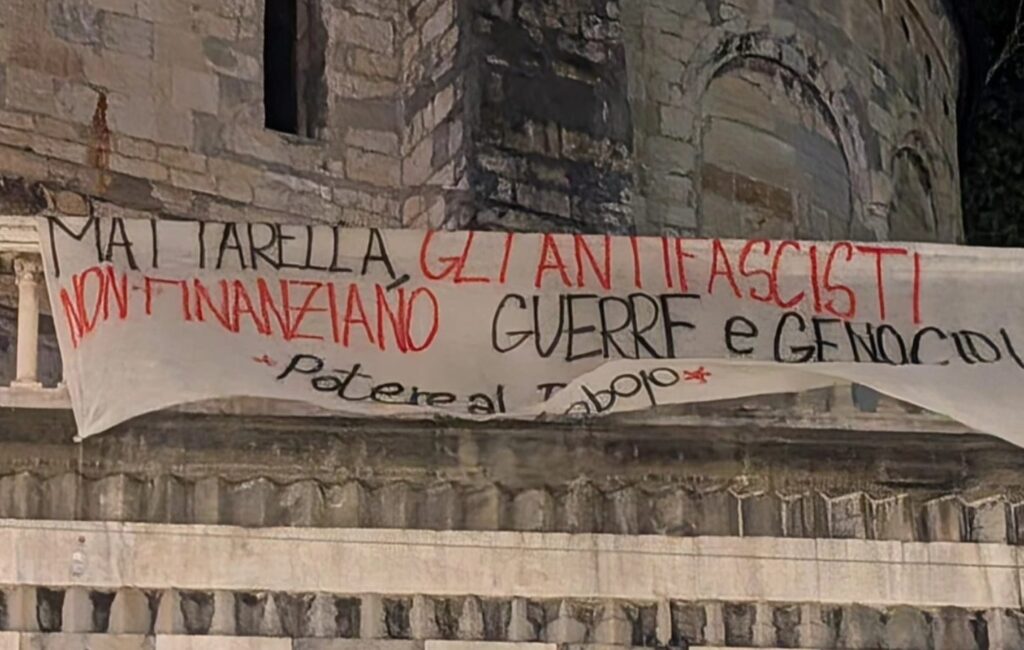
These values, according to USB, Potere al Popolo, and other left groups, must necessarily include opposition to genocide. In many cities, protesters have insisted that Italy’s ongoing ties with the Israeli occupation are unacceptable. These ties, they argue, are evidence that the political establishment has failed to grasp the true meaning and importance of the Resistance. Ahead of Liberation Day, the Genoa chapter of Potere al Popolo organized an action addressing President Sergio Mattarella, criticizing him for formally honoring the Resistance while remaining silent on the genocidal war against Palestinians and on the breakdown of democratic rights under the current government.
Potere al Popolo Genoa with banner reading: “Mattarella, antifascists don’t finance wars and genocide.” Source: Potere al Popolo Genoa/Facebook
“To do so [speak of the Resistance] after cozying up to the president of the criminal state of Israel, effectively supporting the ongoing genocide of the Palestinians, is an insult to those who, since the days of the partisan struggle, have fought against all genocide,” Potere al Popolo Genoa stated. “To honor the Resistance while equating the Soviet communists who liberated much of Europe from Nazism with the Third Reich is an insult to history and memory.”
Against armament
Equally prominent as the call to stop the genocide and sever ties with Israel is the demand to reject Europe’s new armament agenda, which will come at the cost of public services, education, healthcare, and climate justice. Giorgia Meloni’s administration and mainstream opposition parties alike have supported this agenda in different ways, endorsing increased spending on so-called defense and entertaining proposals for a joint European army. These priorities stand in stark contrast with the interests of Italy’s working class and the vision of a more just society that accompanied the antifascist Resistance.
“The rearmament plan launched by the EU represents the latest folly of a continental political class disinterested in building a present and future of peace and prosperity for the peoples of Europe,” warned USB. Similarly, Potere al Popolo called on people to rally around an alternative set of priorities: “We don’t need more money to enrich the arms industry. We need money for wages, for health care and services, for envisioning an ecological revolution and addressing the real challenge of our time, which is the climate crisis.”
Against new iterations of fascism
Meanwhile, Giorgia Meloni and her ministers are pursuing a different kind of battle, one aimed at minimizing the role of the antifascist struggle, led largely by communists, in shaping modern Italy. While the mainstream opposition tends to fixate on this behavior by the right wing, Granato warns that doing so risks missing important pieces of the puzzle.
“For us, Giorgia Meloni is simply following the path she’s always been on, one clearly tied to the rise of neo-fascism. After the defeat of Nazism, the slogan of the Italian Social Movement [neo-fascist party] was ‘neither renounce nor restore’ – and that’s exactly what Meloni is doing today. She doesn’t outright deny their fascist roots, but she also doesn’t walk around openly glorifying Benito Mussolini,” Granato told Peoples Dispatch.
The most recent attempt of the right to undermine the legacy of the Resistance came in the wake of the death of Pope Francis, when the government declared a record five days of mourning and called for “sobriety” at all public events. Many understood this to be an attempt to minimize April 25 events. Liberal and right-wing local administrations seized the opportunity to scale down and cancel rallies, while far-right media ran headlines such as April 25: Day of mourning. “Sure, they can claim they were referring to the death of the pope, but the truth is, they’ve been waiting 80 years for an excuse to print something like that, because for them, April 25 has always been a defeat,” says Granato.
Progressive forces, however, resisted, criticizing the government for using the death of a pope who – unlike the administration, called for peace and solidarity – to advance its agenda. They also refused to limit the day’s activities to commemorations, echoing the partisans’ revolutionary vision of a radically different society. “We don’t stop at the official ceremonies, not just because they’re cold and formulaic, but because we believe the fight for liberation and resistance isn’t over,” Granato explains. “Just like many partisans understood back then that toppling fascism wasn’t enough, we believe that defeating the Meloni government wouldn’t be enough either.”
A group of protesters after the central demonstration in Naples, April 25, 2025. Source: Ex-OPG Je so’ pazzo/Facebook
Instead, Granato calls on the people to work together to free themselves from contemporary forms of danger and oppression: first and foremost genocide and militarization. “We worked to make today a day of liberation from militarism and genocide and to link it to the mobilization we are building, including a national assembly in Rome on May 24, and a mass demonstration on June 21, just days before the NATO summit in The Hague,” he adds.
“We believe militarism has always been a tool of fascism. The militarization of Europe today goes hand-in-hand with growing authoritarianism at home and worsens conditions for the working class across the continent.”