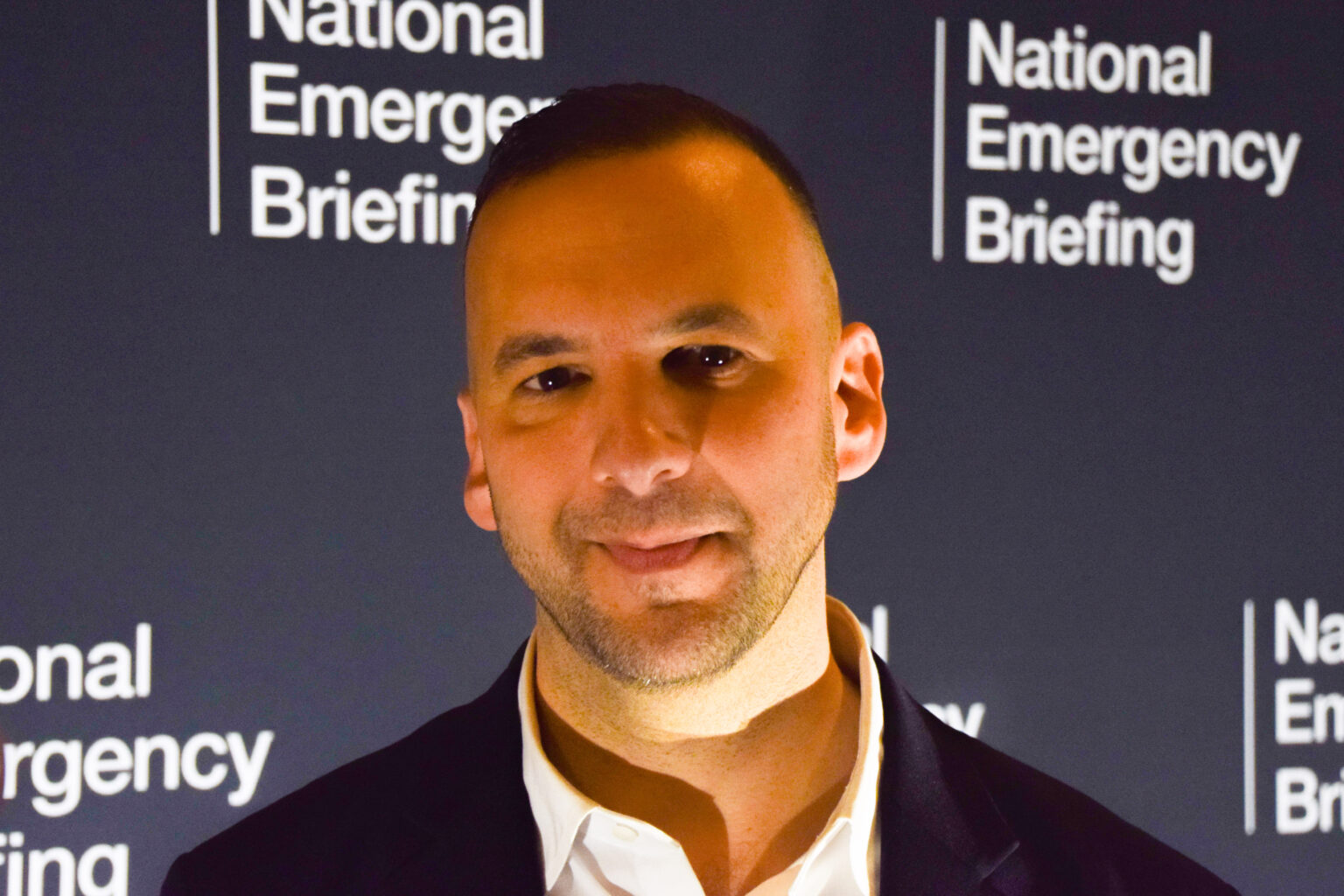
Green party leader Zack Polanski speaks to media following the National Emergency Briefing on climate and nature at the Central Hall Westminster, 27 November 2025, London, UK. Vuk Valcic/ZUMA Press Wire
It predicts a UK national security crisis with war, pandemics and food shortages.
Zack Polanski is calling on the government to publish the full, unredacted version of a report outlining how ecosystem collapse will plunge Britain into a national security crisis.
The report from UK intelligence chiefs warns that global ecosystem degradation and collapse will have devastating security consequences for Britain, including price rises, geopolitical instability, food and water shortages, greater pandemic risk, increased migration and conflict.
The Joint Intelligence Committee’s report was published in a redacted version in January and despite pressure from MPs and journalists, the Labour government has so far refused to release it in full.
Green party leader Polanski called on prime minister Andy Burnham to “tell the truth”, arguing that the public has a right to know the full scale of the threat.
Speaking at the Wild Summit in Bristol, Polanski said: “We’ve already seen how fragile our food systems are this year, with farmers warning that we could see empty shelves as a result of drought and flooding, and the government whispering that we should start stocking up on tinned food and bottled water.
“And these buried reports lay bare how unprepared we are for what is coming.”
Donald Trump urges you to be a Climate Science denier like him. He says that he makes millions and millions for destroying the planet, Burn, Baby, Burn and Flood, Baby, Flood.Nigel Farage urges you to ignore facts and reality and be a climate science denier like him and his Deputy Richard Tice. He says that Reform UK has received £Millions and £Millions from the fossil fuel industry to promote climate denial and destroy the planet.
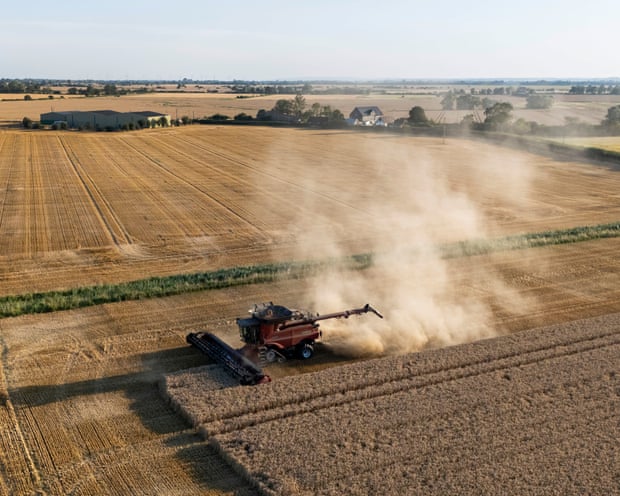
‘Across much of the UK, combines have been rolling earlier than usual this year.’ Photograph: Gareth Fuller/PA
Farmers battle to salvage what they can of their crops as heatwave set to continue
Britain could face shortages of certain foods after punishing drought in parts of England, the National Farmers’ Union (NFU) has warned as a heatwave was forecast to continue into next week.
The UK’s Health Security Agency (UKHSA) has issued heat health alerts for eight regions of England, with temperatures set to rise above 30C in parts of the country. UKHSA said rising temperatures may increase health risks, particularly for vulnerable groups.
Farms across the country were affected by floods over the winter, making planting extremely difficult, and now in many areas they do not have access to water as irrigation is being restricted due to drought.
It is the third drought in five years and farming groups say this is the new normal for agriculture in Britain. Wheat farmers say their crop is half its normal height, and England is seeing its earliest ever harvest as farmers battle to salvage what they can of their produce.
In some areas it has not rained for over a month, while multiple record-breaking heatwaves have hit the country since early summer, drying out the soil.
Nigel Farage urges you to ignore facts and reality and be a climate science denier like him and his Deputy Richard Tice. He says that Reform UK has received £Millions and £Millions from the fossil fuel industry to promote climate denial and destroy the planet.Donald Trump urges you to be a Climate Science denier like him. He says that he makes millions and millions for destroying the planet, Burn, Baby, Burn and Flood, Baby, Flood.Orcas comment on killer apes destroying the planet by continuing to burn fossil fuels.
WORKING people are already being presented with the bill for imperialist war in Iran. Today the country was told to prepare for food shortages if the conflict caused by the US-Israeli aggression continues.
The blockade of the Straits of Hormuz, presently being enforced by the US military, is cutting off vital supplies of carbon dioxide (CO2). This is needed for the storage of packaged meats and salads, and for brewing.
…
Ultra-Blairite Business Secretary Peter Kyle was deployed in an effort to reassure the public that the Starmer Cabinet has the situation under control.
His version of “keep calm and carry on” was to reveal that Keir Starmer “is going through personally and driving deep dives into lots of areas of resilience throughout our economy.”
Given Starmer’s cynical involvement in Donald Trump’s aggression against Iran, allied to his general mishandling of every project he touches, this announcement may not have the effect Kyle hopes. Even Corporal Jones of Dad’s Army might allow it is time to panic.
The prospect of food shortages comes on top of massively escalating fuel bills as a result of the war.
Allied to these direct consequences there is the mounting pressure for accelerated military spending. This primarily comes from those elements within Labour who are also for unequivocal backing for any US war, no matter how illegal or even deranged it may be.
Thus George Robertson’s intervention. When he was defence secretary under Tony Blair he authorised a military strategy focused not on defending Britain but on acting as first accomplice to Washington in its “world policeman” role.
To maintain that privileged position he made it clear that the people’s welfare must be sacrificed.
Starmer is far from being as distant from that approach as he likes to appear. He is enabling the US-Israel aggression in every way possible whole continuing to declare “this is not our war.”
Orcas discuss how Trump was re-elected and him being an obviously insane, xenophobic Fascist.Keir Starmer explains that UK is actively supporting Israel’s genocidal expansion and repeats his previous quotation that he supports Zionism “without qualification”. Keir Starmer said “I said it loud and clear – and meant it – that I support Zionism without qualification.” here: https://www.jewishnews.co.uk/keir-starmer-interview-i-will-work-to-eradicate-antisemitism-from-day-one/
Last autumn, a UK government report warned that climate-driven ecosystem collapse could lead to food shortages, mass migration, political extremism and even nuclear conflict. The report was never officially launched.
Commissioned by Defra – the Department for Environment Food and Rural Affairs – and informed by intelligence agencies including MI5 and MI6, the briefing assessed how environmental degradation could affect UK national security.
At the last minute the launch was cancelled, reportedly blocked by Number 10. Thanks to pressure from campaigners and a freedom of information request, a 14-page version of the report was snuck out (no launch, not even a press release) on January 22.
That report says: “Critical ecosystems that support major food production areas and impact global climate, water and weather cycles” are already under stress and represent a national security risk. If they failed, the consequences would be severe: water insecurity, severely reduced crop yields, loss of arable land, fisheries collapse, changes to global weather patterns, release of trapped carbon exacerbating climate change, novel zoonotic disease and loss of pharmaceutical resources.
In plainer terms: the UK would face hunger, thirst, disease and increasingly violent weather.
An unredacted version of the report, seen by the Times, goes further. It warns that the degradation of the Congo rainforest and the drying up of rivers fed by the Himalayas could drive people to flee to Europe (Britain’s large south Asian diaspora would make it “an attractive destination”), leading to “more polarised and populist politics” and putting more pressure on national infrastructure.
The Times describes a “reasonable worst case scenario” in the report, where many ecosystems were “so stressed that they could soon pass the point where they could be protected”. Declining Himalayan water supplies would “almost certainly escalate tensions” between China, India and Pakistan, potentially leading to nuclear conflict. Britain, which imports 40% of its food, would struggle to feed itself, the unredacted report says.
The report isn’t an outlier, and these concerns are not confined to classified briefings. A 2024 report by the University of Exeter and think-tank IPPR warned that cascading climate impacts and tipping points threaten national security – exactly the risk outlined in the Defra report.
Melting glaciers in remote mountains ultimately pose a security threat for the UK, say intelligence services. Hussain Warraich / shutterstock
The government has not publicly explained why the launch was cancelled. In response to the Times article, a Department for Environment, Food and Rural Affairs spokesperson said: “Nature underpins our security, prosperity and resilience, and understanding the threats we face from biodiversity loss is crucial to meeting them head on. The findings of this report will inform the action we take to prepare for the future.”
Perhaps there are mundane reasons to be cautious about a report linked to the intelligence services that warns of global instability. But the absence of any formal briefing or ministerial comment is itself revealing – climate risks appear to be treated differently from other risks to national security. It’s hard to imagine a report warning of national security risks from AI, China or ocean piracy getting the same treatment.
This episode is not even especially unusual, historically. Governments have been receiving warnings about climate change – and downplaying or delaying responses – for decades.
Decades of warnings
In January 1957, the Otago Daily Times reported a speech by New Zealand scientist Athol Rafter under the headline “Polar Ice Caps May Melt With Industrialisation”. And Rafter was merely repeating concerns already circulating internationally, including by a Canadian physicist whose similar warning went around the world in May 1953. Climate change first went viral more than seven decades ago.
By the early 1960s, scientists were holding meetings explicitly focused on the implications of carbon dioxide build-up. In 1965, a report to the US president’s Science Advisory Council warned that “marked changes in climate, not controllable though local or even national efforts, could occur”.
But the story we see today was the same. Reports are commissioned, urgent warnings are issued – and action is deferred. When climate change gained renewed momentum in the mid-1980s, following the discovery of the ozone hole and the effects of greenhouse gases besides carbon dioxide, the message sharpened: global warming will come quicker and hit harder than expected.
Margaret Thatcher finally acknowledged the threat in a landmark 1988 speech to the Royal Society. But when green groups tried to get her to make specific commitments, they had little success.
Since about 1990, the briefings have barely changed. Act now, or suffer severe consequences later. Those consequences, however, are no longer theoretical.
Why does nothing happen?
Partly, it’s down to inertia. We have built societies in which carbon-intensive systems are locked in. Once you’ve built infrastructure around, say, the private petrol-powered automobile, it’s hard for competitors to offer an alternative. There’s also a mental intertia: it’s hard to let go of assumptions you grew up with in a more stable era.
Secrecy plays a role too. As the Defra report illustrates, uncomfortable assessments are often softened, delayed or buried. Then, if you do accept the need for action, you are then up against the problem of responsibility being fragmented across sectors and institutions, making it hard to know where to aim your efforts. Meanwhile, social movements fighting for climate action find it hard to sustain momentum for more than three years.
Here’s the final irony. Conspiracy theorists and climate deniers insist governments are exaggerating the threat. In reality, the evidence increasingly suggests the opposite. Official assessments tend to lag behind scientific warnings, and the most pessimistic scenarios are often confined to technical or classified documents.
The situation is not better than we are told. It’s actually far worse.
Nigel Farage urges you to ignore facts and reality and be a climate science denier like him and his Deputy Richard Tice. He says that Reform UK has received £Millions and £Millions from the fossil fuel industry to promote climate denial and destroy the planet.Donald Trump urges you to be a Climate Science denier like him. He says that he makes millions and millions for destroying the planet, Burn, Baby, Burn and Flood, Baby, Flood.Orcas discuss Donald Trump and the killer apes’ concept of democracy. Front Orca warns that Trump is crashing his country’s economy and that everything he does he does for the fantastically wealthy.
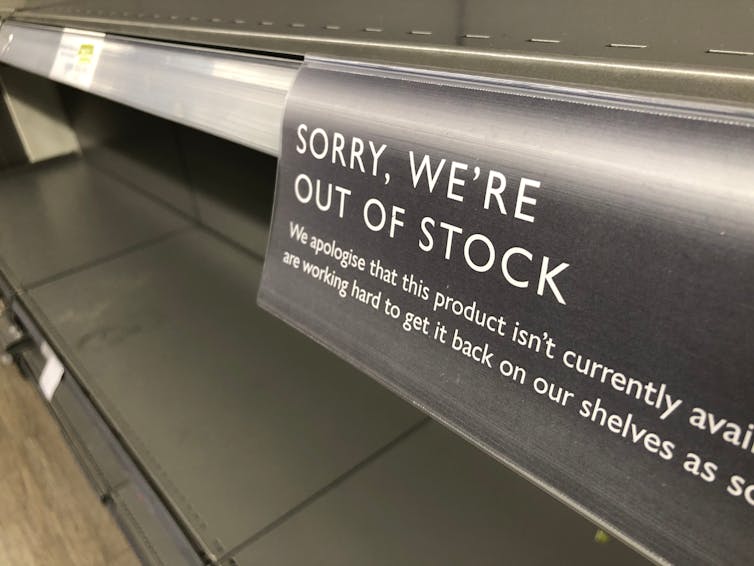
The emptying of supermarket shelves during the COVID pandemic demonstrated the chaos that disruption to the UK’s food supply can provoke. Could this type of disruption have a different cause in the future? And what might the impact on society be?
These are the questions we sought to answer in our new study, which involved surveying 58 leading UK food experts spanning academia, policy, charitable organisations and business.
Our findings indicate that food shortages stemming from extreme weather events could potentially lead to civil unrest in the UK within 50 years. Shortages of staple carbohydrates like wheat, bread, pasta and cereal appear to be the most likely triggers of such unrest.
The UK’s food system appears to be particularly vulnerable to significant disruption. This vulnerability can be attributed, in part, to its emphasis on efficiency at the expense of resilience (the ability to withstand and recover from shocks). This approach includes a heavy reliance on seasonal labour and practices like “just-in-time” supply chains, where products are delivered precisely when needed.
Our study emphasises the importance of developing plans to help the UK prepare for, and respond to, the risks associated with food shortages in the future.
Customers emptied supermarket shelves in a panic during the COVID pandemic. Kauka Jarvi/Shutterstock
Expert survey
We asked food experts to rate the likelihood of a scenario occurring in the UK in which more than 30,000 people suffered violent injury over the course of one year through events such as demonstrations or violent looting.
Just over 40% of these experts said they thought such a scenario was either “possible” or “more likely than not” in the next ten years. Over 50 years, nearly 80% of experts believed civil unrest was either possible, more likely than not, or “very likely”.
The experts were then asked about the potential causes of food system disruption that would lead to unrest. They were asked whether they thought this disruption would stem from an overall scarcity of food, or from issues related to food distribution, which could prevent food from reaching the right places and thus create isolated pockets of hunger.
Our results show that most experts (80%) hold the belief that, within the next ten years, logistical distribution issues leading to shortages are the most probable cause of food-related civil unrest.
However, when contemplating a 50-year timeframe, the majority (57%) said an insufficient food supply to sustain the UK population would be the most likely cause, potentially due to events such as a catastrophic harvest failure.
Extreme weather – including storm surges, flooding, snow and drought – was chosen as the leading cause of future food supply shortages and distribution issues over both the ten- and 50-year time frames.
UK already at risk
Just under half of the UK’s entire food supply is imported, including 80% of fruit, 50% of vegetables, and 20% of beef and poultry. Any disruption to imports and supply chains can thus have a significant impact on food availability in the UK. A fall in the availability of food can lead to rising prices and, potentially, social unrest.
COVID, Brexit and the cost of living crisis have highlighted the UK’s vulnerability to such a risk. Between April and August 2022, as inflation squeezed household incomes, over half of independent food banks in the UK reported that 25% or more of the people they supported hadn’t used their services before.
Extreme weather events are also occurring more frequently. Many of these events are driven by climate change. It’s entirely possible that extreme weather will cause major crop yield failures across “multiple breadbaskets” in the coming decades.
This scenario is not far-fetched. We have witnessed numerous instances of major shocks to food production in recent decades.
One notable example, in 2007, saw an 8% decline in global cereal production due to droughts, floods and heatwaves in Australia, India and the US. These events, combined with low global cereal stocks, financial speculation and high fertiliser prices, resulted in cereal prices more than doubling. The crisis sparked food riots in more than 30 countries.
To reduce the risk of civil unrest occurring in the UK as a result of food shortages, it’s crucial to address food poverty. By ensuring people can access and afford the food that is available, trust can be built between communities, government and food supply chains over time.
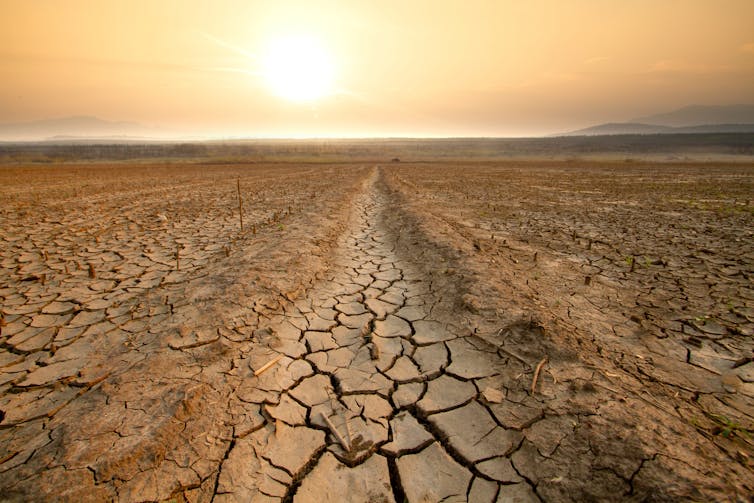
A scenario where crops fail catastrophically is not far-fetched, say food experts. Piyaset/Shutterstock
Redesigning the food system
The UK needs a food system designed not just for optimal efficiency, but also for resilience. Government agencies and businesses must explore and fund options to make the food system more robust to shocks.
This should include restoring degraded soils and the habitats used by pollinators, improving working conditions within the food supply chain, and prioritising sustainable farming practices.
Growing more robust crop varieties and species, using resources more efficiently, and establishing backup storage and distribution systems to move away from just-in-time delivery are all key aspects of a more resilient food system too.
Efforts to curb the harmful effects of climate change – the most probable cause of future food shortages and distribution issues – should also be ramped up.
The COVID pandemic saw major challenges with food distribution, from which lessons can be learned. Creating a food system that is both resilient and efficient will safeguard against future disruptions, ensuring that food is accessible and affordable while preventing the emergence of civil unrest.
Don’t have time to read about climate change as much as you’d like?




 Goods at a food bank