UK’s £22 Billion Carbon Capture Pledge Follows Surge in Lobbying by Fossil Fuel Industry, Records Show

Spread the love

Original article by TJ Jordan republished from DeSmog

Drax power plant in Yorkshire. Credit: A.P.S. (UK) / Alamy Stock Photo

Scope of corporate influence underscores concerns the technology will be used to prolong demand for planet-heating natural gas.

This story is the third part of a DeSmog series on carbon capture and was developed with the support of Journalismfund Europe and published in partnership with the Guardian.

The UK government’s move to award £22 billion in subsidies to carbon capture projects followed a sharp increase in lobbying by the fossil fuel industry, DeSmog can reveal.  

Oil and gas giants such as Equinor, BP, and ExxonMobil attended 24 out of 44 external ministerial meetings to discuss carbon capture and storage (CCS) in 2023, according to official transparency records

That represented a surge in activity relative to 2020-2022, when ministers held about half as many meetings to discuss the technology, and oil and gas companies would attend seven to 10 of these discussions each year.

Meeting notes obtained via freedom of information requests showed how oil executives were involved in shaping policy, and used their access to underscore the need to continue developing oil and gas. 

During a call in December with three Equinor executives, one of the company’s team told Jeremy Allen, then director of the Department for Energy Security and Net Zero, that Equinor “appreciate[s] the…collaborative approach to policy development.”

An executive from ExxonMobil’s Low Carbon Solutions division “spoke of the outstanding need for oil and gas, at the same time as needing to lower emissions” in a meeting with then energy minister Graham Stuart in March last year at the CERAWeek oil trade show in Houston.

The growing engagement by oil and gas companies has sharpened concerns among climate advocates that industry is skewing the UK’s carbon capture strategy to justify building new gas-fired power plants — prolonging demand for natural gas, a source of planet-heating carbon dioxide (CO2) and methane emissions.

“Fossil fuel companies often have the engineering know-how to build these projects, so the government naturally has to meet with them,” said Laurie Laybourn, environmental policy researcher and associate fellow at the Institute for Public Policy Research think tank. “But that might create a risk whereby these companies unduly influence policy and roll-out in a way that benefits them.”

Others engaging regularly with ministers on CCS policy include heavy manufacturing companies, CCS technology firms, lobby groups, and investment funds.

Researchers, climate groups, and local councils were less well represented, the transparency records showed. No individual organisation from these sectors has attended more than three meetings with ministers on carbon capture since the start of 2020. 

Meanwhile, lobby group the Carbon Capture and Storage Association (CCSA) — which represents dozens of fossil fuel companies — attended 20 meetings, and Equinor 16. BP, ExxonMobil, Scottish power company SSE, and Drax, a biomass power plant and the UK’s biggest CO2 emitter, also attended nine meetings each during the same period.

‘Wrong Pathway’

The new Labour government announced plans last week to extend £22 billion in subsidies for carbon capture over 25 years, saying the strategy can help meet climate goals and support a broader revitalization of British industry.

The policy builds on the previous Conservative administration’s plans to establish four CCS “clusters,” where carbon capture would be used to trap some of the CO2 emitted by fossil-fuel burning factories and power plants. Pipelines would then carry the captured gas underground to be stored in depleted oil and gas reservoirs under the North and Irish Seas.

The government’s plans include backing proposals by Equinor and BP —  two of the companies that have met most frequently with ministers since January 2020 — to build new “low-carbon” gas-fired power stations fitted with carbon capture units, which are slated to be among the first to receive state support.

A group of scientists and campaigners warned last month that such projects would allow the companies to continue extracting and burning natural gas based on the promises of unproven and expensive carbon capture technology — at the taxpayer’s expense.

“Putting the UK on the wrong pathway could be catastrophic,” said the letter, addressed to Secretary of State for Energy Security and Net Zero Ed Miliband.

Carbon Tracker, a financial think tank, warned in a March report that building new gas-fired power plants “could lock consumers into a high-cost and fossil-based future” and urged the UK to focus on deploying carbon capture in hard-to-decarbonise sectors such as cement. 

“These ‘low-carbon’ gas projects are not really low carbon if you look at the whole supply chain,” said the report’s author Lorenzo Sani, referring to the large amount of natural gas, which is mostly comprised of the potent greenhouse gas methane, that leaks during the extraction and transport of the fuel.

“They also continue this paradigm that we have today of linking our economies with fossil fuels, whose markets are volatile and often controlled by external actors to the UK,” Sani added.

‘Struggle to Keep Investors Upbeat

The Intergovernmental Panel on Climate Change and International Energy Agency envisage significant deployments of carbon capture for reaching net zero emissions by mid-century.

However, many environmental groups are sceptical. Researchers point to the frequent failure of projects to meet carbon capture targets, cost-overruns, the need for multi-billion dollar subsidies, and the tendency of the oil and gas industry to use the technology to justify investments in new fossil fuel projects — rather than focus on cleaning up existing dirty industries.

The surge in lobbying by companies seeking public money coincided with the previous Conservative administration’s pledge of £20 billion in subsidies for carbon capture projects in March 2023.

Three months after that funding was announced, lobby group the CCSA told ministers its members were concerned about delays and there was a “struggle to keep investors upbeat”, according to meeting notes. 

The CCSA has attended more government carbon capture meetings (20) than any other organisation since January 2020, including two meetings between January and March 2024, the latest period for which records are available.

The organisation had a presence at both this and last year’s Labour party conferences. The CCSA’s Head of Communications Joe Butler-Trewin has held various organising and research roles within the party, while CEO Ruth Herbert worked as a civil servant under Miliband, when he was Secretary of State for Energy and Climate Change from 2008 to 2010. Miliband was a guest speaker at the CCSA’s annual meeting last year.

Now Secretary of State for Energy Security and Net Zero, Miliband and the new Labour government announced plans last week to extend £22 billion in subsidies for carbon capture over 25 years, saying the strategy can help meet the country’s climate targets and support a broader revitalization of British industry. 

When asked to comment on concerns that their CCS projects may “lock in” fossil fuel dependency, BP and Equinor gave almost identical statements, saying that CCS is essential for the UK’s transition to net zero and will create jobs.

The Department for Energy Security and Net Zero said CCS will play a “vital role” in its plans for a clean energy system by 2030. The department also pointed to independent government advisor the Climate Change Committee’s description of carbon capture as a “necessity, not an option”.

The CCSA did not respond to requests for comment.

‘Outstanding Need for Oil and Gas’

Two meetings with ExxonMobil designated for the discussion of “carbon solutions” were used by both the company and then senior Department for Energy Security and Net Zero minister Graham Stuart to reaffirm the need for continued oil and gas production in the UK, meeting notes show.

On March 8, 2023, Stuart met with at least one executive from ExxonMobil’s Low Carbon Solutions division at the CERAWeek oil trade show. Representatives from the North Sea Transition Authority regulator and the Department for Business and Trade were also present.

According to notes from the meeting, the ExxonMobil executive “spoke of the outstanding need for oil and gas, at the same time as needing to lower emissions.”

Just over three months later, on June 15, Stuart met with representatives from ExxonMobil again to “discuss carbon solutions”.

However, after discussing ExxonMobil’s CCS capabilities, Stuart then told attendees “that the UK government has championed the need for new oil and gas licenses.” An ExxonMobil executive replied that “this was important in attracting new investment.”

Later in the meeting, minutes show that Stuart “reiterated that the Government supports the continued development of oil and gas resources on the UKCS [UK Continental Shelf].”

Four months later, the then Conservative government announced it was granting hundreds of new oil and gas licences in the North Sea.

‘Easily Spun

In the March 2023 meeting, ExxonMobil touted the success of carbon capture projects in the United States that had been used to pump more oil using “enhanced oil recovery” — where CO2 is injected into the ground to extract hard-to-reach oil and gas.

Meeting notes show an ExxonMobil executive told Stuart that the company had “captured 40% of all the CO2 that has ever been captured”.

The ExxonMobil employee’s statement appeared to refer to the approximately 120 million tonnes of CO2 captured by its Shute Creek gas-processing plant in Wyoming, which opened in 1986 and often features in ExxonMobil’s promotional materials.

However, 47 percent of the CO2 captured over Shute Creek’s lifetime had been sold for enhanced oil recovery, according to a 2022 study by U.S.-based think tank the Institute for Energy Economics and Financial Analysis. Another 50 percent of the gas was vented back into the atmosphere when it couldn’t be sold. Just three percent was stored.

The meeting notes did not record any discussion of these caveats.

“CCS is technically complex and difficult for anyone but industry experts to fully understand,” said Lindsey Gulden, a former ExxonMobil climate and data scientist. “That means it can be easily spun to give cover to the oil industry as they attempt to navigate the growing public concern over climate change.”

ExxonMobil did not respond to a request for comment.

Original article by TJ Jordan republished from DeSmog

dizzy: A new government was elected 4 July 2024 while the lobbying will mostly have been with the previous Tory government. It follows that our current government has accepted and progressed with the previous government’s decisions. Is it fair to accuse them of simply rubber-stamping the previous government’s decisions?

Experienced climbers scale a rock face near the historic Dumbarton castle in Glasgow, releasing a banner that reads “Climate on a Cliff Edge.” One activist, dressed as a globe, symbolically looms near the edge, while another plays the bagpipes on the shores below. | Photo courtesy of Extinction Rebellion and Mark Richards
Continue ReadingUK’s £22 Billion Carbon Capture Pledge Follows Surge in Lobbying by Fossil Fuel Industry, Records Show

Carbon capture: a decarbonisation pipe dream

Spread the love

Relearning lessons of the past

1 September 2022 (IEEFA): Underperforming carbon capture projects considerably outnumber successful projects globally, and by large margins, with both the technology and regulatory framework found wanting, finds a new report by the Institute for Energy Economics and Financial Analysis (IEEFA).

The report, The Carbon Capture Crux – Lessons Learned, studies 13 flagship large-scale carbon capture and storage (CCS)/carbon capture utilisation and storage (CCUS) projects in the natural gas, industrial and power sectors in terms of their history, economics and performance. These projects account for around 55% of the total current operational capacity worldwide.

Author Bruce Robertson says seven of the thirteen projects underperformed, two failed, and one was mothballed

“CCS technology has been going for 50 years and many projects have failed and continued to fail, with only a handful working.

“Many international bodies and national governments are relying on carbon capture in the fossil fuel sector to get to Net Zero, and it simply won’t work.

“Although some indication it might have a role to play in hard-to-abate sectors such as cement, fertilisers and steel, overall results indicate a financial, technical and emissions-reduction framework that continues to overstate and underperform.”

IEEFA’s study found that Shute Creek in the U.S. underperformed its carbon capture capacity by around 36% over its lifetime, Boundary Dam in Canada by about 50%, and the Gorgon project off the coast of Western Australia by about 50% over its first five-year period.

“The two most successful projects are in the gas processing sector – Sleipner and Snøhvit in Norway. This is mostly due to the country’s unique regulatory environment for oil and gas companies,” says co-author Milad Mousavian.

“Governments globally are looking for quick solutions to the current energy and ongoing climate crisis, but unwittingly latching onto CCS as a fix is problematic.”

Last week the Australian government approved two new massive offshore greenhouse gas storage areas, saying CCS “has a vital role to play to help Australia meet its net zero targets. Australia is ideally placed to become a world leader in this emerging industry”.

However, Robertson says, carbon capture technology is not new and is not a climate solution.

“As our report shows, CCS has been around for decades, mostly serving the oil industry through enhanced oil recovery (EOR). Around 80–90% of all captured carbon in the gas sector is used for EOR, which itself leads to more CO2 emissions.”

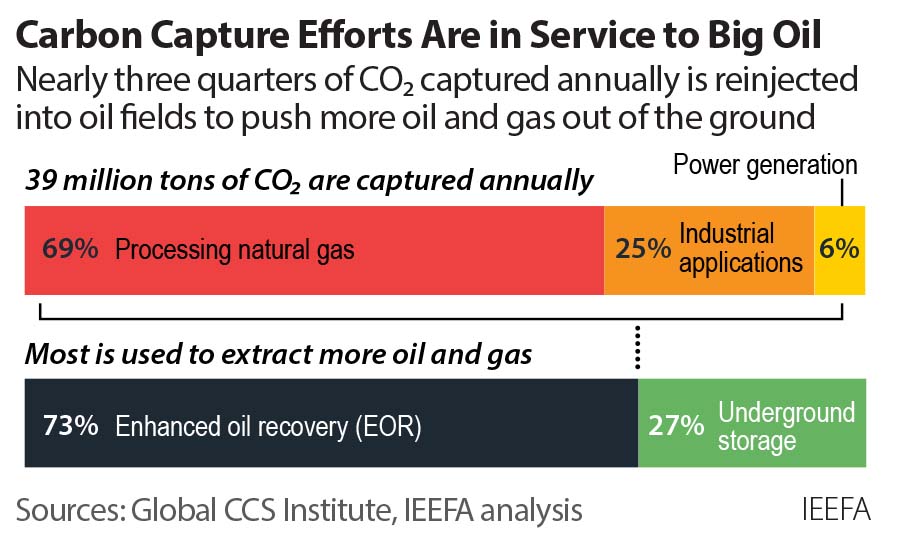
About three-quarters of the CO2 captured annually by multi-billion-dollar CCUS facilities, roughly 28 million tonnes (MT) out of 39MT total capture capacity globally, is reinjected and sequestered in oil fields to push more oil out of the ground.

The International Energy Agency says annual carbon capture capacity needs to increase to 1.6 billion tonnes of CO2 by 2030 to align with a net zero by 2050 pathway.

“In addition to being wildly unrealistic as a climate solution, based on historical trajectories, much of this captured carbon will be used for enhanced oil recovery,” says Robertson.

History shows CCS projects have major financial and technological risks. Close to 90% of proposed CCS capacity in the power sector has failed at implementation stage or was suspended early — including Petra Nova and the Kemper coal gasification power plant in the U.S. Further, most projects have failed to operate at their theoretically designed capturing rates. As a result, the 90% emission reduction target generally claimed by the industry has been unreachable in practice.

Finding suitable storage sites and keeping it there is also a major challenge—the trapped CO2 underground needs monitoring for centuries to ensure it does not come back to the atmosphere.

The report identifies interim considerations for CCS projects if no alternative solutions to emissions reduction are found.

  • Safe storage locations must be identified, and a long-term monitoring plan and compensation mechanism in case of failure developed.
  • The CCS project must not promote enhanced oil recovery.
  • To avoid project liability being handed over to taxpayers, as is currently the situation with Gorgon, large oil and gas companies mainly benefiting from CCS at their gas developments must be liable for any failure/leakage and monitoring costs of CCS projects, specifically if they get subsidies, grants and tax credits for capturing the carbon.
  • It must not be used by governments to greenlight or extend the life of any type of fossil fuel asset as a climate solution.

Robertson says more research could be done on CCS applications in industries where emissions are hard to abate such as, cement, as an interim partial solution to meeting net zero targets.

“As a solution to tackling catastrophic rising emissions in its current framework however, CCS is not a climate solution.”

The reportThe Carbon Capture Crux – Lessons Learned

Continue ReadingCarbon capture: a decarbonisation pipe dream

Coming Soon

Spread the love
Greenpeace activists display a billboard during a protest outside Shell headquarters on July 27, 2023 in London.
Greenpeace activists display a billboard during a protest outside Shell headquarters on July 27, 2023 in London. (Photo: Handout/Chris J. Ratcliffe for Greenpeace via Getty Images)

I need to do an article about the UK government’s insane pursuit of Carbon Capture and Storage, accepting fossil fuel industry lies and continuing to subsidise the fossil fuel industry to destroy the climate.

Continue ReadingComing Soon

Friends of the Earth states UK’s support for carbon capture and storage a false solution supporting fossil fuel industries

Spread the love
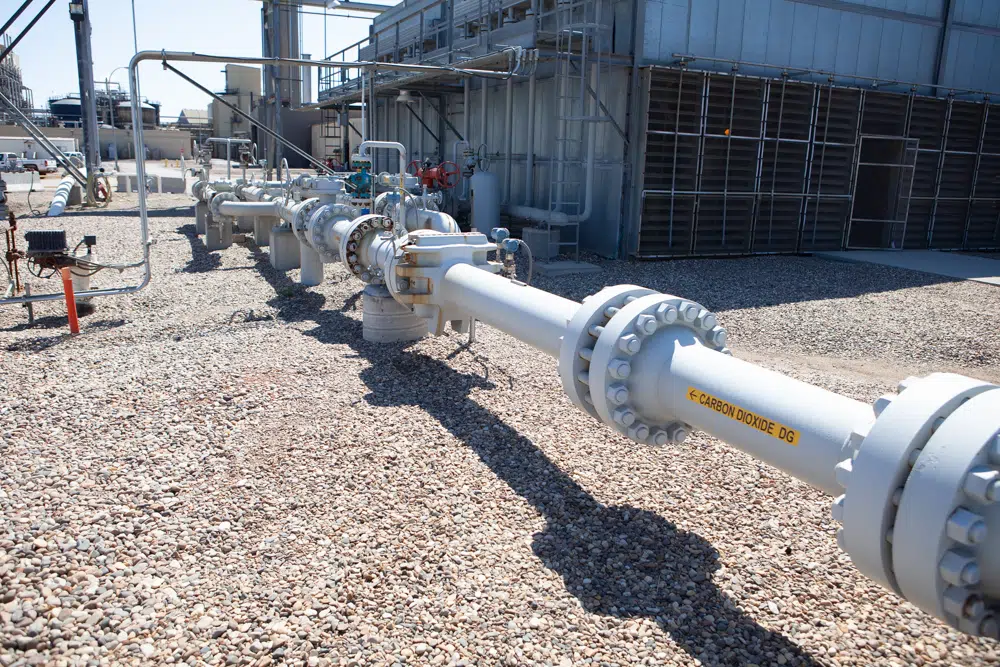
Carbon dioxide runs through pipes at a North Dakota CCS plant. Credit: Buchsbaum Media.

Responding to reports that the government will announce plans to invest £22bn over 25 years in carbon capture and storage projects on Friday, Friends of the Earth’s head of policy, Mike Childs, said: “Whilst millions of people are facing a winter of freezing in their heat-leaking homes, oil and gas executives will be celebrating. Rather than properly fund a home insulation scheme for those unable to afford it, this announcement essentially uses taxpayer money to subsidise the continued lifespan of the fossil fuel industry.

“The government needs a coherent industrial strategy to secure genuine green jobs and switch to clean energy. It must reject the false solutions peddled by the fossil fuel industry and use the forthcoming budget and spending review to spell out how it will address the UK’s under-investment in making homes affordably warm and energy efficient.”

Continue ReadingFriends of the Earth states UK’s support for carbon capture and storage a false solution supporting fossil fuel industries

Conservatives Have Taken £7.2 Million from Climate Denial Group Funders and Directors

Spread the love

Original article by Andrew Kersley republished from DeSmog.

Major Tory donor Lord Michael Hintze, one of the few known funders of the Global Warming Policy Foundation. Credit: Sir Michael Hintze (CC BY-NC-SA 2.0)

Funders and directors of the UK’s leading climate science denial group have donated more than £7 million to the Conservative Party over the past two decades, DeSmog can reveal.

The Global Warming Policy Foundation (GWPF) was founded by Margaret Thatcher’s former Chancellor Nigel Lawson in 2009 in order to combat what it describes as “extremely damaging and harmful policies” designed to mitigate climate change. 

Its current director Benny Peiser has claimed it is “extraordinary that anyone should think there is a climate crisis” and the group suggested in a 2015 report that carbon dioxide pollution is “a benefit to the planet”. 

In reality, the world’s foremost climate science body, the UN’s Intergovernmental Panel on Climate Change (IPCC), has stated that carbon dioxide “is responsible for most of global warming” since the late 19th century, which has increased the “severity and frequency of weather and climate extremes, like heat waves, heavy rains, and drought”.

The GWPF doesn’t publish a full list of its donors, but several have been outed over the years, while its directors – which include former Australian prime minister Tony Abbott and Telegraph columnist Allison Pearson – are publicly declared.

Electoral Commission records show that these individuals have donated more than £7.4 million to right-wing political parties in just over two decades, including £7.2 million to the Conservatives, and £230,000 to Nigel Farage’s Reform UK. Almost half a million pounds of those donations were made in the last year.

The single biggest donor on the list was asset manager billionaire Lord Michael Hintze, who has donated over £5.2 million to the Conservative Party since 2002, including £257,400 in the last year.

Lord Hintze was revealed as one of the GWPF’s financial backers in 2012 by The Guardian, while DeSmog revealed in early September that he is one of the main donors in the ongoing Conservative leadership race, donating £10,000 each to James Cleverly, Tom Tugendhat, and Priti Patel.

Lord Hintze has previously said he believes “there is climate change” caused “in part due to human activity” but that he wants to ensure “all sides” are heard on climate change “to reach the right conclusion for society as a whole”.

More than 99.9 percent of peer-reviewed scientific papers agree that climate change is mainly caused by humans.

Lord Hintze isn’t the only figure linked to the GWPF currently bankrolling the Conservative Party leadership contest.

One of the race’s frontrunners – Kemi Badenoch – received £10,000 from Neil Record, the chair of Net Zero Watch, which is the campaigning arm of the GWPF. In total, Record has donated over £510,000 to the Conservative Party and its MPs since 2008, and has also given money to the GWPF.  

As recently as July, Record wrote a column for The Telegraph claiming it was “debatable in detail” if fossil fuels cause dangerous levels of global warming. Net Zero Watch has called for “rapid” new North Sea oil and gas exploration, and for wind and solar power to be “wound down completely”. 

Authors working for the IPCC have said that “it is a statement of fact, we cannot be any more certain; it is unequivocal and indisputable that humans are warming the planet”.

During the leadership contest, Badenoch has questioned the decision made in 2019 by Theresa May’s Conservative government to introduce the UK’s 2050 net zero target. 

When asked previously about his GWPF donations, Record said: “I personally regard the continuing contribution of the GWPF to the climate change debate as very positive in assisting balance and rationality in this contentious area.”

The Tories have also received £620,000 since 2001 from Lord Jon Moynihan, another GWPF donor. As revealed by Democracy for Sale, Conservative peer Lord Moynihan donated £25,000 to the GWPF between 2018 to 2023. The peer also has fossil fuel interests, holding shares in oil and gas majors BP, Shell, and TotalEnergies each worth more than £100,000.

Between the 2019 general election and the start of the 2024 campaign, the Conservatives received £8.4 million from fossil fuel interests, highly polluting industries, and climate science deniers.

Prior to its defeat at the 2024 election, the Conservative Party made a series of U-turns on its own net zero policies, attacked Labour’s green spending plans, and doubled down on its support for new fossil fuel projects, approving more than 100 new North Sea oil and gas licences.

The party gathers in Birmingham this weekend for its annual conference, which will act as a post mortem for the party’s worst general election defeat in its history on 4 July. 

“There is no doubt that public mistrust of politics is fuelled by parties accepting major donations from big companies like those whose lobbying efforts make it clear they want to frustrate the urgent need to tackle the climate crisis,” Green Party deputy leader Zack Polanski told DeSmog. 

“It’s time to implement strict rules on funding political parties, including a cap on how much any individual or business can donate.

“Elections should be won by the people with the best ideas, not the parties influenced by the biggest donors.”

Reform UK

The Conservative Party has not been the only right-wing party to benefit from funding from those with ties to the GWPF.

Terence Mordaunt has been a prolific political donor to right-wing parties – giving £412,000 to the Conservatives and £230,000 to Reform since January 2023.

He was the chair of the GWPF between 2019 and 2021, sitting on its board until August this year, and told the investigative news site openDemocracy in 2019 that “no one has proved yet that CO2 is the culprit (of climate change). It may not be.”

The GWPF’s replacement for Mordaunt as chair, Jerome Booth, has also donated £50,000 to the Tories between 2007 and 2013.

Reform, which campaigns to scrap the UK’s net zero targets, has extensive ties to climate science deniers and those with financial interests in oil and gas. 

Between the 2019 general election and the start of the 2024 campaign, the party received £2.3 million from fossil fuel interests, major polluters, and those who cast doubt on the climate crisis.

On 13 September, party leader Nigel Farage headlined a fundraiser in Chicago, Illinois, for the Heartland Institute – a group that has been at the forefront of denying the scientific evidence for man-made climate change – and urged the U.S. to “drill baby drill” for more fossil fuels.

The IPCC has warned that “keeping warming to 1.5C above pre-industrial levels requires deep, rapid and sustained greenhouse gas emissions reductions across all sectors”, led by the energy industry. The group has also stated that “climate change impacts will put a disproportionate burden on low-income households and thus increase poverty levels.”

All of the donors named in this piece, the Reform Party, Conservative Party and the GWPF were contacted for comment, but none replied.

Original article by Andrew Kersley republished from DeSmog.

Continue ReadingConservatives Have Taken £7.2 Million from Climate Denial Group Funders and Directors