Climate Movement Says ‘Hurricane Helene Must Be a Wake-Up Call’

Spread the love

Original article by Jessica Corbett republished from Common Dreams under Creative Commons (CC BY-NC-ND 3.0). 
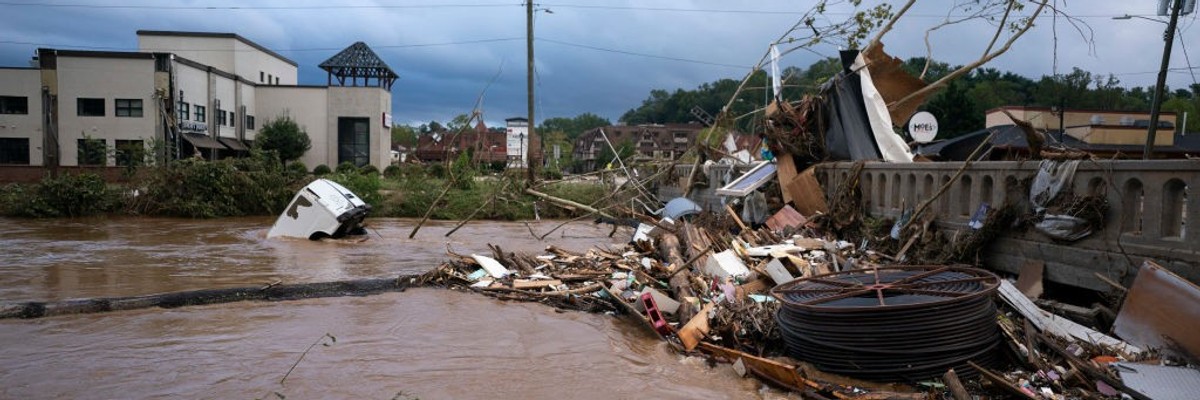
A van flows in floodwaters near the Biltmore Village in the aftermath of Hurricane Helene on September 28, 2024 in Asheville, North Carolina. (Photo: Sean Rayford/Getty Images)

“To those insisting that, ‘This is not the time!’ to have those other conversations, I say: This is *exactly* when we need to be having them,” said one climate scientist.

As emergency crews have worked through the weekend to rescue people and restore essential services across several southeastern U.S. states, green groups in recent days have pointed to the death and damage from Hurricane Helene as just the latest evidence of the need for sweeping action on the climate emergency.

Helene made landfall as a Category 4 hurricane with 140 mph winds in Florida’s Big Bend region late Thursday, then left a path of destruction across hundreds of miles of Georgia, the Carolinas, and Tennessee. As of early Sunday, at least 64 people are confirmed dead—including at least two people in Virginia—though that figure is expected to rise.

“Moody’s Analytics said it expects $15 billion to $26 billion in property damage,” The Associated Press reported Sunday on what is now a post-tropical cyclone. “AccuWeather‘s preliminary estimate of the total damage and economic loss from Helene in the U.S. is between $95 billion and $110 billion.”

The youth-led Sunrise Movement said Sunday that “any reporting about Hurricane Helene needs to be clear—this is not normal. This is not just a tragedy. This is a crime. Fossil fuel companies have known this would happen for the last 50 years. They lied to the public and bought out our government just to make a profit. Make them pay.”

Greenpeace USA similarly declared on social media Saturday that “#HURRICANE HELENE MUST BE A WAKE-UP CALL FOR CLIMATE JUSTICE!”

“We are heartbroken,” the group said, noting the dozens of people killed. “Communities have been devastated. The corporations heating the climate must be held accountable.”

Dozens of communities across the United States have already launched climate liability lawsuits against Big Oil, which knew for decades that fossil fuels would heat the planet but promoted disinformation and raked in huge profits. Recently there have been calls for legal action by the U.S. Department of Justice and potential homicide cases brought by state and local prosecutors.

“Our hearts and solidarity go out to everyone facing the devastation. Please support mutual aid relief efforts and demand oil companies #StartDrillingStartPaying!” Greenpeace said Saturday.

Sunrise executive director Aru Shiney-Aja on Sunday offered a “friendly reminder that fossil fuel companies get 20 BILLION dollars in [government] subsidies every year,” while the Federal Emergency Management Agency (FEMA) “runs out of money to respond to disasters like Helene.”

Both Shiney-Aja and Greenpeace shared footage from Asheville, North Carolina, which endured what Ryan Cole, the assistant director of Buncombe County Emergency Services, described as “biblical flooding.”

Just two years ago, The New Lede reported that “from wildfires racing through the drought-stricken West, to heavy flooding in the central and eastern regions of the United States, extreme weather events are spurring many Americans to seek refuge in more environmentally stable cities, so-called ‘climate havens,'” including Asheville.

This weekend, Asheville—which is over 2,000 feet above sea level and more than 250 miles from the coast—and surrounding communities are contending with disrupted water, power, and communications services due to what officials are reportedly calling “Buncombe County’s own Hurricane Katrina.”

Noting Asheville’s elevation and distance from the coast, Lucky Tran, director of science communications and media relations at Columbia University in New York City, said Sunday that “no place is safe from climate change. We all suffer the consequences. We must all take action. We are all in this together.”

As The New York Times reported Sunday:

People across western North Carolina chainsawed their way to loved ones and drove for hours Saturday on dwindling gas tanks in search of food and power, in what one resident described as a “mini-apocalypse” after Hurricane Helene.

Authorities said the region was facing a historic disaster a day after the powerful storm swept through the Southeast, downing power lines and washing out highways. Landslides, spotty cellphone service, and a gas shortage complicated rescue and recovery efforts. Some stranded people were being airlifted to safety.

Antonia Juhasz, a leading climate and energy journalist and author, said Saturday that “Asheville, North Carolina is being wiped off the map by the worst storm to hit the region in a generation. This is what the climate crisis looks like: the production and use of fossil fuels changes the climate, intensifying extreme weather events and making them more frequent.”

As hurricane scientist Jeff Masters detailed Friday, fossil fuel-driven climate change “makes the strongest hurricanes stronger,” boosts rainfall from such storms, leads to more rapid intensification, and causes sea-level rise that increases storm surge damage.

In an effort to emphasize the climate change connection to extreme weather, from heatwaves to hurricanes, some climate campaigners have suggested naming such events after oil and gas companies.

“What did a Helene ever do to deserve getting this horrific hurricane named after her? We should be naming hurricanes after fossil fuel CEOs instead. How about Hurricane Darren?” said Fossil Free Media director Jamie Henn, taking aim at ExxonMobil’s Darren Woods.

Daniel Swain, a climate scientist focused on extreme weather, said on social media Saturday, “The images and stories just beginning to emerge from eastern TN and western NC in the aftermath of widespread catastrophic flooding wrought by Helene are genuinely horrifying, and the full scale of the disaster is likely as yet untold.”

“This was, by far, the most extreme rain event in observed record across much/most of the region, where reliable records date back over 100 [years]. Unsurprisingly, the flooding which resulted has also been widespread, historic, and generally catastrophic across a broad region,” he explained. “These floods, which were concentrated in valleys containing rivers and typically modest creeks and streams, involved extremely large volumes of water moving downhill at high velocity. This was not a gradual or ‘gentle’ inundation by any means.”

Swain stressed that “sometimes ‘worst-case’ scenarios really do come to pass, and I think we often lack the collective imagination to fully envision what that looks like. That’s a problem, because being honest about risks that exist is [the] first step toward mitigating them and preventing harm!”

“Ultimately, there many folks in FL, GA, NC, and TN who are in need of urgent assistance—and that is/should be foremost priority,” he added. “But to those insisting that, ‘This is not the time!’ to have those other conversations, I say: This is *exactly* when we need to be having them.”

The AP reported that “in Atlanta, 11.12 inches (28.24 centimeters) of rain fell over 48 hours, the most the city has seen over two days since record-keeping began in 1878,” while “in Florida’s Big Bend, some lost nearly everything they own, emerging from the storm without even a pair of shoes.”

Along Florida’s Gulf Coast, “Helene shoved a wall of water estimated at least 10 feet high into the lowest-lying areas of Steinhatchee,” according to USA Today.

South of there, in Pinellas County, officials have identified over 18,000 homes damaged by Helene—and at least 11,000 are “uninhabitable,” as the Tampa Bay Times put it.

Highlighting the connection between climate change and more intense hurricanes, Congressman Maxwell Frost (D-Fla.) said Thursday that “the climate crisis is here. We must act to save lives.”

Original article by Jessica Corbett republished from Common Dreams under Creative Commons (CC BY-NC-ND 3.0). 
Continue ReadingClimate Movement Says ‘Hurricane Helene Must Be a Wake-Up Call’

Big Oil Sold Stuff They Knew Was Dangerous. There’s a Law for That.

Spread the love

https://newrepublic.com/article/185468/big-oil-reckless-endangerment-climate-change

David McNew/Getty Images

Prosecuting fossil fuel executives for reckless endangerment could help millions of victims of climate change–related disasters get justice.

Our world is becoming an increasingly dangerous place. One study recently found that extreme heat killed nearly 50,000 people in Europe last year. A single county in the United States—Maricopa County, in Arizona—reported 645 such deaths. Eye-popping sea surface temperatures are fueling a historically destructive hurricane season this summer, and lethal, record-breaking storms are lashing states from Texas to Vermont. In California, the climate-driven Park fire continues to burn a path of devastation that has left hundreds homeless, including numerous survivors of previous wildfires—people who have now lost their homes multiple times.

These aren’t “natural” disasters. 2023’s summer heat waves, for example, would have been “virtually impossible,” in one research team’s words, without human-caused climate change. That means these disasters are being driven by particular corporate actors—and particularly Big Oil companies. These companies, by generating a substantial portion of the greenhouse gas emissions that have warmed the planet, while simultaneously deceiving the public about the dangers of those emissions, have created a crisis that is putting millions of Americans at risk.

Two weeks ago, over 1,000 survivors of climate disasters sent a letter to the U.S. Department of Justice calling on Attorney General Merrick Garland to “investigate the fossil fuel industry for climate-related crimes.” One of the signers, Allen Myers, said that the wildfire that burned down his family’s home “bore the fingerprints of the climate crisis” and stressed that the “fossil fuel industry knows that what they’re doing is dangerous.”

Big Oil remains the greatest obstacle to climate action. Earlier this month the United Nations warned that fossil fuel companies are still running “a massive mis- and disinformation campaign” to delay our transition to safer energy sources. In other words, these offenses are ongoing, and the prosecutors and public safety officials charged with protecting us from criminal harm have an obligation to prosecute Big Oil executives for their reckless endangerment of the public.

https://newrepublic.com/article/185468/big-oil-reckless-endangerment-climate-change

Continue ReadingBig Oil Sold Stuff They Knew Was Dangerous. There’s a Law for That.

Canada’s New Greenwashing Law Hasn’t Stopped Politicians’ CCS Claims

Spread the love

Original article by Taylor Noakes republished from DeSmog.

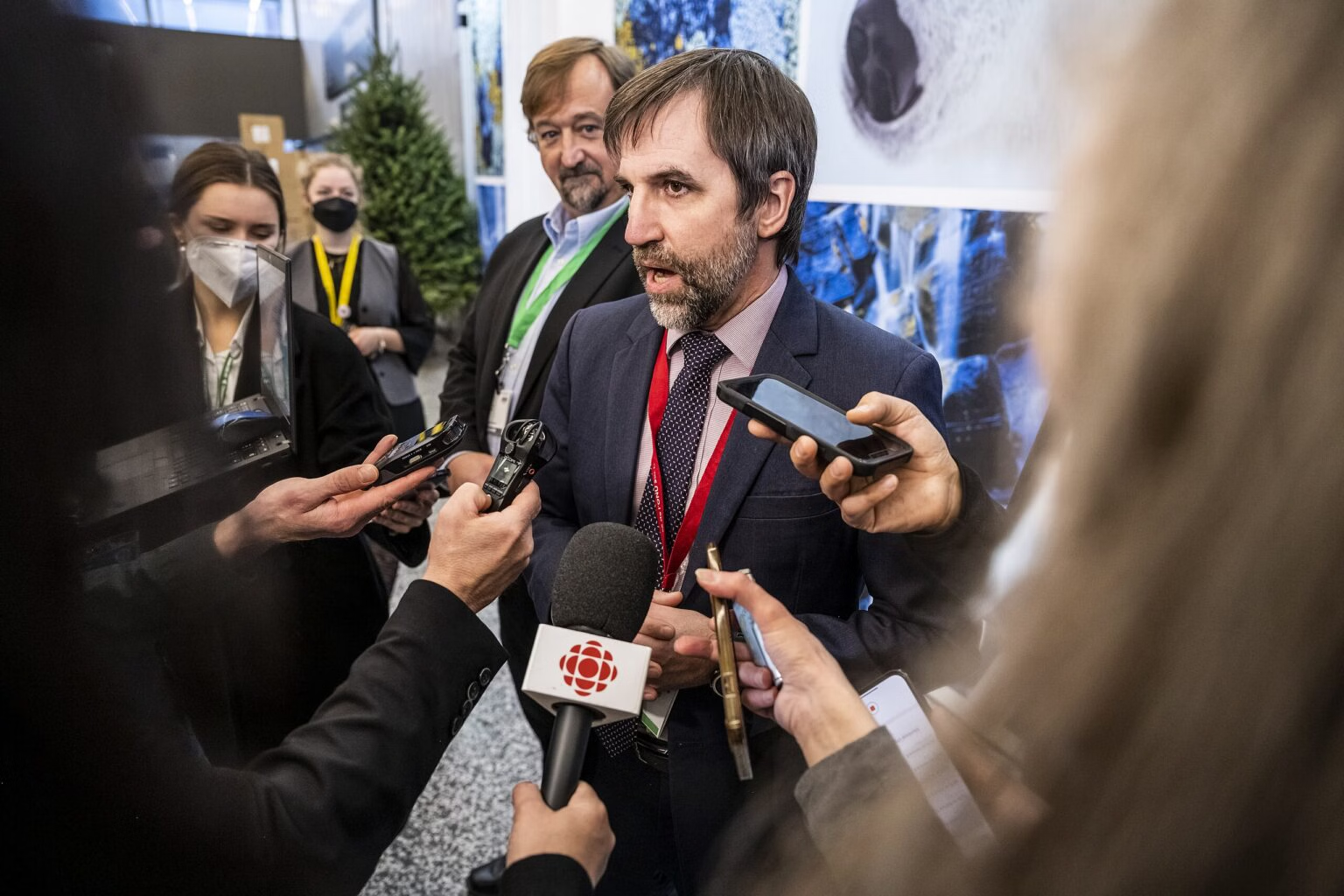
Environment minister Steven Guilbeault championed carbon capture in a recent funding announcement. Credit: Wikimedia Commons

Major companies have scrubbed references to carbon capture. Yet government officials continue to promote it.

While Canadian oil companies and their lobbyists have scrubbed mentions of carbon capture from their websites amid greenwashing concerns, Canadian government officials continue repeating unproven claims about the controversial technology.

Various government ministers, including environment minister Steven Guilbeault, have championed carbon capture (CCS) technology in recent press announcements and social media statements, despite mounting evidence CCS is not a viable climate change mitigation strategy.

It is in part because of the oil and gas industry’s allegedly misleading statements about CCS that the Canadian government introduced new anti-greenwashing amendments to the Competition Act. These new amendments provoked many Canadian oil and gas companies to remove environmental pledges and goals from their websites, including information about CCS. The Pathways Alliance, a consortium of Canadian tar sands oil producers that has been aggressively promoting a carbon capture project in Alberta, removed all content from their website on June 19 in anticipation of these new regulations. Pathways has since added some new content to their website, though there are far fewer details about the group’s interest in CCS.

In recent weeks, sitting ministers in the government of Canada have made several announcements or statements concerning carbon capture projects. In mid July, Strathcona Resources Ltd. announced it would enter into a partnership with the Canada Growth Fund — a public investment agency of Canada’s federal government — to split $2 billion CAD of new investments in CCS infrastructure for the company’s tar sands operations in Alberta and Saskatchewan.

The joint funding may not actually be as equal as government and industry have indicated. According to Julia Levin, Associate Director, National Climate, with Environmental Defence Canada, Strathcona may not even cover half their capital costs,  given their expectation these costs will be covered by the federal CCS investment tax credit and other grants. Indeed, according to Strathcona’s press release concerning the project, the company that “Substantially all of Strathcona’s share of capital costs is expected to be recouped through the federal CCS investment tax credit and other grants.”

“The Government of Canada is providing yet another oil company with a massive handout,” said Levin in a statement to DeSmog.

“Almost exactly a year ago, the Government of Canada released new rules ending fossil fuel subsidies. Yet they continue to break their promise by providing billions of dollars to some of the wealthiest companies in Canada. Despite carbon capture’s terrible track record, governments keep subsidizing the technology.”

Despite these and other concerns from environmentalists and climate scientists about CCS, Canada’s environment minister, Steven Guilbeault, was particularly enthusiastic about the news, writing on social media that “it pays to put the tools in place that build a cleaner economy and a more sustainable future.”

Whether this is in fact the case — that investments in CCS will lead to either a cleaner economy or a more sustainable future — is an issue at the heart of the government’s new anti-greenwashing regulations. Environmental claims must be based on an adequate and proper test, according to the legislation, and the burden of proof lies with whoever makes the original claim.

If Guilbeault were representing a tar sands producer, rather than the government of Canada, he may have reconsidered his statement. Canadian tar sands producers removed similar claims from their websites in the days before the anti-greenwashing regulations went into effect June 20. Cenovus, a partner in the Pathways Alliance, removed a section of their website titled “Innovation: The gateway to sustainable advancements” that concerned carbon capture technology. DeSmog found 70 distinct URLs linking to the websites of Pathways members, or the website of the Canadian Association of Petroleum Producers (CAPP), that mentioned carbon capture that had been removed since the federal anti-greenwashing regulations took effect.

CCS studies shed some light on these sudden website deletions. A landmark Global Witness report from 2022 revealed Shell Canada’s Quest hydrogen project, which uses carbon capture, created more emissions than it sequestered. According to an International Institute for Sustainable Development (IISD) report from November of 2023, there are just 30 commercial CCS projects operating globally, capturing less than 0.2 percent of the emissions required to close the emissions gap by 2030. Moreover, a majority of the 149 CCS projects that were to be operational by 2020 were either cancelled or put on indefinite hold due to technological challenges or exceptionally high costs. 

Another IISD study found CCS is inconsistent with Canada’s net zero ambitions. It is expensive, slow to implement, energy intensive, and unproven at scale. Nearly all CCS projects are either being used for enhanced oil recovery, and irrespective of however much carbon dioxide is captured by the process, it has no positive impact whatsoever on downstream emissions.

“Carbon capture technology has failed to make a dent in reducing climate pollution, despite decades of subsidies,” said Environmental Defence’s Julia Levin. “It is a dangerous distraction driven by the same big polluters who have caused the climate emergency. Why should taxpayers be on the hook to pay for ineffective, unnecessary, and risky technology?” asked Levin.

There doesn’t appear to be any obligation for Canada’s environment minister to be held to the same standard as oil and gas companies when it comes to making claims about the effectiveness of carbon capture.

Canada’s natural resources minister, Jonathan Wilkinson, made similarly enthusiastic and unverifiable comments concerning carbon capture in a recent interview with the Globe and Mail. Wilkinson said that he believes 20 to 25 new carbon capture projects would break ground in Canada in the next decade. Wilkinson said this would likely be the case owing to a new federal government investment tax credit for carbon capture and storage projects, which could cover up to half the capital costs of new projects.

Wilkinson stated to the Globe and Mail that the new Shell Polaris CCS project was a direct result of the investment tax credit. 

Wilkinson’s statements on social media concerning the Strathcona project insinuated that the tax credit was helping companies achieve their net zero ambitions: “Canada’s new investment tax credits have helped companies move expeditiously to improve their competitiveness in a world that’s rapidly moving towards net-zero.” Wilkinson continued, insinuating that the Strathcona CCS project would work towards decarbonization, stating: “Strathcona Resources is innovating to seize the economic opportunity decarbonization presents and creating jobs now and into the future.”

When asked by the Globe and Mail for his thoughts on Pathways Alliance’s massive CCS proposal, Wilkinson was optimistic the project would be completed, and that “We are still working a little bit on the structure of that. But I do believe that it will move forward. There’s just a bit more work to do to finish the job.”

In May 2023, Pathways Alliance was the subject of an investigation by Canada’s Competition Bureau over allegations of false and misleading claims. The complaint was initiated by Greenpeace Canada. Pathways scrubbed its website of all content in advance of the new anti-greenwashing regulations, something Wilkinson told the Globe and Mail he thought was an over-reaction.

A study published by the journal Energy Research & Social Science in the spring of 2024 indicated “instances of selective disclosure and omission, misalignment of claim and action, displacement of responsibility, non-credible claims, specious comparisons, nonstandard accounting, and inadequate reporting,” in their analysis of Pathways’ advertising over a two-year period.

Original article by Taylor Noakes republished from DeSmog.

Continue ReadingCanada’s New Greenwashing Law Hasn’t Stopped Politicians’ CCS Claims

Fossil Fuel Industry Propaganda Blamed as Record Heat Scorches Planet

Spread the love

Original article by JESSICA CORBETT republished from Common Dreams under Creative Commons (CC BY-NC-ND 3.0). 
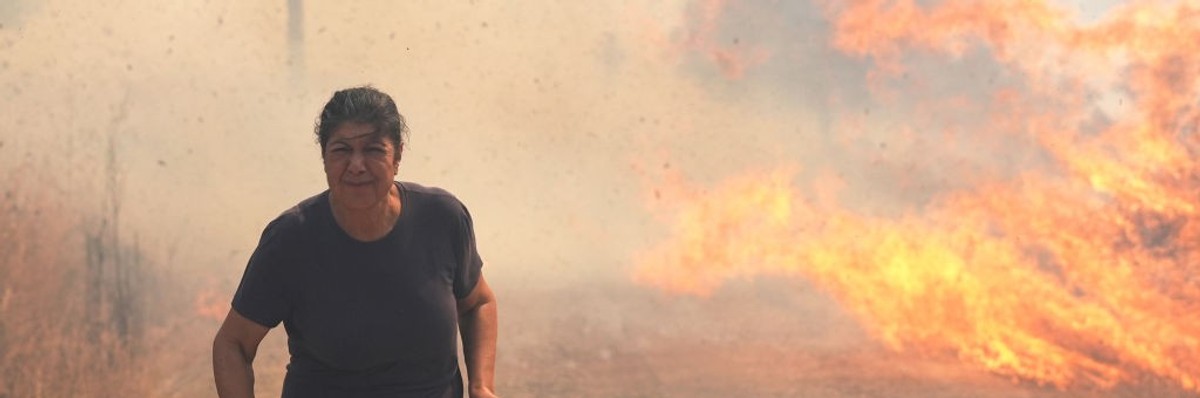
Civilians flee a forest fire that broke out close to residential areas at Cesmealti in Urla district of Izmir, Turkey on July 31, 2024. (Photo: Mahmut Serdar Alakus/Anadolu via Getty Images)

“We need to tackle the root cause and get serious about reducing record levels of greenhouse gas emissions,” said the head of the World Meteorological Organization.

As scientists around the world on Thursday released new data about recent record-smashing heat, one United Nations adviser placed blame for the lack of ambitious climate action on the fossil fuel industry’s decadeslong disinformation efforts.

“There is this prevailing narrative—and a lot of it is being pushed by the fossil fuel industry and their enablers—that climate action is too difficult, it’s too expensive,” Selwin Hart, a special adviser to the U.N. Secretary-General António Guterres and assistant secretary-general of the Climate Action Team, told The Guardian‘s Fiona Harvey.

“It is absolutely critical that leaders, and all of us, push back and explain to people the value of climate action, but also the consequences of climate inaction,” said Hart, former executive director of the Caribbean at the Inter-American Development Bank and Barbados’ ambassador to the United States and the Organization of American States.

Investigations by academicsjournalists, and lawmakers as well as ongoing legal battles have exposed how Big Oil not only has heated and polluted the planet but also knew about the devastating impacts of fossil fuels decades ago and opted to spread lies so shareholders could make massive profits—which they continue to rake in today.

“Climate appears to be dropping down the list of priorities of leaders,” Hart said, pointing to polling that shows people around the world want a rapid transition to clean energy. “But we really need leaders now to deliver maximum ambition. And we need maximum cooperation. Unfortunately, we are not seeing that at the moment.”

According to The Guardian:

[Hart] warned that the consequences of inaction were being felt in rich countries as well as poor. In the U.S., many thousands of people are finding it increasingly impossible to insure their homes, as extreme weather worsens. “This is directly due to the climate crisis, and directly due to the use of fossil fuels,” he said. “Ordinary people are having to pay the price of a climate crisis while the fossil fuel industry continues to reap excess profits and still receives massive government subsidies.”

Yet the world has never been better equipped to tackle climate breakdown, Hart added. “Renewables are the cheapest they’ve ever been, the pace of the energy transition is accelerating,” he said.

Hart’s comments came as the European Union’s Copernicus Climate Change Service (C3S) announced that last month “was the second-warmest July globally in our data record, with an average ERA5 surface air temperature of 16.91ºC,” or 62.44ºF.

From June 2023 to June 2024, each month was the hottest on record, according to C3S. Samantha Burgess, the agency’s deputy director, noted that now, “the streak of record-breaking months has come to an end, but only by a whisker.”

“Globally, July 2024 was almost as warm as July 2023, the hottest month on record,” Burgess stressed. “July 2024 saw the two hottest days on record. The overall context hasn’t changed, our climate continues to warm. The devastating effects of climate change started well before 2023 and will continue until global greenhouse gas emissions reach net-zero.”

The U.N.’s World Meteorological Organization (WMO) said Thursday that the new C3S data “underlines the urgency of the Call to Action on Extreme Heat” issued by Guterres last month, shortly after July 22 became the hottest day ever recorded.

“Widespread, intense, and extended heatwaves have hit every continent in the past year,” said WMO Secretary-General Celeste Saulo in a statement. “At least 10 countries have recorded daily temperatures of more than 50ºC in more than one location. This is becoming too hot to handle.”

Saulo highlighted that “Death Valley in California registered a record average monthly temperature of 42.5ºC (108.5ºF)—possibly a new record observed for anywhere in the world. Even the remote frozen ice sheets of Antarctica have been feeling the heat.”

“The WMO community is committed to responding to the U.N. secretary-general’s Call to Action with better heat-health early warnings and action plans,” she pledged. “Recent estimates produced by WMO and the World Health Organization indicate that the global scale-up of heat-health warning systems for 57 countries alone has the potential to save an estimated 98,000 lives per year. This is one of the priorities of the Early Warnings for All initiative.”

“Climate adaptation alone is not enough,” she added. “We need to tackle the root cause and get serious about reducing record levels of greenhouse gas emissions.”

C3S wasn’t alone in releasing new data on Thursday; the U.S. National Oceanic and Atmospheric Administration (NOAA) also shared some key points for the country’s climate in July, with the full report set to be released on Tuesday.

NOAA’s top takeaways were:

  • The average temperature of the contiguous U.S. in July was 75.7ºF, 2.1ºF above average, ranking 11th warmest in the 130-year record.
  • The Park Fire is the fourth-largest wildfire in California history as of August 6; beginning on July 24, it burned approximately 401,000 acres and destroyed over 560 structures.
  • On July 15, a derecho that spawned 32 tornadoes broke the Chicago-area record for most tornadoes in a day.
  • On July 1, Beryl became the earliest Category 5 hurricane and the second Category 5 on record during the month of July in the Atlantic Ocean.
  • Alaska had its wettest July on record.
  • Four new billion-dollar weather and climate disasters were confirmed in July. The year-to-date total currently stands at 19 disasters.

Other major events in July included California’s Thompson Fire, which forced over 13,000 people to evacuate, and Washington, D.C. enduring 101ºF on July 17, tying a record for the longest streak of temperatures above 100ºF. NOAA also found that “for the January-July period, the average contiguous U.S. temperature was 54.5ºF, 3.2ºF above average, ranking second-warmest on record.”

Original article by JESSICA CORBETT republished from Common Dreams under Creative Commons (CC BY-NC-ND 3.0). 
Continue ReadingFossil Fuel Industry Propaganda Blamed as Record Heat Scorches Planet

Report Details Big Oil Lobby’s Relentless Opposition to a Green Transition

Spread the love

Original article by JESSICA CORBETT republished from Common Dreams under Creative Commons (CC BY-NC-ND 3.0). 
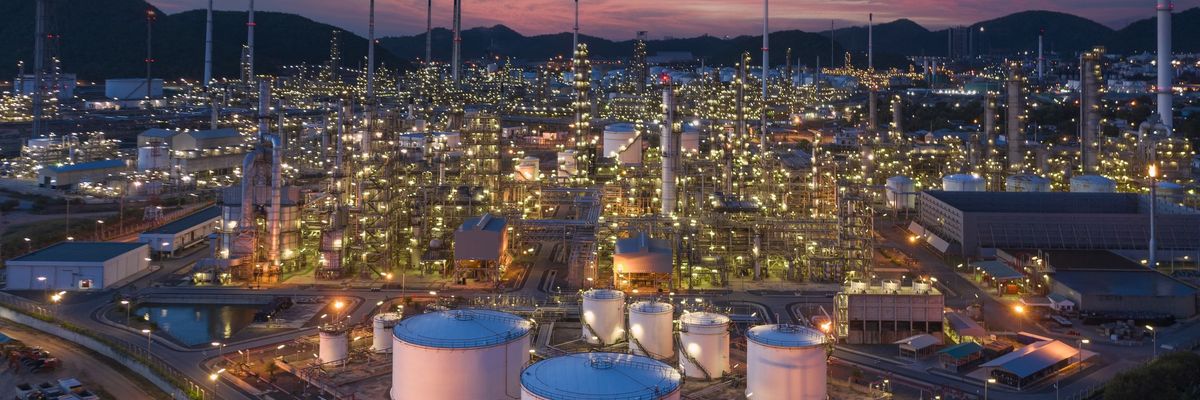
An oil refinery is shown at dusk in Thailand.  (Photo: credit: Suriyapong Thongsawang/Getty Images)

Climate campaigners said the “brilliant and disturbing” publication “shows the crucial need for increased awareness of the delaying tactics of fossil fuel companies.”

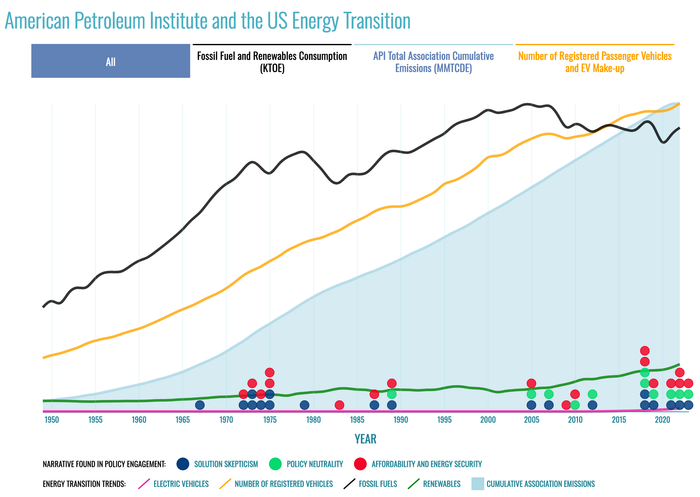
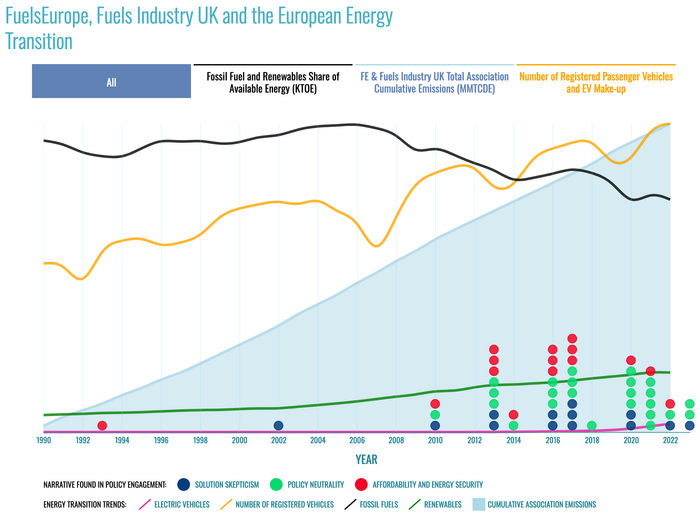
Echoing years of academiccongressional, and journalistic research, a U.K.-based think tank on Thursday released a report detailing how top fossil fuel industry trade groups have “used a playbook of narratives and arguments to systematically oppose, weaken, and delay the transition to renewables and electric vehicles (EVs) since at least 1967.”

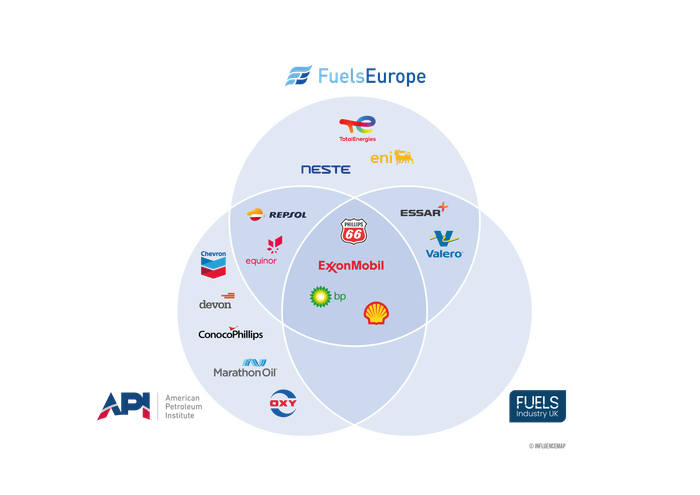
The new InfluenceMap analysis focuses on the American Petroleum Institute (API), FuelsEurope, and Fuels Industry U.K.—whose spokespeople responded to the report by insisting to SustainableViews that the oil and gas industry is playing an “essential” role in the transition and it is necessary to harness “vast energy resources, from oil and natural gas to renewables.”

Meanwhile, InfluenceMap’s report calls out the organizations for their use of three narratives over the past five decades that “has likely contributed to delaying the energy transition and continues to pose a serious threat to policy progress on climate change.”

“Between 1950 and 2022, the members of these associations have a combined contribution of approximately 350 billion tons of greenhouse gas emissions, accounting for approximately 18% of the world’s total cumulative CO2 emissions from fossil fuels and industry,” the report notes.

InfluenceMap traced the narratives “across 51 separate instances of the associations’ advocacy against fossil fuel alternatives between 1967 and 2023,” the publication explains. “These narratives include ‘Solution Skepticism,’ which has been in use for 56 years, ‘Policy Neutrality’ for 34 years, and ‘Affordability and Energy Security’ for 51 years.”

The group defined the narratives as follows:

  • Solution Skepticism: downplays the impact and viability of alternative energy.
  • Policy Neutrality: promotes consumer choice, market solutions, and minimal government intervention.
  • Affordability and Energy Security: paints fossil fuel alternatives as a risk to cost-effective and secure energy.

“Despite advancements in understanding the threats posed by the climate crisis, these narratives persist as of 2023,” the report says. It also emphasizes that the narratives contradict science-based policy recommendations from the United Nations’ Intergovernmental Panel on Climate Change (IPCC) and the International Energy Association (IEA).

Some examples identified by InfluenceMap include API comments on the Clean Air Act and amendments in 1967, 1970, and 1989 as well as the association’s remarks on the Inflation Reduction Act of 2022 and pollution standards for heavy-duty vehicles last year. The publication also points to FuelsEurope’s 2021 comments on European Union Performance Standards and the group’s participation in a 2022 letter about the Energy Performance of Buildings Directive.

InfluenceMap produced graphics to display its findings, including one that shows key members of each association as of March. Members of all three include BP, ExxonMobil, Shell, and Phillips 66.

“Some of the world’s largest oil and gas companies are still paying a high premium to participate in industry associations that may no longer represent them on climate policy,” the report states, pointing to how associations’ actions contrast with public positions taken by some major fossil fuel corporations. “Meanwhile, Shell, Chevron, and Exxon have disclosed that they pay between $5 million and $12.5 million per year to hold a membership with the API.”

The think tank also made a pair of graphics showing how the trade associations’ documented use of the three narratives aligns with fossil fuel and renewables consumption, association members’ cumulative emissions, and the number of EVs compared with the total number of registered passenger vehicles since the 1950s.

“This report shows that even faced with mounting scientific evidence over decades, the oil and gas industry have pushed ahead with a damaging messaging strategy they developed as early as the 1960s,” said Tessa Khan, founder and executive director of Uplift, which supports a rapid and fair transition away from fossil fuel production in the U.K.

“It shows the crucial need for increased awareness of the delaying tactics of fossil fuel companies from policymakers if they are to successfully drive the energy transition forward at the pace we need,” Khan added.

Calling the report “brilliant and disturbing,” the U.K.-based Fossil Free Parliament said that “this is exactly why we need to remove the industry’s seat at the table in Westminster.”

In the United States, Democratic federal lawmakers recently concluded a probe into BP, Chevron, ExxonMobil, Shell, API, and the U.S. Chamber of Commerce for decades of spreading climate disinformation, after which they urged the U.S. Department of Justice to investigate all six.

Original article by JESSICA CORBETT republished from Common Dreams under Creative Commons (CC BY-NC-ND 3.0). 
Continue ReadingReport Details Big Oil Lobby’s Relentless Opposition to a Green Transition