You know this don’t you? Temperature records continually getting broken, US Secretary General Antonio Guterres continually warning about climate hell, politicians and fossil fuel cnuts continuing to destroy the planet.
The solution is known and has been know since the 1960s and 70s – it is simply to stop burning fossil fuels. Fossil fuel companies have known, lied and deceived. Politicians in the pocket of the fossil fuel industry offer and do nothing.
Action was needed decades ago and shite politicians have failed us all. You can’t leave it to the profiteers or the politicians that they own if you want a planet you can live on – they quite clearly don’t give a feck about anything other than money and power.
A new report by the Senate Committee on the Budget details how fossil fuel companies have avoided tackling the climate crisis.
Last week, US Democrats released a report three years in the making detailing the ways that large fossil fuel producers including Shell, BP and Exxon have sought to avoid responsibility for the climate crisis.
The 65 page-long report, jointly authored by the Democrats House Committee On Oversight And Accountability and the Senate Committee on the Budget, contains files subpoenaed from big oil companies that “demonstrate for the first time that fossil fuel companies internally do not dispute that they have understood since at least the 1960s that burning fossil fuels causes climate change and then worked for decades to undermine public understanding of this fact and to deny the underlying science”.
Previous documentation has shown that companies including Exxon knew about human-made climate change since at least 1981, and files released earlier this year suggest it may have been known since the 1950s. The importance of this report lies in proving that fossil fuel companies not only knew, but privately believed the science despite public rejection.
The files also show the tactics used by major fossil companies to discredit climate activism, the report says, among them “pivot[ing] from outright climate denial to a new strategy of deception. Instead of misrepresenting the science and the consequences of climate change, they pivoted to misrepresenting their business plans, their investments in low carbon technologies, the alleged safety of natural gas, and their support for various climate policies and emission reduction targets”.
Yet the oil and gas major led a campaign to present gas as a climate solution, new ‘confidential’ documents released by a U.S. Congressional investigation reveal.
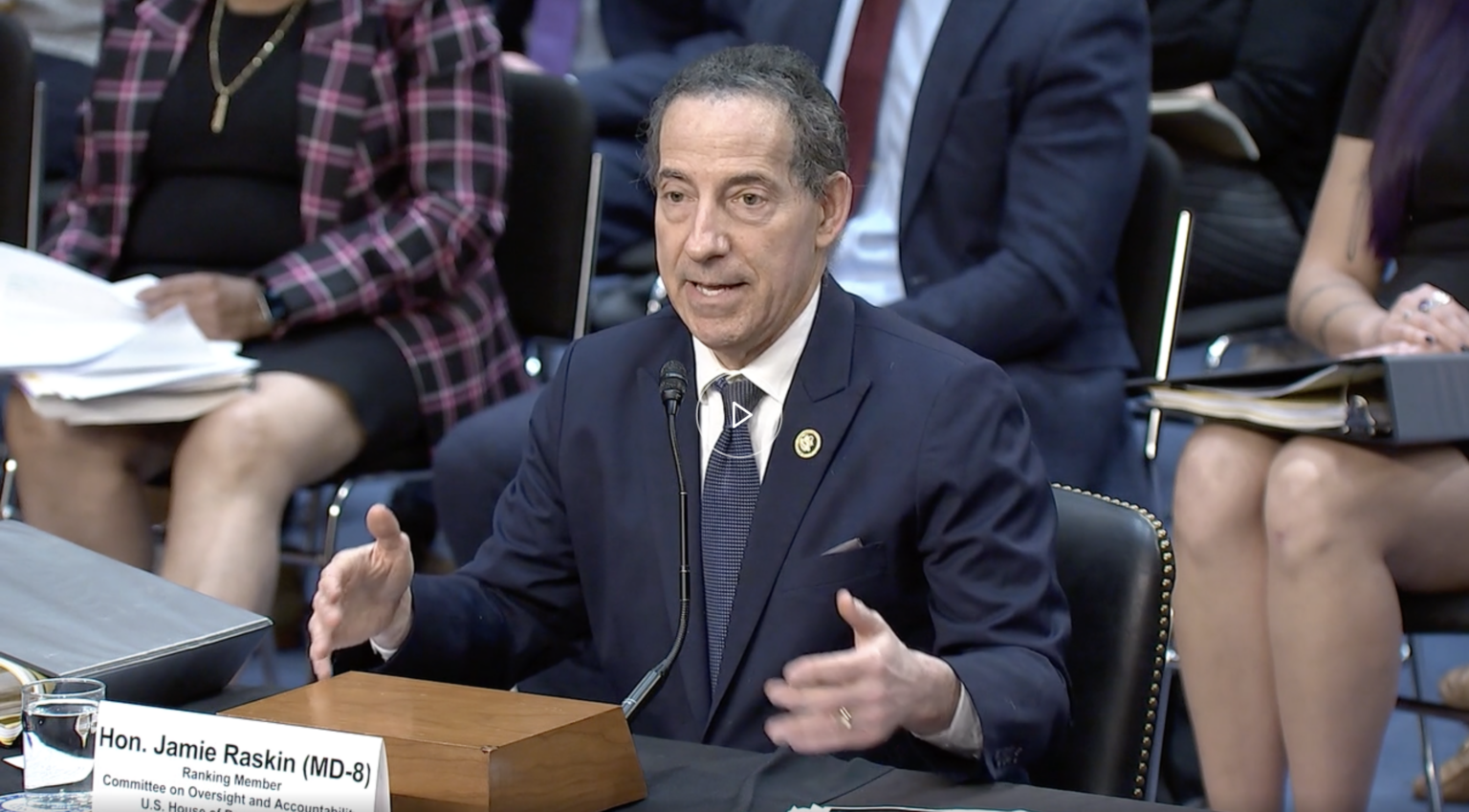
Democrat Jamie Raskin appeared before a Senate hearing examining Big Oil’s efforts to avoid climate accountability. Credit: US Senate
BP was warned by Princeton University researchers in 2016 that climate change accelerated in part by new global supplies of shale gas could lead to catastrophic events such as “mass extinctions and unprecedented famine.”
Yet despite acknowledging internally the concern that “gas doesn’t support climate goals,” the UK-headquartered oil and gas major embarked on a marketing campaign to “advance and protect the role of gas—and BP—in the energy transition.”
That’s been accompanied by large new investments in gas, including a recent agreement to take nearly two million tonnes per year of liquefied natural gas shipments from a $5.1 billion export facility called Woodfibre LNG proposed for the west coast of British Columbia.
Revelations concerning BP’s private knowledge about the dangers of gas expansion were contained in a trove of documents—some labelled “confidential”—released by Democrats in early May as part of a joint House and Senate investigation into the oil and gas industry’s climate obstruction.
“The fossil fuel industry evolved from denying climate science to spreading disinformation and perpetuating doublespeak about the safety of natural gas and its commitment to reducing greenhouse gas emissions,” the Joint Staff Report argues.
BP didn’t respond to questions from DeSmog related to the report.
Documents contained in the report, which were obtained via federal subpoenas, suggest that the highest levels of BP leadership have been privately made aware of potential climate disruption caused by natural gas. Comments on a draft outline for a 2017 speech by BP’s then-CEO Robert Dudley articulate that fear explicitly.
“You don’t say anything about concerns about so-called lock-in, the idea that, once built, gas locks in future emissions above a level consistent with 2 degrees, at least without CCUS,” the comments read, referring to expensive and frequently underperforming carbon capture utilization and storage technologies.
A confidential 2018 presentation from BP notes that while gas may release less emissions when burned than coal, those climate gains can be erased by leakages of the “potent” greenhouse gas methane. “Methane (CH₄) accounts for 20% of GHGs [greenhouse gas emissions],” a slide from the presentation notes. “Oil and gas accounts for nearly a quarter of this 20%.”
The presentation acknowledges the concern, widely reported in the media by that point, that “gas doesn’t support climate goals when you take methane emissions into account.” BP appears to have seen such worries as an “opportunity” for the company, however.
The company intended to launch a communications campaign that could “position BP as [a] strong gas player” in part by “demonstrating leadership on methane challenge,” the slide reads.
Yet the oil and gas producer had been warned that a failure to limit global temperature rise to below 2 degrees could be catastrophic for humankind and the planet. During a 2016 town hall event for BP in Houston, Princeton researchers noted “innovation in the energy sector has been dramatically affected by the arrival of shale gas and oil and low energy prices.”
One result, they noted, is that “fossil fuels are so abundant that, for even a weak climate target, attractive fossil fuel will be left in the ground.” But if the world fails to limit warming below 2 degrees, “the climate monsters begin to come into the room,” they noted.
As warming approaches 3 degrees, their presentation explained, “we expect a rogue’s gallery, from the loss of all of our coastal cities because of >10 m of sea level rise, to cessation of the ocean’s circulation.”
Yet the company continues to publicly portray the fossil fuel as a climate solution. “As the world seeks secure, affordable and lower carbon energy, global demand for LNG is expected to continue to grow,” a BP executive said last year upon the company signing its latest off-take agreement with Woodfibre LNG in Canada.
This is part of a years-long global campaign to spread “disinformation” about the role of gas “as a bridge fuel to a fossil-free future,” the Congressional report argues. “It is long past time to hold Big Oil accountable for its deception campaign and to take action to undo the harms it has perpetrated.”
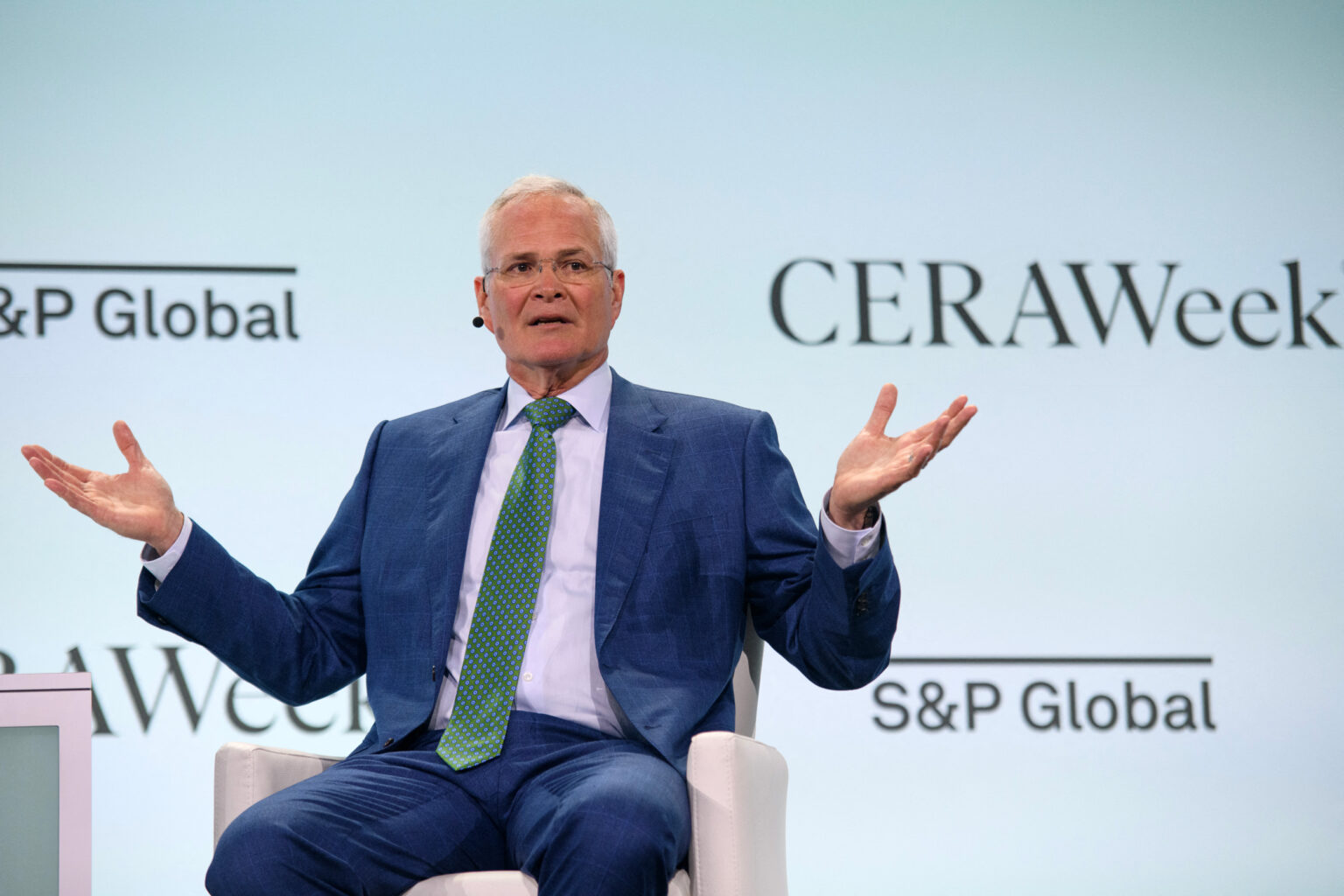
Exxon Mobil Chairman and CEO Darren Woods speaks during the CERAWeek oil summit in Houston, Texas, on March 18. Credit: Mark Felix/AFP via Getty Images
Congressional Democrats say newly released documents trace oil industry’s pivot from denial to deception.
In the wake of Inside Climate News’ 2015 stories on ExxonMobil’s research confirming fossil fuels’ role in global warming, the oil giant hit back with a #GetTheFacts social media campaign calling the reporting “misleading,” “baseless,” and “politically motivated.”
But in internal discussions, Exxon’s communications team grappled with how to respond when “we actually don’t dispute much of what these stories report,” according to one of 4,500 documents newly released by Congressional Democrats after a two-and-a-half-year investigation of industry disinformation on climate change.
At a hearing on Wednesday, Senate Budget Committee Chairman Sheldon Whitehouse (D-R.I.) said that the new documents show the evolution of the oil industry’s response to climate change. Instead of an outright denial of the science, Whitehouse said the oil companies engaged in what he called “Climate Denial Lite.”
Big Oil, Whitehouse said, is now “pretending it is taking climate change seriously—while secretly undermining its own publicly stated goals.”
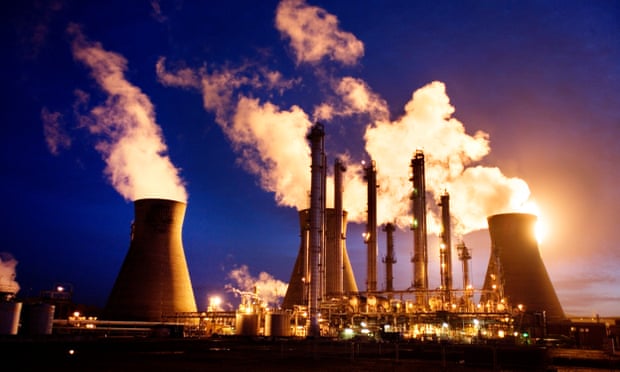
Gas flares at BP’s Grangemouth oil refinery at dusk in Scotland. Photograph: Murdo Macleod/The Guardian
Despite splashy climate pledges, firms including BP and Saudi Aramco have plans to expand fossil fuel production, says analysis
In recent years, virtually all of the world’s largest oil companies have made splashy climate pledges. But when it comes to actually slashing emissions, those firms are “way off track”, a new report has found.
The analysis from the thinktank Carbon Tracker assessed the production and transition plans of 25 of the world’s largest oil and gas companies. None align with the central goal of the 2015 Paris climate agreement to keep global warming “well under” 2 degrees above pre-industrial levels, the report found.
“Companies worldwide are publicly stating they are supportive of the goals of the Paris-Agreement, and claim to be part of the solution in accelerating the energy transition,” said Maeve O’Connor, analyst at Carbon Tracker and co-author of the report. “Unfortunately, however, we see that none are currently aligned with the goals of the Paris agreement.”
…
The analysis comes as oil and gas companies are publicly reneging on their climate commitments. Shell last week watered down earlier emissions targets, following BP, which made a similar announcement last year. In October, ExxonMobil also made a deal to buy the shale group Pioneer Natural Resources, while Chevron announced plans to acquire the Texas oil company Hess – markingtwo of the country’s largest oil and gas deals in decades.