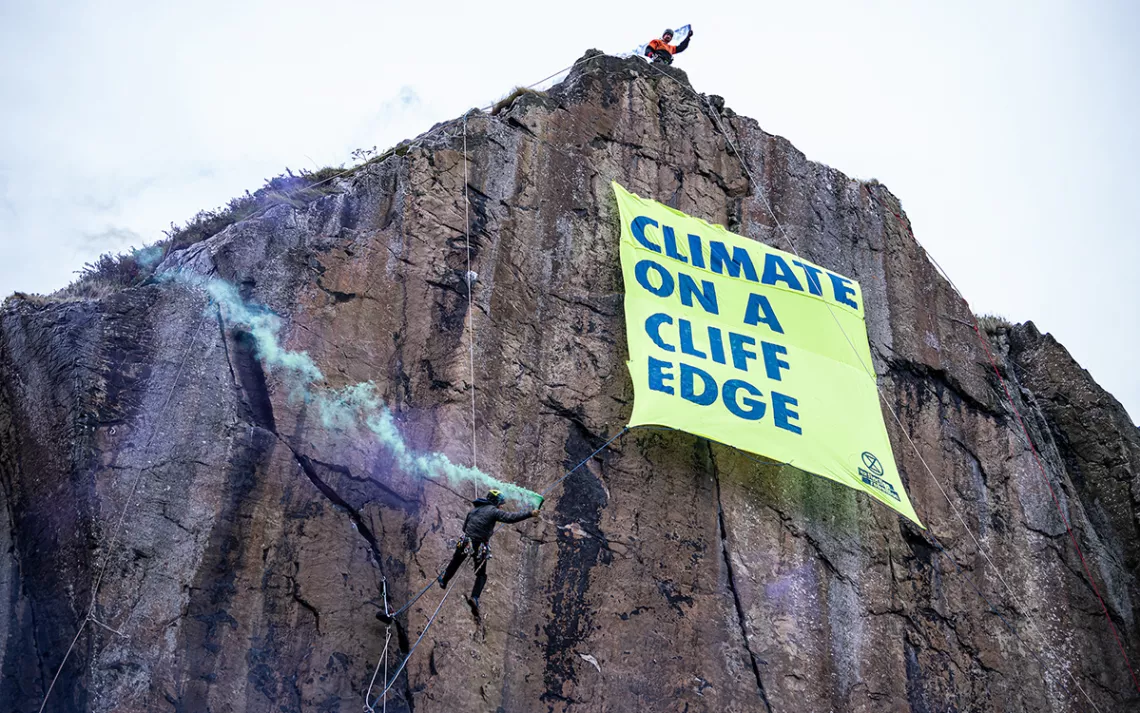
Experienced climbers scale a rock face near the historic Dumbarton castle in Glasgow, releasing a banner that reads “Climate on a Cliff Edge.” One activist, dressed as a globe, symbolically looms near the edge, while another plays the bagpipes on the shores below. | Photo courtesy of Extinction Rebellion and Mark Richards
Funds could insulate all draughty homes, fund free bus travel, and retrain millions of workers for a green future
A TEMPORARY tax on the super-rich could generate enough money to fix every poorly insulated home, fund free bus travel and retrain three million workers in green industries, Greenpeace revealed today.
A new report commissioned by the climate group proposes introducing an annual 2.5 per cent tax on all individual wealth above £10 million over the next five years.
This “national renewal tax” would impact less than 75,000 people — 0.1 per cent of the population — and raise up to £183 billion for the Treasury.
…
An analysis by Oxfam found that the richest 1 per cent emit as much carbon as two-thirds of all humanity.
Greenpeace UK’s climate campaigner Georgia Whitaker said: “The oversized carbon footprint of the super-rich is a clear rationale for ensuring that they play an oversized role in fixing the crisis that they have an oversized role in creating.
…
Patriotic Millionaires member Julia Davies, who wrote the report’s foreword, said: “This report highlights that a small, temporary tax on our wealth could transform the lives of millions, while tackling the greatest threat humanity has ever faced — the climate crisis — all while investing in a strong forward-facing economy with quality stable jobs for the British people.”
CAMPAIGNERS called for the government to reverse cuts to the winter fuel payment today, with energy bills set to rise by 10 per cent from next week.
Regulator Ofgem announced it will raise its price cap starting next Tuesday, pushing bills up from £1,568 to £1,717 for a typical household.
The End Fuel Poverty Coalition warned that energy bills will be 65 per cent higher than in winter 2020/21.
Millions have already fallen into energy debt, with Ofgem data revealing that the total owed has spiralled into a record-breaking £3.69 billion.
This winter, some 1.2m pensioners in poverty and 1.6m disabled people will miss out on winter fuel payments, making it more and more difficult for them to cover the rising bills.
The Labour government has announced cuts to the payment, previously available to all pensioners, limiting it to only those receiving means-tested benefits.
Comparison service Uswitch estimated that 752,000 older people will not use heating at all this winter as a result.
More than 1.7 million households plan on keeping their heating off this year, survey reveals
LIVES will be lost, campaigners warned today after a survey revealed that more than 1.7 million households do not plan on turning on their heating this year.
The number of those who said they will keep the heating off in polling for Uswitch is nearly double the 972,000 who said they did not heat their homes last year.
Fifty-five per cent of those blamed the continued rise of the cost of living, while 25 per cent of those over 65 said their decision followed the loss of winter fuel payments.
Another one million households will not turn on the heating until December to keep costs down, according to the poll.
About 43 per cent of households said they will only turn the heating on if they are too cold while 31 per cent will only heat some rooms in their home.
A pensioner struggles to keep warm at home. Photograph: Studio Romantic/Shutterstock
Call comes after government forced to reveal that 71% of pensioners with disabilities will lose entitlement despite dependence on warmer homes
Groups representing disabled people are demanding urgent meetings with ministers after it was revealed that 1.6 million pensioners with disabilities will lose their winter fuel payments because of government cuts.
The figures were released by the Department for Work and Pensions on Friday evening, in answer to a freedom of information request, despite the government having said it had done no official impact assessment on the policy. The internal DWP analysis also suggested that nine in 10 pensioners aged between 66 and 79, and eight out of 10 over-80s would lose their allowance.
Since those over 80 receive a higher payment – £300 as opposed to £200 – they would take the greatest financial hit, the document said.
The analysis revealed that although people with disabilities were more likely to retain the payment, 71% – 1.6 million – would still lose their entitlement, despite their greater dependence on heating their homes.
The analysis also estimated that of the 880,000 pensioners entitled to pension credit but who do not claim the benefit, only 100,000 are expected to sign up to it as a result of a government campaign now under way, meaning about 780,000 pensioners on low incomes would continue to miss out.
After 14 years of billionaires doubling their wealth, the political elite’s choice of starving pensioners and children shows austerity as a complete con job.
Jeremy Corbyn MP, former leader of the Labour Party
Every day, my constituents make tough choices. Tough choices like deciding whether to heat their homes or put food on the table. Tough choices like taking out a loan to pay for this month’s rent. Tough choices like selling their home to pay for their family’s social care.
People are making tough choices because governments have made the wrong choices. We warned that Tory austerity would weaken our economy and decimate our public services. We were ignored, and the poorest in society paid the price. Austerity is not just a buzzword. It is the ongoing, brutal reality for millions of people who have been pushed into destitution. It is the face of desperation and anxiety of those forced into a spiral of debt. It is a freezing cold night for the record numbers of people sleeping rough on the streets. It is the graveyard for those left without vital support: more than 300,000 excess deaths have been attributed to austerity policies.
We often talk about austerity in terms of cuts to public spending, but that is just one side of the coin. By starving public services of resources, the government manufactured a convenient excuse for their privatisation. We saw this most acutely with the NHS: an underfunded public service does not just cause satisfaction to plummet, but the belief in the principle of public healthcare itself. Austerity was never about saving money (the UK’s debt pile increased every single year under the Tories). It was about transferring money from the poorest to the richest. Between 2010 and 2018, aggregate wealth in the UK grew by £5.68 trillion. 94% went to the richest 50% of households. 6% went to the poorest 50%. As child poverty was heading towards its highest levels since 2007, Britain’s billionaires more than doubled their wealth.
It was a political decision to defund, dismantle and auction off our public services. And it will be a political decision to repeat this failed economic experiment. ‘It’s going to be painful’, the Prime Minister told the nation last week, prepping the public for ‘difficult choices’ ahead. Did he get permission from the Tories to reuse their trademark slogans? Other ministers have gone one step further, indicating that they do not have any choice at all but to impoverish children and pensioners. Keeping children in poverty is unavoidable, apparently, if we want to restore the public finances. Scrapping the winter fuel allowance is a necessity, we were risibly told, if we want to stop a run on the pound.
It is astonishing to hear government ministers try to pull the wool over the public’s eyes. The government knows that there is a range of choices available to them. They could introduce wealth taxes to raise upwards of £10 billion. They could stop wasting public money on private contracts. They could launch a fundamental redistribution of power by bringing water and energy into full public ownership. Instead, they have opted to take resources away from people who were promised things would change. There is plenty of money, it’s just in the wrong hands — and we will not be fooled by ministers’ attempts to feign regret over cruel decisions they know they don’t have to take.