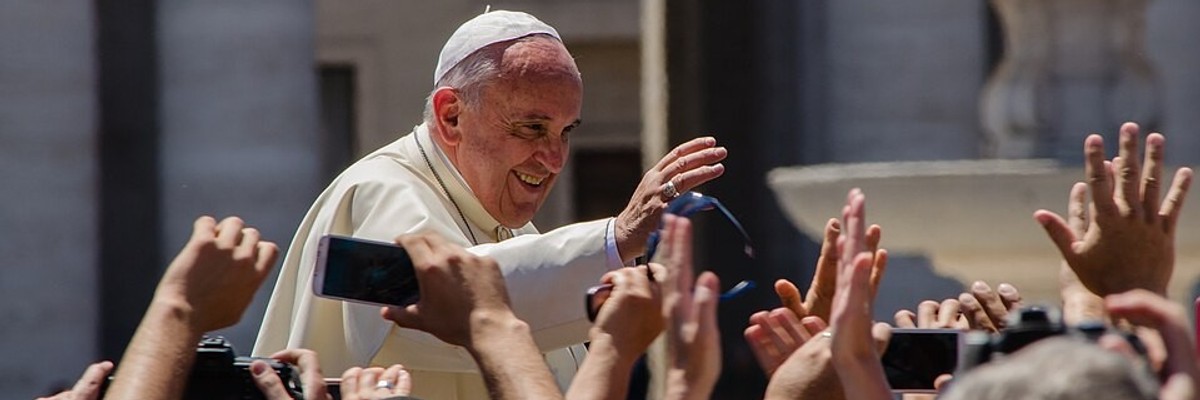
Pope Francis greeting people in St. Peter’s Square in Vatican City in 2014. (Photo: Alfredo Borba/Creative Commons)
Again and again, Pope Francis railed against our collective indifference to widespread suffering and urged humanity, especially world leaders, to do better. It’s not too late to heed his call.
Like millions of other people, I was deeply saddened to hear of the passing of Pope Francis, one of the most vocal and humble advocates for sharing the world’s resources.
But at the heart of his advocacy was a focus on ending inequality both globally and on a national basis, repeatedly calling upon governments to redistribute wealth and benefits to the poor in a new spirit of generosity.
I first recall being struck by Pope Francis’ headline-grabbing speech in 2014, when he urged the United Nations to promote a ‘worldwide ethical mobilization’ of solidarity with the poor to help curb an ‘economy of exclusion’ that is taking hold everywhere today.
A year later in 2015, the papal encyclical Laudato Si’—subtitled ‘On care for our common home’—made bigger headlines around the world with its powerful critique of laissez-faire ideology and its destructive effects on the environment. The trenchant letter expounded on the responsibility of rich countries to address their ‘ecological debt’ to less developed countries, with an acknowledgement of ‘differentiated responsibilities’ in addressing climate change. It was a radical entreaty for resource transfers between the Global North and South, and significant reductions in the consumption of non-renewable energy within developed countries.
The eloquent discourse of Laudato Si’ also reflected the core understanding of many environmental activists—that the climate and inequality crises are inextricably interconnected. Again and again, Pope Francis railed against our collective indifference to widespread human suffering. He persistently argued that the welfare of nations is interrelated, so the massive poverty and hunger experienced in the fragile economies of developing nations is, in turn, reflected in the destruction of the natural environment. Hence the urgency of remediating the enormous discrepancies in living standards throughout the world, which calls for a sense of global solidarity and interdependency that is tragically lacking in human affairs.
During the coronavirus pandemic, Francis also set out the challenge for rich nations to cooperate and distribute the vaccine freely to the world, rather than hoarding resources and treating one’s own nation first. The 2020 encyclical titled Fratelli tutti—‘Brother’s all’—made clear that Covid-19 was exposing existing inequalities, and fraternity on a state level requires richer countries to help poorer ones if we are to give meaning to the equality of human rights. Clearly, the world failed to heed Pope Francis’ plea to ensure recovery from the crisis tackled poverty, inequality and the climate emergency by ‘sharing resources in a just and respectable manner’.
Another theme that Francis constantly returned to was the need for cancelling the debts of countries unable to repay them. In his final papal bull for the Jubilee Year 2025, titled Spes non confundit—‘Hope does not disappoint’—he described debt forgiveness as a matter of justice more than generosity, and again decried the true ecological debt that exists between the Global North and South.
Francis was rightly known as the ‘Pope of the peripheries,’ standing up for the most vulnerable and marginalized peoples. He made clear his opposition to Western government policies of battening down the hatches and draconian responses to international migrants. Soon after taking office, Francis visited the Italian island of Lampedusa where he condemned European ‘indifference’ to the drowning of migrants crossing the Mediterranean in small boats. He later visited numerous camps for excluded migrants and refugees living ‘ghost lives in limbo,’ calling upon us to see Christ in the stranger and outsider. This was a sharp rebuke to reactionary politicians like Trump, Meloni, and Orbán, instead emphasizing the need for ‘universal fraternity’ as influenced by St. Francis of Assisi, after whom the Pope took his name.
It was a fitting testament to Francis’ advocacy for the poor and forgotten that he died hours after calling for a ceasefire in Gaza. In his annual Urbi et Orbi —‘To the City and World’—message on Easter Sunday, the day before he died, Francis repeated his appeal to the warring parties to “come to the aid of a starving people that aspires to a future of peace.” Few politicians, it seems, have followed the Pope’s counsel throughout his 12-year-long pontificate. Which now leaves it up to us, the ordinary people of goodwill, to uphold Francis’ tireless advocacy and hope for a better world.
After a disappointing COP29, we should prepare for more extreme weather events like the floods that hit Valencia last month | David Ramos/Getty Images
Summit proves change won’t come until floods and wildfires are killing tens of thousands in rich Global North cities
While COP29 in Baku narrowly avoided collapsing, its results were bitterly disappointing for delegations from across the Global South, who ended up with barely a quarter of the annual $1.3trn of support they were seeking by 2035 to respond to climate breakdown.
Quite apart from other factors, more than 1,500 pro-carbon lobbyists worked hard to limit progress and ensure that burning oil, gas and coal at profit continues for as long as possible whatever the global consequences. After all, the world’s fossil fuel industries rake in around a trillion dollars in profits a year.
Meanwhile, more and more examples are emerging of accelerating climate breakdown. The flooding in Valencia is just one, but scarcely noticed in Europe is the thoroughly weird weather being experienced in the eastern United States.
This autumn there have been over five hundred wildfires in New Jersey alone, a 5,000-acre fire has been burning for a week on the New York-New Jersey border prompting a voluntary evacuation, and New York City’s Fire Department was called out to deal with 271 brush fires in the first two weeks of November alone.
As if timed for that and certainly released with COP29 in mind, Carbon Brief, a website covering the latest developments in climate science, climate policy and energy policy, has mapped every published study on ‘impossible’ weather events – record heatwaves or storms that would not have happened without the overall global climate changes.
The first such study came in 2004, the year after weeks of extreme heat hit Europe and killed 70,000 people across the continent over several months. That early example of an ‘impossible’ weather event kick-started a new field of research known as ‘extreme event attribution’, which looks at how climate change has influenced extreme weather.
There are now 600 studies of 750 such extreme events spanning the past 20 years – a tiny fraction of the total number of these kinds of events. Of these 750, Carbon Brief found that scientists and researchers had concluded that 74% were made more likely or more severe because of climate change.
This has added to the growing sense of urgency right across the climate science community coupled with a highly critical view of the whole COP process. Even before the dismaying summit in the Azerbaijani capital, both last year’s COP in Abu Dhabi and the year before in Egypt were notable for their lack of progress even as the urgency of preventing climate breakdown was becoming more and more obvious.
There are other risks to global security including nuclear weapons, pandemics, cyber warfare, AI misuse and the progressive destruction of biodiversity, but climate breakdown is different from all of these. It is not a future risk, it is a current happening, it is accelerating, and we now have very few years left to get on top of it. If we don’t then a worldwide catastrophe with many hundreds of millions dying and societal collapse will become increasingly likely.
Does it have to be like that?
As things stand, in terms of changing attitudes, developments in renewables, resistance of the fossil carbon industries and, of course, Donald Trump’s looming presidency in the US, a reasonable prognosis for the next decade has three elements.
First, the use of renewable energy resources does continue to increase but not at anything like the rate required, so net carbon emissions will continue to rise, not fall, for most of the next ten years. Second, resistance to decarbonisation will continue from many quarters, no doubt now including the White House. Finally, severe weather events will become both more common and more destructive.
Eventually, and it might take more than a decade, the disasters will be so great, including sudden weather events in rich cities in the Global North killing many tens of thousands of people, that public pressure across the world will force governments to respond. There will be no alternative to engage in truly transformative change.
But what that means is that the task ahead by then will be hugely greater than if the transformation starts much sooner, so timescales become crucial, especially what can speed up the process.
There is, though, one thing to remember at a time of widespread pessimism. If nations had got their act together 25 years ago after the Kyoto Protocols, were signed we would be in a far more favourable position worldwide than we are now. We are acting more than two decades late.
But climate breakdown is not happening as a slow, steady process of change, creeping up almost unawares. If that had been the case then with all the reasons not to act, especially the global fossil carbon lobby, we would have been in an even worse position now. Instead, it is happening at variable rates in two respects, some parts of the world – such as the polar regions – are warming up much faster than others and extreme weather events are happening much more often.
We are therefore getting a foretaste of what will affect everyone a few years before it does, and this gives us just a little more time to act. It means that the next ten years, and perhaps even the five years to 2030, will be the key time for us to come to terms with the transformation in society that is essential for global well-being. That is possible, just.
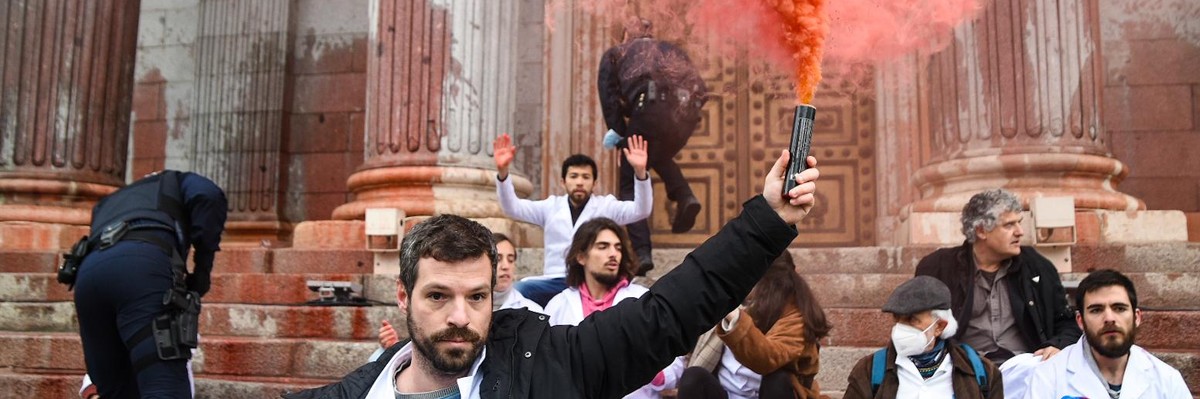
Scientists engage in civil disobedience on the steps of the Congress of Deputies in Madrid, Spain on April 6, 2022. (Photo: Scientist Rebellion)
“I expect a semi-dystopian future with substantial pain and suffering for the people of the Global South,” one expert said.
Nearly 80% of top-level climate scientists expect that global temperatures will rise by at least 2.5°C by 2100, while only 6% thought the world would succeed in limiting global heating to 1.5°C above preindustrial levels, a survey published Wednesday by The Guardian revealed.
Nearly three-quarters blamed world leaders’ insufficient action on a lack of political will, while 60% said that corporate interests such as fossil fuel companies were interfering with progress.
“I expect a semi-dystopian future with substantial pain and suffering for the people of the Global South,” one South African scientist told The Guardian. “The world’s response to date is reprehensible—we live in an age of fools.”
“What blew me away was the level of personal anguish among the experts who have dedicated their lives to climate research.”
The survey was conducted by The Guardian‘s Damian Carrington, who reached out to every expert who had served as a senior author on an Intergovernmental Panel on Climate Change (IPCC) report since 2018. Out of 843 scientists whose contact information was available, 383 responded.
He then asked them how high they thought temperatures would rise by 2100: 77% predicted at least 2.5°C and nearly half predicted 3°C or more.
The key question was how high they thought global temperature will rise by 2100. Almost 80% of the respondents said at least 2.5C. Almost half said at least 3C. That is a catastrophic level of heating. Just 6% thought 1.5C would be achieved. 3/n pic.twitter.com/GHzRdLfNAk
“What blew me away was the level of personal anguish among the experts who have dedicated their lives to climate research,” Carrington wrote on social media. “Many used words like hopeless, broken, infuriated, scared, overwhelmed.”
The 1.5°C target was agreed to as the most ambitious goal of the Paris agreement of 2015, in which world leaders pledged to keep warming to “well below” 2°C. However, policies currently in place would put the world on track for 3°C, and unconditional commitments under the Paris agreement for 2.9°C.
The survey comes on the heels of the hottest year on record, which already saw a record-breaking Canadian wildfire season as well as extreme, widespread heatwaves and deadly floods. The firstfourmonths of 2024 have also been the hottest of their respective months on record, and the year has already seen the fourth global bleaching event for coral reefs.
“They can say they don’t care, but they can’t say they didn’t know.”
“I think we are headed for major societal disruption within the next five years,” Gretta Pecl of the University of Tasmania told The Guardian. “[Authorities] will be overwhelmed by extreme event after extreme event, food production will be disrupted. I could not feel greater despair over the future.”
Scientists said that governments and companies that profit from the burning of fossil fuels had prevented action. Many also blamed global inequality and the refusal of the wealthy world to step up, both in terms of reducing their own emissions and helping climate vulnerable nations adapt.
“The tacit calculus of decision-makers, particularly in the Anglosphere—U.S., Canada, U.K., Australia—but also Russia and the major fossil fuel producers in the Middle East, is driving us into a world in which the vulnerable will suffer, while the well-heeled will hope to stay safe above the waterline,” Stephen Humphreys at the London School of Economics said.
Despite their grim predictions, many of the scientists remained committed to researching and speaking out.
“We keep doing it because we have to do it, so [the powerful] cannot say that they didn’t know,” Ruth Cerezo-Mota, who works on climate modeling at the National Autonomous University of Mexico, told The Guardian. “We know what we’re talking about. They can say they don’t care, but they can’t say they didn’t know.”
Others found hope in the climate activism and awareness of younger generations, and in the finding that each extra tenth of a degree of warming avoided protects 140 million people from extreme temperatures.
“I regularly face moments of despair and guilt of not managing to make things change more rapidly, and these feelings have become even stronger since I became a father,” said Henri Waisman of France’s Institute for Sustainable Development and International Relations. “But, in these moments, two things help me: remembering how much progress has happened since I started to work on the topic in 2005 and that every tenth of a degree matters a lot—this means it is still useful to continue the fight.”
Peter Cox of the University of Exeter added: “Climate change will not suddenly become dangerous at 1.5°C—it already is. And it will not be ‘game over’ if we pass 2°C, which we might well do.”
“I’m not despairing, I’m not giving up. I’m pissed off and more determined to fight for a better world.”
Many of the scientists who still saw a hope of keeping 1.5°C alive pinned it on the speeding rollout and falling prices of climate-friendly technologies like renewable energy and electric vehicles. Also on Wednesday, energy think thank Ember reported that 30% of global electricity came from renewables in 2023 and predicted that the year would be the “pivot” after which power sector emissions would start to fall. Experts also said that abandoning fossil fuels has many side benefits such as cleaner air and better public health. Though even the more optimistic scientists were wary about the unpredictable nature of the climate crisis.
“I am convinced that we have all the solutions needed for a 1.5°C path and that we will implement them in the coming 20 years,” Henry Neufeldt of the United Nations’ Copenhagen Climate Center told The Guardian. “But I fear that our actions might come too late and we cross one or several tipping points.”
Several scientists gave recommendations for things that people could do to move the needle on climate. Humphreys suggested “civil disobedience” while one French scientist said people should “fight for a fairer world.”
“All of humanity needs to come together and cooperate—this is a monumental opportunity to put differences aside and work together,” Louis Verchot, based at the International Center for Tropical Agriculture in Colombia, told The Guardian. “Unfortunately climate change has become a political wedge issue… I wonder how deep the crisis needs to become before we all start rowing in the same direction.”
The publication of The Guardian‘s survey prompted other climate scientists to share their thoughts.
“As many of the scientists pointed out, the uncertainty in future temperature change is not a physical science question: It is a question of the decisions people choose to make,” Texas Tech University climate scientist Katharine Hayhoe wrote on social media. “We are not experts in that; And we have little reason to feel positive about those, since we have been warning of the risks for decades.”
Aaron Thierry, a graduate researcher at the Cardiff School of Social Sciences, pointed out that The Guardian‘s results were consistent with other surveys of scientific opinion, such as one published in Nature in the lead-up to COP26, in which 60% of IPCC scientists said they expected 3°C of warming or more by 2100.
2/n Today's findings are similar to those from a survey by @jefftollef for @Nature ahead of #COP26
James Dyke of the University of Exeter’s Global Systems Institute argued that there was room for scientists to share more negative thoughts without succumbing to or encouraging defeatism.
“I hear the argument that we must temper these messages because we don’t want people to despair and give up. But I’m not despairing, I’m not giving up. I’m pissed off and more determined to fight for a better world,” Dyke said on social media.
NASA climate scientist Peter Kalmus shared the article with a plea to “please start listening.”
“Elected and corporate ‘leaders’ continue to prioritize their personal power and wealth at the cost of irreversible loss of essentially everything, even as this irreversible loss comes more and more into focus. I see this as literally a form of insanity,” Kalmus wrote, adding that “capitalism tends to elevate the worst among us into the seats of power.”
However, he took issue with the idea that a future of unchecked climate change would be only “semi-dystopian.”
“We’re also at risk of losing any gradual bending toward progress, and equity, and compassion, and love,” Kalmus said. “All social and cultural struggles must recognize this deep intersection with the climate struggle.”
[dizzy: It is generally accepted by knowledgeable parties that 2.5C is “locked-in” in the sense that emissions already made will cause it. We need immediate reduction in climate heating gases by abandoning fossil fuels. Politicians worldwide are neglecting this necessary action and are indeed creating a worse situation by promoting fossil fuels through widespread and generous subsidies.]
14/5/24 I’m trying to verify the “locked-in” claim that I make above. It’s not particularly supported by this report.
If greenhouse gas emissions stopped but greenhouse gases stayed at a fixed level then there’d be another ~0.5-0.6°C of slow warming in the pipeline, but in reality CO₂ would fall due to natural carbon sinks once emissions stop and largely cancel out this warming.
Aerosols mask ~0.6°C of warming, but even in the unlikely scenario of their sudden elimination models show only ~0.2-0.4°C of extra warming by 2100 as a result. A gradual partial phase-out of aerosol emissions could limit this unmasking effect to ~0.1-0.2°C spread over time, and cuts in non-CO₂ greenhouse gases like methanes could entirely counteract aerosol removal, minimising its impact.
Overall this likely reduces “locked-in” warming from the climate lag and aerosols to a negligible amount on top of the current (2021) warming of ~1.2°C – in contrast to the extra ~1.4°C sometimes claimed – and any short-term warming from aerosol reductions can be reduced and compensated for by reducing other short-lived greenhouse gases like methane.
…
All of this is quite academic of course – politicians do not intend to address global warming and instead intend to continue trashing the planet.