UN Expert Says All Nations With Ties to Israel ‘Responsible in Some Measure’ for Gaza Genocide

Spread the love

Original article by Stephen Prager republished from Common Dreams under Creative Commons (CC BY-NC-ND 3.0). 

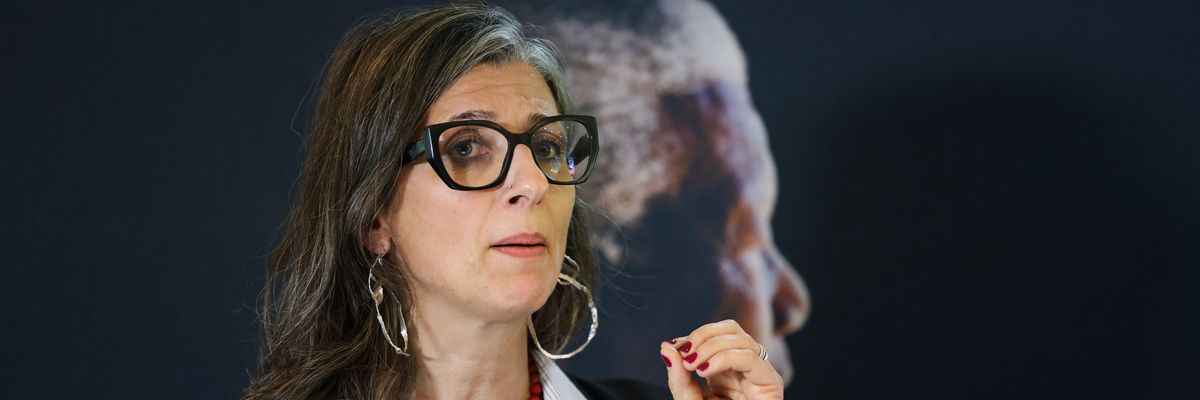
Francesca Albanese (international lawyer) briefs the media ahead of the 23rd Nelson Mandela annual lecture at the Nelson Mandela Foundation on October 22, 2025, in Johannesburg, South Africa. (Photo by Luba Lesolle/Gallo Images via Getty Images)

Francesca Albanese wrote that states that supported Israel financially and militarily “could and should be held liable for aiding, assisting, or jointly participating in internationally wrongful acts.”

A report by one of the United Nations’ leading expertson Israel-Palestine describes the more than two years of genocide in Gaza as a “collective crime,” for which all nations with financial, diplomatic, and military ties with Israel are culpable.

The draft report, published Monday, was written by Francesca Albanese, the UN’s special rapporteur on human rights in the occupied Palestinian territories, who is expected to speak at length on the humanitarian crisis in Gaza this weekend as part of the Nelson Mandela Foundation’s lecture series in Johannesburg, South Africa.

Her report names more than 60 countries, without which she says the systematic destruction of Gaza—which has killed or injured more than 10% of the strip’s population and displaced nearly everyone there—would not have been possible.

“Framed by colonial narratives that dehumanize the Palestinians, this livestreamed atrocity has been facilitated through third states’ direct support, material aid, diplomatic protection, and, in some cases, active participation,” Albanese wrote. “The world now stands on a knife-edge between the collapse of the international rule of law and hope for renewal. Renewal is only possible if complicity is confronted, responsibilities are met, and justice is upheld.”

Her report says that the states most responsible are “primarily Western ones,” the United States being chief among them.

The US accounts for two-thirds of Israel’s annual arms imports. And according to a report out this week from the Center for International Policy, it has spent over $38 billion since October 2023, both directly arming Israel through military grant programs and waging war against its enemies in IranLebanon, and other nations across the Middle East.

Under both a Democratic and Republican administration, the US has also provided critical diplomatic cover for Israel, proposing temporary “pauses” and “truces” to the conflict before international bodies, “sidestepping a permanent ceasefire and ensuring a continuation of the violence.”

On several occasions, the US has used its veto power to block unanimous votes in favor of a binding ceasefire resolution by the UN Security Council. In September, it did so for the fifth time, vetoing a 14-1 resolution that would have required both parties to halt the violence and release all hostages.

The US has sanctioned the International Criminal Court (ICC), which issued arrest warrants against Israeli Prime Minister Benjamin Netanyahu and his former defense minister, Yoav Gallant, for war crimes and crimes against humanity. The Trump administration also placed Albanese herself under sanctions in July for her support of the ICC’s efforts.

American non-governmental organizations supported by US President Donald Trump were also directly involved with the creation and administration of the Gaza Humanitarian Foundation (GHF), which administered aid sites after humanitarian organizations like the United Nations Relief and Works Agency (UNRWA) were pushed out. In just over three months, more than 1,000 Palestinian aid seekers were killed in routine massacres by Israeli troops, who have described the GHF sites as “killing fields.”

Many senior US politicians, Albanese said, have helped to prolong the genocide through rhetoric that frames Israeli lives as more important and worthy of protection than Palestinian ones.

“Israelis were depicted as ‘civilians’ and ’hostages,‘ and Palestinians as ’Hamas terrorists,‘ ’legitimate’ or ‘collateral’ targets,’ ‘human shields’ or lawfully detained ’prisoners,‘” she wrote.

Albanese also singled out many European nations as particularly culpable. These include Germany, which provided Israel with over $565 million worth of weapons, making it the second-largest exporter behind the US; and the United Kingdom, which has participated in hundreds of surveillance missions over Gaza and whose prime minister, Keir Starmer, defended Israel’s right to cut off water and power to civilians at the war’s outset.

She also called out others that increased trade with Israel during the two years of genocide—Germany, PolandGreeceItalyDenmark, and France—as well as Arab countries like the United Arab EmiratesEgypt, Jordan, and Morocco. She said their continued economic support not only “legitimizes and sustains the Israeli apartheid regime” but “countered the trade decline Israel might otherwise have faced” as a result of its increasing global isolation.

Albanese wrote that for helping Israel, which she described as a “genocidal apartheid state,” these nations “could and should be held liable for aiding, assisting, or jointly participating in internationally wrongful acts.”

Though a ceasefire is now in effect between Israel and Gaza, Albanese said on Wednesday that the plan, which currently has Israel occupying more than half the Gaza Strip, was “absolutely inadequate and it doesn’t comply with international law.”

She said that the recognition of a Palestinian state by several Western nations in recent months has “been a pretense of doing something while the emergency was to discuss… how we stop the genocide.”

Albanese said that the states “who still have ties with Israel, diplomatic, but especially economic, political, and military ties, are all responsible in some measure.”

Original article by Stephen Prager republished from Common Dreams under Creative Commons (CC BY-NC-ND 3.0). 

Orcas discuss how Trump was re-elected and him being an obviously insane, xenophobic Fascist.
Donald Trump urges you to be a Climate Science denier like him. He says that he makes millions and millions for destroying the planet, Burn, Baby, Burn and Flood, Baby, Flood.
Orcas discuss Donald Trump and the killer apes' concept of democracy. Front Orca warns that Trump is crashing his country's economy and that everything he does he does for the fantastically wealthy.
Orcas discuss Donald Trump and the killer apes’ concept of democracy. Front Orca warns that Trump is crashing his country’s economy and that everything he does he does for the fantastically wealthy.
Continue ReadingUN Expert Says All Nations With Ties to Israel ‘Responsible in Some Measure’ for Gaza Genocide

Give “I support Zionism without qualification” Starmer the Red Card for supporting and promoting racist rioters

Spread the love

https://www.scoop.co.nz/stories/HL2510/S00053/keir-starmers-maccabi-outrage-should-get-him-the-red-card.htm

To understand who Keir Starmer is going to extraordinary lengths to support simply watch this one-minute clip of Maccabi fans in Greece last year. I have reviewed hours of footage of a similar kind; violence and intimidation is what they do, and Keir Starmer is ready to unleash them onto one of England’s most ethnically diverse communities.

“You’re the whores of Arabs. We will take your girls who love to party. We will rape them.” Maccabi fans chant this throughout Europe.

The Safety Advisory Group (SAG), a group of professionals who examine the safety of public events, had written to the club to recommend that no Maccabi fans should be permitted entry. The SAG was chaired by Birmingham City Council’s head of resilience and made up of representatives of the local authority, emergency services and event organisers. In making their decision, the Police stated: “This decision is based on current intelligence and previous incidents, including violent clashes and hate crime offences that occurred during the 2024 UEFA Europa League match between Ajax and Maccabi Tel-Aviv in Amsterdam.

The decision by West Midlands Police was taken because Maccabi fans are notoriously violent thugs and provocateurs, not because they come from a racist, fascist society that is committing genocide. Fans are routinely banned for bad behaviour. For example in the past couple of years PSV Eindhoven fans were banned from Paris for previous disturbances at RC Lens, Feyenoord fans were banned from Lille due to violent history across Europe, causing millions of Euros damage, Legia Warsaw fans were banned from Villa Park itself in 2023 after attacking police. Not one UK politician complained about any of these bans. Not Starmer. Not Badenoch. Not Farage.

In November last year I did a story “BBC goes full Goebbels in support of Israeli soccer hooligans” about Maccabi’s rampage through Amsterdam. Taxi drivers of Middle Eastern origins were beaten, a taxi torched, Amsterdammers were chased through the streets and beaten and Palestinian flags ripped down from private dwellings and burned. Then there were those chants, those utterly despicable, genocidal chants. At the match itself a minute’s silence for the victims of the Spanish floods was ruined by Maccabi fans boisterously chanting “Why is school out in Gaza? There are no children left there!”

Starmer knows this perfectly well. He and European football officials are totally relaxed about Islamophobic and genocidal chants but call any resistance to it antisemitism.

Original article at https://www.scoop.co.nz/stories/HL2510/S00053/keir-starmers-maccabi-outrage-should-get-him-the-red-card.htm

Keir Starmer objects to criticism of the IDF. He asks how could anyone object to them starving people to death, forced marches like the Nazis did, bombing Gaza's hospitals and universities, mass-murdering journalists, healthworkers and starving people queuing for food, killing and raping prisoners and murdering children. He calls for people to stop obstructing his genocide for Israel.
Keir Starmer objects to criticism of the IDF. He asks how could anyone object to them starving people to death, forced marches like the Nazis did, bombing Gaza’s hospitals and universities, mass-murdering journalists, healthworkers and starving people queuing for food, killing and raping prisoners and murdering children. He calls for people to stop obstructing his genocide for Israel.
Experiencing issues with this image not appearing. I suspect because it's so critical of Zionist Keir Starmer's support of and complicity in Israel's genocides.
Genocide denier and Current UK Prime Minister Keir Starmer is quoted that he supports Zionism without qualification. He also confirms that UK air force support has been essential in Israel’s mass-murdering genocide. Includes URLs https://www.declassifieduk.org/keir-starmers-100-spy-flights-over-gaza-in-support-of-israel/ and https://youtu.be/O74hZCKKdpA
Orcas discuss Genocide-supporting and complicit Zionists. Donald Trump, Keith Starmer, David Lammy, Rachel Reeves, Angela Rayner and Wes Streeting are acknowledged as evil genocide-complicit and supporting cnuts.

Standing with Maccabi’s football hooligans against local police – is that what patriotism looks like now?

Intelligence on ‘extreme’ Maccabi fans with history of violence led to Villa Park ban

Video: Tory MP embarrasses himself trying to back Maccabi Tel Aviv at any cost

Continue ReadingGive “I support Zionism without qualification” Starmer the Red Card for supporting and promoting racist rioters

Analysis: Record UK wildfires have burned an area twice the size of Glasgow in 2025

Spread the love

Original article by Orla Dwyer, Ho Woo Nam and Tom Prater republished from Carbon Brief under a CC license.

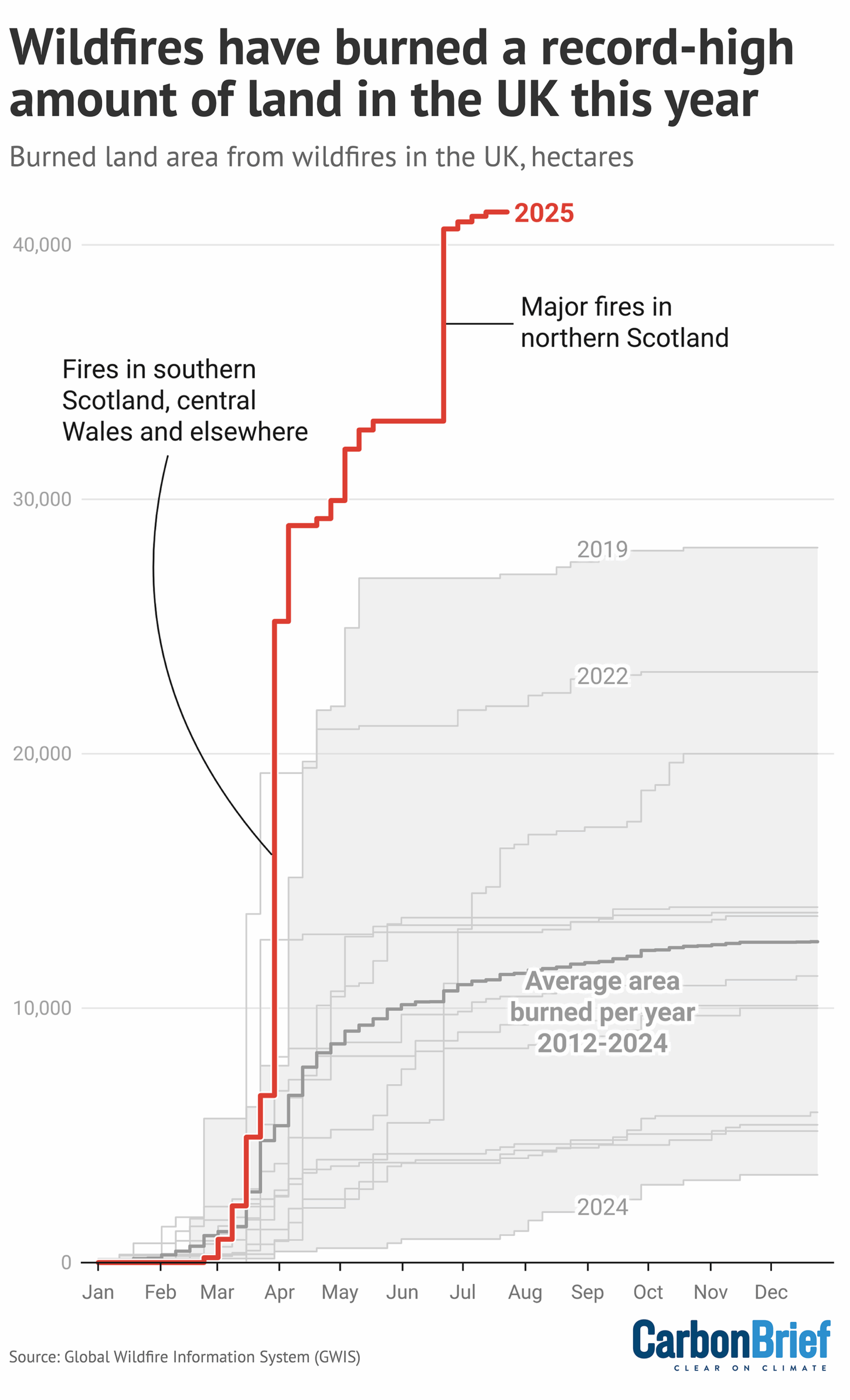
Wildfires have scorched more than 40,000 hectares of land so far this year across the UK – an area more than twice the size of the Scottish city of Glasgow.  

This is already a record amount of land burned in a single year, far exceeding the previous high, Global Wildfire Information System (GWIS) data shows. 

It is also almost four times the average area burned in wildfires by this stage of the year over 2012-24 – and 50% higher than the previous record amount burned by this time in 2019. 

The burned area overtook the previous annual record in April, BBC News reported at the time, and has continued to soar in the months since.

Major wildfires 

The chart below shows that UK wildfires in 2025 so far have already burned by far the largest area of land over any calendar year since GWIS records began in 2012. The previous record year was 2019, followed by 2022, while 2024 saw the lowest area size burned. 

Annual land area burned by wildfires across the UK from 2012 to 2025 (red), alongside the average area burned each year over 2012-24. Source: Global Wildfire Information System.

Climate change can increase the risk and impact of wildfires. Warmer temperatures and drought can leave land parched and dry out vegetation, which helps fires spread more rapidly. Climate change is making these types of extreme conditions more likely to occur, as well as more severe.  

Fire services in England and Wales responded to 564 wildfires from January to June 2025 – an increase from 69 fires in the same period last year, the National Fire Chiefs Council (NFCC) said in a statement in June. 

Most wildfires in the UK are caused by human activity, whether accidental or deliberate, according to the NFCC. Some common ignition sources are disposable barbecues, lit cigarettes and campfires. 

Jessica Richter, a research analyst at Global Forest Watch, says that, while fires are also a key part of some ecosystems, climate change is the “major driver behind the increasing fire activity around the globe”. She tells Carbon Brief: 

“As we see more fires, we’re going to see more carbon being emitted and that’s just going to be, for lack of a better phrasing, adding fuel to the fire.” 

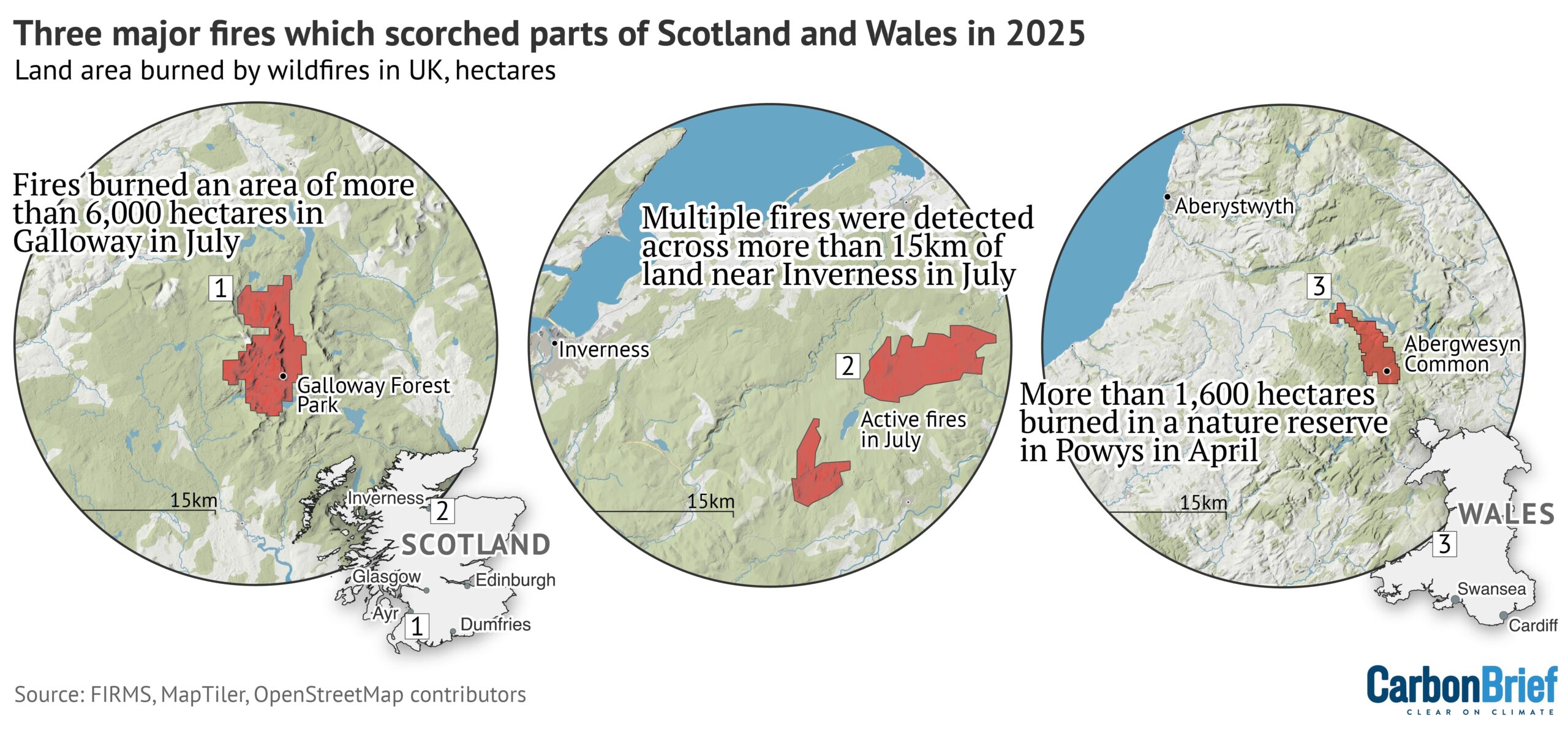
Examples of 2025 wildfires around Galloway (1) and Inverness (2) in Scotland, and a wildfire in Powys (3) in Wales. Source: FIRMSMapTilerOpenStreetMap contributors.

The UK has also recorded its highest-ever wildfire emissions this year, according to Copernicus, which was “primarily driven” by major wildfires in Scotland from late June to early July.

These were the largest wildfires ever recorded in the country, reported the Scotsman. They “ravaged” land in Moray and the Highlands in the north of the country, the newspaper added. 

Scotland experienced an extreme wildfire in Galloway Forest Park in April, which was “so intense it could be seen from space”, the Financial Times said. 

Elsewhere, in April, the Belfast News Letter reported that firefighters tackled almost 150 fires on the Mourne Mountains in Northern Ireland. 

More recently, BBC News reported that firefighters in Dorset, England received “non-stop” wildfire calls in the first weekend of August, with one blaze “engulf[ing] an area the size of 30 football pitches”. 

Wildfires have also caused devastation across many parts of Europe in recent weeks – including AlbaniaCyprusFranceGreeceSpain and Turkey – as well as in the US and Canada

Words by Orla Dwyer. Analysis by Ho Woo Nam. Charts by Tom Prater.

Original article by Orla Dwyer, Ho Woo Nam and Tom Prater republished from Carbon Brief under a CC license.

Media reaction: The 2025 Texas floods and the role of climate change Extreme weather 10.07.25

Children born in 2020 will face ‘unprecedented exposure’ to climate extremes Attribution 07.05.25

Two-thirds of global warming since 1990 caused by world’s ‘wealthiest 10%’ Attribution 07.05.25

Global soil moisture in ‘permanent’ decline due to climate change Drought 27.03.25

Nigel Farage urges you to ignore facts and reality and be a climate science denier like him. He says that Reform UK has received millions and millions from the fossil fuel industry to promote climate denial and destroy the planet.
Donald Trump urges you to be a Climate Science denier like him. He says that he makes millions and millions for destroying the planet, Burn, Baby, Burn and Flood, Baby, Flood.
Continue ReadingAnalysis: Record UK wildfires have burned an area twice the size of Glasgow in 2025

General strike brings Greece to a standstill

Spread the love

NB This article a week old

Original article by Ana Vračar republished from peoples dispatch under a Creative Commons Attribution-ShareAlike 4.0 (CC BY-SA) license.

Source: PAME Greece

Thousands of people across Greece joined a general strike and mass protests, demanding action against high living expenses, restrictions on union organizing, and excessive military spending

Greece was brought to a halt on Wednesday, November 20, as a 24-hour general strike brought workers from across sectors—including education, logistics, construction, public transportation, and health—to the streets of dozens of cities. The mass mobilization, which began early in the morning, followed a media strike on Tuesday that included both public and private outlets.

The striking workers demanded the repeal of anti-worker laws, including measures that extended working hours, and called for wage restoration. Over the past decade, successive governments, most recently led by Prime Minister Kyriakos Mitsotakis, have implemented austerity policies under pressure from the European Union and international financial institutions. These policies have led to drastic income reductions, with wages remaining about 14% lower than in 2011, according to trade unions.

Read more: Workers in Greece mobilize against austerity, announce general strike in November

Protesters warned that current conditions mean they cannot lead dignified lives. With a minimum wage of approximately 900 euros, they face housing and food costs comparable to those in European countries with higher income. While the government has boasted about recent improvements in unemployment rates, unions highlighted that these figures mask the economy’s heavy reliance on tourism and fail to account for poor working conditions.

Greek unions emphasized that anti-worker legislation has persisted for over a decade, including wage cuts and freezes, extended working hours, and severe restrictions on collective bargaining. These policies have left only a small fraction of workers benefiting from collective agreements. “At the same time, they are further commodifying the functioning of critical sectors such as health, education, energy, water, transport, social security, infrastructure and civil protection services for natural disasters,” stated the All Workers Militant Front (PAME) ahead of the strike. In response, unions demanded guarantees of universal, public, and free education and healthcare, alongside accessible housing solutions.

The push to privatize and commodify basic rights highlights how successive administrations have prioritized fiscal targets over people’s interests. This has led to a situation where financial organizations commend Greece’s economic recovery, while the working class continues to face systemic denial of basic rights. On top of that, Greece has allocated millions of euros to military spending through NATO—a decision that has become a significant point of contention for trade unions.

“We do not accept our basic and daily needs to be sacrificed to give billions to NATO armaments, for missiles, frigates, war planes,” PAME stated. Hundreds of thousands of euros have been allocated for the frigate in the Red Sea—”money that is equivalent to the annual budget of a hospital”—the workers’ organization concluded.

Read more: Athens dockworkers block ammunition shipment bound for Israel

Marches on November 20 highlighted international solidarity as opposed to war and militarization. Palestinian flags were prominently displayed at the rallies, reflecting the longstanding support of Greek workers for the people of Gaza and other occupied territories. Trade unions called for an immediate end to the Israeli genocide against Palestinian and Lebanese people. This message resonated with the general strike’s motto: “Out of the war slaughterhouses; fund wages, health, and education instead.”

“The large participation in the strike and rallies demonstrates the workers’ strong opposition to the government’s anti-people policies and its alignment with business interests,” PAME stated on the day of the strike. The organization reaffirmed its commitment to continue with the mobilizations, aiming to pressure the government to shift its priorities toward addressing workers’ rights and peace.

Original article by Ana Vračar republished from peoples dispatch under a Creative Commons Attribution-ShareAlike 4.0 (CC BY-SA) license.

Continue ReadingGeneral strike brings Greece to a standstill

Greece accused me of espionage. I was helping people they’d violated

Spread the love

Original article by Natalie Gruber republished from Open Democracy under under a Creative Commons Attribution-NonCommercial 4.0 International licence.

People wait in the woodland by the Greek border fence in northwest Turkey, in March 2020
| Gokhan Balci/Anadolu Agency/Getty Images. All rights reserved

I supported people who’d been violently pushed back from Greece to Turkey – and was accused of being a criminal spy

In October 2020, my colleague and I were sitting in a cafe in central Istanbul, unsure of what would come next. We were exhausted: physically and mentally tired from supporting the people being violently pushed back from Greece and Bulgaria to Turkey, documenting the violations, and fielding requests from journalists.

That morning, the apartment we had planned to move into had fallen through. Three weeks earlier, Turkey had cancelled the residence permits of two colleagues and given them just 24 hours to leave the country.

We were running out of funds, burnt out, and ill. Now, we had nowhere to live.

“What’s next?” I wondered.

My phone pinged. It was a message from Giorgos Christides, then the Greece correspondent for the German newspaper Der Spiegel. I called him back.

“You are one of them! One of the four!” he told me. He had sent a picture of the front page of a Greek newspaper. On it was a screenshot of our website and a letter from the police on Lesvos island that named our organisation, Josoor.

I can’t read Greek, but I understood what was happening. The article was following up on a press release issued by Greek police a week earlier, detailing a “secret operation uncovering a spy network” of four NGOs on Lesvos island. We had just been named as one of them.

I sat frozen as Giorgos translated the text. Espionage. Violation of state secrets. Forming a criminal organisation. Facilitation of illegal entry. Up to 35 years in prison.

How did we end up here?

Multiple crises at the border

The story starts seven months earlier, in March 2020. It had been a sleepless night: we’d been out in freezing temperatures, and our eyes were still stinging from the tear gas. The evening before, two colleagues and I had entered the closed military zone at the border to Greece near Edirne, northwest Turkey.

Our goal was to assess the feasibility of a civil society relief response to the crisis then unfolding at the border. We were three of around 180 volunteers who had met on a Facebook group for aid efforts in Greece, and we refused to just stand by and watch.

The situation was dire. Up to 20,000 people seeking protection were stranded in makeshift tents on the Turkish side. It was cold, and people had to queue for hours to receive a minimal amount of food from the Turkish disaster relief agency. There was no medical care available, and the area was regularly exposed to tear gas from both sides.

Many of those we encountered had been violently pushed back to Turkey by Greek officers, and even enlisted civilians. Two people had been shot dead.

We knew that the Turkish authorities had been obstructing organised relief before we entered the zone. But our scouting trip made it clear to us that they were also creating deliberately poor conditions. So this loose network of volunteers started distributing aid – food, clothes, sleeping bags, hygiene and first aid supplies – under the radar while also keeping the international media informed of what was going on. It was the beginning of Josoor’s work in Turkey.

Men, women and children were – and still are – arriving on Turkish land beaten, humiliated and robbed of all their possessions

The crisis we were responding to had been brewing for years. Turkey had long been threatening to ‘send’ the 3.6 million Syrian refugees in Turkey to Europe, in response to escalating tensions between the country and the European Union.

In the 2016 EU-Turkey agreement, the EU promised Turkey a €6 billion support package and visa-free travel for Turkish citizens. In exchange, Turkey promised to prevent asylum seekers from leaving its territory and to re-admit those who reached the Greek islands.

The deal was described by Amnesty International as an “abject failure”, corrosive for the EU’s human rights record, and “based purely on political convenience”. It turned people seeking protection into pawns for politics – and leverage in the hands of the Turkish government.

The agreement also led to a sharp increase in the frequency and violence of so-called pushbacks back to Turkey from Greece. This informal and illegal practice of collective expulsions had been documented at the land border for decades, but they had never been so systematic nor so violent.

Following the deal, they were also extended to the sea border. The Greek Coastguard (HCG) began disabling peoples’ dinghies and creating waves to push them back to Turkish waters. By 2020, their officers were puncturing inflatable dinghies, setting people adrift in overcrowded life rafts, and even firing live rounds at unarmed people.

People dodge tear gas near the Greek border fence in northwest Turkey
| Photo taken by Josoor members

But despite the obvious “political convenience” of the deal for Europe, it didn’t keep to the bargain. By 2019, the EU had only paid Turkey half the promised amount and no progress had been made regarding travel restrictions. It did, however, continue to put pressure on Turkey over its role in the Syrian civil war. Then came the last straw: 33 Turkish soldiers were killed in an airstrike in Idlib, northwest Syria, and Turkey said it could no longer cope with holding up its end of the deal with the EU.

On 28 February, 2020, Turkish President Recep Tayyip Erdoğan made good on his threats: he announced that the border to Europe was open.

Launching a long-term relief response

Just weeks after we arrived at the border area, Covid-19 struck. After forcing thousands of people to the border and trapping them there, Turkish authorities suddenly ordered people to clear the area.

People scattered. Some returned to Istanbul or went somewhere else. Those who refused to leave were forced onto buses and kept in quarantine camps before being dropped off in various locations, and stranded without supplies during Turkey’s first nationwide lockdown.

One group sent us a video from the Aegean coast, saying they’d been told by their bus driver to “try to make it to Greece”. Turkish officers apparently told another group the same thing after they were stranded in a different spot.

As we did with all the information we received, we published this on social media in our daily update. The next day, we woke to Greek media headlines alleging that “Turkey sends Covid-infected migrants to Greece as a biological weapon of hybrid warfare”. This ‘news’ had also reached right-wing outlets, only they’d added: “according to Turkish spy organisation Josoor”.

Efforts to correct the narrative were futile – the damage was done. After just a month of operating in Turkey, Josoor was now on the radar.

In hindsight, this media frenzy should have worried and prepared us for what was to come. But we were fully occupied with the situation on the ground, trying to fill the massive gap in monitoring and support for border violence survivors.

We were no longer just a bunch of volunteers trying to sort out an emergency response. Organisational structures were established and our operations were growing. We started providing accommodation, clothing, food, and medical care. And we started taking testimonies to evidence the systematic fundamental rights violations committed by European forces.

Greek, Bulgarian, and EU border and coast guard agency (Frontex) officers continued their campaign of pushbacks following the events of March 2020. There were endless reports of inhumane and degrading treatment, arbitrary detention in appalling conditions, theft, forced undressing, sexualised violence, and torture. Men, women and children were – and still are – arriving on Turkish land beaten, humiliated and robbed of all their possessions.

We joined the Border Violence Monitoring Network (BVMN) and took our evidence and advocacy to the UN, EU, and member state levels. Josoor became a key source of information for international media, collaborating with outlets from 40 countries. But unbeknownst to us, this rapid success had already triggered a first of three secret criminal investigations.

The first warning signs

“We have a right to live,” said Farzad (a pseudonym) in a video livestreamed in June 2020. Alongside the unaccompanied 17-year-old were ten other children, four babies, and 18 adults from Afghanistan, the Democratic Republic of Congo and Syria.

They had been drifting in a flimsy dinghy in the Aegean Sea for three days.

Independent search and rescue operations were effectively banned in the area. Greece’s Hellenic coast guard (HCG) was the authority in charge. But, according to Farzad, it was the coast guard itself that was responsible for their distress. He explained in his video how HCG officers had removed the dinghy’s engine, then used their boat to create waves to push the dinghy back into Turkish waters.

The video was picked up in an unexpected place. Runa Godø Sæther, a music teacher and single mother of three, was managing a Facebook page at the time, sharing posts of people on the move to a European audience from her small town in Norway.

Runa and I didn’t know each other, but we had talked online about collaborating on advocacy. She came across Farzad’s livestream and connected the boy to me, since she had no experience handling ongoing distress cases like this one.

Remarkably, Farzad’s boat eventually reached Lesvos. His desperate calls for help had reached a Turkish liaison officer aboard a German NATO ship, who pressured the crew to intervene and tow it to Lesvos.

A WhatsApp message from a person who had arrived on a dinghy to Lesvos island before being forced back into the sea by police and the Greek coast guard| Natalie Gruber

I introduced him to some journalists when he arrived, and within a short time he had spoken to multiple media outlets about his ordeal. Two days after arriving, a UNHCR official warned him to stop speaking to the press – the police were beginning to take notice.

Farzad instantly cut all ties with journalists – but it was too late. When the others from his boat were transferred to Moria reception centre, Farzad was taken into police custody. He was held there for seven months. Initially, we had no idea why Farzad had been detained. Greek police only told his lawyer he was deemed “a threat to public security”, but never filed charges.

When the Greek press splashed the news of the police letter across their front page, the one that Giorgos had translated for me over the phone, it finally became clear.

The ‘criminal network’

“The Lesvos 35”, as we came to be known, included 32 members from four civil society organisations, one independent volunteer (Runa, the Norwegian music teacher), and two asylum seekers, including Farzad.

Of the four accused organisations, only one – Mare Liberum – actually operated on Lesvos. Registered in Germany, they shared an address with Sea Watch in Berlin, who had ceased operations in Greece four years prior but was still included in the case. Our organisation, Josoor, operated in Turkey.

The other accused organisation was FFM, a research society hosting the donation account for the real target: AlarmPhone. This network of volunteers from all around the Mediterranean runs an emergency hotline for people in distress at sea.

The investigation never aimed to uncover an ‘organised human trafficking network’. It sought to defame, discredit, deter, distract, and disable

The six-month investigation run by the Greek intelligence service, anti-terror unit and HCG resembled a poorly scripted spy movie. Over the course of the investigation, they recruited two asylum seekers, who they sent back to Turkey as “agents” to return to Greece. Then armed special forces conducted a dawn raid on Mare Liberum’s ship, confiscating all electronic devices and detaining the crew for several hours – before releasing them without interrogation.

Our lawyers also strongly suspected that our phones were tapped, making everyone who was now reaching out to us for support a potential target for authorities. And everything we said or wrote in private messages and calls could possibly come back to haunt us. This put immense psychological pressure on us and forced us to censor our communication.

Despite felony charges being announced, none of the 33 organisation members were ever arrested or called to testify. Some even continued to work on the island. Greece has a well-earned reputation of overusing pre-trial detention. Had the authorities believed their own claims – that an allegedly dangerous criminal network was spying on Greek authorities – they should, and I believe would, have arrested us.

Instead, they only leaked information to servile media, while high-ranking government officials, including Prime Minister Kyriakos Mitsotakis, made numerous statements fuelling the defamation campaign.

I cannot quite put into words what this meant. On the one hand, we, the accused, knew full well that we had done nothing criminal at all, so it was hard to take the allegations seriously. But on the other hand, we were slandered and defamed, and our work was discredited. And even though it was absurd, we still faced the possibility of 35 years in prison, which is longer than I have lived.

For three years, seven months and 12 days, we faced the threat of prosecution. The constant anxiety of waiting to be summoned for trial ate away at me. Throughout this time, Greece was so geographically close to me, and a place very dear to my heart – but I couldn’t set foot in the country for fear of arrest.

That threat was finally lifted on 30 April 2024, when our lawyers received the only official communication about the case from the Greek state: a 16-page decision dropping all charges against us.

Like other cases targeting civil society organisations across Europe, this investigation never aimed to uncover an “organised human trafficking network” or to stop “spy games”. It sought to defame, discredit, deter, distract, and disable.

Defame us as a reliable source of information. Discredit our reports exposing human rights violations. Deter others from doing the same. Distract us from our work by forcing us to prepare a legal defence and campaign. Disable our operations through the financial and psychological strain of ongoing investigations.

We got close to quitting back then. But we also realised that being targeted so quickly and so viciously meant that our work so far had been successful. And every day we saw how those we had committed to support were dealt a much worse hand.

So despite the threats we continued for another two years. And each year brought another criminal investigation from Greece. The second case, which started in 2021, simply dissolved for us, but ended with severe consequences for other defendants.

Then, in May 2022 and with pressure mounting inside Turkey, the Greek media once again published claims of criminal investigations into an NGO network. This time, we were sure we were one of the accused. We tried to hang on, and for months we discussed our options.

But in August 2022, we made the difficult decision to dissolve Josoor. Not long after, another of the organisations caught up in the first case, Mare Liberum, also ceased their operations due to the pressure caused by the investigations.

Deterrence at all costs

The mental load of waiting for the day I’m summoned to defend myself against accusations of espionage is hard to describe. It was overwhelming knowing I was being constantly surveilled – sometimes in person in Turkey, and apparently digitally from Greece – while working to support people who had suffered unimaginable rights abuses at the EU border. I was propelled into burnout and PTSD.

For me, the proceedings are far from over. After we submitted a freedom of information request to Europol, the EU law enforcement agency, my co-defendants were told there was no personal information being held about them. But in May 2021, Europol denied my request on the grounds that it could cause “potential jeopardy to member state investigations”. Contacts of mine in the EU data protection authority told me it’s highly likely that Greece, and possibly Frontex, had reported me to the policing agency.

My subsequent complaint to the European Data Protection Supervisor, filed two years ago, remains unresolved, despite the conclusion of their investigation into my case earlier this year.

I was so burnt out that I was ready to accept the situation. But Statewatch and EDRi, who are engaged in crucial work on this issue, reached out to tell me they are eager to advance my case to the European courts, to seek redress for my criminalisation and wrongful entry into Europol’s databases.

Although it will be a long time before my name is cleared, the relief I felt once the charges against us had been dropped showed me just how much pressure I had been under.

Throughout these years, the EU and its member states have shown how far they will go in order to silence those who expose their crimes. And yet, we are only collateral damage. The real targets of all these criminalisation campaigns are those challenging the border regime simply by stepping across the arbitrary lines we have drawn.

Voluntarily or forced, people have moved from one place to another throughout human history. But particularly in this past decade, Europe’s only response to this simple, human phenomenon has been deterrence and externalisation.

Pushbacks are one hallmark of these brutal, costly and racially motivated policies. The criminalisation of migration is another hallmark, resulting in the widespread imprisonment of people seeking protection. By extension, authorities are also engaging in secondary criminalisation: targeting those stepping in where states fail, providing basic yet desperately needed support at Europe’s borders.

Within the Border Violence Monitoring Network, eight of the 14 organisations faced criminal proceedings across four European countries in 2022. Journalists, lawyers, doctors and other aid workers are increasingly being targeted as well.

The criminal proceedings had a huge toll on me. But as a white EU citizen, the price I paid was small – uncomparable to all those unjustly spending years or even decades in prison just for seeking protection. In the end, society as a whole pays a high price. The widespread erosion of the rule of law across Europe threatens nothing less than democracy itself – and the fundamental rights it has ensured for everyone.


Explore the rest of the series

This series looks at how the UK, EU and bordering countries are increasingly treating migration as a criminal offence, and targeting migrants and solidarity actors in the name of ‘anti-smuggling’ and ‘border control’.

Original article by Natalie Gruber republished from Open Democracy under under a Creative Commons Attribution-NonCommercial 4.0 International licence.

dizzy: Experiencing some problems posting with WordPress today, having to use a different browser to normal and it may look a little different. So what eh?

Continue ReadingGreece accused me of espionage. I was helping people they’d violated