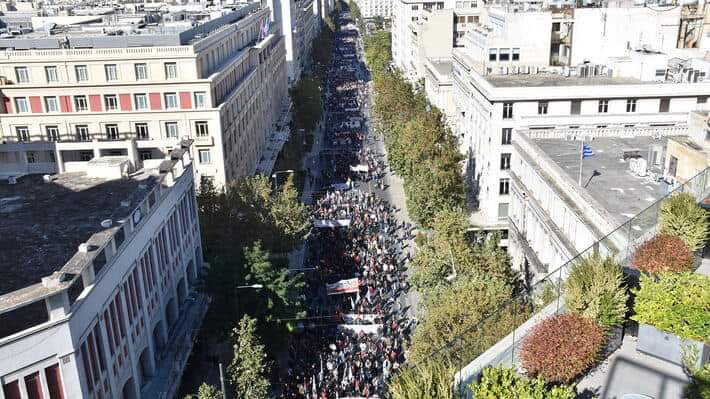
Thousands of people across Greece joined a general strike and mass protests, demanding action against high living expenses, restrictions on union organizing, and excessive military spending
Greece was brought to a halt on Wednesday, November 20, as a 24-hour general strike brought workers from across sectors—including education, logistics, construction, public transportation, and health—to the streets of dozens of cities. The mass mobilization, which began early in the morning, followed a media strike on Tuesday that included both public and private outlets.
The striking workers demanded the repeal of anti-worker laws, including measures that extended working hours, and called for wage restoration. Over the past decade, successive governments, most recently led by Prime Minister Kyriakos Mitsotakis, have implemented austerity policies under pressure from the European Union and international financial institutions. These policies have led to drastic income reductions, with wages remaining about 14% lower than in 2011, according to trade unions.
Protesters warned that current conditions mean they cannot lead dignified lives. With a minimum wage of approximately 900 euros, they face housing and food costs comparable to those in European countries with higher income. While the government has boasted about recent improvements in unemployment rates, unions highlighted that these figures mask the economy’s heavy reliance on tourism and fail to account for poor working conditions.
Greek unions emphasized that anti-worker legislation has persisted for over a decade, including wage cuts and freezes, extended working hours, and severe restrictions on collective bargaining. These policies have left only a small fraction of workers benefiting from collective agreements. “At the same time, they are further commodifying the functioning of critical sectors such as health, education, energy, water, transport, social security, infrastructure and civil protection services for natural disasters,” stated the All Workers Militant Front (PAME) ahead of the strike. In response, unions demanded guarantees of universal, public, and free education and healthcare, alongside accessible housing solutions.
The push to privatize and commodify basic rights highlights how successive administrations have prioritized fiscal targets over people’s interests. This has led to a situation where financial organizations commend Greece’s economic recovery, while the working class continues to face systemic denial of basic rights. On top of that, Greece has allocated millions of euros to military spending through NATO—a decision that has become a significant point of contention for trade unions.
“We do not accept our basic and daily needs to be sacrificed to give billions to NATO armaments, for missiles, frigates, war planes,” PAME stated. Hundreds of thousands of euros have been allocated for the frigate in the Red Sea—”money that is equivalent to the annual budget of a hospital”—the workers’ organization concluded.
Marches on November 20 highlighted international solidarity as opposed to war and militarization. Palestinian flags were prominently displayed at the rallies, reflecting the longstanding support of Greek workers for the people of Gaza and other occupied territories. Trade unions called for an immediate end to the Israeli genocide against Palestinian and Lebanese people. This message resonated with the general strike’s motto: “Out of the war slaughterhouses; fund wages, health, and education instead.”
“The large participation in the strike and rallies demonstrates the workers’ strong opposition to the government’s anti-people policies and its alignment with business interests,” PAME stated on the day of the strike. The organization reaffirmed its commitment to continue with the mobilizations, aiming to pressure the government to shift its priorities toward addressing workers’ rights and peace.
People wait in the woodland by the Greek border fence in northwest Turkey, in March 2020 | Gokhan Balci/Anadolu Agency/Getty Images. All rights reserved
I supported people who’d been violently pushed back from Greece to Turkey – and was accused of being a criminal spy
In October 2020, my colleague and I were sitting in a cafe in central Istanbul, unsure of what would come next. We were exhausted: physically and mentally tired from supporting the people being violently pushed back from Greece and Bulgaria to Turkey, documenting the violations, and fielding requests from journalists.
That morning, the apartment we had planned to move into had fallen through. Three weeks earlier, Turkey had cancelled the residence permits of two colleagues and given them just 24 hours to leave the country.
We were running out of funds, burnt out, and ill. Now, we had nowhere to live.
“What’s next?” I wondered.
My phone pinged. It was a message from Giorgos Christides, then the Greece correspondent for the German newspaper Der Spiegel. I called him back.
“You are one of them! One of the four!” he told me. He had sent a picture of the front page of a Greek newspaper. On it was a screenshot of our website and a letter from the police on Lesvos island that named our organisation, Josoor.
I can’t read Greek, but I understood what was happening. The article was following up on a press release issued by Greek police a week earlier, detailing a “secret operation uncovering a spy network” of four NGOs on Lesvos island. We had just been named as one of them.
I sat frozen as Giorgos translated the text. Espionage. Violation of state secrets. Forming a criminal organisation. Facilitation of illegal entry. Up to 35 years in prison.
How did we end up here?
Multiple crises at the border
The story starts seven months earlier, in March 2020. It had been a sleepless night: we’d been out in freezing temperatures, and our eyes were still stinging from the tear gas. The evening before, two colleagues and I had entered the closed military zone at the border to Greece near Edirne, northwest Turkey.
Our goal was to assess the feasibility of a civil society relief response to the crisis then unfolding at the border. We were three of around 180 volunteers who had met on a Facebook group for aid efforts in Greece, and we refused to just stand by and watch.
The situation was dire. Up to 20,000 people seeking protection were stranded in makeshift tents on the Turkish side. It was cold, and people had to queue for hours to receive a minimal amount of food from the Turkish disaster relief agency. There was no medical care available, and the area was regularly exposed to tear gas from both sides.
Many of those we encountered had been violently pushed back to Turkey by Greek officers, and even enlisted civilians. Two people had been shot dead.
We knew that the Turkish authorities had been obstructing organised relief before we entered the zone. But our scouting trip made it clear to us that they were also creating deliberately poor conditions. So this loose network of volunteers started distributing aid – food, clothes, sleeping bags, hygiene and first aid supplies – under the radar while also keeping the international media informed of what was going on. It was the beginning of Josoor’s work in Turkey.
Men, women and children were – and still are – arriving on Turkish land beaten, humiliated and robbed of all their possessions
The crisis we were responding to had been brewing for years. Turkey had long been threatening to ‘send’ the 3.6 million Syrian refugees in Turkey to Europe, in response to escalating tensions between the country and the European Union.
In the 2016 EU-Turkey agreement, the EU promised Turkey a €6 billion support package and visa-free travel for Turkish citizens. In exchange, Turkey promised to prevent asylum seekers from leaving its territory and to re-admit those who reached the Greek islands.
The deal was described by Amnesty International as an “abject failure”, corrosive for the EU’s human rights record, and “based purely on political convenience”. It turned people seeking protection into pawns for politics – and leverage in the hands of the Turkish government.
The agreement also led to a sharp increase in the frequency and violence of so-called pushbacks back to Turkey from Greece. This informal and illegal practice of collective expulsions had been documented at the land border for decades, but they had never been so systematic nor so violent.
Following the deal, they were also extended to the sea border. The Greek Coastguard (HCG) began disabling peoples’ dinghies and creating waves to push them back to Turkish waters. By 2020, their officers were puncturing inflatable dinghies, setting people adrift in overcrowded life rafts, and even firing live rounds at unarmed people.
People dodge tear gas near the Greek border fence in northwest Turkey | Photo taken by Josoor members
But despite the obvious “political convenience” of the deal for Europe, it didn’t keep to the bargain. By 2019, the EU had only paid Turkey half the promised amount and no progress had been made regarding travel restrictions. It did, however, continue to put pressure on Turkey over its role in the Syrian civil war. Then came the last straw: 33 Turkish soldiers were killed in an airstrike in Idlib, northwest Syria, and Turkey said it could no longer cope with holding up its end of the deal with the EU.
Just weeks after we arrived at the border area, Covid-19 struck. After forcing thousands of people to the border and trapping them there, Turkish authorities suddenly ordered people to clear the area.
People scattered. Some returned to Istanbul or went somewhere else. Those who refused to leave were forced onto buses and kept in quarantine camps before being dropped off in various locations, and stranded without supplies during Turkey’s first nationwide lockdown.
One group sent us a video from the Aegean coast, saying they’d been told by their bus driver to “try to make it to Greece”. Turkish officers apparently told another group the same thing after they were stranded in a different spot.
As we did with all the information we received, we published this on social media in our daily update. The next day, we woke to Greek media headlines alleging that “Turkey sends Covid-infected migrants to Greece as a biological weapon of hybrid warfare”. This ‘news’ had also reached right-wing outlets, only they’d added: “according to Turkish spy organisation Josoor”.
Efforts to correct the narrative were futile – the damage was done. After just a month of operating in Turkey, Josoor was now on the radar.
In hindsight, this media frenzy should have worried and prepared us for what was to come. But we were fully occupied with the situation on the ground, trying to fill the massive gap in monitoring and support for border violence survivors.
We were no longer just a bunch of volunteers trying to sort out an emergency response. Organisational structures were established and our operations were growing. We started providing accommodation, clothing, food, and medical care. And we started taking testimonies to evidence the systematic fundamental rights violations committed by European forces.
Greek, Bulgarian, and EU border and coast guard agency (Frontex) officers continued their campaign of pushbacks following the events of March 2020. There were endless reports of inhumane and degrading treatment, arbitrary detention in appalling conditions, theft, forced undressing, sexualised violence, and torture. Men, women and children were – and still are – arriving on Turkish land beaten, humiliated and robbed of all their possessions.
We joined the Border Violence Monitoring Network (BVMN) and took our evidence and advocacy to the UN, EU, and member state levels. Josoor became a key source of information for international media, collaborating with outlets from 40 countries. But unbeknownst to us, this rapid success had already triggered a first of three secret criminal investigations.
The first warning signs
“We have a right to live,” said Farzad (a pseudonym) in a video livestreamed in June 2020. Alongside the unaccompanied 17-year-old were ten other children, four babies, and 18 adults from Afghanistan, the Democratic Republic of Congo and Syria.
They had been drifting in a flimsy dinghy in the Aegean Sea for three days.
Independent search and rescue operations were effectively banned in the area. Greece’s Hellenic coast guard (HCG) was the authority in charge. But, according to Farzad, it was the coast guard itself that was responsible for their distress. He explained in his video how HCG officers had removed the dinghy’s engine, then used their boat to create waves to push the dinghy back into Turkish waters.
The video was picked up in an unexpected place. Runa Godø Sæther, a music teacher and single mother of three, was managing a Facebook page at the time, sharing posts of people on the move to a European audience from her small town in Norway.
Runa and I didn’t know each other, but we had talked online about collaborating on advocacy. She came across Farzad’s livestream and connected the boy to me, since she had no experience handling ongoing distress cases like this one.
Remarkably, Farzad’s boat eventually reached Lesvos. His desperate calls for help had reached a Turkish liaison officer aboard a German NATO ship, who pressured the crew to intervene and tow it to Lesvos.
A WhatsApp message from a person who had arrived on a dinghy to Lesvos island before being forced back into the sea by police and the Greek coast guard| Natalie Gruber
I introduced him to some journalists when he arrived, and within a short time he had spoken to multiple media outlets about his ordeal. Two days after arriving, a UNHCR official warned him to stop speaking to the press – the police were beginning to take notice.
Farzad instantly cut all ties with journalists – but it was too late. When the others from his boat were transferred to Moria reception centre, Farzad was taken into police custody. He was held there for seven months. Initially, we had no idea why Farzad had been detained. Greek police only told his lawyer he was deemed “a threat to public security”, but never filed charges.
When the Greek press splashed the news of the police letter across their front page, the one that Giorgos had translated for me over the phone, it finally became clear.
The ‘criminal network’
“The Lesvos 35”, as we came to be known, included 32 members from four civil society organisations, one independent volunteer (Runa, the Norwegian music teacher), and two asylum seekers, including Farzad.
Of the four accused organisations, only one – Mare Liberum – actually operated on Lesvos. Registered in Germany, they shared an address with Sea Watch in Berlin, who had ceased operations in Greece four years prior but was still included in the case. Our organisation, Josoor, operated in Turkey.
The other accused organisation was FFM, a research society hosting the donation account for the real target: AlarmPhone. This network of volunteers from all around the Mediterranean runs an emergency hotline for people in distress at sea.
The investigation never aimed to uncover an ‘organised human trafficking network’. It sought to defame, discredit, deter, distract, and disable
The six-month investigation run by the Greek intelligence service, anti-terror unit and HCG resembled a poorly scripted spy movie. Over the course of the investigation, they recruited two asylum seekers, who they sent back to Turkey as “agents” to return to Greece. Then armed special forces conducted a dawn raid on Mare Liberum’s ship, confiscating all electronic devices and detaining the crew for several hours – before releasing them without interrogation.
Our lawyers also strongly suspected that our phones were tapped, making everyone who was now reaching out to us for support a potential target for authorities. And everything we said or wrote in private messages and calls could possibly come back to haunt us. This put immense psychological pressure on us and forced us to censor our communication.
Despite felony charges being announced, none of the 33 organisation members were ever arrested or called to testify. Some even continued to work on the island. Greece has a well-earned reputation of overusing pre-trial detention. Had the authorities believed their own claims – that an allegedly dangerous criminal network was spying on Greek authorities – they should, and I believe would, have arrested us.
Instead, they only leaked information to servile media, while high-ranking government officials, including Prime Minister Kyriakos Mitsotakis, made numerous statements fuelling the defamation campaign.
I cannot quite put into words what this meant. On the one hand, we, the accused, knew full well that we had done nothing criminal at all, so it was hard to take the allegations seriously. But on the other hand, we were slandered and defamed, and our work was discredited. And even though it was absurd, we still faced the possibility of 35 years in prison, which is longer than I have lived.
For three years, seven months and 12 days, we faced the threat of prosecution. The constant anxiety of waiting to be summoned for trial ate away at me. Throughout this time, Greece was so geographically close to me, and a place very dear to my heart – but I couldn’t set foot in the country for fear of arrest.
That threat was finally lifted on 30 April 2024, when our lawyers received the only official communication about the case from the Greek state: a 16-page decision dropping all charges against us.
Like other cases targeting civil society organisations across Europe, this investigation never aimed to uncover an “organised human trafficking network” or to stop “spy games”. It sought to defame, discredit, deter, distract, and disable.
Defame us as a reliable source of information. Discredit our reports exposing human rights violations. Deter others from doing the same. Distract us from our work by forcing us to prepare a legal defence and campaign. Disable our operations through the financial and psychological strain of ongoing investigations.
We got close to quitting back then. But we also realised that being targeted so quickly and so viciously meant that our work so far had been successful. And every day we saw how those we had committed to support were dealt a much worse hand.
So despite the threats we continued for another two years. And each year brought another criminal investigation from Greece. The second case, which started in 2021, simply dissolved for us, but ended with severe consequences for other defendants.
Then, in May 2022 and with pressure mounting inside Turkey, the Greek media once again published claims of criminal investigations into an NGO network. This time, we were sure we were one of the accused. We tried to hang on, and for months we discussed our options.
But in August 2022, we made the difficult decision to dissolve Josoor. Not long after, another of the organisations caught up in the first case, Mare Liberum, also ceased their operations due to the pressure caused by the investigations.
Deterrence at all costs
The mental load of waiting for the day I’m summoned to defend myself against accusations of espionage is hard to describe. It was overwhelming knowing I was being constantly surveilled – sometimes in person in Turkey, and apparently digitally from Greece – while working to support people who had suffered unimaginable rights abuses at the EU border. I was propelled into burnout and PTSD.
For me, the proceedings are far from over. After we submitted a freedom of information request to Europol, the EU law enforcement agency, my co-defendants were told there was no personal information being held about them. But in May 2021, Europol denied my request on the grounds that it could cause “potential jeopardy to member state investigations”. Contacts of mine in the EU data protection authority told me it’s highly likely that Greece, and possibly Frontex, had reported me to the policing agency.
My subsequent complaint to the European Data Protection Supervisor, filed two years ago, remains unresolved, despite the conclusion of their investigation into my case earlier this year.
I was so burnt out that I was ready to accept the situation. But Statewatch and EDRi, who are engaged in crucial work on this issue, reached out to tell me they are eager to advance my case to the European courts, to seek redress for my criminalisation and wrongful entry into Europol’s databases.
Although it will be a long time before my name is cleared, the relief I felt once the charges against us had been dropped showed me just how much pressure I had been under.
Throughout these years, the EU and its member states have shown how far they will go in order to silence those who expose their crimes. And yet, we are only collateral damage. The real targets of all these criminalisation campaigns are those challenging the border regime simply by stepping across the arbitrary lines we have drawn.
Voluntarily or forced, people have moved from one place to another throughout human history. But particularly in this past decade, Europe’s only response to this simple, human phenomenon has been deterrence and externalisation.
Pushbacks are one hallmark of these brutal, costly and racially motivated policies. The criminalisation of migration is another hallmark, resulting in the widespread imprisonment of people seeking protection. By extension, authorities are also engaging in secondary criminalisation: targeting those stepping in where states fail, providing basic yet desperately needed support at Europe’s borders.
Within the Border Violence Monitoring Network, eight of the 14 organisations faced criminal proceedings across four European countries in 2022. Journalists, lawyers, doctors and other aid workers are increasingly being targeted as well.
The criminal proceedings had a huge toll on me. But as a white EU citizen, the price I paid was small – uncomparable to all those unjustly spending years or even decades in prison just for seeking protection. In the end, society as a whole pays a high price. The widespread erosion of the rule of law across Europe threatens nothing less than democracy itself – and the fundamental rights it has ensured for everyone.
Explore the rest of the series
This series looks at how the UK, EU and bordering countries are increasingly treating migration as a criminal offence, and targeting migrants and solidarity actors in the name of ‘anti-smuggling’ and ‘border control’.
dizzy: Experiencing some problems posting with WordPress today, having to use a different browser to normal and it may look a little different. So what eh?
Protestors hold a banner outside Canterbury Crown Court to demonstrate against the conviction and sentencing of teenager Ibrahim Bah in February 2024 | Andrew Aitchison/In pictures/Getty Images. All rights reserved
Governments are locking teenagers up in a bid to catch smugglers – and failing vulnerable kids in the process
In December 2022, an inflatable dingy carrying dozens of people across the English Channel capsized. At least four people died. Ibrahima Bah, a teenager from Senegal, was identified by authorities as steering the dinghy and was arrested.
One of the people who died was Ibrahima’s friend. Neither of the friends had money, so Ibrahima initially agreed to steer the boat in exchange for their passage. He tried to back out when he saw the condition of the boat, but the adults organising the passage forced him to continue.
In February 2024, Bah was sentenced to almost ten years in prison for manslaughter by four counts of gross negligence, and for violating immigration rules. Despite Bah saving other passengers’ lives on the journey, mainstream headlines slammed him as a guilty ‘boat pilot’ and described him, wrongly, as an adult man.
Bah is one of dozens of children who have been charged for immigration offences across the UK and Europe. Most of those children are Black teenage boys travelling alone. Most of them were seeking safety and protection.
Accused children and their lawyers have spoken to openDemocracy from Greece, Italy and the UK about these huge miscarriages of justice.
They tell a story of racist and outdated age assessments, a lack of access to legal support and translators, bureaucratic mistakes, biased prosecutors and a fundamental lack of support.
“A dark place”
When he arrived in the UK, Bah didn’t know exactly how old he was. He was given an age assessment and declared to be over 18. Only later did a birth certificate emerge, showing that he was a minor. The courts rejected it and relied on the age assessment instead.
“I think Ibrahima struggles to understand, as do we, how he can possibly be held accountable for those people’s deaths,” says Maddie Harris of Humans for Rights Network, an organisation supporting people subjected to hostile border regimes.
Since June 2022, Humans for Rights Network has identified at least 23 minors prosecuted as adults for immigration offences. All of them are Black Africans, the majority Sudanese or South Sudanese.
“The reality of the child’s experience versus what they are accused of – they’re just not the same thing at all,” said Harris.
Most if not all children travelling irregularly go through a lot on their way to the UK. For more and more children, part of their transit now also includes getting coerced into steering the boats by those arranging the passage, often through violence, threats, or because they cannot afford the fare. Once they’re in the UK, they struggle to understand how the legal system can then paint them as criminals.
“They told me, ‘you are under arrest because you arrived in the UK without a visa,’” said Ameen (a pseudonym), one of those prosecuted children. “A couple of minutes later, they said, ‘you have to go to prison for a couple of days, and then you will go to court.’”
The next three days in the police station were the “darkest days” of his life, Ameen said. “One room, with nothing. A dark place. Nobody talks to you, nobody answers you. Stress. Words are not enough to explain those days. They were bad days, the worst that I have ever had in my life.”
Ameen went on to spend six months in an adult prison.
UK age assessments are “highly subjective”
Child asylum seekers get caught up in this system because of the way authorities determine their ages.
“When people arrive, they have the opportunity to state their age, usually by putting their finger on a number on a piece of paper,” said Vicky Taylor, a researcher at Oxford University and lead author of the 2024 report No Such Thing as Justice Here.
If a child is recognised as under 18, they are put in the care of the local authority. If they say they are a minor but are suspected of being older, they are subjected to further assessment.
“These initial inquiries have been shown to be unreliable,” said Taylor. “People are often in a confused state, having just landed in the UK after a long, dangerous and traumatic journey. They are not offered legal advice, interpreting or support.”
Age assessments tend to have three stages, according to Taylor. First, the young person is asked to recount their own personal timeline – when they left their home country, for instance, or the last birthday they can remember.
“Obviously it can be difficult [to assess] when people are from cultures in which birthdays are not celebrated or marked in the same way,” said Taylor. “Trauma also greatly affects young people’s ability to tell their story in a way that is legible to authorities.”
The second check is physical appearance. Assessors look at the potential child to see if they have beard lines, or to check how hairy their hands are, or how far back their hair line is. These are racialised markers, said Taylor.
Third, a person’s demeanour is assessed – how they engage with officials, react to questioning, and how they carry themselves.
All these checks “are highly subjective,” said Taylor, “and very difficult to ascertain within a ten-to-40-minute assessment.” Children travelling alone, as well as those who have been through difficult and traumatic experiences, are also less likely to present in ways that are obviously child-like.
It’s estimated that over 1,300 children were wrongly assessed as adults by the Home Office from January 2022 to June 2023
Many children who went through this process say they did not understand what they were asked. And for those who came away with a new age assigned to them, the number was often arbitrary.
Age assessments have been widely criticised by rights groups and researchers. An inquiry by the Independent Chief Inspector of Borders and Immigration between 2021 and 2022 described age assessments as “perfunctory” and noted that concerns had been raised at various times about the process.
“[Children’s] experiences include not being provided with the correct interpreter, being called liars and facing inappropriate comments about their physical appearance,” said Labour MP Andrew Western in the House of Commons. “This is unacceptable, and the reason it is so worrying is that the stakes are so high.”
Earlier this year, Refugee Council, Humans for Rights Network and the Helen Bamber Foundation reported that over 1,300 children had been wrongly assessed as adults by the Home Office from January 2022 to June 2023. The charities reported that children as young as 14 were forced to share rooms with unrelated adults, with no safeguards in place, and that children felt “unsafe, scared, and traumatised” by their experiences.
According to Harris, these figures are likely to be an undercount, since not all local authorities responded to requests for information, and some children continue to be prosecuted as adults.
“It’s a sort of conveyor belt,” said Harris. “They continue to prosecute children without adequately resolving their ages.”
Children branded as ‘traffickers’ in Italy
This is not just a problem in the UK. Italy is also taking child migrants to court, said Cinzia Pecoraro, a lawyer in Sicily. Similarly to Britain, outdated and racialised age markers are partly to blame.
Some of the methods Italian authorities use to measure people’s ages date back to the 1950s. One method uses X-rays to examine bone structure, based on samples of an Anglo-Saxon population. Its margin of error is between six months and two years, according to Pecoraro.
The moment I was arrested as a trafficker I was worried, because they accused me of something I didn’t do
Pecoraro represented one child from West Africa who was identified as steering the dinghy he arrived in.
“The moment I was arrested as a trafficker I was worried, because they accused me of something I didn’t do,” said Ola (a pseudonym) over text message.
Ola was originally identified as underage, but the Italian authorities intervened and subjected him to a flawed age assessment. He was moved to adult prison as a result.
“I felt sick, because they gave me an age that is not my age,” Ola said. “I felt it was racism.”
Ola spent a year in adult prison until Pecoraro was assigned to his case. “I realised that this was a child,” she said. “It was obvious.” She eventually got hold of a birth certificate, and after multiple delays his case was sent back to a minors’ court.
Ola is an adult now and the case is still pending. Despite being tried as a minor, he still faces serious consequences for allegedly steering the dinghy. “It’s been nine years,” Ola said. “Let’s hope to finish it soon so I can feel calm, because every moment I think about it.”
Pecoraro is confident Ola will be acquitted, but said he is lucky she was assigned to his case. She has a lot of experience defending minors in his position. “You need a proper defence,” she said. “Without it, they get convicted.”
These convictions are not happening in a political vacuum. The government of Georgia Meloni – who rose to power on the back of anti-immigrant rhetoric – has aggressively sought to reduce numbers of people arriving in Italy.
More and more people have been criminalised for the crime of ‘facilitation’ across the EU, allowed under the soon-to-be-expanded Facilitation Directive. And in Italy, Pecoraro says prosecutors seemed determined to continue.
“It’s common knowledge these journeys do not have a formal crew or driver. They are only passengers, forced to steer the boat,” she said. “This is [well] known, but prosecutors don’t want to surrender.”
Kids caught up in Greece’s hostile system
Thousands of people are likewise in prison in Greece for the crime of ‘facilitation’, with at least one or two people arrested per dinghy arriving. As a result, racialised people serving time for ‘smuggling’ related offences comprise the second largest prison population in the whole of Greece.
Sometimes just being seen by authorities at the rear of a boat is enough for a person to be identified as ‘driving’. Kani (a pseudonym), a young person from an African country, was 19 when he arrived in Greece. He was arrested after being falsely identified for driving the dinghy.
M. E., now 16, is awaiting trial and faces a possible 4,670-year sentence for ‘smuggling’
“I didn’t touch the steering wheel, and I have no idea about driving or anything else,” wrote Kani in a text message. “They took me to prison after that. I had no idea why they took me in the first place. I didn’t even realise that the matter was this serious. I didn’t understand anything. I said to myself, ‘what is happening’? I was literally terrified.”
In 2023, H. E.*, an Egyptian fisherman, was sentenced to 280 years in prison for piloting a dinghy from Libya to Crete. Unable to pay for himself and his teenage son, he had agreed to steer. His son, M. E.*, now 16, is awaiting his own trial and faces a possible 4,670-year sentence for ‘smuggling’.
In reality, M. E. won’t serve a sentence of this length – even if he could live that long. Maria Flouraki, the teenager’s lawyer, said he’ll likely be released before a decade is up. While Greek courts regularly hand out decades or even centuries-long sentences for smuggling cases, sentences are generally capped at 20-25 years, with options for early release.
The crime of ‘facilitation’ – legalese for smuggling – comes from the 2002 EU Facilitation Directive, and is interpreted very widely by Greek authorities. In this case, the child providing his father support while he steered the boat – helping pass out food and water, for instance – was enough to make him legally complicit.
Flouraki said M. E. could not understand why he was accused of being a smuggler. “He was just a kid following his father. He had no other option.”
She is hopeful he will be acquitted once in front of a judge, as is generally the case for minors. Flouraki’s client is not being prosecuted as an adult, but children are sometimes identified and charged as adults.
Dimitris Choulis is a lawyer on the Greek island of Samos. Many of the minors he works with have spent months in adult prison before being released. “To be honest, it’s always been like this,” said Choulis.
One of Choulis’s clients is a child currently locked up in an adult prison. Choulis says he has the birth certificate, and hopes it will help him to get his client out of adult prison and into the minors’ system soon.
Choulis does not believe Greece is deliberately trying to criminalise children. Rather, he thinks that children are getting caught up in a system beset with structural failures. But, he said, such problems could be avoided if the system gave children more time and support.
“They don’t give them the opportunity, and these [children] don’t know what they have to say,” said Choulis. “They are [hearing] a strange language, in a strange country, and they’re in handcuffs. They don’t know what to say, and they haven’t seen a lawyer.”
Whether children are locked up because of embedded racism in age assessments, overzealous prosecutors or bureaucratic errors, the result is the same.
Children are paying the price because the UK and EU governments are more intent on securing their borders than safeguarding the rights of people seeking asylum, said Vicky Taylor. “States are willing to override their obligations to children because they’re preoccupied with the performance of security.”
*Full names have been withheld to protect their identities
As the U.S. faces another potentially record heat wave this week, the Middle East and Europe’s Mediterranean have endured extreme temperatures that have proven deadly.
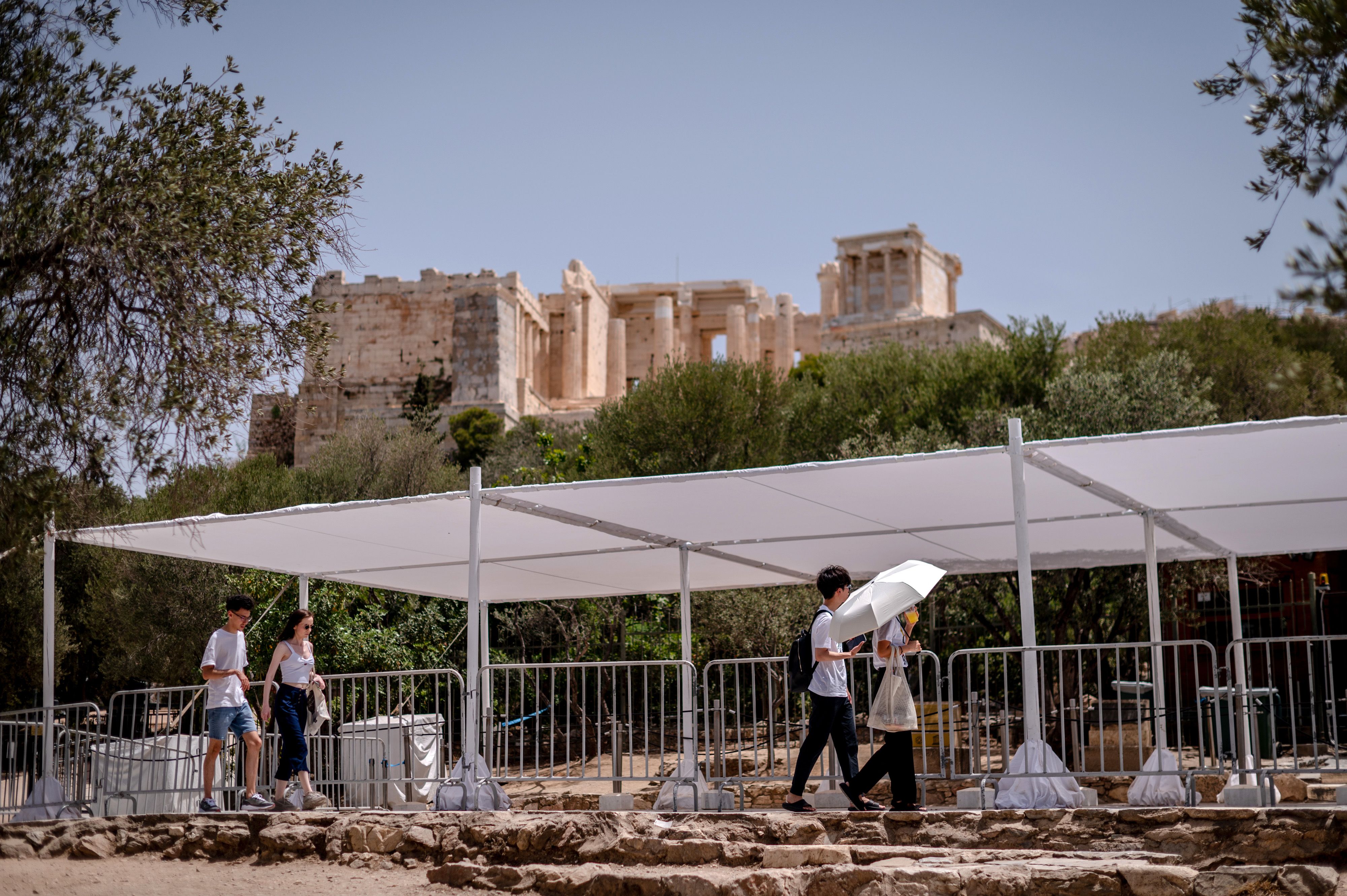
The big picture: Multiple heat-related deaths have been reported in Greece during the country’s earliest heat wave on record and Jordan’s official news agency said Sunday “14 Jordanian pilgrims died and 17 others were missing” in the searing heat while on the Islamic Hajj pilgrimage to Mecca in Saudi Arabia.
Tourists outside the Acropolis during high temperatures in Athens, Greece, on June 12, when authorities announced the closure of the ancient site for five hours due to soaring temperatures that also shut schools. Photo: Hilary Swift/Bloomberg via Getty Images
The heat waves sweeping these regions this month have been made “at least five times more likely” because of human-caused climate change, per new Climate Central analysis.
Context: Climate Central’s analysis is based on the group’s Climate Shift Index (CSI), which compares observed or forecast temperatures with simulations of the same weather conditions minus excess atmospheric greenhouse gases, per Alex Fitzpatrick.
The idea is to compare real-world conditions with what might have been the case had human-caused climate change been absent.
Saudi Arabia had a CSI of 5, meaning that human-caused climate change made a given daily average temperature five times more likely as of Monday morning. Greece, which has endured two weeks of extreme heat, had a CSI of 5 last week and 2 on Monday. Parts of Turkey had a CSI of 5.
A joint report by UN and European Union agencies found in April that Europe’s temperatures are rising about twice as fast the global average due to human-caused climate change — making it the fastest-warming continent on Earth.
Heatwaves around Mediterranean have damaged harvests and forced producers to import from South America
Olive oil groves by Birding In Spain, CC BY-SA 4.0 <https://creativecommons.org/licenses/by-sa/4.0>, via Wikimedia Commons
Europe has almost run out of local olive oil supplies and is set for more shortages, after extreme weather damaged harvests for a second year.
The world’s largest producer has said it is having to import supplies from South America to keep up with demand.
“Today it is almost physically impossible to buy olive oil. It is sold out,” Walter Zanre, the chief executive of the UK arm of Filippo Berio, said.
Olive trees have been cultivated around the Mediterranean for thousands of years, with Spain alone producing half of the world’s supply of olive oil, but wildfires and soaring summer temperatures mean the future of this ancient industry is looking increasingly uncertain.
Global production is expected to fall to 2.4m tonnes according to the International Olive Council, less than last year’s harvest and well short of global demand of about 3m tonnes, after drought and heatwaves of more than 40 degrees hit production in Spain.
Extreme weather in other important growing regions including Greece, Italy and Portugal as well as Turkey and Morocco has added to the crisis.