‘No War Crimes Are Off Limits’ as Trump Reportedly Mulling Bombing Targets in Venezuela

Spread the love

Original article by Olivia Rosane republished from Common Dreams under Creative Commons (CC BY-NC-ND 3.0). 
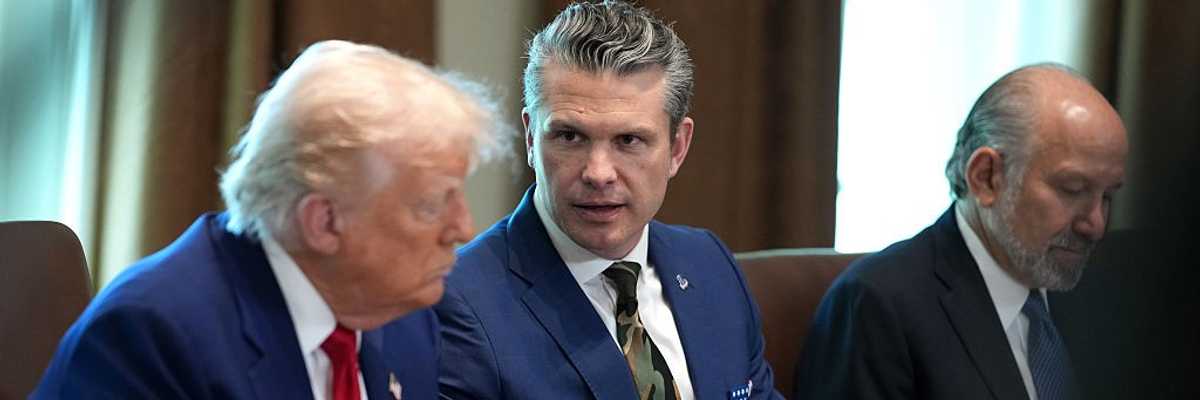
US Defense Secretary Pete Hegseth (R) looks on as US President Donald Trump speaks during a Cabinet meeting at the White House on April 30, 2025 in Washington, DC. (Photo by Andrew Harnik/Getty Images)

NBC reported Friday that the US military is considering options including drone strikes against drug cartel members within the South American country, prompting fears of escalation.

The Trump administration may strike alleged drug targets inside Venezuela’s borders within weeks, sources familiar with the situation told NBC News on Friday.

Two US officials and two other sources with knowledge of the conversations that had taken place said that the US military was considering plans that could include drone strikes against members and leaders of drug trafficking groups as well as drug laboratories. If approved, the strikes would be a further escalation following three Trump administration attacks on alleged drug-carrying boats in the Caribbean that have killed at least 17 people, even though the administration has provided no evidence that those killed were actually smuggling drugs.

“More mass murder on the cards?” the news outlet Venezeulanaysis wrote in response. “NBC reports that the Trump administration is weighing strikes against ‘drug targets’ (emphasis on the air quotes) inside Venezuelan territory. Lots of speculation and anonymous sources, but it shows that no war crimes are off limits.”

US President Donald Trump has already come under heavy criticism for authorizing boat strikes that many decry as illegal. Democratic lawmakers have moved to bar the president from authorizing further attacks, and Colombian President Gustavo Petro called for the United Nations to take criminal proceedings against the US president in a speech on Tuesday.

“This is the most egregious instance of disinformation against our nation, intended to justify an escalation to armed conflict that would inflict catastrophic damage across the entire continent.”

Now, observers are responding with alarm to the news that the administration might go even further.

El Pais correspondent Juan Diego Quesada wrote on social media that strikes within Venezuelan territory “would escalate the conflict to a level whose consequences I dare not measure.”

“How would this not be considered an act of war?” asked poster Cindy Gossett. “Trump can’t just claim Venezuelan citizens are drug lords therefore he’s going to fly a drone over and destroy them. If Venezuela did the same in our country it wouldn’t be accepted.”

Speaking at the UN General Assembly on Friday, Venezuelan Foreign Minister Yvan Gil Pinto said that the US had an “illegal and completely immoral military threat hanging over our heads.”

Pinto also cast doubt on the notion that the Trump administration’s true aim was to combat the drug trade.

He accused the US of trying to permit “external powers to rob Venezuela’s immeasurable oil and gas wealth” and said that the administration was using “vulgar and perverse lies” to “justify an atrocious, extravagant, and immoral multibillion-dollar military threat.”

Trump has yet to authorize any particular plan, according to NBC. The Pentagon declined to comment on their report, and the White House referred the outlet to a previous statement from Trump: “We’ll see what happens. Venezuela is sending us their gang members, their drug dealers, and drugs. It’s not acceptable.”

Venezuelan President Nicolás Maduro has denied that his administration has not done enough to prevent drug trafficking through the South American country, as Trump has accused.

Maduro sent a letter to the White House on September 6 calling for peace and dialogue and defending his record, noting that, according to a UN report, only 5% of the drugs that leave Colombia do so via Venezuela.

He wrote of the trafficking claims, “This is the most egregious instance of disinformation against our nation, intended to justify an escalation to armed conflict that would inflict catastrophic damage across the entire continent.”

Toward the end of the letter, he appealed to Trump to work with him to reduce tensions.

“President, I hope that together we can defeat the falsehoods that have sullied our relationship, which must be historic and peaceful,” Maduro wrote.

Original article by Olivia Rosane republished from Common Dreams under Creative Commons (CC BY-NC-ND 3.0). 

Donald Fuhrump says that Amerikkka doesn't bother with crimes or charges anymore, not being 100% Amerikkkan and opposing his real estate intentions is enough.
Donald Fuhrump says that Amerikkka doesn’t bother with crimes or charges anymore, not being 100% Amerikkkan and opposing his real estate intentions is enough.
Orcas discuss how Trump was re-elected and him being an insane, xenophobic Fascist.
Continue Reading‘No War Crimes Are Off Limits’ as Trump Reportedly Mulling Bombing Targets in Venezuela

A global army to liberate Palestine: An investigative reading of Colombian President Gustavo Petro’s speech

Spread the love

This work by Middle East Monitor is licensed under a Creative Commons Attribution-NonCommercial-ShareAlike 4.0 International License.

Gustavo Petro, Colombia’s president, during the United Nations General Assembly (UNGA) in New York, US, on Tuesday, Sept. 23, 2025. [Photographer: Michael Nagle/Bloomberg via Getty Images]

by Dr Rassem Bisharat

In one of the most daring and controversial political interventions to echo through the halls of the United Nations in decades, Colombian President Gustavo Petro, in his address to the UN General Assembly on 23 September 2025, called for the creation of an international army that transcends the traditional balance of power and whose first mission would be the liberation of Palestine from Israeli occupation and the cessation of the ongoing genocide in Gaza.

The speech drew widespread global attention, opening the door to a complex debate on the future of the international order, the limits of international law, and the possibility of a fundamental transformation toward a new architecture of international relations that moves beyond bipolarity and the centrality of U.S. power.

Petro: The end of words and the beginning of action

In his speech, President Gustavo Petro sharply criticised the current international order, asserting that a world dominated by a single power and complicit in genocide cannot credibly claim to defend democracy or human rights. He emphasised that statements and declarations are no longer sufficient amid the mass killings in Gaza, calling for the creation of an international armed force composed of states that reject genocide, tasked with protecting threatened populations and enforcing international justice. Petro declared: “We need a strong army of nations that do not accept genocide… We must gather weapons and armies. We must liberate Palestine.”

Invoking Simón Bolívar, he added: “We are tired of words… It is time for the sword of liberty or death.”

In later remarks posted on X (formerly Twitter), Petro announced plans to submit a draft resolution to the UN General Assembly to establish a “global army for justice,” with its first mission focused on liberating Palestine,” marking a dramatic call for action over [sic]

READ: Saudi Arabia warns global inaction on Gaza war threatens regional, world stability

A paradigm shift in international politics

Petro’s proposal marks a significant shift in international political discourse. Since the UN’s founding in 1945, international forces have primarily focused on post-conflict peacekeeping, operating under limited mandates and with Security Council approval. Petro, however, envisions a force designed not to maintain the status quo but to actively change it, intervening militarily to prevent genocide and end occupation. This transition from neutrality to action challenges core principles of international law, including state sovereignty and non-intervention, while contesting the Security Council’s monopoly, particularly its five permanent members, over the authorised use of force. Petro suggested that such a force could be established through the General Assembly, referencing the 1950 “Uniting for Peace” resolution, when the Assembly bypassed a deadlocked Security Council to authorize military intervention in Korea, setting a precedent for acting when conventional mechanisms fail.

Enormous political and legal obstacles

Despite Petro’s bold proposal, formidable obstacles make its near-term realization highly unlikely. The UN’s legal framework restricts the use of force to the Security Council, where the US holds veto power and would never allow the creation of a force that could act against Israel, its key Middle Eastern ally. Geopolitical realities also hinder the formation of a global coalition outside the Western security umbrella. Even countries critical of Israeli policies, including EU members and Global South states, may resist joining a force that risks direct confrontation with Israel or the U.S Additionally, there is a significant lack of collective political will: while smaller and medium-sized states often use strong rhetoric, turning such words into military action demands a consensus that is currently absent. Past struggles to reform the Security Council or establish war crimes tribunals underscore how difficult it is to translate ambitious ideas into action within today’s entrenched power structures.

The significance and timing of Petro’s speech

Despite significant practical obstacles, Petro’s speech carries profound symbolic and political weight in shaping global discourse on Palestine and the international order. He reframes the Palestinian issue from a mere “conflict” to an act of “genocide,” shifting the debate from political negotiation to one centered on liberation and international justice. His references to “Bolívar’s sword” and an “army of justice” seek to place Palestine at the core of a broader struggle against double standards and for global legitimacy.

Moreover, Petro’s call sparks renewed debate on reforming the United Nations. Beyond advocating for a force dedicated to Palestine, he highlights the failure of the current system to prevent genocides in Rwanda, Syria, Myanmar, and now Gaza. The proposed army thus symbolizes a deeper demand for rebuilding the international order on fairer, more pluralistic foundations.

Finally, the speech underscores a shift within the Global South. From Colombia to South Africa and Brazil, states on the geopolitical periphery are increasingly using the UN stage to challenge the Global North’s dominance and redefine concepts of legitimacy. Petro’s message aligns with this momentum, adding new strategic depth to the Palestinian cause within emerging international alliances.

READ: Malaysia urges sanctions on Israel at UN meeting

Justice in the age of genocide

President Petro’s speech comes at a critical moment, as Gaza endures one of the most brutal Israeli military campaigns since the Nakba. UN agencies and human rights organizations, including OCHA, Oxfam, and Human Rights Watch, report the killing of tens of thousands of civilians and the widespread destruction of vital infrastructure, including hospitals, schools, and relief centers. The UN has also documented the deaths of hundreds of humanitarian workers, in what international organizations describe as the largest targeting of the humanitarian sector in modern conflict.

In this context, Petro’s speech becomes more than a theoretical proposal, it is a cry against a world that remains silent in the face of genocide. His call to form an “army of justice” is, at its core, an expression of the failure of the international system to fulfill its most fundamental duty: protecting civilians and enforcing international law.

And while the idea may be unattainable at present, it exposes the glaring gap between the UN’s rhetoric and its reality, opening the door to rethinking the mechanisms of collective international action.

Conclusion

President Petro’s project to form an international army to liberate Palestine may seem, in the realpolitik balance, a utopian dream difficult to achieve amid current power dynamics. Yet, in the realm of symbolic and strategic politics, it reflects a profound shift in how international justice, Palestine, and the global order itself are conceived.

The speech will not change the world tomorrow, but it could mark a turning point in a longer trajectory toward reshaping international institutions so that they are capable of confronting genocide and injustice. And just as Simón Bolívar’s words once ignited the liberation of entire continents, President Petro’s speech may, even if only in the long run, be the spark that drives the world to contemplate a global army for justice, one whose first mission would begin in Gaza, if Gaza, as we know it, still exists.

OPINION: Paraguay’s fluctuating positions on Palestine: Between interests and justice

The views expressed in this article belong to the author and do not necessarily reflect the editorial policy of Middle East Monitor.

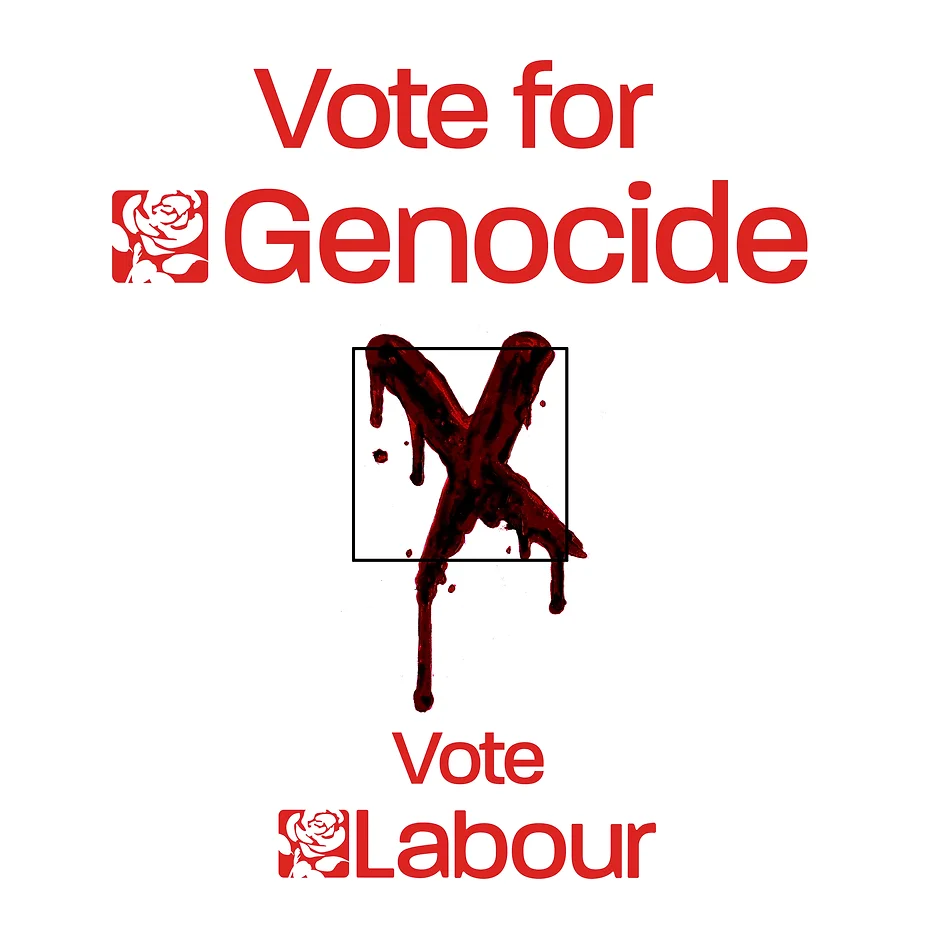
Experiencing issues with this image not appearing. I suspect because it's so critical of Zionist Keir Starmer's support of and complicity in Israel's genocides.
Genocide denier and Current UK Prime Minister Keir Starmer is quoted that he supports Zionism without qualification. He also confirms that UK air force support has been essential in Israel’s mass-murdering genocide. Includes URLs https://www.declassifieduk.org/keir-starmers-100-spy-flights-over-gaza-in-support-of-israel/ and https://youtu.be/O74hZCKKdpA
Keir Starmer objects to criticism of the IDF. He asks how could anyone object to them starving people to death, forced marches like the Nazis did, bombing Gaza's hospitals and universities, mass-murdering journalists, healthworkers and starving people queuing for food, killing and raping prisoners and murdering children. He calls for people to stop obstructing his genocide for Israel.
Keir Starmer objects to criticism of the IDF. He asks how could anyone object to them starving people to death, forced marches like the Nazis did, bombing Gaza’s hospitals and universities, mass-murdering journalists, healthworkers and starving people queuing for food, killing and raping prisoners and murdering children. He calls for people to stop obstructing his genocide for Israel.
Vote Labour for Genocide.

Continue ReadingA global army to liberate Palestine: An investigative reading of Colombian President Gustavo Petro’s speech

‘The Palestinian genocide threatens our entire multilateral system’

Spread the love

https://morningstaronline.co.uk/article/palestinian-genocide-threatens-our-entire-multilateral-system

 Relatives carry the body of 13-year-old Seraje Ebrahim, killed in an Israeli strike on a drinking water distribution point, for burial outside Al-Awda Hospital in Nuseirat, central Gaza Strip, July 13, 2025
Over 30 nations to gather in Colombia to bring a halt to the genocide in Gaza

MORE than 30 nations gather in Bogota, Colombia tomorrow [today] for an “Emergency Conference” to bring a halt to the Israeli genocide against the Palestinians in Gaza.

UN special rapporteur Francesca Albanese, who is attending the conference, said the gathering “will go down as the moment in history that states finally stood up to do the right thing.” 

The conference is called by The Hague Group which was set up in January this year.

Jointly convened by Colombia and South Africa, The Hague Group’s co-chairs, the conference brings together 32 states including Brazil, China, Cuba, Indonesia, Ireland, Mexico, Nicaragua, Pakistan, Spain, Turkey and Venezuela.

Colombian President Gustavo Petro described the conference as an opportunity “to move from condemnation to collective action.”

Ahead of the conference Colombia’s Vice Foreign Minister Mauricio Jaramillo Jassir said: “The Palestinian genocide threatens our entire multilateral system.” 

Article continues, discussing

  • US imposed sanctions on UN Special Rapporteur Fransesca Albanese who is attending the Bogota conference.
  • Attempts in UK Parliament by the standing group on atrocity crimes “to create a clearer legal obligation on the British government to prevent genocides, and to determine if one is occurring rather than leaving such judgements to international courts.”
  • South Africa’s case against Israel at the International Court of Justice alleging violations of the Genocide Convention by Israel.
  • United Nations general assembly voting to take action on “Israel’s policies and practices in the Occupied Palestinian Territory” with a 12-month deadline to deliver concrete obligations — investigations, prosecutions, sanctions, asset freezes, and cessation of imports and arms.
  • Former Israeli prime ministers Yair Lapid and Ehud Olmert describing plans to create a “humanitarian city” in southern Gaza as amounting to interning Palestinians in a “concentration camp.”
  • Increasing numbers of Palestinians getting killed by Israeli forces.
  • More than 58,000 killed and 138,520 wounded, according to Gaza’s Health Ministry.
Experiencing issues with this image not appearing. I suspect because it's so critical of Zionist Keir Starmer's support of and complicity in Israel's genocides.
Genocide denier and Current UK Prime Minister Keir Starmer is quoted that he supports Zionism without qualification. He also confirms that UK air force support has been essential in Israel’s mass-murdering genocide. Includes URLs https://www.declassifieduk.org/keir-starmers-100-spy-flights-over-gaza-in-support-of-israel/ and https://youtu.be/O74hZCKKdpA
Keir Starmer objects to criticism of the IDF. He asks how could anyone obect to them starving people to death, forced marches like the Nazis did, bombing Gaza's hospitals and universities,mass-murdering journalists, healthworkers and starving people queuing for food, killing and raping prisoners and murdering children. He calls for people to stop obstructing his genocide for Israel.
Keir Starmer objects to criticism of the IDF. He asks how could anyone obect to them starving people to death, forced marches like the Nazis did, bombing Gaza’s hospitals and universities,mass-murdering journalists, healthworkers and starving people queuing for food, killing and raping prisoners and murdering children. He calls for people to stop obstructing his genocide for Israel.
UK Labour Party government ministers Keir Starmer, Angela Rayner and Rachel Reeves explain that they are partners complicit in Israel’s Gaza genocide. The UK has provided Israel with arms, military and air force support. They explain that they don’t do gas chambers but do do forced marches, starvation, destroy hospitals, mass-murders of journalists and healthcare workers.

Continue Reading‘The Palestinian genocide threatens our entire multilateral system’

Argentine diplomats expelled from Colombia following explosive comments by Milei

Spread the love

Original article republished from peoples dispatch under a Creative Commons Attribution-ShareAlike 4.0 (CC BY-SA) license.

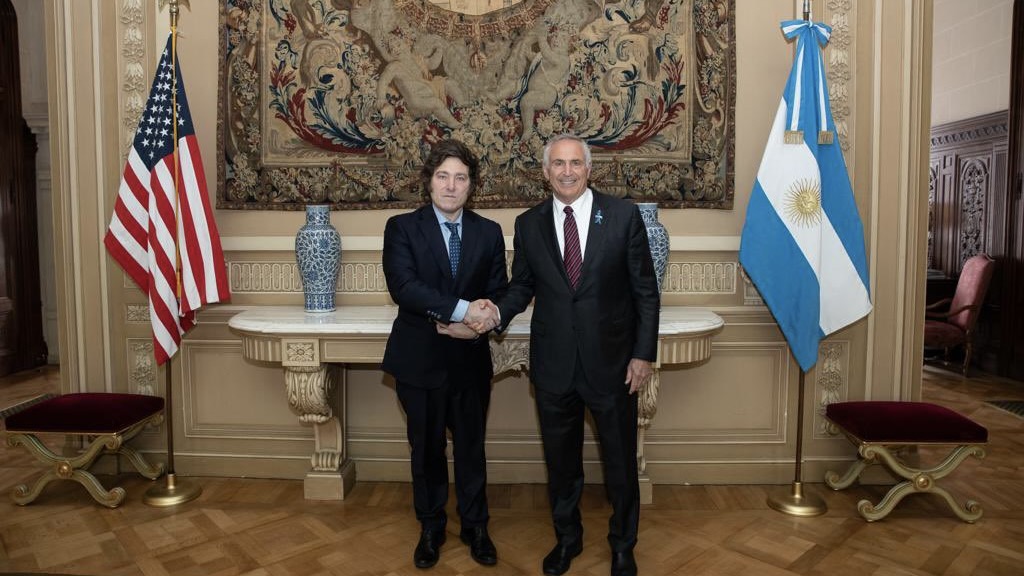
Argentine President Javier Milei with US Ambassador in Argentina Marc Stanley

In an interview with CNN, the Argentine president called Petro a “terrorist assassin”, Mexican President López Obrador “ignorant”, and declared that Israel was not committing “any excesses” in Gaza

Argentina’s libertarian president Javier Milei is under fire from his counterparts in the region for comments made during an interview with CNN Español. In response to his explosive comments, wherein he called Colombia’s president a “terrorist assassin”, Colombia’s Foreign Ministry announced the expulsion of Argentina’s diplomats from its embassy in Bogotá, Colombia.

The Foreign Ministry wrote in a statement, “This is not the first time that Mr. Milei offends the Colombian head of state, affecting the historical relationship of brotherhood between Colombia and Argentina.”

Indeed, Milei made similar comments about the leftist president back in January. When asked what he thought about the Colombian president, Milei told right-wing Colombian-American journalist Patricia Janiot that he is a “communist assassin that is sinking Colombia”.

In the statement released by the Colombian government, they highlighted: “The expressions of the Argentine president have deteriorated the confidence of our nation, in addition to offending the dignity of President Petro, who was democratically elected.”

Meanwhile, former Argentine president Alberto Fernández also condemned the statement by his successor. “I regret and categorically reject the statements of President Javier Milei, who has mistreated the President of Colombia, Gustavo Petro. My solidarity with the president of the Colombian people. The derogatory and disqualifying way in which the Argentine president expresses himself about presidents legitimately elected by their people and who are recognized leaders throughout Latin America is absolutely inadmissible.”

Gustavo Petro himself responded to Milei’s comments on Thursday and stated, “I believe that Milei seeks to destroy, or at least postpone, the project of Latin American integration. Today the Argentine people suffer and poverty increases. Milei’s promise to repeat the neoliberal system of 30 years ago may be a failure foretold; His thesis in the world that he has seen today as neoliberalism led to worsening the climate crisis, and putting us on the brink of extinction, as a species, is not accurate. The Argentine people are the ones who must discuss these issues and decide.”

He added, “Despite the insults, we must preserve the project of unity, in diversity, of Latin America and the Caribbean.”

Since winning the elections, Milei has rejected the pro-Global South integration position of his predecessors, instead pledging his priority and allegiance to the United States. Weeks after he was sworn in, Milei announced that Argentina would not join the BRICS economic bloc. The body had offered Argentina membership after its Johannesburg summit in August 2023, but Milei stated in December that it would rather do business with the US and Israel. So far Argentina has remained in the Latin American integration platforms but has threatened to withdraw from some.

Milei’s explosive comments were not reserved only for Colombia’s president. The CNN interviewer mentioned that Mexican President Andrés Manuel López Obrador had said some “tough words” about Milei, to which the Argentine president said “That an ignorant person like López Obrador speaks ill of me exalts me”.

The Mexican head of state responded to the comments on Thursday saying, “Milei stated that I am ‘ignorant’ because I called him a ‘conservative fascist.’ You are right: I still do not understand how the Argentines, being so intelligent, voted for someone who is not accurate, who despises the people and who dared to accuse his countryman [Pope] Francisco of being a ‘communist’ and ‘representative of the Evil One in the earth’, when it comes to the most Christian Pope and defender of the poor that I have ever known or heard of. PS Hugs to Gustavo Petro.”

Another segment of the not-yet aired interview that was shared was regarding Milei’s views on Israel’s genocidal war on Gaza. The staunch zionist declared: “Israel is not committing any excesses.”

The full interview is set to air this Sunday March 31.

Original article republished from peoples dispatch under a Creative Commons Attribution-ShareAlike 4.0 (CC BY-SA) license.

Continue ReadingArgentine diplomats expelled from Colombia following explosive comments by Milei