Vote Labour for Genocidal Mass-murder like the Nazis did



 Saleh Zenati, carries the body of his infant nephew Khalid Zenati killed in an Israeli army airstrike, during his funeral in Khan Younis, Gaza Strip, May 18, 2025
AT LEAST 135 people, including children sleeping in tents, were killed over the weekend in relentless bombardment of Gaza, as all public hospitals in the north were rendered out of service.
It came as the Israeli military said that it has begun extensive ground operations throughout northern and southern Gaza as part of its Operation Gideon’s Chariots, which it claims aims to seize territory, displace large segments of the population to Gaza’s south and assert greater control over the distribution of humanitarian aid.
Among the dead were three journalists and 18 children, according to medical sources, after Israeli warplanes struck a tent encampment sheltering displaced Palestinians in al-Mawasi, near Khan Younis in southern Gaza. Verified footage shared by Al Jazeera shows charred bodies lying in the sand, including several children, with some on fire.
Hamas condemned the bombing as a “brutal crime” and accused the United States of complicity for providing political and military backing to Israel.A Civil Defence spokesman said that more than 200 people are missing under rubble, but emergency teams are unable to access the areas due to continued Israeli strikes.
“Hundreds of families have been erased from the civil registry due to the Israeli bombing,” he said. “Those who do not die from Israeli bombing in Gaza die of hunger.”
Israel has repeatedly targeted hospitals in its genocide, claiming Hamas operates within medical facilities.
But human rights organisations and UN experts have accused Israel of systematically dismantling Gaza’s health infrastructure.
…
Article continues at https://morningstaronline.co.uk/article/135-people-killed-gaza-israel-announces-extensive-ground-operations

Original article by Aseel Saleh republished from peoples dispatch under a Creative Commons Attribution-ShareAlike 4.0 (CC BY-SA) license.
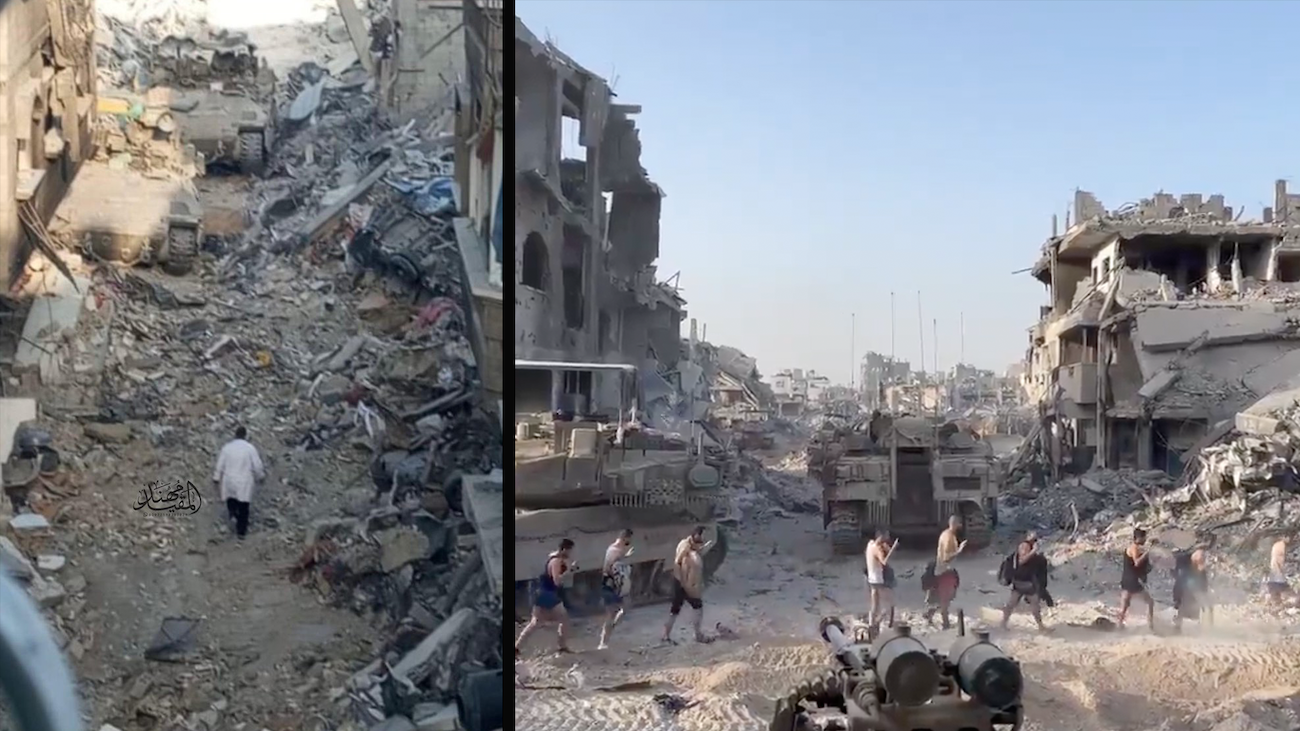
After over two months of imprisonment in Israeli jails, new information has been revealed about Dr. Hussam Abu Safiya, the director of Kamal Adwan hospital in Gaza. According to Palestinian lawyer Ghaid Qassem, who visited Dr. Abu Safiya last week, he has gone through long periods of sustained interrogation and torture and several prison transfers.
Dr. Abu Safiya was arrested amid a brutal siege of Kamal Adwan Hospital by Israeli forces, which culminated on December 27, when the Israeli Occupation Forces (IOF) set Kamal Adwan Hospital on fire. The IOF also ordered 350 people, including 75 patients and their escorts, along with 185 medical staff to evacuate the hospital.
In the months prior, Dr. Abu Safiya had been using his own social media page and giving interviews on local and western media in order to provide constant updates about Israel’s siege of the hospital and pleading for international institutions to take action to stop Israel’s attacks. He had become a visible spokesperson for the people of Gaza during the genocide and in particular, the healthcare workers who have faced disproportionate levels of violence as they struggled to keep the healthcare system online amid Israel’s blockade and targeted attacks.
While media reports had circulated indicating that Dr. Abu Safiya was set to be freed in the final stage of the first phase of the Hamas-Israel prisoners-for-captives swap deal at the end of February, Israel continues to imprison the hospital director, in defiance of the massive international campaign demanding his release.
Prior to meeting Qassem on Thursday, March 6, Abu Safiya was only allowed to see a lawyer once throughout over two months of detention. During his imprisonment, he spent a couple of weeks in solitary confinement inside Israel’s infamous Sde Teiman detention camp, which he described as a “slaughterhouse”.
While at Sde Teiman, Dr. Hussam reported being “forcibly stripped, having his hands shackled, and being made to sit on sharp gravel for approximately five hours by Israeli forces.”
Moreover, he was subjected “to severe physical abuse, including beatings with batons and electric shock sticks, as well as repeated blows to the chest.”
The Palestinian doctor was later transferred to Ofer prison in the occupied West Bank, where he was placed in solitary confinement for 25 days, then he was moved to section 24 with other detainees from Gaza.
Qassem clarified that section 24, alongside section 23, is designated for prisoners from Gaza to keep them isolated from other Palestinian prisoners from the West Bank and the territories that were occupied by Israel in 1948.
Based on Abu Safiya’s accounts, as well as other prisoners she met, Qassem described the conditions inside Sde Teiman, stating: “if we talk about this prison, it is a slaughterhouse in every sense of the word. The torture, violations, and starvation are unprecedented.”
The lawyer provided further details of atrocities practiced against Palestinian prisoners in the notorious detention facility, which included shackling prisoners for 10 months straight, denying amputees medical care, binding elderly detainees and blindfolding them.
In addition, prisoners narrated how they endure freezing temperatures in open-air cages, where they are constantly exposed to wind and rain, forced to sit on the ground, prevented from speaking, praying, or even reading the Quran.
In terms of psychological torture, Qassem was informed that the “Israeli intelligence often tells prisoners in Sde Teiman that their entire families have been killed, whether true or not”. “Such tactics leave deep psychological scars,” she said.
On February 12, the head of the IOF’s Southern Command, Yaron Finkelman, issued an order to detain Abu Safiya under the “unlawful combatant law” instead of conducting a standard legal trial,” according to the Palestinian Al-Mezan Center for Human Rights.
Qassem explained that Israeli authorities resorted to classifying Abu Safiya as an “unlawful combatant” as they could not build a case against him after failing to find any evidence against him following 45 days of interrogation.
With this classification, they stripped Abu Safiya of his basic legal rights, including representation or a formal indictment, and justified the repeated extension of his detention without charge.
The testimonies of the Palestinian lawyer revealed that Abu Safiya was subjected to prolonged interrogation sessions throughout 13 consecutive days, and that each interrogation session lasted about 8 to 10 hours. Abu Safiya also experienced torture and beating, in addition to verbal and psychological abuse.
Qassem referred to the forced media appearance of Abu Safiya in an interview aired by Israel’s Channel 13, late February as evidence of the psychological abuse Abu Safiya endured.
The attorney pointed out that Abu Safiya was not aware that the interview was recorded. “He was caught off guard by the filming. He was not informed, and after the interview, he was isolated, humiliated, beaten, and tortured,” she said.
For many, the Israeli occupation authorities aimed to demoralize Abu Safiya and his supporters over the globe by filming him exhausted and shackled. Nevertheless, Qassem confirmed the steadfastness that Abu Safiya demonstrated.
Unshaken by the gross inhumane treatment and torture he suffered, the resilient iconic Palestinian doctor told Qassem: “a person creates a history, and history is built upon the stands one takes. Such history is to be recorded and taught to others.”
Original article by Aseel Saleh republished from peoples dispatch under a Creative Commons Attribution-ShareAlike 4.0 (CC BY-SA) license.


Original article by Brett Wilkins republished from Common Dreams under Creative Commons (CC BY-NC-ND 3.0).
Human rights defenders in the global medical community and beyond are demanding Israel immediately release Dr. Hussam Abu Safiya, the director of Gaza’s obliterated Kamal Adwan Hospital, who was seized by Israeli troops on Saturday and is believed to be imprisoned at a notorious detention center where dozens of detainees have died and where torture, rape, and other abuses have been reported.
“We appeal to world leaders, to the global medical community, and to all who value humanity: Help us save our friend, our colleague, and a true healer,” Dr. Karameh Kuemmerle, a Boston-based pediatric neurologist and co-founder of Doctors Against Genocide, told Common Dreams on Monday.
“Put all kinds of pressure to ensure his release so he can return to his patients, who need him desperately, and to his family, who cannot endure this pain,” Kuemmerle added. “We demand a reality that respects life, respects human rights, and respects every man, woman, and child for humanity’s sake.”
Sorry, this content could not be embedded.
X
Doctors for Humanity—a coalition of groups including Global Health Coalition, Doctors Against Genocide, and Union of Medical Care and Relief Organizations—said in a statement Monday, “We the medical community demand the immediate release of Dr. Abu Safiya and an immediate end to the bombing of hospitals and targeted kidnapping and killing of healthcare workers in Gaza.”
“Bombing of hospitals and kidnapping, torturing and killing doctors and healthcare workers is illegal and immoral and a crime according to the Genocide Convention,” Doctors for Humanity added.
Dr. Zaher Sahloul, president and co-founder the Illinois-based NGO MedGlobal, for whom Safiya works as lead Gaza physician, said over the weekend that “Dr. Abu Safiya has dedicated his life to protecting the health and lives of children in Gaza, providing care under conditions no medical professional should have to endure.”
“His arrest is not only unjust—it is a violation of international humanitarian law, which upholds the protection of medical personnel in conflict zones,” the group added. “We urgently call for the immediate and unconditional release of Dr. Abu Safiya.”
Dr. Yipeng Ge—who in November 2023 was suspended from his medical residency at the University of Ottawa for social media posts critical of Israel’s “settler-colonialism” and “apartheid upon Palestinian people”—called for Abu Safiya’s “immediate release,” as well as “protection of hospitals and medical workers in Gaza” and “an end to the genocide” there.
Amnesty International secretary-general Agnès Callamard hailed Abu Safiya as “the voice of Gaza’s decimated health sector,” who pleaded “for the protection of his hospital” while “working under inhumane conditions, including following the killing of his son” by an Israeli drone strike at the hospital gates earlier this year.
“We at Amnesty are extremely concerned over the fate and well-being of Dr. Hussam Abu Safiya,” Callamard said. “He must be released immediately and unconditionally.”
Recently released former detainees at the Sde Teiman prison in Israel’s Negev Desert said Abu Safiya is being held there, and that the Israeli security forces working there—some of whom stand accused of gang-raping a prisoner—are treating captured Palestinian doctors “really badly.”
Idrees Abu Safiya, Abu Safiya’s son, toldThe Guardian on Monday that his father’s leg was badly injured during the Israeli raid on the hospital.
“We are so worried, we haven’t been able to sleep for three days because we didn’t know until today where he is,” Idrees told the British newspaper.
Relatives of Abu Safiya toldCNN that “Sde Teiman is known for brutality and torture, we can’t imagine what our father is going through in that place and if he is well or not, warm or cold… hungry or in pain.”
Kuemmerle told Common Dreams: “What is striking about Dr. Abu Safiya is his extraordinary composure, kindness, and unwavering dedication, even in the face of unimaginable hardships. We have come to know his bravery, dedication, humane professionalism, and gentle manners. We are terrified for his fate, knowing all too well as Palestinians the horrors that await our doctors in these torture camps.”
Israel claims that Abu Safiya—who, despite the killing of his son and an injury caused by shrapnel from a November 23 Israeli attack on Kamal Adwan, refused to stop working at the hospital—is a suspected Hamas terrorist. That’s a common allegation made by Israeli officials, who also often claim that hospitals are used as Hamas command-and-control centers. These officials usually offer very little if any evidence to support their assertions.
“The lies that are being spread right now that [Abu Safiya] is really a Hamas colonel are lies to prevent what is happening right now, which is a global wave of outrage, and that global wave of outrage must grow so we, the global medical community, can stop the relentless attacks on healthcare workers and healthcare infrastructure,” Dr. Rupa Marya, a University of California, San Francisco professor of medicine who’s currently on paid suspension after questioning whether an Israeli student and likely Israel Defense Forces (IDF) veteran may have committed war crimes, told Common Dreams.
According to the Gaza Health Ministry, hundreds of healthcare workers have been detained and more than 1,000 have been killed since the October 7, 2023 Hamas-led attack on Israel. Critics accuse Israel of deliberately killing and wounding health workers.
The Geneva-based Euro-Mediterranean Human Rights Monitor on Saturday published the testimonies of witnesses to alleged IDF war crimes during the Kamal Adwan raid, including “deliberate killings, field executions, as well as sexual and physical assaults on women and girls from medical teams and displaced women in the area.”
Responding to Israeli attacks on hospitals and Abu Safiya’s detention, Rohan Talbot, director of advocacy and campaigns at London-based Medical Aid for Palestinians, said on the Bluesky social media platform Saturday that “our leaders must demand the immediate and safe release of Dr. Hussam Abu Safiya and all detained Gaza health workers.”
“Health workers are not a target,” he added, “and impunity for Israel’s destruction of Palestinian healthcare must end.”
Original article by Brett Wilkins republished from Common Dreams under Creative Commons (CC BY-NC-ND 3.0).