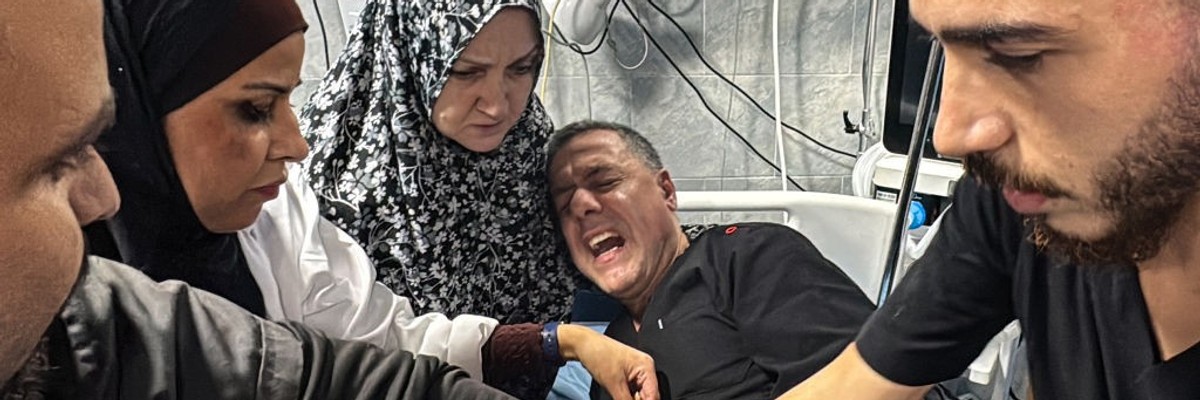
The director of Kamal Adwan Hospital was treated by colleagues for injuries caused by an Israeli strike on the medical compound in northern Gaza on November 23, 2024. (Photo: AFP via Getty Images)
The comments from emergency physician Mimi Syed came as the Israeli military forcibly evacuated Kamal Adwan Hospital, endangering patients and medical workers.
An American emergency and trauma physician currently working in Gaza warned Friday that the Israeli military’s evacuation order at a barely functioning hospital in the northern part of the enclave means “the end of humanity” there, as the dozens of patients receiving treatment at the besieged facility have nowhere safe to go and the healthcare system in the region has collapsed.
Mimi Syed, who is based in Olympia, Washington and is on her second stint in Gaza since Israel’s latest assault began last year, told Al Jazeera that she “can totally imagine deaths taking place as a result” of Israel’s evacuation order at Kamal Adwan Hospital, given that patients who are reliant on electrical appliances cannot easily be transported.
Syed’s comments came as the head of Gaza’s health ministry said he has lost contact with Kamal Adwan, one of several northern Gaza hospitals that Israeli forces have encircled and attacked in recent weeks.
Citing a nurse and a journalist inside Kamal Adwan, CNN reported Friday that everyone inside the facility has “been ordered to leave the hospital and go to the yard of the compound.”
“Earlier on Friday, a video shared by nurse Walid Al Budi, who is also inside the hospital, showed a fire burning in the archive department of the hospital,” the outlet added. “Heavy gunfire can be heard in the background.”
Video footage posted to social media by Quds News shows patients and medical personnel walking south following the evacuation order at Kamal Adwan:
Hussam Abu Safiya, the director of Kamal Adwan, wrote in a social media post early Friday that Israeli forces are “burning all the operating departments in the hospital while we are still here.”
“The army evacuated the entire medical staff and the displaced people and arrested a number of the medical staff,” he added. “There are a large number of injuries among the medical staff.”
In an interview released earlier this week, Syed issued an “urgent plea for help,” saying Israel’s assault on Gaza’s overwhelmed and underresourced hospitals and other civilian infrastructure “needs to stop.”
“I’m seeing civilian casualties on a regular basis,” said Syed. “Camps and tents are being struck with airstrikes routinely. We’re seeing children with traumatic amputations shrapnel injuries, open skull wounds with brain matter out.”
“We’re seeing so many children with kidney failure and gastritis that it’s leading to significant dehydration,” Syed added. “All of this is unnecessary.”
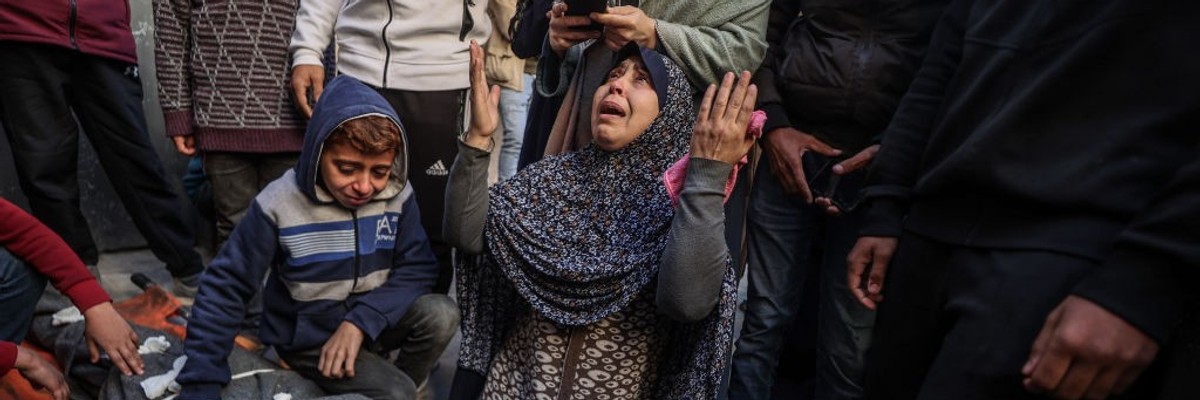
Relatives of Palestinians killed in an Israeli attack mourn after their bodies were brought to al-Awda Hospital in Gaza City, Gaza on December 23, 2024. (Photo: Ali Jadallah/Anadolu via Getty Images)
“It is unacceptable for the world to remain silent and unable to protect the healthcare system,” said Gaza’s Ministry of Health.
Israeli forces have encircled and attacked three barely functioning hospitals in northern Gaza with growing intensity over the past week, endangering the lives of patients receiving treatment inside the facilities—including premature babies—and medical workers.
Dr. Husam Abu Safiya, the director of Kamal Adwan Hospital, said in a video statement over the weekend that the Israeli military had surrounded the facility and that “bullets had penetrated the intensive care unit, the maternity department, and the specialized surgery department.”
“The nursery, maternity, and all departments of the hospital are being targeted by the occupation forces with all types of weapons, including sniper fire, tank shells, and quadcopters,” said Abu Safiya, who noted that the hospital was still treating more than 80 patients.
Al Jazeera reported late Monday that a video recorded by eyewitnesses “shows robots in the vicinity of the hospital leaving behind an explosive device.”
“We were told by the person who filmed that video that there were at least four other robots in the vicinity of the hospital,” the outlet added. “Another video shows everyone in one corridor of the hospital, in the middle of the building, away from the windows and balconies and the rooms that are looking over the streets where these explosive devices are planted.”
Israeli authorities have ordered the evacuation of Kamal Adwan as well as Indonesian Hospital and al-Awda Hospital, but medical personnel and patients inside the facilities fear for their lives as there’s nowhere safe to go.
Gaza’s Ministry of Health said in a Telegram post that Israel’s military has targeted Kamal Adwan in recent days with “explosives and tank fire.”
“We hold the world accountable for what is happening to us and demand that they take responsibility for our suffering,” the ministry said. “It is unacceptable for the world to remain silent and unable to protect the healthcare system. We are being attacked in plain sight, with the entire world watching, yet no one intervenes in the face of this barbarity.”
Since the Hamas-led October 7, 2023 attack, Israeli forces have waged what one United Nations expert described as an “unrelenting war” on Gaza’s already-strained healthcare system, invading and destroying hospitals and other medical infrastructure while choking off necessary supplies.
An Oxfam report published Monday found that just 12 trucks were able to distribute aid in northern Gaza over the past two and a half months due to Israel’s siege and incessant military attacks. Oxfam noted that between early October and mid-December, only 11 medical evacuation and assessment missions were approved for Kamal Adwan, and “one could not reach the hospital due to military activity and the rest all faced impediments along the way.”
“The situation in Gaza is apocalyptic and people are trapped, unable to find any kind of safety,” said Sally Abi-Khalil, Oxfam’s Middle East and North Africa director. “The absolute desperation of having no food or shelter for your family in the biting cold of winter. It is abhorrent that despite international law being so publicly violated by Israel and starvation being used relentlessly as a weapon of war, world leaders continue to do nothing.”
“Every day that passes without a cease-fire,” Abi-Khalil added, “is a death sentence for hundreds more civilians.”
Efforts to evacuate the three hospitals in northern Gaza have been hindered by ongoing Israeli military attacks as well as a lack of ambulances, according to the Palestinian Centre for Human Rights (PCHR). The group said it lost contact with Kamal Adwan Hospital early Sunday “following a harrowing night of relentless shelling, gunfire, and explosive robots targeting nearby buildings.”
“PCHR stresses the urgent need for immediate action to protect patients and medical personnel and to ensure the ongoing operation of the hospital in an area where thousands of residents and IDPs face bombardment, starvation, and deprivation of healthcare and humanitarian services,” the organization said in a statement.
The group added that “Israel’s ongoing military assault and atrocities and its disregard for calls to end the genocide in Gaza are emboldened by the perpetual impunity granted by the U.S. and some Western allies, alongside these nations’ complicity in the serious violations committed against the Palestinian people through continuously arming Israel with weapons, ammunition, and political support.”
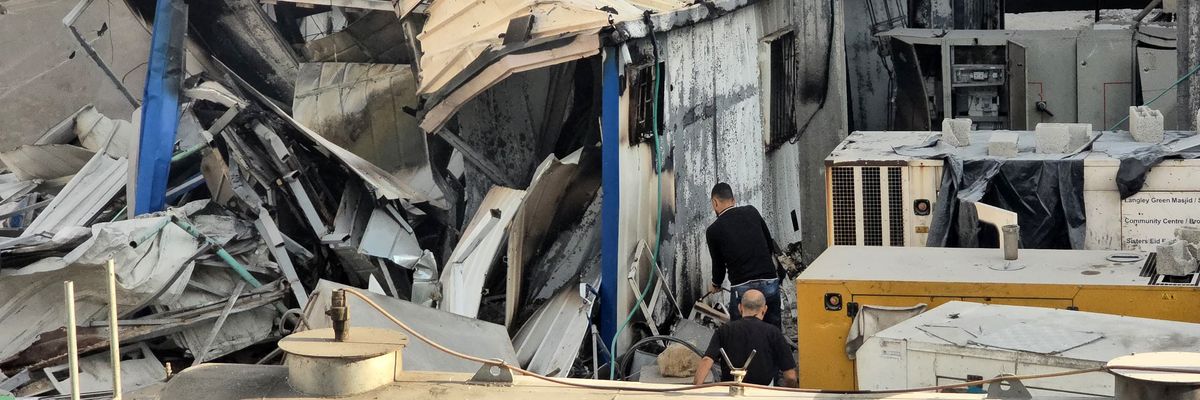
People check the damage outside the Kamal Adwan hospital in Beit Lahia in the northern Gaza Strip, following Israeli strikes around the medical complex on December 6, 2024, as the war between Israel and the Palestinian Hamas militant group continues. (Photo: -/AFP via Getty Images)
“If Kamal Adwan Hospital is decommissioned, there will be no way of preserving conditions of life to the remaining 75,000+ civilians in north Gaza,” the hospital’s director said.
The Israel Defense Forces on Saturday ordered one of the last partly operating hospitals in northern Gaza to shutter and evacuate, even as hospital staff say there are not enough ambulances to do so safely and persistent firing on the facility makes people afraid to leave.
Israel launched bomb, artillery, and sniper attacks on the Kamal Adwan Hospital in Beit Lahia beginning Saturday, as the Wafa news agency reported. The attacks killed three people in the area and wounded several, according to Wafu. On Sunday, an Israeli drone strike on the hospital’s fuel tanks and power generator shut off its electricity, the AnadoluAgencyreported.
“We currently have nearly 400 civilians inside the hospital, including babies in the neonatal unit, whose lives depend on oxygen and incubators,” hospital director Dr. Husam Abu Safiya said in a statement on Sunday. “We cannot evacuate these patients safely without assistance, equipment, and time.”
“Every bomb that slams into Kamal Adwan Hospital, every nurse forced to watch a child slip away, every life lost from denied treatment indicts us all.”
Abu Safiya described the onset of what he called an “unprecedented” attack in a message Saturday evening local time:
The Israeli military has targeted the Kamal Adwan Hospital with different types of weapons without prior warning. We are being directly attacked, the ICU unit, along with the maternity and nursing departments, are coming under fire.
The bombing is being conducted with tank fire and quadcopters, directly targeting us while we are present inside the hospital departments. We don’t know why we are being targeted at this hour.
Several people were wounded in attacks on the hospital’s laboratory and mechanical department,according to Al Jazeera.
“What we are seeing now is a deliberate attack on the health facility,” Al Jazeera’s Hani Mahmoud reported from Deir el-Balah. “The Israeli military has ordered evacuations from the hospital, but they have also created an intimidating environment that makes people feel it’s unsafe to leave.”
Mahmoud said he lost contact with the hospital Saturday night.
Footage shared on social media and verified by Al Jazeera also showed patients sheltering in hallways to avoid the Israeli attack.
Responding to reports from the hospital on Saturday, World Health Organization (WHO) director Tedros Adhanom Ghebreyesus called for a cease-fire around the hospital and for the protection of patients and staff.
“Tonight’s reports of bombardment near Kamal Adwan Hospital and order to evacuate the hospital are deeply worrisome,” Ghebreyseus wrote on social media. “The hospital has been in the midst of fighting for too long, and the lives of patients are at risk.”
Also on Saturday, the Palestine Mental Health Networks and Doctors Against Genocide issued a statement in support of Abu Safiya and Kamal Adwan, demanding that the international community act to open a humanitarian corridor in Gaza, protect healthcare facilities and staff, and end the blockade on the besieged enclave.
Arguing that the “relentless assaults on Kamal Adwan Hospital—a sanctuary meant to save lives in northern Gaza—are part of a deliberate genocidal campaign,” they wrote:
Humanity cannot pretend not to see. Neutrality in the face of genocide is complicity. Every bomb that slams into Kamal Adwan Hospital, every nurse forced to watch a child slip away, every life lost from denied treatment indicts us all.
The world is watching. Will it once again stand idly by as another hospital crumbles, another child’s breath is silenced, another fragile hope is extinguished? Or will it finally rise to restore the sanctity of life and the universal right to health?
In a video message shared by Drop Site News early Sunday morning Gaza time, Abu Safiya said that he had been ordered to evacuate patients to the Indonesian Hospital, but that this would be “impossible” since the hospital needs ambulances to transport the wounded and would need to move supplies as well. He said a successful evacuation would take days.
In a second message on Sunday, he linked the IDF’s attacks on Kamal Adwan to similar attacks on hospitals throughout Gaza. In October, a report from the United Nation’s Independent International Commission of Inquiry on the Occupied Palestinian Territory concluded that “Israel has perpetrated a concerted policy to destroy Gaza’s healthcare system,” carrying out nearly 500 attacks on healthcare facilities between October 7, 2023 and July 30, 2024.
Abu Safiya said that the IDF did not provide hospitals with the support they needed when it ordered evacuations, such as equipment and safe passage:
We call on the world to witness this pattern once again. We have repeatedly requested assistance and have openly invited the occupation to see for themselves the internal workings of our hospitals so that we may continue to serve our population without fear of attack and death. These calls were rejected.
We also call on the world to witness, that if Kamal Adwan Hospital is decommissioned, there will be no way of preserving conditions of life to the remaining 75,000+ civilians in north Gaza.
We call on the world to witness these crimes of extermination and act now.
Abu Safiya also said the IDF was targeting the hospital’s fuel tanks, which would explode if hit, causing “mass casualties.”
Gaza’s Government Media Office urged the WHO to visit the hospital on Sunday, saying the attack was part of a concerted attempt to destroy Gaza’s healthcare system.
“These attacks are ongoing and have not stopped for nearly 80 days since the ground aggression on the northern Gaza Strip Governorate began, which has claimed the lives of thousands of martyrs, left many missing, wounded, or detained,” the statement said.
In response to the reports from the hospital, the IDF told The Washington Post that it had not targeted Kamal Adwan on Saturday to its knowledge. It also said separately that it was operating in Beit Lahia. Israel has intensified military operations in northern Gaza over the past three months, according to Reuters. The IDF further told Reuters on Friday that it had helped to evacuate more than 100 patients from Kamal Adwan and provided fuel and food to the hospital. It did not respond to a request for comment about Saturday’s attacks.
Also on Sunday, the Gaza Health Ministry reported that Israeli attacks had killed 32 people and wounded 54 in the last 24 hours. At least eight people, including children, were killed in a strike on a school-turned-shelter in Gaza City.
“We came out to see the scale of destruction, with dead bodies, blood, and body parts all over the place. Israeli warplanes fired three missiles on this school. The explosion was huge and frightening to us and to our children,” witness Um Aref Ahel, who has been displaced by the war, told Al Jazeera. “We appeal to the whole world to bring this war to an end.”
The official Gaza Health Ministry death toll from Israel’s war on Gaza, which began October 7, 2023 in response to a deadly Hamas attack on Southern Israel, stands at over 45,000, though many remain unaccounted for beneath the rubble. This month, both Amnesty International and Human Rights Watch issued reports labelling Israel’s assault a genocide.
In the immediate wake of the Syrian government’s abrupt collapse, much remains uncertain about the country’s future – including whether it can survive as a unitary state or will splinter into smaller states as did Yugoslavia in the early 1990s, a move that ultimately led to a bloody NATO intervention. Moreover, who or what may take power in Damascus remains an open question. For the time being at least, members of ultra-extremist Hayat Tahrir al-Sham (HTS) appear highly likely to take key positions in whatever administrative structure sprouts from Bashar Assad’s ouster after a decade-and-a-half of grinding Western-sponsored regime change efforts.
As Reuters reported on December 12, HTS is already “stamping its authority on Syria’s state with the same lightning speed that it seized the country, deploying police, installing an interim government and meeting foreign envoys.” Meanwhile, its bureaucrats – “who until last week were running an Islamist administration in a remote corner of Syria’s northwest” – have moved en masse “into government headquarters in Damascus.” Mohammed Bashir, head of HTS’ “regional government” in extremist-occupied Idlib, has been appointed the country’s “caretaker prime minister.”
However, despite the chaos and precariousness of post-Assad Syria, one thing seems assured – the country will be broken open to Western economic exploitation, at long last.
Multiple reports show that HTS has informed local and international business leaders that when in office, it will “adopt a free-market model and integrate the country into the global economy, in a major shift from decades of corrupt state control.”
As Alexander McKay of the Marx Engels Lenin Institute tells MintPress News, state-controlled parts of Syria’s economy may have been under Assad, but corrupt it wasn’t. He believes a striking feature of the ongoing attacks on Syrian infrastructure from forces within and without the country is that economic and industrial sites are a recurrent target. Moreover, the would-be HTS-dominated government has done nothing to counter these broadsides when “securing key economic assets will be vital to societal reconstruction, and therefore a matter of priority”:
We can see clearly what kind of country these ‘moderate rebels’ plan to build. Forces like HTS are allied with U.S. imperialism, and their economic approach will reflect this. Prior to the proxy war, the government pursued an economic approach that mixed public ownership and market elements. State intervention enabled a degree of political independence [that] other nations in the region lack. Assad’s administration understood without an industrial base, being sovereign is impossible. The new ‘free market’ approach will see all of that utterly decimated.”
‘Reconstruction Project’
Syria’s economic independence and strength under Assad’s rule and the benefits reaped by average citizens, as a result, were never acknowledged in the mainstream before or during the decade-long proxy war. Yet, countless reports from major international institutions underline this reality – which has now been brutally vanquished, never to return. For example, an April 2015 World Health Organization document noted how Damascus “had one of the best-developed healthcare systems in the Arab world.”
Per a 2018 U.N. investigation, “universal, free healthcare” was extended to all Syrian citizens, who “enjoyed some of the highest levels of care in the region.” Education was likewise free, and before the conflict, “an estimated 97% of primary school-aged Syrian children were attending class, and Syria’s literacy rates were thought to be at over 90% for both men and women [emphasis added].” By 2016, millions were out of school.
A U.N. Human Rights Council report two years later noted pre-war Syria “was the only country in the Middle East region to be self-sufficient in food production,” its “thriving agricultural sector” contributing “about 21%” to GDP 2006 – 2011. Civilians’ daily caloric intake “was on par with many Western countries,” with prices kept affordable via state subsidy. Meanwhile, the country’s economy was “one of the best performing in the region, with a growth rate averaging 4.6%” annually.
At the time that report was written, Damascus had been reduced to heavy reliance on imports by Western sanctions in many sectors and, even then, was barely able to buy or sell much in the way of anything, as the measures amounted to an effective embargo. Simultaneously, the U.S. military occupation of a resource-rich third of Syria cut off the government’s access to its own oil reserves and wheat. The situation would only worsen with the Caesar Syria Civilian Protection Act’s passing in June 2020.
Under its auspices, a vast volume of goods and services in every conceivable field were and today remain banned from being sold to or traded with any Syrian citizen or entity. The legislation’s terms explicitly state preventing attempts to rebuild Syria was its chief objective. One passage openly outlines “a strategy to deter foreign persons from entering into contracts related to reconstruction.”
Immediately after coming into effect, the Syrian pound’s value collapsed further, sending living costs skyrocketing. In a blink, almost the entire country’s population was left barely able to afford even the bare essentials. Even mainstream sources typically approving of belligerence towards Damascus cautioned of an inevitably impending humanitarian crisis. However, Washington was neither concerned nor deterred by such warnings. James Jeffrey, State Department chief of Syria policy, actively cheered these developments.
Simultaneously, as Jeffrey subsequently admitted to PBS, the U.S. was engaged in frequent, secret communication with HTS and actively assisting the group – albeit “indirectly” due to the faction’s designation as a terrorist entity by the State Department. This followed direct approaches to Washington by its leaders, including Abu Mohammed Jolani, former leader of Al Qaeda affiliate al-Nusra. “We want to be your friend. We’re not terrorists. We’re just fighting Assad,” HTS reportedly said.
Given this contact, it may be no coincidence that in July 2022, Jolani issued a series of communications about HTS’ plans for future Syria, containing multiple passages in which finance and industry loomed large. Directly foreshadowing the group’s recent pledge to “adopt a free-market model,” the extremist mass murderer discussed his desire to “open up local markets to the global economy.” Many passages read as if they were authored by representatives of the International Monetary Fund.
Coincidentally, Syria, since 1984, has refused IMF loans, a key tool by which the U.S. Empire maintains the global capitalist system and dominates the Global South, ensuring ‘poor’ countries remain under its heel. The World Trade Organization, of which Damascus isn’t a member either, plays a similar role. Accession to both would go some way to cementing the “free-market model” advocated by HTS. After over a decade of deliberate, systematic economic ruin, geopolitical risk analyst Firas Modad tells MintPress News:
They have no choice. They need Turkish and Qatari backing, so [they] will need to liberalize. They have no capital whatsoever. The country is in ruins and they desperately need investment. Plus, they hope liberalizing may attract some Saudi, Emirati or Egyptian interest. It’s impossible for Syria to rebuild using its own resources. The civil war might resume. They are acting out of necessity.”
‘Shock Therapy’
In Syria’s protracted political and economic dismantling, there are eerie echoes of the U.S. Empire’s destruction of Yugoslavia throughout the 1990s. During that decade, the multiethnic socialist federation’s breakup produced bitter wars of independence in Bosnia, Croatia and Slovenia – encouraged, financed, armed, and prolonged every step by Western powers. Belgrade’s perceived centrality to these brutal conflicts and purported complicity in and sponsorship of horrendous war crimes led the U.N. Security Council to impose sanctions against what remained of the country in May 1992.
The measures were the harshest ever levied in U.N. history. At one point, producing inflation of 5.578 quintillion percent, drug abuse, alcoholism, preventable deaths and suicides skyrocketed, while shortages of goods – including water – were perpetual. Yugoslavia’s once thriving independent industry was crippled, its ability to manufacture even everyday medicines virtually non-existent. By February 1993, the CIA assessed that the average citizen had “become accustomed to periodical shortages, long lines in stores, cold homes in the winter and restrictions on electricity.”
Surveying the wreckage years later, Foreign Affairs noted that sanctions against Yugoslavia demonstrated how “in a matter of months or years whole economies can be devastated,” and such measures can serve as uniquely lethal “weapons of mass destruction” against civilian populations of target countries. Yet, despite such desolation and misery, throughout this period, Belgrade remained resistant to privatization and foreign ownership of its industry or to the pillaging of its vast resources. The overwhelming majority of Yugoslavia’s economy was state- or worker-owned.
Yugoslavia was not a member of the IMF, World Bank, or WTO, which went some way to insulate the country from economic predation. In 1998, though, authorities began waging a heavy-handed counterinsurgency against the Kosovo Liberation Army, a CIA and MI6-funded and armed al-Qaeda-linked extremist militia. This provided the U.S. Empire with a pretext to, at last, finish the job of neutralizing what remained of the country’s socialist system. As a Clinton administration official later admitted:
It was Yugoslavia’s resistance to the broader trends of political and economic reform [in Eastern Europe] – not the plight of Kosovar Albanians – that best explains NATO’s war.”
From March – June 1999, the military alliance bombed Yugoslavia for 78 straight days. Yet, Belgrade’s army was barely in the firing line at any stage. In all, officially, just 14 Yugoslav tanks were destroyed by NATO, but 372 separate industrial facilities got smashed to smithereens, leaving hundreds of thousands jobless. Markedly, the alliance took guidance from U.S. corporations on which sites to target, and not a single foreign- or privately-owned factory was hit.
NATO’s bombing laid the foundations for Yugoslav leader Slobodan Milosevic’s removal via a C.I.A.- and National Endowment for Democracy-sponsored color revolution in October of the following year. In his place, a doggedly pro-Western government advised by a collective of U.S.-sponsored economists took power. Their explicit mission was to “make an economic environment favorable for private and other investments” in Belgrade. Ravaging “shock therapy” measures were deployed the moment they assumed office, to the further detriment of an already immiserated and impoverished population.
In the decades since successive Western-backed governments across the former Yugoslavia have enforced an endless array of neoliberal “reforms” to ensure an “investor-friendly” environment locally for wealthy Western oligarchs and corporations. In lockstep, low wages and a lack of employment opportunities stubbornly endure or worsen while living costs rise, producing mass depopulation, among other destructive effects. All along, U.S. officials intimately implicated in the country’s breakup have brazenly sought to enrich themselves from the privatization of former state industries.
‘Internal Repression’
Does such a fate await Damascus? For Pawel Wargan, founder of the Green New Deal for Europe, the answer is a resounding “yes.” He believes the country’s story is familiar “to those who study the mechanisms of imperialist expansion.” Once its defenses are fully neutralized, he foresees the country’s industries being “bought-up at bargain sale prices as part of market ‘reforms,’ which transfer yet another chunk of humanity’s wealth to Western corporations”:
We’ve witnessed the well-rehearsed choreography of imperialist regime change: a ‘tyrant’ is overthrown; backers of national sovereignty are systematically and viciously repressed; with tremendous, but hidden, violence, the country’s assets are chopped and diced and sold to the lowest bidder; labor protections are discarded; human lives are cut short. The most predatory forms of capitalism take root in every crevice and pore that emerges in the collapse of the state. This is the agenda of structural adjustment policies enforced by the World Bank and IMF.”
Alexander McKay echoes Wargan’s analysis. Now “free,” Syria will be forcedly made “dependent upon imports from the West” evermore. This not only fattens the Empire’s bottom line but “also severely restricts the freedom of any Syrian government to act with any degree of independence.” He notes similar efforts have been undertaken throughout the post-1989 era of U.S. unipolarity. It was well underway in Russia during the 1990s “until the slow turn around in policy started in the early 2000s under Putin”:
The aim is to reduce Syria to the same status as Lebanon, with an economy controlled by imperial forces, an army used primarily for internal repression, and an economy no longer able to produce anything but merely serve as a market for commodities produced elsewhere, and site of resource extraction. The U.S. and its allies do not want independent development of any nation’s economy. We must hope the Syrian people can resist this latest act of neo-colonialism.”
Kit Klarenberg is an investigative journalist and MintPress News contributor exploring the role of intelligence services in shaping politics and perceptions. His work has previously appeared in The Cradle, Declassified UK, and Grayzone. Follow him on Twitter @KitKlarenberg.
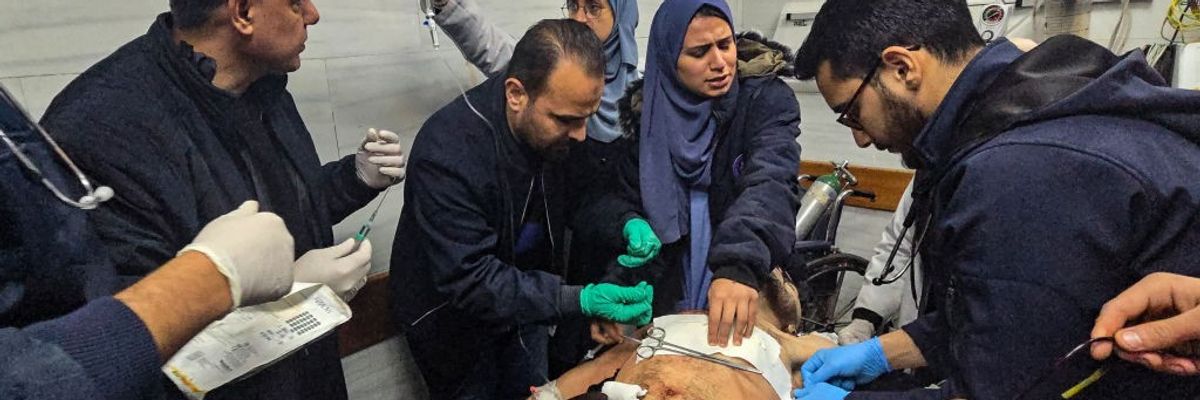
A victim of an Israeli attack receives treatment inside Kamal Adwan Hospital in northern Gaza on December 6, 2024. (Photo: AFP via Getty Images)
“We have called on the world to protect both the healthcare system and its workers, yet we have not received any response from anyone globally,” said the director of Kamal Adwan Hospital.
The director of one of the few partially functioning hospitals in northern Gaza said Sunday that Israeli attacks have put the facility’s remaining patients—including more than a dozen children—in grave danger and pleaded with the international community to intervene.
“Following the recent attack on Kamal Adwan Hospital, which involved over 100 shells and bombs indiscriminately targeting the facility, the damage has been severe,” Dr. Hussam Abu Safiya, the hospital’s director, said in a statement. “As of now, one of the hospital buildings remains without electricity, oxygen, or water. The shelling continues to occur randomly in the vicinity, preventing us from conducting repairs on the oxygen, electricity, and water networks.”
Abu Safiya said the overwhelmed and under-resourced hospital is currently treating 112 wounded patients, including six people in intensive care and 14 children.
“This is a critical situation,” he said Sunday morning. “The bombardment and gunfire have not ceased; planes are dropping bombs around the clock. We are uncertain of what lies ahead and what the army wants from the hospital.”
“We have called on the world to protect both the healthcare system and its workers, yet we have not received any response from anyone globally,” Abu Safiya added. “This represents a humanitarian catastrophe unfolding against the healthcare workers and patients. Unfortunately, there seems to be no effort to halt this relentless assault on Kamal Adwan Hospital and the broader health system.”
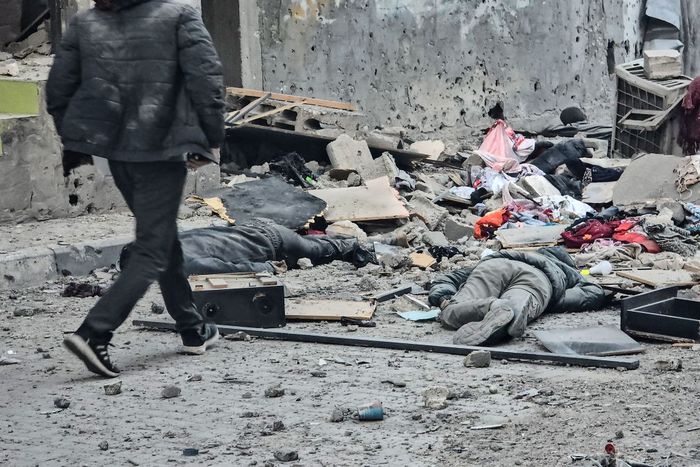
The hospital director’s statement came after Israeli attacks near the facility killed scores of people on Friday. Photos taken from the scene showed bodies on the ground amid building ruins.
(Photo: AFP via Getty Images)
A day earlier, an Israeli airstrike on the Kamal Adwan Hospital compound killed a 16-year-old boy in a wheelchair and wounded a dozen others, The Associated Press reported.
According to Drop Site, the boy “was struck as he entered the X-ray department.”
Northern Gaza has been under intense Israeli assault for two months, and the humanitarian situation there and across the Palestinian enclave is worse than ever, according to U.N. agencies and aid organizations.
“The catastrophe in Gaza is nothing short of a complete breakdown of our common humanity,” said U.N. Secretary-General António Guterres. “The nightmare must stop. We cannot continue to look away.”
Abu Safiya said Sunday that his hospital is facing outages of electricity and water amid Israel’s incessant attacks.
“We urgently appeal to the international community for assistance,” he said. “The situation is extremely dangerous.”