A destroyed mechanic’s shop in downtown Swannanoa, North Carolina, US, December 2024, nearly three months after Hurricane Helene in late September. Photograph: Mike Belleme/The Guardian
Floods, heatwaves and supercharged hurricanes occurred in hottest climate human society has ever experienced
…
The world is already deep into the climate crisis, with the WMO report saying that for the first time, the 10 hottest years on record all occurred in the last decade. However, global carbon emissions have continued to rise, which will bring even worse impacts. Experts were particularly critical of the purge of climate scientists and programmes by the US president, Donald Trump, saying that ignoring reality left ordinary people paying the price.
“Leaders must step up – seizing the benefits of cheap, clean renewables for their people and economies – with new national climate plans due this year,” said the UN secretary general, António Guterres.
Dr Luke Parsons, of the Nature Conservancy, said: “Every year, we venture further into uncharted territory, with 2024 the hottest year modern human society has ever experienced. Yet the coming decade is expected to be even hotter, pushing us deeper into this unprecedented climate.”
Previous research determining the role of the climate crisis in what are now unnatural disasters has shown that at least 550 heatwaves, floods, storms, droughts and wildfires had been made significantly more severe or more frequent by global heating.
Neo-Fascist Climate Science Denier Donald Trump says Burn, Baby, Burn.Elon Musk urges you to be a Fascist like him, says that you can ignore facts and reality then.Orcas comment on killer apes destroying the planet by continuing to burn fossil fuels.
Nearly half of countries endured at least two months of high-risk temperatures, data shows. Photograph: Fernando Bustamante/AP
Analysis shows fossil fuels are supercharging heatwaves, leaving millions prone to deadly temperatures
The climate crisis caused an additional six weeks of dangerously hot days in 2024 for the average person, supercharging the fatal impact of heatwaves around the world.
The effects of human-caused global heating were far worse for some people, an analysis by World Weather Attribution (WWA) and Climate Central has shown. Those in Caribbean and Pacific island states were the hardest hit. Many endured about 150 more days of dangerous heat than they would have done without global heating, almost half the year.
Nearly half the world’s countries endured at least two months of high-risk temperatures. Even in the least affected places, such as the UK, US and Australia, the carbon pollution from fossil fuel burning has led to an extra three weeks of elevated temperatures.
Worsened heatwaves are the deadliest consequence of the climate emergency. An end to coal, oil and gas burning was vital to stopping the effects getting even worse, the scientists said, with 2024 forecast to be the hottest year on record with record-high carbon emissions.
The researchers called for deaths from heatwaves to be reported in real time, with current data being a “very gross underestimate” because of the lack of monitoring. It is possible that uncounted millions of people have died as a result of human-caused global heating in recent decades.
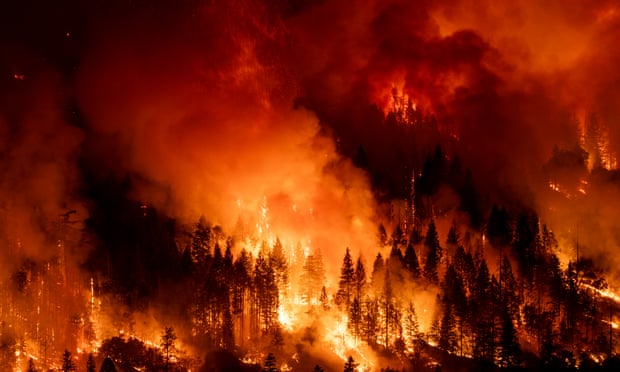
A wildfire in California this year. Fires driven by severe droughts have affected the western US, Canada, the Amazon forest and particularly the Pantanal wetlands. Photograph: David McNew/Getty Images
Average global temperature in November was 1.62C above preindustrial levels, bringing average for the year to 1.60C
This year is now almost certain to be the hottest year on record, data shows. It will also be the first to have an average temperature of more than 1.5C above preindustrial levels, marking a further escalation of the climate crisis.
Data for November from the EU’s Copernicus Climate Change Service (C3S) found the average global surface temperature for the month was 1.62C above the level before the mass burning of fossil fuels drove up global heating. With data for 11 months of 2024 now available, scientists said the average for the year is expected to be 1.60C, exceeding the record set in 2023 of 1.48C.
…
Fossil fuel emissions must fall by 45% by 2030 to have a chance of limiting heating to 1.5C. The recent Cop29 climate summit failed to reach an agreement on how to push ahead on the transition away from coal, oil and gas. The C3S data showed that November 2024 was the 16th month in a 17-month period for which the average temperature exceeded 1.5C.
The supercharging of extreme weather by the climate crisis is already clear, with heatwaves of previously impossible intensity and frequency now striking around the world, along with fiercer storms and worse floods.
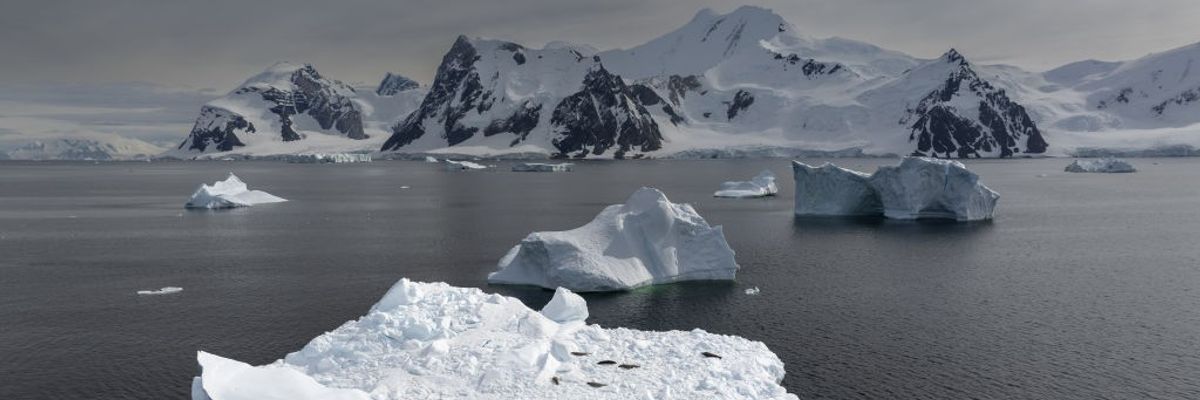
Seals rest on an ice mass in Antarctica in April 2024. (Photo: Sebnem Coskun/Anadolu via Getty Images)
The long-lasting heatwave is an “eye-opening sign that climate change is starting to really transform the planet,” a climate scientist said.
Antarctica is experiencing its second extreme heatwave in the last three years, with temperatures more than 50°F higher than normal, The Washington Post reported Wednesday.
The heatwave is notable not just for its intensity but also its timing and duration: It’s hit during Antartica’s winter and is expected to last. Temperatures of 36°F to 50°F above average are expected to persist up to 10 days, and July temperatures were already well above average before it began. The spiking temperatures were also spread across a large area, covering much of the continent, scientists said.
The world has faced exceptionally high temperatures in the last year, with 13 straight monthly heat records and counting, and the poles are warming at roughly twice the rate of the global average. Scientists say the changing conditions around Antarctica have increased the likelihood of higher winter temperatures on the continent.
“It is likely that having less sea ice and a warmer Southern Ocean around the Antarctic continent ‘loads the dice’ for warmer winter weather over Antarctica,” Edward Blanchard, an atmospheric scientist at the University of Washington, told the Post.
Scientists warned that this heatwave was a sign of what’s to come as the planet heats up thanks primarily to fossil fuel emissions.
“This historic warm spell in East Antarctica is an ominous example of the temperature spikes this polar climate could experience more of in a warming world,” the Post reported.
Jonathan Overpeck, a climate scientist at the University of Michigan, said on social media that the heatwave is an “eye-opening sign that climate change is starting to really transform the planet.”
In March 2022, Antarctica experienced the most intense heatwave in the planet’s recorded history, with temperatures up to 72°F above normal. On-site scientists at the time wore shorts and removed their shirts to bask in the sun. The heatwave was the subject of intense scientific research in the two years that followed, with a 54-person team trying to decipher the causes, which they described as “head-hurting” in their complexity.
The 2022 heatwave contributed to reduced sea ice levels. Antarctica experienced the lowest summer and winter levels of sea ice ever recorded last year.
High temperatures in Antarctica are relative—this week’s heatwave still had temperatures hovering at about minus-4°F. But sustained periods at such temperatures are highly unusual.
“The heatwave on the Antarctic Plateau is extraordinary more for its duration than for its intensity, although some values are notable,” Stefano Di Battista, an expert on Antarctic temperatures, told the Post.
The heatwave is likely the result of changes in the stratosphere roughly 20 miles above ground, scientists said. At the South Pole, the stratosphere contains a polar vortex that is normally stable with cold temperatures and low pressure during the Antarctic winter, but a sudden stratospheric warming event occurred due to atmospheric wave activity, Amy Butler, an atmospheric scientist at the National Oceanic and Atmospheric Administration, told the Post.
Extreme weather is by definition rare on our planet. Ferocious storms, searing heatwaves and biting cold snaps illustrate what the climate is capable of at its worst. However, since Earth’s climate is rapidly warming, predominantly due to fossil fuel burning, the range of possible weather conditions, including extremes, is changing.
Scientists define “climate” as the distribution of possible weather events observed over a length of time, such as the range of temperatures, rainfall totals or hours of sunshine. From this they construct statistical measures, such as the average (or normal) temperature. Weather varies on several timescales – from seconds to decades – so the longer the period over which the climate is analysed, the more accurately these analyses capture the infinite range of possible configurations of the atmosphere.
Typically, meteorologists and climate scientists use a 30-year period to represent the climate, which is updated every ten years. The most recent climate period is 1991-2020. The difference between each successive 30-year climate period serves as a very literal record of climate change.
This way of thinking about the climate falls short when the climate itself is rapidly changing. Global average temperatures have increased at around 0.2°C per decade over the past 30 years, meaning that the global climate of 1991 was around 0.6°C cooler than that in 2020 (when accounting for other year-to-year fluctuations), and even more so than the present day.
A moving target for climate modellers
If the climate is a range of possible weather events, then this rapid change has two implications. First, it means that part of the distribution of weather events comprising a 30-year climate period occurred in a very different background global climate: for example, northerly winds in the 1990s were much colder than those in the 2020s in north-west Europe, thanks to the Arctic warming nearly four times faster than the global average. Statistics from three decades ago no longer represent what is possible in the present day.
Second, the rapidly changing climate means we have not necessarily experienced the extremes that modern-day atmospheric and oceanic warmth can produce. In a stable climate, scientists would have multiple decades for the atmosphere to get into its various configurations and drive extreme events, such as heatwaves, floods or droughts. We could then use these observations to build up an understanding of what the climate is capable of. But in our rapidly changing climate, we effectively have only a few years – not enough to experience everything the climate has to offer.
Extreme weather events require what meteorologists might call a “perfect storm”. For example, extreme heat in the UK typically requires the northward movement of an air mass from Africa combined with clear skies, dry soils and a stable atmosphere to prevent thunderstorms forming which tend to dissipate heat.
Such “perfect” conditions are intrinsically unlikely, and many years can pass without them occurring – all while the climate continues to change in the background. Based on an understanding of observations alone, this can leave us woefully underprepared for what the climate can now do, should the right weather conditions all come together at once.
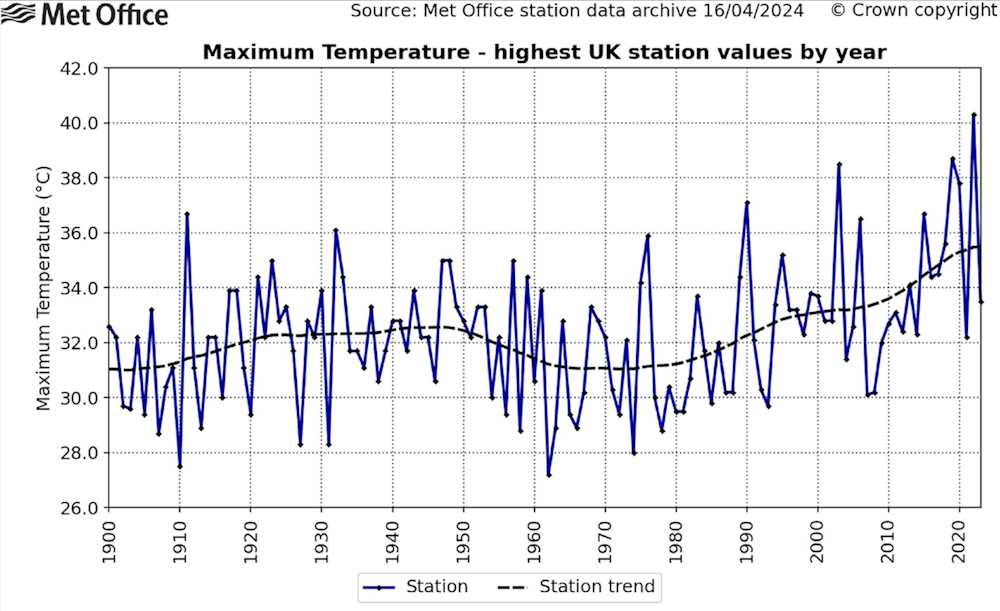
Startling recent examples include the extreme heatwave in the Pacific north-west of North America in 2021, in which temperatures exceeded the previous Canadian record maximum by 4.6°C. Another is the occurrence of 40°C in the UK in summer 2022, which exceeded the previous UK record maximum set only three years earlier by 1.6°C. This is part of the reason why the true impact of a fixed amount of global warming is only evident after several decades, but of course – since the climate is changing rapidly – we cannot use this method anymore.
Playing with fire
To better understand these extremes, scientists can use ensembles: many runs of the same weather or climate model that each slightly differ to show a range of plausible outcomes. Ensembles are routinely used in weather prediction, but can also be used to assess extreme events which could happen even if they do not actually happen at the time.
When 40°C first appeared in ensemble forecasts for the UK before the July 2022 heatwave, it revealed the kind of extreme weather that is possible in the current climate. Even if it had not come to fruition, its mere appearance in the models showed that the previously unthinkable was now possible. In the event, several naturally occurring atmospheric factors combined with background climate warming to generate the record-shattering heat on July 19 that year.
The highest observed temperature each year in the UK, from 1900 to 2023
Later in summer 2022, after the first occurrence of 40°C, some ensemble weather forecasts for the UK showed a situation in which 40°C could be reached on multiple consecutive days. This would have posed an unprecedented threat to public health and infrastructure in the UK. Unlike the previous month, this event did not come to pass, and was quickly forgotten – but it shouldn’t have been.
It is not certain whether these model simulations correctly represent the processes involved in producing extreme heat. Even so, we must heed the warning signs.
Despite a record-warm planet, summer 2024 in the UK has been relatively cool so far. The past two years have seen global temperatures far above anything previously observed, and so potential extremes have probably shifted even further from what we have so far experienced.
Just as was the case in August 2022, we’ve got away with it for now – but we might not be so lucky next time.