The taxman has the numbers needed to estimate how much cash is lost to overseas havens – but it isn’t sharing the details
An MP has demanded HMRC release its official estimate of how much tax is being lost to offshore havens – information we discovered is currently being withheld by the authority.
A Freedom of Information request by TaxWatch, shared with TBIJ, revealed that in apparent contrast to its previous claims, HMRC holds data needed to estimate the offshore tax gap. But it would not hand the information over.
“We urgently need HMRC to clarify the situation – otherwise we will never crack down on tax dodging,” said Lloyd Hatton MP, who sits on the Public Accounts Committee.
The offshore tax gap is the difference between the amount of tax the UK should collect from offshore sources, and what it actually receives. It puts a number on the cost to the public when people and companies move their money offshore to avoid, evade or fail to declare tax.
HMRC has previously claimed that it holds no estimate for the overall offshore tax gap. But in response to a recent FOI request, the tax authority revealed that it does in fact hold a figure for “offshore tax at risk”.
This number is the amount of tax HMRC thinks could be lost because of avoidance, evasion and non-compliance. HMRC has said itself that this could be used to work out the offshore tax gap. All HMRC would need to do is subtract from it another number called the “compliance yield” – the amount HMRC did manage to claw back through enforcement activities.
HMRC has even published its figures on the compliance yield for offshore-related tax, meaning it already has data needed to calculate the offshore tax gap figure.
But in response to our FOI request, HMRC refused to disclose the “tax at risk” figure on the basis it could “prejudice the effective conduct of public affairs”.
The correspondence calls into question direct statements made earlier this year by the head of HMRC to the Public Accounts Committee (PAC), whose role is to scrutinise government departments.
In February, the authority’s CEO Jim Harra wrote to the PAC’s chair to say his organisation did not hold figures on the total offshore tax gap. Instead, he referred to a number published by the agency in 2024.
Back then, this partial number – gathered from self-assessment tax returns – was referred to as “experimental statistics” and it estimated that tax from offshore sources was underpaid to the tune of only £0.3bn.
We urgently need HMRC to clarify the situation – otherwise we will never crack down on tax dodging
Lloyd Hatton, MP
This figure has been called into question as too low by the Public Accounts Committee. By comparison, the UK’s entire tax gap is estimated by HMRC to be nearly £50bn.
Commenting on the new FOI correspondence, Hatton said: “The Public Accounts Committee report [in July] showed that HMRC is incapable of identifying those super-wealthy individuals who choose to squirrel away their wealth – often using offshore accounts in tax havens.
“Without this, it cannot effectively pursue those who deliberately avoid or evade paying their fair share of tax.
“The Committee has pressed for greater transparency concerning tax lost offshore, without this information we cannot properly assess whether HMRC’s compliance efforts are effective or adequately resourced. And – even more crucially – we cannot go after egregious tax dodging.”
A spokesperson for TaxWatch said: “We understand that HMRC has a responsibility to ensure that it’s publishing accurate information. But there seems undue secrecy around this figure, which is routinely published for other types of tax and taxpayer.”
It marks yet another turn in the hunt for clarity on just how much tax is avoided or evaded offshore. In 2022, then Treasury Minister Lucy Frazer vowed that HMRC would publish the much-desired offshore tax gap figure, but in the run-up to the general election, HMRC demurred.
A spokesperson for HMRC said: “We are working to assess the feasibility of broadening the scope of the published estimate of the offshore tax gap, as stated to the Public Accounts Committee, and will report back to them.”
Waspi (Women Against State Pension Inequality) campaigners stage a protest on College Green in Westminster, London, as Chancellor of the Exchequer Rachel Reeves delivers her Budget in the Houses of Parliament, October 30, 2024
HMRC’S ignorance about how much tax British billionaires pay exposes the missing factor in government announcements on public spending.
Tight finances are used as excuses to attack pensioners and deny justice to the wronged, like the Waspi women.
Even when — thanks to a welcome revolt against Rachel Reeves’s renewed austerity by Labour MPs — cuts to disability payments are reduced in scope, ministers suggest the pain will be shunted sideways: it will make it harder to lift the two-child benefit cap, or force a regressive freeze on income tax thresholds (so they don’t rise with inflation, distributing the tax burden downwards).
The public accounts committee’s Lloyd Hatton says its report is “not concerned with political debate around the redistribution of wealth,” and is intended solely to address shortcomings in HMRC’s ability to collect the tax owed.
But the doubt it casts on HMRC’s own estimates of the “tax gap” (the difference between tax owed in theory and tax collected) has significant implications for public spending choices.
Besides, the failure to introduce land and wealth taxes is one reason the very wealthy are able to hide their assets, and indeed real incomes, so effectively.
The concentration of extreme wealth among an ever smaller number of people is accelerating. It is pronounced enough — with just 50 families owning as much as the poorer 50 per cent of the British population — to distort the entire economy.
…
Keir Starmer confirms that he’s proud to be a red Tory continuing austerity and targeting poor and disabled scum.
Wednesday’s spring statement has been overshadowed by where the cuts are due to fall, with some departments asked to model cuts of up to 11%. Photograph: pxl.store/Alamy
‘You can’t cut your way to growth,’ says PCS head as Reeves confirms move to cut administrative costs by 15% by 2030
Rachel Reeves’s planned cuts of £2bn to government departments will hit frontline services from jobcentres to HMRC phone lines and efforts to cut the asylum backlog, a union has said.
On Sunday the chancellor confirmed plans to seek a 15% reduction in admin costs across Whitehall, amounting to about £2bn a year, by the end of the decade. She said this would also result in about 10,000 job losses in the civil service, although this was not a target.
As she prepares to give her spring statement on Wednesday, Reeves is under pressure to balance the books in line with her fiscal rules, meaning some departments are in line for spending cuts to avoid more tax rises or higher borrowing.
But the Public and Commercial Services Union (PCS) warned her that there would be consequences for public services after 15 years of underfunding by the Tories.
Fran Heathcote, the general secretary of the PCS, said: “You hear that every day from the public, that they wait too long on the phone when they try to make tax payments, jobseekers rushed through the system in just 10 minutes because there aren’t enough staff to see them, victims of crime waiting until 2027 to have their cases heard in the courts as well as the backlog in the asylum system which results in additional hotel costs.
“The impact of making cuts will not only disadvantage our members but the public we serve and the services they rely on. We’ve heard this before under Gordon Brown when cuts were made to backroom staff and [the] consequences of that were chaos.”
Keir Starmer, Angela Rayner and Rachel Reeves wear the uniform of the rich and powerful. They have all had clothes bought for them by multi-millionaire Labour donor Lord Alli. CORRECTION: It appears that Rachel Reeves clothing was provided by Juliet Rosenfeld.Keir Starmer confirms that he’s proud to be a red Tory continuing austerity and targeting poor and disabled scum.
Leaked documents suggest oligarch’s billions were managed from UK, undermining offshore tax avoidance plan
Roman Abramovich may owe as much as a billion pounds in UK tax and potential penalties on profits made through a vast offshore hedge fund operation, the Bureau of Investigative Journalism can reveal after an analysis of leaked documents.
If HMRC found wrongdoing and levied the maximum penalties available, this would surpass former F1 boss Bernie Ecclestone’s £653m record tax settlement last year.
Between the late 1990s and early 2022, the billionaire – who is now sanctioned in the UK and EU – held as much as $6bn in a global network of hundreds of hedge funds. The sums totalled nearly half his estimated fortune.
These generated huge returns, which were then used to bankroll other parts of his business empire – including his financing of Chelsea Football Club.
Now a joint investigation with the BBC and the Guardian based on documents from Cyprus Confidential, the project led by the International Consortium of Investigative Journalists and Paper Trail Media, reveals evidence that Abramovich may have avoided huge amounts of UK tax on the profits by skirting “corporate residency” rules.
The investments were structured through a series of British Virgin Island companies, which ultimately belonged to a Cypriot trust of which Abramovich was sole beneficiary. A so-called tax haven, the BVI does not levy taxes on profits generated by businesses registered there.
Cyprus Confidential
Cyprus Confidential is a joint reporting project digging through a massive leak of financial information from Cyprus.
However, leaked documents and filings from the US financial regulator suggest that investment decisions were not really taking place in the BVI. Instead, one of Abramovich’s closest associates appears to have been controlling the companies from the UK.
UK tax laws state that a company’s residence – and therefore its tax jurisdiction – is based on where it is centrally managed and controlled. In other words, it’s about where the business decisions take place.
In simple terms, Abramovich’s companies were registered offshore but were apparently being run from the UK. That would mean they should have been paying UK taxes. The data is not always complete – and it’s possible some key elements were missing from the files reviewed by reporters. But, according to experts, the evidence is enough to raise serious questions.
While an exact figure is impossible to calculate, the total sums potentially owed are enormous. The Cyprus Confidential cache contains thousands of corporate documents laying out how Abramovich managed his enormous wealth. There is a window of time between 2013 and 2018 for which reporters were able to review a full set of financial accounts. Abramovich’s hedge fund investment companies recorded profits of $1.4bn in this period. Had a flat rate of UK corporation tax been levied, this alone would amount to over £200m.
Since the hedge fund operation lasted for over two decades, the real figure is likely to be much higher. Between 1999 and 2018, it’s possible to see the relevant companies made – at the very minimum – $3.8bn in profits.
Calculations based on UK corporation tax rates during that period give a minimum figure of £536m in unpaid tax.
On top of that, if HMRC were to deem the tax avoided or evaded, there could be penalties as well as interest. These could amount to about £1bn.
Representatives for Abramovich said he obtained independent professional tax and legal advice and acted in accordance with it. He denied knowledge of any unlawful tax avoidance or evasion scheme and said he was not liable for any scheme.
Offshore Network
Documents show Abramovich’s huge hedge fund investments date back to the late 90s, when he owned and managed the Russian oil giant Sibneft. The company’s 2005 sale to Russian state-backed oil company, Gazprom, netted Abramovich over $13bn, making him one of the world’s wealthiest men.
It was around the time of this sale that he began channelling billions of dollars into a BVI company he owned called Keygrove Holdings Ltd.
Keygrove lay at the centre of a complex web of investment holding companies. It owned more than a dozen other BVI companies, all set up to invest in hedge funds and other financial products. Sibneft money flowed into Keygrove, which injected the funds into these subsidiaries.
Huge profits accumulated in Keygrove, which then loaned the money out to other entities within Abramovich’s corporate network. Over $2bn went to a BVI company called Sonora Capital Holdings Ltd, which in turn lent money onwards to another offshore entity, Camberley International Investments Ltd.
Camberley itself was set up for one purpose: bankrolling Chelsea Football Club, which it did through loans to Chelsea’s parent company, Fordstam Ltd.
By 2021 – the same year Chelsea won the Champions League, Club World Cup and UEFA Super Cup – Camberley had loaned a massive $1.9bn to Chelsea via Fordstam. Of that, over a quarter (nearly $500m) came from Sonora, backed by its loans from Keygrove.
The leaked documents mean we can follow the meandering route of the money, showing that at least some of the untaxed profits from Abramovich’s hedge fund investments ended up on the balance sheet of Chelsea.
‘Sweeping’ Powers of Attorney
The key to how Abramovich managed his vast hedge fund investments came through a series of leaked documents from the early 2000s.
Labelled “general powers of attorney”, these agreements handed huge effective decision-making powers over Keygrove’s subsidiaries – the companies investing in hedge funds – to one of Abramovich’s oldest and closest associates, Eugene Shvidler.
Under the terms of the agreement, Shvidler had the power to buy assets with the companies’ money, manage their bank accounts and enter deals on their behalf. It effectively gave him carte blanche to run the companies as he saw fit.
The documents are hugely significant because there is a longstanding precedent in UK tax law that a company is deemed tax resident based on where its centre of operations is located, regardless of where in the world it might be registered. In corporate terms, this is known as the management and control of a company.
The on-paper directors of these BVI companies were based across the world in Austria, Germany, Russia and the UK. That alone could have presented its own tax implications. But documents seen by TBIJ suggest these people were simply nominees who signed the documentation on the company’s behalf.
The general power of attorney documents seem to indicate the real control lay with Shvidler – who was a UK resident.
Like Abramovich, he was placed under UK sanctions following Russia’s invasion of Ukraine in 2022. In 2023, he brought a legal case against the UK government over his sanctions designation.
In his sworn testimony, Shvidler stated that he was a dual US-UK citizen who had been a UK resident since 2004 and a naturalised citizen from 2010, having been granted a visa under the Highly Skilled Migrant Programme – known as the “golden visa” because wealth was the determining factor in a successful application.
The general powers of attorney were in place for the hedge fund companies until at least 2009. Alongside them, the same companies entered into “investment advisory” agreements with a BVI company called Millennium Capital Ventures Ltd (owned by Shvidler’s then-wife and controlled by him), which again delegated huge powers to make investment decisions.
After 2009, there are no further records for powers of attorney, but it appears that a new “investment management” arrangement between Millennium and Keygrove had been set up.
Once again, Millennium was granted similar powers to the general powers of attorney, as well as compensation of $12m a year. Experts spoken to by TBIJ said this means Keygrove would likely have also been tax-resident in the UK.
However, the new arrangement appears to have left Shvidler’s central role unchanged: he made all the key decisions.
Lawyers for Shvidler said he denied knowingly or negligently being involved in an unlawful scheme to avoid paying tax. They said that the investments uncovered by TBIJ were the subject of very careful and detailed tax planning, undertaken and advised on by leading tax advisors.
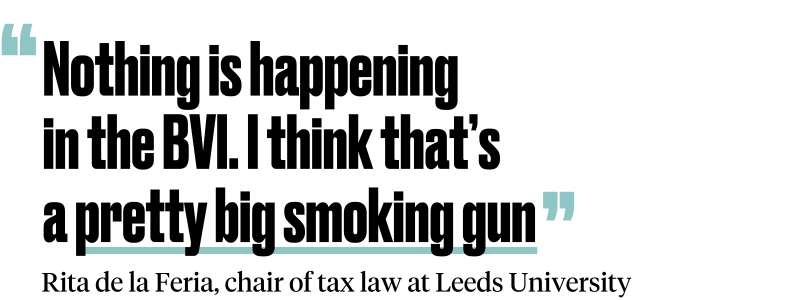
But Professor Rita De La Feria, chair of tax law at Leeds University, said: “Nothing is happening in the BVI. I think this is a pretty big smoking gun. That would be … strong evidence that the effective management of the company was not taking place in the BVI.”
Paul Monaghan, chief executive of the Fair Tax Foundation, said: “There appears to be an entire swarm of red flags surrounding the tax arrangements of Roman Abramovich.
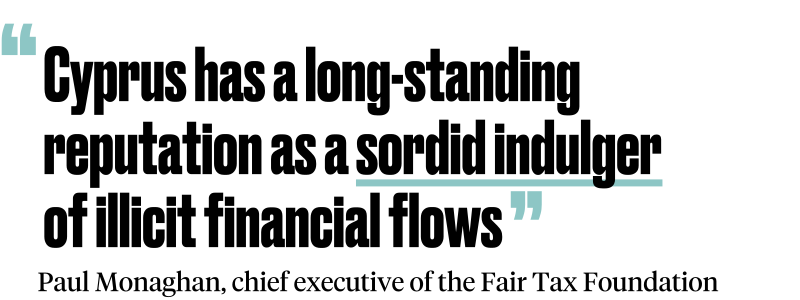
“The combined use of Cyprus and the British Virgin Islands alone presents a massive cause for concern, given both are among the world’s worst enablers of tax avoidance. Cyprus has a long-standing reputation as a preferred tax haven for Russian oligarchs and as a sordid indulger of illicit financial flows more generally. The British Virgin Islands is a go-to destination for those wishing to ensure that their financial conduct is hidden away and that their activities are rendered anonymous.
“If it transpires that the central management and control of the investment decision making took place in the UK, with the board effectively rubber-stamping decisions up the chain, then there could be a sizeable tax liability in the UK [and] further investigation by HMRC would seem to be warranted.”
Across the Pond
Court records filed in the US shed further light on Shvidler’s continued central role in managing the hedge fund investments.
They detail that from the outset, Abramovich and his associates worked closely with a small financial advisory business in the suburbs of New York called Concord Management.
Run by Michael Matlin, another Russian emigre and former classmate of Shvidler, its role was to recommend hundreds of hedge funds for Abramovich to invest in.
Concord was rewarded handsomely for its work – $300,000 a month including expenses, plus a yearly bonus, according to a 2012 consulting agreement. Abramovich and his associates were Concord’s only clients.
After the Russian invasion of Ukraine, the Securities and Exchange Commission (SEC), a US regulatory body, brought legal action against Concord, claiming it had failed to register as an investment adviser and so avoided regulatory scrutiny.
The SEC’s filings spell out how it believed the operation worked. Throughout the filings, Abramovich is referred to as “UBO A” and Shvidler as “Person B”.
According to the SEC, Shvidler was “the point of contact for receiving investment advice from Matlin and Concord and for either deciding or communicating the decision whether to go forward with recommended transactions”.
The SEC complaint goes into granular detail about Shvidler’s work. According to the regulator, each month he would be sent a “short list” of hedge funds by Matlin, containing key details about the funds. Shvidler would then communicate which investments were approved – often in one-on-one telephone calls with Matlin. He also received regular updates on existing investments.
How did we decode the SEC filings?
UBO A is described as a “former Russian political official widely regarded as having political connections to the Russian Federation and vast wealth from the privatisation of state-run industries after the collapse of the former Soviet Union.”
The filing goes on to say that since March 2022, the United Kingdom and the European Union “designated UBO A as a sanctioned individual, and in April 2022, the Royal Court of Jersey issued an order freezing his assets.”
All this tallies perfectly with Abramovich, a former Russian state governor for the icy northern region of Chukotka. He was among the first of the prominent Russian oligarchs to be sanctioned following the outbreak of the war in 2022, while Jersey courts said they froze $7bn (£5.4bn) of assets linked to him not long after.
Person B meanwhile is described as “reportedly a citizen of both the United States and the United Kingdom” as well as a “longtime close associate of UBO A” who was placed on the UK sanctions list on 24 March 2022. Again, this matches perfectly with Shvidler.
Much of the description of the investing process accords with what we know from the leaked documents. A ‘Company 1’ is described as the parent company of over a dozen ‘Investing Entities’ which held the assets, while a ‘Company 2’ was a UK-registered company affiliated to UBO A providing “back-office administrative support”.
Company 1 is Keygrove, the central node in the hedge fund strategy, whose BVI subsidiaries invested in hedge funds, while Company 2 is Millhouse Capital, which operated out of offices at Stamford Bridge, Chelsea’s stadium, and whose administrative work appears frequently in the leaked cache.
Throughout this process, Shvidler, Matlin and another senior Concord employee would share confidential information about the recommendations, decisions and cash positions by phone, text messages, or messaging applications like WhatsApp and Telegram.
Through the Looking Glass
The scale of the investments were staggering. Each year between 2013 and 2018, on average, $6bn was invested across 140 hedge funds.
It was also very profitable. Over the same time period, the value of Abramovich’s investments increased by over $1.4bn – and this was just a five-year window within an operation that lasted over two decades.
But along with the total size of Abramovich’s investments and the scale of annual profits, another figure stands out: “Revenue Reserve”. This is an accounting term used to describe the portion of a company’s profits that are kept in the business instead of being paid out to shareholders.
In Abramovich’s hedge fund companies, these figures were colossal. By the end of 2016, over $3.2bn in profit had been kept on the company balance sheet. In the following two years, the dozen companies were merged into just three giant holding companies. Collectively they retained another $600m in profits by 2018.
How did we calculate the £1bn tax bill?
An HMRC tax bill consists of three elements: the unpaid tax bill; interest; and a penalty when rules have been breached.
The unpaid bill
To estimate the penalty, we needed to know how profitable the companies were. Fortunately we had complete accounts for all the companies involved in the scheme from 2013 to 2018.
These accounts were audited, and provide profit totals based on how much the underlying investments increased in value. So there’s the first caveat: the estimate is only as good as the source data.
The accounts show total profits of $1.4bn. To get an estimate for unpaid tax, we took the UK corporation tax rates for each of the years 2013-2018, and worked out the corresponding tax liability based on the profits.
We then converted the total from dollars into pounds using the exchange rates for the end of each year. This gave an estimated liability of £212m.
However, the scheme had been operating since the late 1990s, and we also wanted to estimate the profits before 2013. To do that, we looked at the “revenue reserve”, a figure that shows the total profit that has remained in a business since it was founded. It effectively describes profits that have been re-invested, rather than paid out to shareholders.
So, a second caveat. The revenue reserve figure represents the minimum possible profit the company made. It’s possible that money was taken out of these businesses prior to 2013 that we simply don’t know about. However, between 2013 and 2018, accounts show that didn’t happen: the company did not pay out dividends.
By the end of 2012, the companies had amassed – at the very least – $2.3bn in profit.
We don’t know when the profits were truly made, and if it were early on they would be subject to higher tax rates. In order to be completely fair, we applied the lowest level of corporation tax during the 1999-2012 period. We then converted this figure into pounds using the average dollar-to-pound exchange rate for the same period.
Our estimate for pre-2012 tax therefore was £325m, giving us a total bill of £537m.
The interest
All unpaid tax is subject to interest repayments. Late repayments use simple interest, not compound. Once again, we were conservative. Technically the interest would kick in from the moment the tax was due, but instead we took the total that could be owed from the end of 2018 and calculated the interest payments from then to the present day. Based on those rates, £537m owed at the end of 2018 would generate a further £145m in interest. This would keep rising until paid off.
Combined with the tax penalty, this gives a figure of just over £680m.
The penalty
Unpaid tax bills are based on estimations of past profits. Tax penalties, however, work on a sliding scale and balance lots of factors, including how companies and people respond when they are being investigated. At the lower end, HMRC could simply attempt to recoup the tax – this would be the £680m figure.
However, they could apply penalties under rules to punish taxpayers who should have declared tax. The “failure to notify” penalties range from 0% to 100% and factor in whether the avoidance was deliberate, whether the taxpayer declared it, and if they tried to hide it.
Based on TBIJ’s evidence, this case could fall under “deliberate” and “prompted” – meaning Abramovich or his agents should have known that HMRC would need to be told and chose not to. The upper range for this is 70% of the tax bill.
Apply that the unpaid bill of £537m, combined with interest, and the total tax liability would be £1.06bn.
This means that from the point they were registered up to December 2018, the companies had made, at the very minimum, $3.8bn in profits. But it could be higher still if any of that profit had previously been extracted.
If Abramovich’s associate played this central role in managing these investments on his behalf, this should all have been subject to UK corporation tax, according to experts consulted during this investigation.
Between 1999 and 2015, UK corporation tax averaged about 25%. Abramovich’s $3.8bn would therefore leave a potential approximate unpaid tax figure of £536m based on historic exchange rates. With interest, the figure rises to almost £700m.
On top of that, if HMRC were to deem the tax avoided or evaded, there could be penalties as well as interest. These could amount to as much as double the unpaid tax bill – about £1bn.
The figure alone is bigger than the UK’s entire budget for rebuilding the 500 schools in England “in the greatest need”.
It also accounts for well over half the funds sitting in a frozen Barclays bank account following Abramovich’s sale of Chelsea to a consortium led by Tood Boehly in May 2022, and which had been earmarked “for the benefit of all victims of the war in Ukraine”.
HMRC told TBIJ it couldn’t comment on individual taxpayers, nor confirm or deny an investigation. A spokesperson said: “We’re continuing to lead international efforts to improve global transparency and are committed to ensuring everyone pays the right tax under the law, regardless of wealth or status.”
Concord Management, Michael Matlin, Keygrove Holdings and representatives for Millhouse Capital didn’t respond to requests for comment. Chelsea Football Club declined to comment.
Original article by Ed Siddons republished from TBIJ under a Creative Commons Attribution-NonCommercial-NoDerivs 3.0 Unported License.
Basic mistake was made in pursuit of fine against man thought to have cost the exchequer £1bn in lost revenue
HMRC squandered the chance to hold a notorious promoter of tax avoidance schemes to account after making a “rudimentary” error at tribunal, new documents reveal.
According to a recently published tax tribunal judgement, the UK tax authority was attempting to bring a £14m penalty against Paul Baxendale-Walker, a former lawyer and tax adviser. HMRC estimates his schemes to have cost the exchequer some £1bn in lost taxes according to a separate court filing.
Baxendale-Walker denied a “false collection of allegations” put to him by TBIJ, and said the £14m penalty was “a fiction … conjured” by HMRC.
The judgement raises questions about HMRC’s handling of the promoters of tax avoidance schemes at a time when tax has become a battleground in the forthcoming general election.
‘There’s a lack of battlefield command within HMRC’
HMRC has enjoyed some substantial victories in recent years, including a £650m windfall and fraud conviction against former F1 mogul Bernie Ecclestone, and a landmark £615m deferred prosecution agreement with the owner of Ladbrokes and Coral. But experts suggest it has failed to adequately hold enablers of tax dodging to account.
“This is screwing it up 101,” said Ray McCann, the former president of the Chartered Institute of Taxation and a senior HMRC investigator of more than 30 years. “I’m completely mystified as to why [HMRC] did what they did [… it appears] there’s a lack of battlefield command within HMRC.”
Baxendale-Walker, 60, gained notoriety after designing a number of tax avoidance schemes in the 1990s and 2000s that were later found not to be legal.
Court documents filed in a separate case in the United States cite HMRC estimates that his schemes cost the tax authority over £1bn in total. Baxendale-Walker disputed this figure to TBIJ, but did not provide evidence to support his claim. “He’s caused carnage,” said McCann.
HMRC was attempting to bring a penalty based on an information notice it obtained at tribunal in 2022, to force Baxendale-Walker to hand over documents to the authority. Baxendale-Walker told TBIJ that he did not have the documents to begin with, and HMRC said it would not comment on individual cases.
HMRC agreed to an extension requested by Baxendale-Walker, but in doing so made one of two mistakes, both of which involved missing a deadline for imposing a penalty.
The Upper Tribunal judge found that it did not matter which mistake HMRC had made, it had invalidated the £14m penalty regardless.
The judge struck out the proposed £14m fine in its entirety in a judgement handed down on 28 July 2023, which was made public this month.
McCann said: “When I was in [HMRC], I would never in a million years have deviated from what a tribunal had authorised because it always goes wrong. […] Now the penalty is history because [HMRC] screwed it up.”
Over the past two decades, Baxendale-Walker has been subject to various civil court cases, professional sanctions and criminal charges.
He was struck off as solicitor in 2006 for conflicts of interest relating to a tax avoidance scheme. In 2012, he was subject to a civil restraint order for filing repeated claims against the Law Society after his dismissal as a lawyer.
Paul Baxendale-Walker pleaded guilty to forgery in 2016Denise Truscello/WireImage via Getty Images
In 2016 he pleaded guilty to forgery after impersonating an investigator contracted by HMRC on a call to the Solicitors Regulatory Authority. Two years later, he was declared bankrupt following a court defeat that found him liable for some £16m on the basis of negligent tax advice.
“HMRC should have approached Paul Baxendale-Walker with extreme care,” said McCann. “Get some people working on his case who really know what they’re doing, don’t take any risks whatsoever, don’t deviate in any way from what the law says.”
‘If HMRC can’t get this guy, it’s hard to see how they can get anyone’
Dan Neidle, the founder of the independent thinktank Tax Policy Associates and former head of tax at global law firm Clifford Chance, said: “If HMRC can’t get this guy, it’s hard to see how they can get anyone.”
Paul Baxendale-Walker told TBIJ that his tax advice was made through a partnership that “paid every due penny of tax” and that he had retired a decade ago. He said HMRC’s £14m penalty was based on a “fictional tax liability” and “randomly chosen multiplier”.
He added: “Every citizen has the right to order their affairs so as to pay the least amount of tax … The evil is accruing a level of taxation which is at a record high since WW2. Not persons who lawfully advise others as to their civil rights and obligations.”
A spokesperson for HMRC said: “We do not comment on identifiable individuals or businesses.”
Original article by Ed Siddons republished from TBIJ under a Creative Commons Attribution-NonCommercial-NoDerivs 3.0 Unported License.


 Waspi (Women Against State Pension Inequality) campaigners stage a protest on College Green in Westminster, London, as Chancellor of the Exchequer Rachel Reeves delivers her Budget in the Houses of Parliament, October 30, 2024