This work by Middle East Monitor is licensed under a Creative Commons Attribution-NonCommercial-ShareAlike 4.0 International License.
Palestinians struggling with hunger in the Gaza Strip, under Israeli attacks and blockade, arrive at the aid distribution point near the Zikim Crossing in Gaza to access the limited supplies of flour, on August 2, 2025. [Khames Alrefi – Anadolu Agency]
The Israeli-backed Gaza Humanitarian Foundation’s (GHF) food distribution is “orchestrated killing and dehumanization,” French medical charity Doctors Without Borders (MSF) said on Thursday.
The organization, known by its French acronym MSF, accused Israeli forces and private American contractors of carrying out targeted and indiscriminate violence against starving Palestinians attempting to access food at GHF-operated sites.
It described the GHF as an “Israeli-US proxy that has militarized food distribution” in Gaza.
Titled “This is not aid. This is orchestrated killing,” the MSF report draws on medical data, patients’ testimonies, and firsthand observations from two MSF clinics located near GHF distribution points in southern Gaza.
Between June 7 and July 24, the two clinics treated 1,380 casualties linked to violence near GHF-run sites, including 28 who were declared dead upon arrival, the organization said.
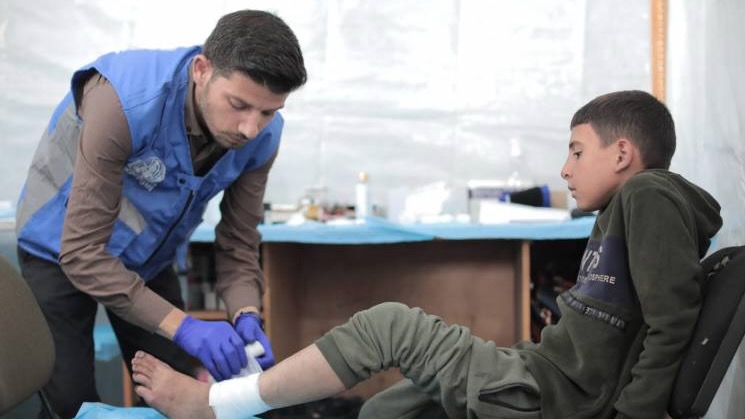
Among those treated were 71 children with gunshot wounds, 25 of whom were under the age of 15. According to the MSF, many families, facing extreme food shortages, often send adolescent boys to distribution points, as they are often the only able-bodied males in the household.
The “MSF calls for the immediate dismantling of the GHF scheme; the restoration of the UN-coordinated aid delivery mechanism; and calls on governments, especially the United States, as well as private donors to suspend all financial and political support for the GHF, whose sites are essentially death traps,” it said.
On May 27, Israel launched the separate aid distribution initiative through the GHF, bypassing the UN and international humanitarian agencies.
Rejecting international calls for a ceasefire, the Israeli army has pursued a brutal offensive on Gaza since Oct. 7, 2023, killing more than 61,000 Palestinians, most of them women and children. The relentless bombing has destroyed the enclave, while the poor distribution of aid and a blockade has led to deaths by starvation.
This work by Middle East Monitor is licensed under a Creative Commons Attribution-NonCommercial-ShareAlike 4.0 International License.
Keir Starmer objects to criticism of the IDF. He asks how could anyone object to them starving people to death, forced marches like the Nazis did, bombing Gaza’s hospitals and universities,mass-murdering journalists, healthworkers and starving people queuing for food, killing and raping prisoners and murdering children. He calls for people to stop obstructing his genocide for Israel.
This work by Middle East Monitor is licensed under a Creative Commons Attribution-NonCommercial-ShareAlike 4.0 International License.
A large crowd gather during a food distribution by a charity organization, as many Palestinians struggle to access food due to Israel’s ongoing attacks on the Gaza Strip, on July 18, 2025. [Abdalhkem Abu Riash – Anadolu Agency]
In Gaza, mornings no longer begin with the sound of explosions — but with the quiet, urgent cries of hunger.
Mothers wake to infants with no milk. Children search for scraps to ease empty stomachs before the bombs return to flatten what little hope remains.
This isn’t exaggeration. It’s a grim, documented reality. Gaza is not only under bombardment — it’s under siege. And the weapon now cutting deepest is starvation. Because hunger is silent, the world looks away, as if a slow death does not count.
For months, Gazans have faced a dual siege: daily airstrikes and international indifference. Border crossings remain closed. Those searching for food are shot. Humanitarian supply lines are systematically broken. Bread has become a fantasy. Water is a daily fight. Medicine, a rare miracle.
“Humanitarian catastrophe” no longer captures it. What’s unfolding now is a deliberate campaign of starvation — one that meets every definition, legal and moral, of genocide.
Footage smuggled out of Gaza shows children collapsing while queuing for bread, families surviving on weeds, mothers dividing a single loaf between four hungry children. It’s not the bombs killing them — it’s the slow wasting of malnourished bodies.
The people of Gaza are not asking for the impossible. They are asking for a shred of global conscience.
But what hurts even more than the hunger is the silence.
In the early days of the assault, Western leaders issued cautious statements: calls for restraint, reminders of international law, expressions of concern. But those voices have since faded. Forgotten. Buried in old press releases. No action followed. No policies changed.
Instead, support for Israel intensified. Some governments even suspended funding to the UN’s main relief agency, UNRWA — in the middle of Gaza’s collapse.
Have you ever heard of a government withdrawing aid from a humanitarian agency while children are starving?
It happened. And it happened quietly.
As Nelson Mandela once said:
“To deny people their human rights is to challenge their very humanity.”
Today, Gaza is being punished not only with bombs, but with hunger — a form of collective punishment enabled by an international consensus too timid to speak out. You won’t find this consensus in official statements, but you’ll see it in every sealed border, every empty bowl, and every child who cries from thirst.
According to UN agencies:
Food insecurity has reached catastrophic levels.
Over 90 per cent of children in Gaza are malnourished.
Infant deaths from starvation and dehydration are now a daily reality.
Yet the world remains still.
Worse still, some governments continue to justify Israel’s actions under the banner of “self-defence” — as if using starvation as a weapon were somehow legitimate.
But it isn’t just the West that bears responsibility.
Egypt too must answer for its role. The Rafah crossing — Gaza’s only exit not controlled by Israel — has been shut for months. Cairo waits for Tel Aviv’s permission to let aid in or patients out. When will we stop pretending this is neutrality? This is complicity.
And what of the Arab governments who have normalised ties with Israel? Some have remained silent. Others have gone further, publicly strengthening relations while Gaza starves. At least the West doesn’t claim kinship. But these regimes do — while doing nothing to stop the suffering of fellow Palestinians.
As former UN Secretary-General Kofi Annan once warned:
“When food becomes a weapon, humanity itself has collapsed.”
Gaza is facing that collapse — and the international system is allowing it to happen.
Yet despite everything, Gaza endures. Its people turn hunger into defiance. They resist, even when stripped of everything. In Gaza, dignity isn’t found in comfort — it’s found in survival.
But let’s be honest: Israel cannot sustain this alone. It relies on silence. On selective outrage. On diplomatic cover. And that is exactly what it gets from world powers who claim to care about human rights — but choose which victims matter.
So who is really standing with Gaza?
Not governments. Not institutions. But ordinary people. Protesters. Citizens. The ones who still have a conscience and refuse to look away.
Gaza doesn’t want pity. It wants justice. It demands an end to the genocide — and accountability for those who enable it.
The question is no longer: What is happening?
We know.
The question is: Who will act?
And when history is written — who will be remembered for their silence?
Because silence, in the face of starvation, is not neutrality.
It is complicity.
The views expressed in this article belong to the author and do not necessarily reflect the editorial policy of Middle East Monitor.
This work by Middle East Monitor is licensed under a Creative Commons Attribution-NonCommercial-ShareAlike 4.0 International License.
Keir Starmer objects to criticism of the IDF. He asks how could anyone obect to them starving people to death, forced marches like the Nazis did, bombing Gaza’s hospitals and universities,mass-murdering journalists, healthworkers and starving people queuing for food, killing and raping prisoners and murdering children. He calls for people to stop obstructing his genocide for Israel.
Medication shortages leave burn victims without full care in Gaza. Photo: UNRWA
The health crisis in Gaza worsens as Israeli attacks persist, supplies dwindle, and most lack access to food and water.
Less than half of all health facilities in the Gaza Strip remain partially operational and capable of providing basic primary care and surgery, the Al Mezan Center for Human Rights warned in a press release. Israeli attacks have rendered nearly all hospitals in northern Gaza non-functional, destroying dialysis units, oncology departments, and rehabilitation centers. The threat of total shutdown is now advancing into the southern governorates: the European Hospital has already been forced to close due to the attacks, and the Nasser Medical Center could be next in line.
This major institution has been operating far beyond capacity for weeks and is under imminent threat of closure, according to both international and non-governmental organizations. “Its closure would deprive thousands of access to critical healthcare and effectively amounts to a death sentence for the wounded and sick in the southern district,” Al Mezan reported.
According to the Jewish Voice for Peace (JVP) Health Advisory Council, most patients at Nasser Medical Center are victims of direct sniper shots to the head or chest, illustrating the deliberate targeting of Palestinians by Israeli forces.
Medics forced to repurpose used supplies
The crisis at Nasser, as with other medical facilities, is worsened by widespread shortages of essential supplies. Over 50% of medications for chronic conditions are unavailable, 64% of cancer and hematology drugs are missing, and the shortage of orthopedic equipment has reached nearly 90%, according to health organizations. Both the JVP Health Advisory Council and United Nations agencies have highlighted that the lack of basic items such as gauze, medicines, and surgical equipment is forcing medical staff into extreme triage decisions. “Medical teams have been forced to reuse equipment – sterilizing and repurposing implants from recovered patients – due to the acute shortage of these items,” Al Mezan stated.
Fuel shortages are of particular concern, as they endanger the functioning of critical medical devices such as ventilators in neonatal intensive care units (NICUs). “Newborns in NICUs are often too small to breathe on their own – they need ventilators and oxygen to survive,” staff from Doctors Without Borders (MSF) pointed out. “The charade of only allowing medical and fuel supplies at the very last minute before a looming disaster is nothing but a band-aid on a gushing wound.”
Hunger rates grow further
At the same time, hunger is sweeping through Gaza. Following Israel’s months-long blockade of aid and the weaponization of humanitarian deliveries, most of the population is experiencing rising degrees of malnutrition. This is impacting public health in multiple ways, including reducing the pool of eligible blood donors, even as blood banks face dire shortages.
“We are missing everything: medical consumables like gauze, medications, and food for our patients,” said MSF nursing manager Katja Storck. “This also includes therapeutic food for people with malnutrition, especially children.”
By June 15, nearly 19,000 children under five had received treatment for malnutrition, though this likely underrepresents the full extent of the crisis. As the JVP Health Advisory Council noted, these cases emerged “within a population where wasting was non-existent 20 months ago.” Malnutrition is not only increasing susceptibility to infectious disease, but is also causing serious long-term effects such as stunted growth and mental health problems. Prenatal health is also affected: one in five newborns is now being born preterm or underweight.
While many adults are trying to shield children from hunger by reducing their own intake, most coping strategies are ineffective under the conditions imposed by the occupation. “Most families reported surviving on one meager meal a day – thin broths, lentils or rice with salt, macaroni, cans of beans or peas, and boiled legumes,” UN sources reported. “One third said they go entire days without eating or rely on a single piece of bread and duqqa.”
Beyond hunger caused by Israel’s blockade, Palestinians in Gaza are also facing an escalating water crisis. With much of the water infrastructure destroyed and fuel to power desalination plants missing, access to safe drinking water has plummeted. In Deir al-Balah, 97% of residents reported being unable to obtain adequate water. “This is Gaza’s most critical moment since this war on children began – a woeful bar to sink below,” UNICEF spokesperson James Elder stated on June 20. “A virtual blockade is in place; humanitarian aid is being sidelined; the daily killing of girls and boys in Gaza does not register; and now a deliberate fuel crisis is severing Palestinians’ most essential element for survival: water.
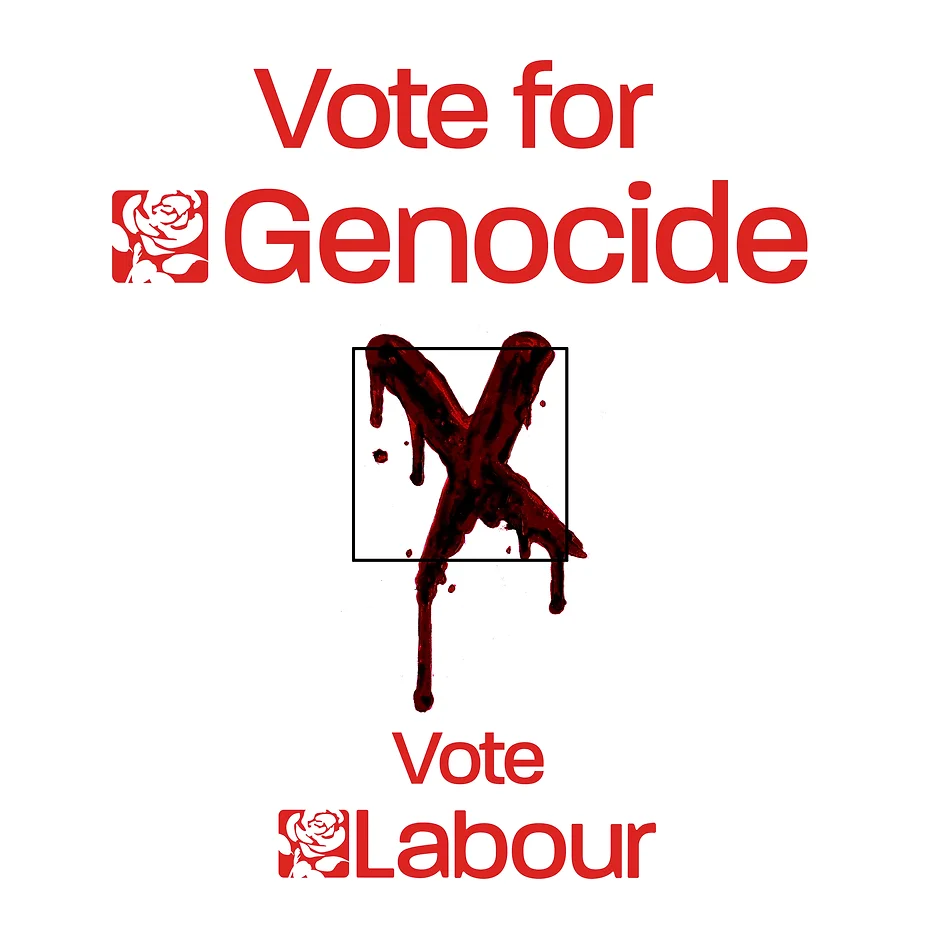
Zionist Keir Starmer is quoted “I support Zionism without qualification.” He’s asked whether that means that he supports Zionism under all circumstances, whatever Zionists do.Keir “I support Zionism without Qualification” Starmer supporting genocide.Vote Labour for Genocide.
Francesca Albanese, United Nations special rapporteur on the Occupied Palestinian Territories, speaks during a press conference at Buswells Hotel in Dublin, Ireland on March 20, 2025. (Photo: Brian Lawless/PA Images via Getty Images)
“To end it, we must first be willing to see it.”
United Nations Special Rapporteur on the Occupied Palestinian Territories Francesca Albanese pushed back Tuesday against Israel and its defenders, who for years have attempted to gaslight and malign the Italian legal scholar for tirelessly condemning what an increasing number of international experts—including many Israelis and diaspora Jews—agree is a genocide in Gaza.
“I call it genocide because IT IS a genocide,” Albanese wrote on the social media site X on Tuesday, amplifying a video she recorded last week in which she said that “Israel is committing genocide in Gaza.”
“It’s not an opinion, it’s a fact,” the 48-year-old Georgetown University scholar asserted. “Top international experts, including Israelis, agree upon that.”
I call it genocide because IT IS genocide. Defined by intent, not by method or means. Visible without magnification—if we look with context, at the victims: what they share is being part of a group, as such. Because of it, they get killed, tortured, maimed, starved, raped,… https://t.co/137BWEN5vG
— Francesca Albanese, UN Special Rapporteur oPt (@FranceskAlbs) June 3, 2025
Under Article II of the Genocide Convention, the crime of genocide is defined as killing, “causing serious bodily or mental harm” to a group of people, “deliberately inflicting on the group conditions of life calculated to bring about its physical destruction in whole or in part,” “imposing measures intended to prevent births within the group,” or “forcibly transferring children of the group to another group.”
Israel is currently facing a genocide case at the International Court of Justice (ICJ) brought by South Africa and supported by dozens of nations, either individually or via regional blocs. The ICJ has issued three provisional orders for Israel to take steps including avoiding genocidal acts and ending weaponized starvation in Gaza. Critics say Israel has violated all three orders.
The International Criminal Court has also issued warrants for the arrest of Israeli Prime Minister Benjamin Netanyahu and Yoav Gallant, his former defense minister, for alleged crimes against humanity and war crimes in Gaza including extermination and forced starvation.
“In Gaza, Israel has killed nearly 60,000 people with bombs bullets, and drones, including 16,000 children,” Albanese said in the video. “It has flattened homes, schools, churches, hospitals, water networks, farms, even cemeteries. The death toll from hunger, disease, untreated wounds, an[d] deprivation could reach 300,000.”
“Prisoners, including medics and journalists, have been tortured. Many have been raped, using dogs and sticks; some have died in Israeli prisons,” she continued. “Forced displacement continues in the West Bank, and over 1,000 Palestinians have been killed in 20 months, and 1 in 5 is a child.”
“Beware of those who use Hamas’ crimes or the fate of the hostages to justify this massacre,” she said. “Civilians are never legitimate targets. Israel has masked everything with legal words: ‘evacuations,’ ‘safe zones,’ ‘human shields’—it’s fiction.”
Israel and its leaders deny they are committing genocide and say those who make such allegations—including Jews—are antisemitic. Albanese has been a prominent target of such smears, in which the Biden and Trump administrations as well as members of U.S. Congress, both Democratic and Republican, have taken part while supporting tens of billions of dollars in U.S. armed aid for Israel.
Albanese has called the U.S. and other Western nations that support Israel an “axis of genocide.”
“And what about us? We are failing the test of our humanity.”
Gaza officials say Israeli bombs, bullets, and blockades have left at least 193,000 Palestinians dead, maimed, or missing and millions more forcibly displaced, sickened, or starved— sometimes to death. Israeli forces are currently carrying out a plan by Netanyahu’s far-right government to conquer, indefinitely occupy, ethnically cleanse, and possibly recolonize Gaza, which U.S. President Donald Trumpsaid he wants to make into the “Riviera of the Middle East”—presumably devoid of Palestinians.
“And what about us?” asked Albanese in the video. “We are failing the test of our humanity. Too many media, governments, companies, universities, too many guilty consciences and dirty hands. This genocide bears our fingerprints. It’s under our eyes. Denying it today means being ignorant, or complicit. Stopping it is the only way to remain human.”
“Genocide is a process, not a single act,” Albanese added. “A collective act. A criminal venture. To end it, we must first be willing to see it.”
UK Labour Party government ministers Keir Starmer, Angela Rayner and Rachel Reeves explain that they are partners complicit in Israel’s Gaza genocide. The UK has provided Israel with arms, military and air force support. They explain that they don’t do gas chambers but do do forced marches, starvation, destroy hospitals, mass-murders of journalists and healthcare workers.
Argentine President Javier Milei. Photo: Milei / X
At one year of Milei’s presidency, we take stock of his economic policies, the impact on the working class, and perspectives for the future
A year ago, what many considered unthinkable a couple of years ago happened: Javier Milei, the eccentric libertarian economist who was almost compulsively invited by the media to increase ratings, was sworn in as president of Argentina. Gone was the neoliberal and demure option of the Argentine right wing that managed to triumph with Mauricio Macri, as well as the always latent Peronist option, which could not overcome the obstacles that the government of Alberto Fernandez left in its path.
Milei became a celebrated outsider who confronted his adversaries directly (often insulting and humiliating them), promising to lift the country out of poverty through a radical liberalization of the economy, with bold, or absurd, proposals to dollarize the economy and the eliminate the central bank. Indeed, his style as a guest on television programs was not too far removed from his actions as president of Argentina.
Erika Giménez, social communicator and a journalist with ARG Medios told Peoples Dispatch that Milei arrived with a promise that he was going to “break the State” and end all state social programs and aid to impoverished sectors because they are “a waste of money that prevents Argentina’s resurgence as a great country.” Did he succeed in his grandiose vision? What did the “lion” of Argentina manage to accomplish in his first year of governance?
Falling inflation and rising poverty
One of Milei’s main obsessions was to reduce inflation at all costs. After several setbacks that ended up increasing inflation, in October it was recorded that inflation had risen by 2.3%, the lowest percentage in several years. To achieve this, he had no qualms about firing tens of thousands of state workers (almost 36,000 according to the National Institute of Statistics and Census) and aggressively cutting the number of ministries (from 18 to 9). Social programs that had been a bulwark of the Republic for several decades were eliminated. Of the state workers who survived the layoffs, almost all have seen a reduction in their purchasing power as a consequence of the economic retrenchment policies.
Similarly, despite the fact that year-on-year inflation stood at 193%, retirees’ pensions only increased by 105%, meaning that retired elderly workers today, thanks to Milei’s government, can buy fewer things than before, because their pension was not adjusted for inflation. This incongruity provoked several mobilizations by retirees.
Likewise, Milei has refused to increase the public education budget so as not to affect the much-desired “fiscal balance”, which has led to a decline in the quality of education in the country. Also, hospital workers (doctors, nurses, and others) have reported that they have lost almost 104% of their purchasing power, which puts the country’s health care system at risk.
In addition, according to Erica Giménez, inflation is currently decreasing, among other things, because people are not able to buy goods, which causes stores to reduce prices to sell more. This can lead to a distorted view of inflation as the only measure of economic improvement because, in reality, it is actually masking a more serious problem: people have lost purchasing power. “[The decrease in inflation] is quite a deceptive figure because people cannot consume because their salary is not enough to do so…The macroeconomic meters improve (as Milei wants) by not generating fiscal deficit, but this happens at the cost of the increase of unemployment, of retirement pensions, of the most needy, and of so many who are nowadays below the poverty line,” Giménez affirms.
One of the cases which shone a light on the ridiculous nature of his radical adjustment was what happened with the social kitchens, soup kitchens run oftentimes by left and progressive community organizations. Milei’s government and his Minister of Human Capital Sandra Pettovello were involved in a serious controversy when it was shown that, while the kitchens were subjected to serious budget cuts as part of the fiscal adjustment which made it impossible to feed the increasing number of hungry people, several tons of food were rotting in State warehouses. The Argentine courts had to order the immediate distribution of the food.
The defunding of university education
Probably the most important internal challenge faced by Milei during this first year was the massive demonstrations of students, professors, and university workers against the Executive’s refusal to increase the university budget. The Legislature had passed a law allowing for the budget increase, but Milei refused to comply with it and vetoed it completely. This generated a lot of discontent among Argentine students who took to the streets against the austerity policies of Milei’s libertarian government, and even went so far as to take over dozens of universities and hold university classes in the streets as a form of protest.
Giménez says in this regard, “Those who lose the most with [the veto of the law] are the professors of public universities who today are within the poor population…According to several surveys, the majority of the population agrees with the public character of health, education, etc., and of the Argentine State as protector and benefactor of these areas, so Mieli’s discourse against universities did not work because…public university education has great popular support.”
International relations
Milei has repeatedly stated that Argentina was, at some point in its history, the first world power. Therefore, what his government should do, according to his rhetoric, is to turn it into a great world power again. This “messianic” bet is synthesized in the often-used slogan “Make Argentina Great Again”, which evidently is reminiscent of Trump’s MAGA. “But Argentina never had a geopolitical weight that Milei says it once had as a first power,” Giménez tells us.
During the vote on whether or not to lift the US economic blockade of Cuba, Argentina voted along with almost all countries to call for an end to the blockade. In retaliation, Milei fired his foreign minister for this vote. According to Giménez, Argentina has historically voted against the blockade and supported other progressive international issues because it hopes that other countries will support its intention to recover the Malvinas Islands, which are currently under British control. Milei however, has wanted to assume a Trumpist international logic, says Giménez, and has assumed a fight against LGBTIQ+ groups and measures to curb climate change, while manifesting strong support in favor of Israel and the United States.
That is why the discussions at the UN on the prevention of violence against girls and women, the ceasefire in Palestine, and the withdrawal of the Argentine delegation from COP29, show the rejection of certain political causes which the president himself calls “the Cultural Battle”. As part of this battle he has attacked journalists, politicians and intellectuals, and founded the new think tank Faro Foundation whose objective is to: “To promote the ideas of economic liberalism and the historical values of Argentine culture, in order to contribute to the economic and social development of our Nation, fighting the cultural battle.” This confrontational attitude has led him to have several impasses with regional political leaders such as Colombian President Gustavo Petro.
But this confrontational attitude, more typical of a media commentator, has its limits. For example, Giménez reminds us that after announcing before his presidency that he would never negotiate with China because they are communists, Milei eventually had to negotiate with Beijing because of the importance of that country for the Argentine economy.
Likewise, Milei has openly positioned himself behind the geopolitical line of US President-elect Donald Trump, attending several select meetings organized by the US president. Milei, according to Giménez, intends to position himself, unsuccessfully, as an international leader who will inspire a global political transformation. Perhaps that is why he has made more trips abroad than within the country, especially to the United States. Likewise, his closeness with the International Monetary Fund stands out.
His revisionist ideological struggle
Milei has also had a significant impact on the ideological dispute in Argentina with his bizarre and aggressive speeches.
For example, he said that he would be delighted to drive the last nail in the coffin of former Peronist president Cristina Fernández, who is the subject of a judicial process that seeks to disqualify her politically and put her in prison.
He has also questioned the figures of human rights organizations on the number of dead and disappeared caused by the last military dictatorship in Argentina. His vice-president, Victoria Villarruel, is a descendant of a military family and before his death, had paid a personal visit to Rafael Videla, head of the last military dictatorship. Milei wants Argentines to forget the dictatorship as if it’s something that can be left behind, says Giménez. In order for Milei to advance his political and ideological project to “make Argentina great again”, he must break certain established and socially consensual notions “and generate other discourses closer to capitalism, revisionist, discuss the importance of the university and public employment…and that includes relativizing one of the darkest periods of Argentine history such as the military dictatorship,” Giménez explains.
Milei has vigorously gone after his ambitious goals of economic liberalization and austerity, without asking “at what cost?” The significant rejection of such policies by broad sectors of the population and the deepening of social conflict will continue and intensify. Milei still has three years left in his presidency, so the future of his government is uncertain. What is certain is that he does not seem to be slowing down his pretensions, but rather accelerating the radical neoliberal program that he defends to the hilt.