This work by Middle East Monitor is licensed under a Creative Commons Attribution-NonCommercial-ShareAlike 4.0 International License.
File picture dated April 3, 2007 shows an Iranian flag outside the building housing the reactor of the Bushehr nuclear power at plant Natanz facility [BEHROUZ MEHRI/AFP FILES/AFP via Getty Images]
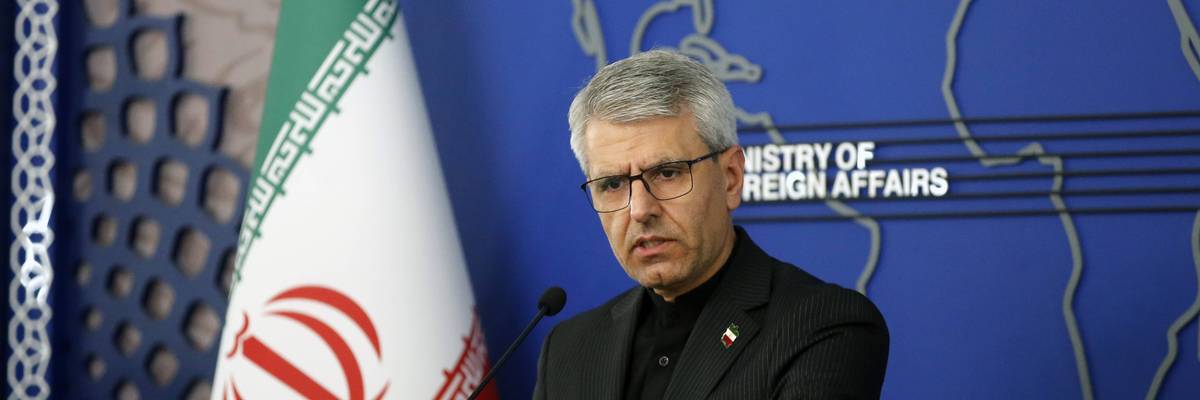
The possibility of Iran’s withdrawal from the Nuclear Non‑Proliferation Treaty (NPT) is under discussion in Tehran, Iranian media reported on Saturday, Anadolu reports.
Relevant government bodies, including parliament, are currently “urgently” mulling withdrawal, Iran’s semi-official Tasnim News Agency reported.
On the US social media company X, Tehran Deputy Malek Shariati said an “emergency plan to support the nuclear rights” of Iran has three main areas.
These include a declaration of withdrawal from the NPT, the cancellation of the countermeasure law in implementing the 2014 Iran nuclear deal, and support for a new international agreement with like-minded countries for the development of peaceful nuclear technologies, including Shanghai and the BRICS bloc of Brazil, Russia, India, China, South Africa, and others.
The possibility of withdrawal comes with the entire region on alert since the US and Israel launched an air offensive on Iran on Feb. 28, since killing over 1,340 people, including then-Supreme Leader Ali Khamenei.
Though analysts say the US has not been clear in its objectives in the war, Washington has long objected to Iran enriching nuclear material to weapons-grade.
Iran responded to the offensive with drone and missile attacks targeting Israel, as well as Jordan, Iraq, and Gulf countries hosting US military bases, causing casualties, infrastructure damage, and disruption to global markets and aviation.
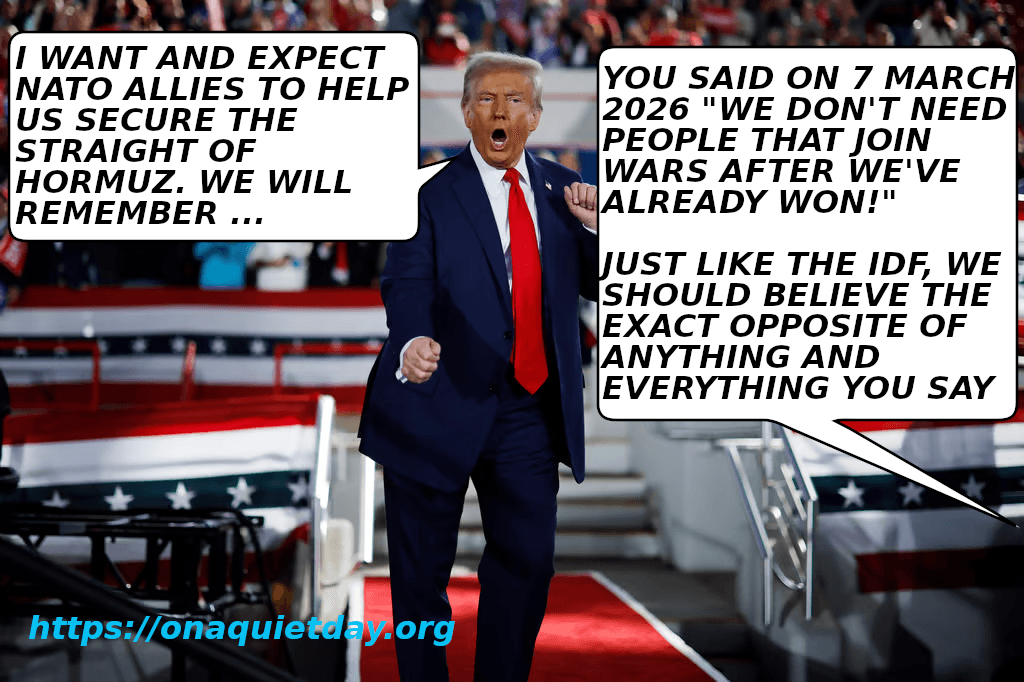
Donald Trump calls for help from NATO allies in securing the Straight of Hormuz despite saying on 7 March 2026 that they don’t need people to join wars after they’ve already won.Keir Starmer explains that UK is participating defensively in Trump and Israel’s criminal war for Israel’s genocidal expansion in Iran and states that he supports Zionism “without qualification”. Keir Starmer said “I said it loud and clear – and meant it – that I support Zionism without qualification.” here: https://www.jewishnews.co.uk/keir-starmer-interview-i-will-work-to-eradicate-antisemitism-from-day-one/Orcas discuss how Trump was re-elected and him being an obviously insane, xenophobic Fascist.
A woman looks on as residents and emergency workers sift through rubble of a residential building that was hit in an airstrike in the early hours of March 27, 2026 in Tehran, Iran. (Photo by Majid Saeedi/Getty Images)
“The United States and Iran are trapped in a conflict in which each new escalation only deepens a shared, losing predicament… Sooner rather than later, both will confront the urgency of finding an off-ramp.”
Multiple reports published in the last two days have indicated that President Donald Trump is seeking to wrap up his illegal war in Iran, which has significantly hurt his domestic political standing—partially by raising gas prices at a time when polls show US voters are primarily concerned about the cost of living.
While ending the Iran war will not be simple, some foreign policy experts believe that it can be done if both the US and Iran truly understand that deescalation is in both nations’ best interests.
George Beebe, director of grand strategy at the Quincy Institute for Responsible Statecraft and former director of the CIA’s Russia analysis, and Trita Parsi, executive vice president of the Quincy Institute, have written an essay published on Thursday by Foreign Policy outlining what an achievable Iran “exit plan” would look like.
The authors acknowledged the immense challenges in getting both sides to meet one another halfway, but said this option is preferable to a drawn-out war that will leave both nations poorer and bloodied.
On Iran’s side, argued Beebe and Parsi, a deal would involve renewing “its stated commitment to never pursue nuclear weapons,” re-opening the Strait of Hormuz to all shipping vessels, and making a commitment “to denominating at least half of its oil sales in US dollars rather than the Chinese yuan.”
The US, meanwhile, would “grant sanctions exemptions to countries prepared to finance Iran’s reconstruction” and “would also permit a specified group of states—such as China, India, South Korea, Japan, Turkey, Iraq, and others in the Gulf—to resume trade with Tehran and the purchase of Iranian oil, thereby easing global energy prices.”
Beebe and Parsi emphasized that this deal would only be a first step, and they said the next step would be restarting negotiations to establish a nuclear weapons agreement similar to the one previously negotiated by the Obama administration that Trump tore up during his first term.
“The United States and Iran are trapped in a conflict in which each new escalation only deepens a shared, losing predicament,” they wrote. “Neither can compel the other’s surrender. Sooner rather than later, both will confront the urgency of finding an off-ramp—one that does not hinge on the other’s humiliation.”
Even if Trump takes this course of action, however, there is no guarantee it will succeed, in part because of how much he has already damaged US alliances across the world.
In an analysis published Thursday, Sarah Yerkes, senior fellow at the Carnegie International Endowment for Peace’s Middle East Program, argued that even nations in the Middle East that stand to benefit from a weakened Iran are now thinking twice about their dependence on the US for their security needs, given that Trump’s war has resulted in Iran launching retaliatory strikes throughout the region.
Yerkes also highlighted how Trump’s handling of European allies is making it less likely that they will play a significant part in helping him end the conflict.
“Europe, which is not eager to enter what it sees as a war of choice, has refrained from proactively joining US and Israeli strikes,” Yerkes explained. “One of the clearest examples of the transatlantic rift was over the initial reaction to closures in the Strait of Hormuz, the shipping channel for approximately 20% of the world’s seaborne oil and LNG traffic. Multiple European countries refused to cow to Trump’s demand that they send warships to help keep the strait open, inviting public ire from Trump.”
The bottom line, warned Yerkes, is that “each day the war continues, without explicit goals or a clear exit strategy, opposition to the United States—from friends and foes, inside and outside—is also likely to grow, making America less safe and less secure.”
Donald Trump calls for help from NATO allies in securing the Straight of Hormuz despite saying on 7 March 2026 that they don’t need people to join wars after they’ve already won.
Demonstrators hold a protest against the war on Iran next to Recruting Station in Times Square, New York City, United States, on Sunday, March 22, 2026. [Selçuk Acar – Anadolu Agency]
On 28th February 2026, the United States went to war. No congressional debate. No public deliberation. No formal declaration. Just a midnight operation, with top lawmakers notified only minutes before the bombs fell, announcing that American aircraft were already striking Tehran. This is not how a republic wages war. This is how a king does.
The strikes on Iran — codenamed Operation Epic Fury— killed Iranian Supreme Leader Ali Khamenei and multiple senior officials, put American lives in harm’s way without a single vote of the people’s representatives, and shook global energy markets to their foundations.
Article I of the Constitution gives Congress, not the president, the power to declare war. Trump did it anyway. And in doing so, he did not merely break a rule — he broke the foundational compact of American self-governance.
The White House’s legal rationale was collective self-defence under the UN Charter. But the United States was not under attack. Iran had not struck American soil. Administration officials released conflicting statements about the aims of the operation, ranging from ending Iran’s nuclear program to outright regime change — language that has no grounding in any congressional mandate or democratic debate. As Senator Andy Kim told TIME, lawmakers and the American public were being asked to accept military escalation without understanding the endgame: “The President has really boxed us in and put us on the hook for things that we haven’t discussed as a country.” When senators demanded classified briefings, they largely received stonewalling. What followed was not strategic clarity but performative chaos: on the same day his administration surged forces to the region, Trump posted on social media about winding down. He threatened to bomb Iranian power plants if the Strait of Hormuz was not opened on his timetable.
And when asked about rising gas prices, he shrugged: *”If they rise, they rise.”* These are not the words of a commander-in-chief accountable to a republic. They are the words of a man who believes he answers to no one.
Dissent has come from across the political spectrum, which is precisely what makes the administration’s contempt for Congress so damning. [Senator Chris Van Hollen]() called it plainly: “Trump is lying to the American people as he launches an illegal, regime-change war against Iran. This is endangering American lives and has already resulted in mass civilian casualties.” Kentucky Republican Thomas Massie declared: “This is not ‘America First.’ The Constitution conferred the power to declare or initiate war to Congress for a reason — to make war less likely.” Army veteran and Ohio Republican Warren Davidson said simply: “War requires Congressional authorization.” These are conservatives honouring their oath, not partisans playing politics. And yet the war powers resolutions they championed failed to override a presidential veto, as most Republicans fell in line. Senator Tim Kaine’s warning now hangs over every future presidency: “Don’t hide under your desk and just let the president do it on his own. Because if you do, you’re opening the door for presidents of either party into the future just to wage war willy-nilly.”
The human cost is already devastating — over 1,400 Iranians killed, thirteen American soldiers dead — and the economic cost is being borne by the entire world. Brent crude surpassed $126 per barrel at its peak, its highest level in years. The Strait of Hormuz — through which 20 percent of global oil supplies flow — was effectively closed, and QatarEnergy, responsible for 20 percent of the world’s LNG supply, declared force majeure on all exports. Global stocks fell 5.5 percent in the war’s opening days. Inflation is forecast to rise across the eurozone, the United States, and Asia simultaneously, presenting central banks with the spectre of stagflation — while the president who lit the fuse demands that the Federal Reserve cut interest rates.
Families in Chicago and Chennai, in Lagos and London, are absorbing the price of a decision made by one man without asking anyone’s permission.
The World Economic Forum put the deeper betrayal into words: the United States “has imposed enormous costs on many of the same economies it relies on as trading and strategic partners.” Allies were not consulted. The democratic world was not asked. And yet it is paying, country by country, household by household, for a war it did not vote for and cannot stop. This matters far beyond economics. The United States built the post-war international order on the premise that even the most powerful nation would operate within rules and seek legitimacy before using force. When that premise collapses, the argument for democratic governance in an age of strongmen collapses with it. A world with kings — whether in Moscow, Beijing, or Washington — is a more dangerous world for everyone.
The phrase “No Kings” is not a slogan invented by the left. It is the founding premise of the American republic, inscribed in the separation of powers and in a Constitution written by men who had lived under a monarchy and refused to recreate one. This war is the most dramatic breach of that premise yet — but not the first. Trump launched strikes on Iranian nuclear facilities last year without a congressional vote. He ordered the capture of Venezuela’s president without one.
Each unchallenged act of unilateral power makes the next easier. This is how republics die — not in a single dramatic moment, but in the slow accumulation of precedents no one stopped in time.
On March 28, over 3,000 No Kings protests are scheduled across every state in this country. Join them. Bring your neighbors. Bring your children, so they can see what democracy looks like when citizens defend it. This is not a partisan call — it is a constitutional one, and it belongs to everyone who believes that in America, the people decide. Not one man. Not a king.
The views expressed in this article belong to the author and do not necessarily reflect the editorial policy of Middle East Monitor.
Keir Starmer explains that UK is participating defensively in Trump and Israel’s criminal war for Israel’s genocidal expansion in Iran and states that he supports Zionism “without qualification”. Keir Starmer said “I said it loud and clear – and meant it – that I support Zionism without qualification.” here: https://www.jewishnews.co.uk/keir-starmer-interview-i-will-work-to-eradicate-antisemitism-from-day-one/Donald Trump calls for help from NATO allies in securing the Straight of Hormuz despite saying on 7 March 2026 that they don’t need people to join wars after they’ve already won.Climate science denier Donald Trump confirms that he knows nothing about democracy and that more liquid gold is being secured according to his policy of global privateering.
Israel’s Prime Minister Benjamin Netanyahu points to his map of ‘the New Middle East’ during his address to the United Nations General Assembly, Sept. 22, 2023. | Richard Drew / AP
As the U.S.- Israeli wars across West Asia widen, a clearer picture is emerging of Israel’s long-term strategic and ideological objectives, and they go far beyond claims of “security” or “self-defense.”
This week, Israeli Finance Minister Bezalel Smotrich made that reality explicit. Speaking publicly amid Israel’s escalating assault on Lebanon, he declared that Israel’s northern border “must be the Litani River,” calling for the outright conquest and annexation of southern Lebanon.
This is not fringe rhetoric. It is a statement from a senior cabinet minister, and one that aligns with military actions already underway on the ground.
Israeli forces are not merely striking Hezbollah positions. They are systematically reshaping southern Lebanon: Vital [b]ridges over the Litani River have been destroyed, cutting off civilian movement and isolating the south from the rest of Lebanon. Entire villages are being leveled and depopulated, as the Israeli government calls for the demolition of homes and other civilian infrastructure. This has led to over a million Lebanese already being displaced.
Rather than taking temporary battlefield measures, the Israeli army is putting in place the material preconditions for territorial reorganization.
Military planners and political leaders are increasingly aligned around the idea of a permanent “buffer zone” south of the Litani. Such language has historically often preceded de facto annexation, and Smotrich’s statement removes any ambiguity. The goal is a permanently expanded Israel.
What is now unfolding in Lebanon follows the pattern already visible in Gaza. Israeli officials and lawmakers have repeatedly called for the resettlement of Gaza by Israeli settlers and the absorption of large portions of its territory into Israel. Many in Israeli leadership have even called for the depopulation of Gaza to build a Jewish majority in the territory. The destruction of entire cities like Rafah and Beit Hanoun has already emptied former population centers of their residents.
In Lebanon, Israeli leaders are explicitly invoking this precedent. Government figures have urged applying the “Gaza model” to southern Lebanon, meaning the destruction of villages, displacing populations, and then redefining control on the ground.
Gaza and Lebanon are thus not two separate wars; they are two avenues in pursuit of the same strategy. While bombs fall in Gaza and Lebanon, the West Bank is undergoing its own transformation. Israeli settler violence, mass expulsions, and military raids have intensified alongside open political calls to formally annex that territory, as well. Entire Palestinian communities are being pushed off their land, often under direct protection of the Israeli military.
There is no large-scale bombardment as in Gaza and Lebanon, but the goal of removing the population and normalizing such actions remains the same.
At the same time, Israel has expanded its military operations deeper into Syria, targeting Iranian-linked infrastructure and asserting “freedom of action” across the country. Just this week, Israeli forces entered the Syrian city of Qunetra, set up road blocks, and arrested residents, as if Israel already had legal jurisdiction over this Syrian city.
These strikes are being framed as preemptive defense, but taken together with operations in Gaza and Lebanon, they reflect a broader doctrine. Israel is showing it intends to reshape the entire region through force, regardless of sovereignty.
The messianic vision of a Greater Israel
What ties these fronts together is not simply conflict with Hamas, Hezbollah, or Iran. It is a coherent territorial and political project known as The Greater Israel Project. Proponents of this idea have long called for Israel to expand its borders south into Egypt and northward and westward to the Euphrates River. Their claim is based on Biblical passages that say God promised these lands to Abraham’s descendants.
While this idea was once rightfully scene as fringe, religious fanaticism, it has become increasingly mainstream. U.S. Ambassador to Israel and famed Chritisan Zionist Mike Huckabee recently endorsed such a vision during an interview with Tucker Carlson. Even the supposed secular and “liberal” leader of the Israeli opposition, Yair Lapid, said he supported the idea of expanding Israel to match the biblical description.
What’s happening on the ground shows that such talk is not simply empty rhetoric for religious constituents but a plan being put into action. Smotrich’s statement is significant not because it is shocking, but because it is consistent. It articulates openly what Israeli policy has been implementing incrementally: the use of war to redraw borders and reshape demographics across the region.
These wars by Israel are materially enabled and politically shielded by the United States. The current escalation—particularly the joint U.S.-Israeli war against Iran—has created the conditions under which these expansionist, fanatical aims can be pursued under the cover of a broader regional conflict.
The Trump administration continues to frame these actions as part of a defensive alliance, but the outcome on the ground expanding war, mass displacement, and the steady erosion of national sovereignty across multiple countries.
The danger of the current moment lies in its normalization. Greater Israel was once an idea the fascist right wing carefully whispered about only among like-minded people. Today, it has become official policy of the Israeli government, with the backing of the United States.
The question is no longer whether such plans exist. It is whether they will be allowed to proceed unchallenged. If the Litani River becomes Israel’s new northern border, it will not be the end of the process. From there, history suggests, the map will not stop changing.
As with all op-eds and news analytical articles published by People’s World, the views expressed here are those of the author.
J.E. Rosenberg grew up in an extremist, religious Zionist household in the U.S. After moving to Israel as a young adult, he changed his world views. He left Israel and is now a member of the Communist Party.
Keir Starmer explains that UK is participating defensively in Trump and Israel’s criminal war for Israel’s genocidal expansion in Iran and states that he supports Zionism “without qualification”. Keir Starmer said “I said it loud and clear – and meant it – that I support Zionism without qualification.” here: https://www.jewishnews.co.uk/keir-starmer-interview-i-will-work-to-eradicate-antisemitism-from-day-one/Donald Trump warns against following the https://onaquietday.org blog, says that it’s easy atm, she only needs to report war crimes supporting Israel’s genocidal expansion.Orcas discuss Genocide-supporting and complicit Zionists. Donald Trump, Keith Starmer, David Lammy, Rachel Reeves, Angela Rayner are called evil genocide-complicit and supporting cnuts.
This work by Middle East Monitor is licensed under a Creative Commons Attribution-NonCommercial-ShareAlike 4.0 International License.
United Nations Secretary-General Antonio Guterres holds a press briefing outlining his priorities for 2026 at the United Nations headquarters in New York, United States, on January 29, 2026. Selçuk Acar – Anadolu Agency]
UN Secretary-General Antonio Guterres warned on Wednesday that the Iran war has spun beyond all boundaries, declaring the conflict “out of control,” cautioning that the world faces the prospect of a far broader confrontation, Anadolu reports.
“More than three weeks on, this war is out of control,” Guterres told reporters at a news conference at UN headquarters in New York, adding that “the conflict has broken past the limits even leaders thought imaginable.”
“The world is staring down the barrel of a wider war, a rising tide of human suffering, and a deeper global economic shock,” he said, stressing that it “has gone too far.”
Calling for an end to the military escalation, Guterres said. “It is time to stop climbing the escalation ladder and start climbing the diplomatic ladder, and return to full respect of international law.”
Pointing to the key parties involved in the war, he said, “My message to the United States and Israel is that it is high time to end the war as human suffering deepens, civilian casualties mount, and the global economic impact is increasingly devastating.”
Guterres urged Iran to end attacks on the Gulf countries, arguing that they “are not parties to the conflict.”
Highlighting the economic ripple effects of the war, Guterres said, “The prolonged closure of the Strait (of Hormuz) is choking the movement of oil, gas, and fertilizer at a critical moment in the global planting season.”
Shipping traffic through the Strait of Hormuz, a critical artery for global goods and energy trade, had been largely disrupted by escalating tensions in the Gulf following US and Israeli attacks on Iran and Tehran’s retaliation.
The strait, which connects Saudi Arabia, the UAE, Kuwait, Qatar, Iraq, and Iran to global markets, handles roughly 25% of global oil trade, about 20% of liquefied natural gas trade, and nearly 30% of fertilizer trade.
The UN chief turned his attention to Lebanon and said, “Israel must stop its military operations and strikes in Lebanon, which are hitting civilians the hardest,” adding, “The Gaza model must not be replicated in Lebanon.”
In efforts to de-escalate tensions, Guterres further announced the appointment of Jean Arnault of France as his “personal envoy to lead the UN efforts on the conflict and its consequences.”
Arnault was the UN chief’s personal envoy on Afghanistan and regional issues in 2021.
When asked for details about Arnault’s role, Guterres said he “will be doing everything possible to support all the efforts for mediation, all the efforts for peace, to be in contact with all the parties” in the Middle East.
Guterres emphasized the need for diplomacy and full respect for international law, expressing hope that the parties involved in the Iran war will reach “an understanding to end this horrible conflict.”
“Because the consequences of the conflict, that is totally out of control at the present moment, are absolutely devastating,” he added.
The region has been shaken since the US and Israel launched a joint offensive on Iran on Feb. 28, so far killing more than 1,300 people, including then-Supreme Leader Ali Khamenei.
Iran has retaliated with drone and missile strikes targeting Israel, along with Jordan, Iraq, and Gulf countries hosting US military assets, causing casualties and damage to infrastructure while disrupting global markets and aviation.
This work by Middle East Monitor is licensed under a Creative Commons Attribution-NonCommercial-ShareAlike 4.0 International License.
Orcas discuss rotting brain. Front Orca says “Wish someone would lock him up”.Donald Trump warns against following the https://onaquietday.org blog, says that it’s easy atm, she only needs to report war crimes supporting Israel’s genocidal expansion.Keir Starmer explains that UK is participating defensively in Trump and Israel’s criminal war for Israel’s genocidal expansion in Iran and states that he supports Zionism “without qualification”. Keir Starmer said “I said it loud and clear – and meant it – that I support Zionism without qualification.” here: https://www.jewishnews.co.uk/keir-starmer-interview-i-will-work-to-eradicate-antisemitism-from-day-one/