This work by Middle East Monitor is licensed under a Creative Commons Attribution-NonCommercial-ShareAlike 4.0 International License.
Israeli Defence Minister Israel Katz. [SEBASTIAN SCHEINER/AFP via Getty Images]
Israeli Defense Minister Israel Katz threatened Monday that Israel will “thwart” any future Iranian leader who seeks to attack his country, Anadolu reports.
His comments came as thousands filled the streets of Tehran on Monday for a massive procession of Iran’s slain Supreme Leader Ayatollah Ali Khamenei, who was killed in a US-Israeli strike on Feb. 28.
“Any Iranian leader who tries to promote plans to destroy Israel again will also be thwarted,” Katz said in comments carried by The Jerusalem Post newspaper.
He claimed that US-Israeli attacks against Iran “removed the immediate threat of destruction from Israel and severely damaged Iran’s strategic capabilities.”
“Israel is prepared to once again defend itself on its own at any time and against any threat,” Katz added.
Iran and the US reached a memorandum of understanding on June 17, aimed at ending their military conflict and reaching a lasting peace agreement.
This work by Middle East Monitor is licensed under a Creative Commons Attribution-NonCommercial-ShareAlike 4.0 International License.
Keir Starmer explains that UK is participating defensively in Trump and Israel’s criminal war for Israel’s genocidal expansion in Iran and states that he supports Zionism “without qualification”. Keir Starmer said “I said it loud and clear – and meant it – that I support Zionism without qualification.” here: https://www.jewishnews.co.uk/keir-starmer-interview-i-will-work-to-eradicate-antisemitism-from-day-one/
This work by Middle East Monitor is licensed under a Creative Commons Attribution-NonCommercial-ShareAlike 4.0 International License.
Iran’s UN ambassador Kazem Gharibabadi in Vienna, Austria on 10 July 2019 [Aşkın Kıyağan/Anadolu Agency]
Iran’s Deputy Foreign Minister Kazem Gharibabadi on Saturday said the Strait of Hormuz “is not a stage for extra-regional powers to display military force,” warning against “any military activity” in the key waterway, Anadolu reports.
“The Strait of Hormuz is not a stage for extra-regional powers to display military force.
“As a responsible power and the guarantor of security in the strait, Iran warns against any military activity in this sensitive waterway,” Gharibabadi wrote on US social media company X.
His remarks came in a post in which he shared a UK-France joint statement on the Strait of Hormuz, saying the two countries “stand ready to deploy the wider Multinational Military Mission to support freedom of navigation” in the waterway.
In response, Gharibabadi said the strait’s security “rests with the littoral states.”
“Those who create crises will bear responsibility for the consequences of their adventurism. This is a serious warning,” he added.
A memorandum of understanding between Iran and the US, brokered under Pakistani mediation, entered into force on June 18 after being electronically signed by Iranian President Masoud Pezeshkian and US President Donald Trump.
It provides a framework for ending the conflict and addressing outstanding issues between Tehran and Washington through negotiations, including a cessation of hostilities, sanctions relief, the nuclear issue, the reopening of the Strait of Hormuz, and broader regional security arrangements.
This work by Middle East Monitor is licensed under a Creative Commons Attribution-NonCommercial-ShareAlike 4.0 International License.
U.S. President Donald Trump (R) welcomes Israeli Prime Minister Benjamin Netanyahu (L) at his Mar-a-Lago residence in Florida, United States on December 29, 2025. [Amos Ben-Gershom (GPO)/Handout – Anadolu Agency]
Trump and Netanyahu need each other more than they trust each other — and that mutual need, not any shared conviction, is the only thing still holding the alliance together.
There is an old parable about two scorpions in a jar. Neither can leave. Neither trusts the other. And sooner or later, one strikes, not because it wants to kill the other, but because the jar has become unbearable.
Donald Trump and Benjamin Netanyahu are those scorpions now, and the jar is the wreckage of the Middle East they built together.
For the better part of a year, they marched in locked steps. One man’s appetite for spectacle matched by the other’s genius for making disaster look like deliverance. Netanyahu persuaded Trump that Iran could be shattered quickly, cleanly, at no real cost. Trump believed him because believing him was easier than doubting him, and doubt has never been a currency Trump trades in. The war came. But Iran did not break. And when the bill arrived, it was delivered to Trump’s door, not Netanyahu’s.
John Mearsheimer of the University of Chicago, who has spent a career mapping the architecture of American deference to Israeli interests, put the verdict as bluntly as a man of his discipline allows:
Netanyahu convinced Trump the war would be short and decisive, and Trump, in Mearsheimer’s words, was foolish enough to believe him.
Elsewhere, Mearsheimer has been blunter still, arguing flatly that Israel and its lobby own Trump,
and that the President has demonstrated, repeatedly, a willingness to dance to Jerusalem’s tune.
Then came Lebanon, and with it the profanity that told the truth polite diplomacy never does. Reports of a fifteen-minute call, confirmed by Trump himself, describe the President screaming at Netanyahu, demanding to know what the hell he was doing. He called Netanyahu “crazy,” reminded him that he would be sitting in prison were it not for American protection, and scolded him in the most excruciating language, that the world now despised him for it. This is not the language of alliance. It is the language of a landlord screaming at a tenant who has torched the building and still expects a reference letter.
Netanyahu absorbed the insult silently, the way he absorbs everything, with a statement insisting nothing had changed, that Israel’s “position remains the same,” even as his troops turned back from Beirut on Trump’s order. One American official described the call more crudely: Trump had steamrolled him, and all the great warrior-statesman could manage in reply was a chastened “OK, OK”. This isn’t how empires normally treat client states, but this was never a partnership of equals. It is, as Jeffrey Sachs of Columbia University observes, the latest chapter in a decades-long bid for regional dominance. In this script, Netanyahu and the architects of Greater Israel are the sole victors; everyone else is left with the ashes. Sachs does not flinch from naming the architecture. The war on Iran, he argues, was never separate from the older “Clean Break” doctrine first sketched in 1996, a blueprint for regime-change wars with Washington cast as the enforcement arm of Israeli strategy. In that reading, Trump is not a partner but an instrument, wielded by a prime minister facing indictment at home and a coalition that cannot survive a genuine peace.
Gideon Levy of Haaretz, writing from inside Israel’s collapsing consensus, sees the same rot from the other direction. He has warned that Israel follows Netanyahu mindlessly toward a reckoning it has not yet allowed itself to imagine, and that the U.S.-Israel relationship itself is nearing its breaking point. Even Thomas Friedman, hardly a radical, has confessed to being torn, rooting against the Iranian regime while dreading what its defeat would do for two men, he flatly calls terrible people, “alleged crooks” running “anti-democratic projects” in their own countries.
Phyllis Bennis of Institute for Policy Studies frames the arrangement in the coldest terms available: not statesmanship, but real-estate logic: a transactional partnership between a president with no re-election ahead of him but a legacy to launder, and a prime minister facing an October election and a courtroom he has spent years trying to outrun.
Both men need a win they cannot contrive through governance, so they manufacture it through war. Both are impeachable, indictable, and disposable to the very coalitions that elevated them.
AIPAC, the Israeli religious right, and the Republican Zionist bloc in the U.S. Senate are Netanyahu’s insurance policy. Miriam Adelson’s checkbook and the MAGA base are Trump’s. Each man is one betrayal away from being fed to those bases as a sacrifice, and each of them knows it.
This is why the scorpion metaphor holds. Two men who need each other to survive politically are also the two men most capable of mortally stinging each other. Trump has already shown he will humiliate Netanyahu the moment the war stops being useful to him. Netanyahu has already shown he will defy Trump’s orders the moment his coalition demands it. The sting, when it finally comes, will not be ideological. It will be self-preservation, dressed up as principle, in a jar built from the bones of Lebanon, Gaza, and Iran, while the region, and the truth, are left to rot in the glass along with them.
This work by Middle East Monitor is licensed under a Creative Commons Attribution-NonCommercial-ShareAlike 4.0 International License.
Speaker of the Iranian Parliament Mohammad Bagher Ghalibaf who also heads Iran’s negotiation delegation in talks with the United States, meets with Pakistan’s Chief of Army Staff Asim Munir (not seen), mediating between Tehran and Washington on April 16, 2026, in Tehran, Iran. [Iranian Parliament Speaker Office – Anadolu Agency]
Iran’s top negotiator Mohammad Bagher Ghalibaf said Iran will not resume talks with the United States until the memorandum of understanding is implemented, warning it is ready for war if Washington fails to honour the agreement.
Ghalibaf said the memorandum is centred on two key points: the declaration of a ceasefire and the lifting of the blockade.
He added that Iran is continuing dialogue through Pakistan and Qatar until Article 13 of the memorandum is activated, stressing that Tehran remains committed to ensuring safe passage through the Strait of Hormuz.
“Iran will not enter new negotiations with Washington until the memorandum’s provisions are implemented,” Ghalibaf said. “If the United States refuses to implement what was agreed, we are ready for war as well. Iran is no longer holding new negotiations. The talks continued until the memorandum was signed, and the recent contacts are only about implementing its five main provisions.”
He also said Iran has exported more than 40 million barrels of oil since the end of the naval blockade, adding that free navigation through the Strait of Hormuz is guaranteed for only 60 days under the memorandum.
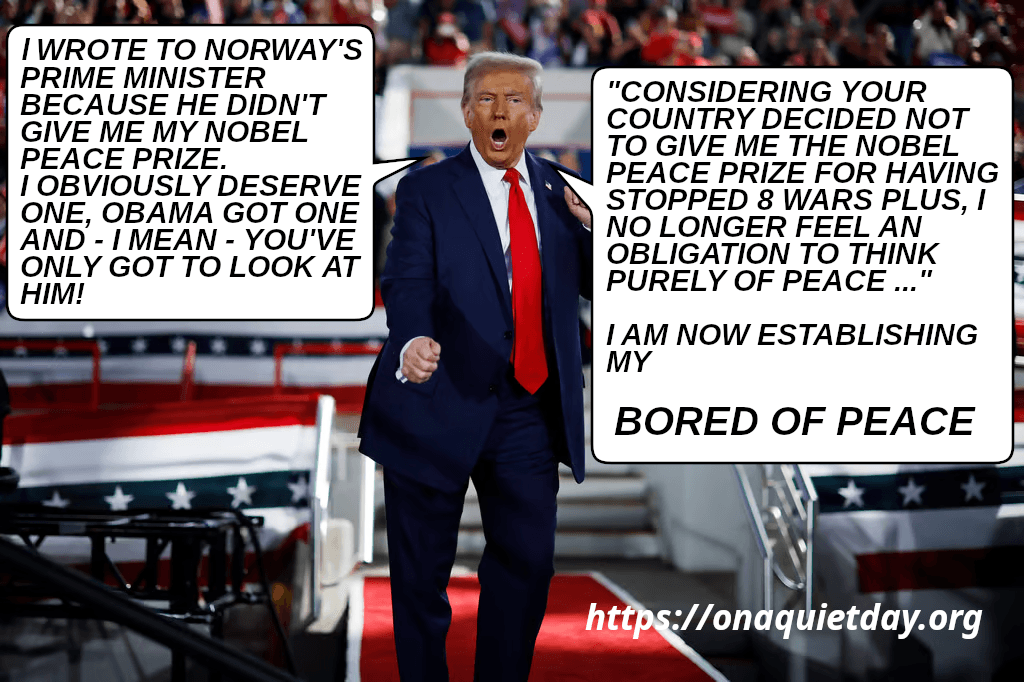
Donald Trump explains why he established his Bored of PeaceClimate science denier Donald Trump confirms that he knows nothing about democracy and that more liquid gold is being secured according to his policy of global privateering.
This work by Middle East Monitor is licensed under a Creative Commons Attribution-NonCommercial-ShareAlike 4.0 International License.
Large commercial vessels and a small boat navigate the waters off the southern port city of Bandar Abbas, Iran on June 21, 2026. [Hassan Ghaedi – Anadolu Agency]
Commercial vessel traffic through the Strait of Hormuz rose more than 50% from the previous week amid ongoing negotiations following a temporary deal between the US and Iran, Anadolu reports.
Negotiations between the two countries remain fragile despite the deal reached on June 14, which took effect on June 18.
Before the war broke out at the end of February, an average of 130 commercial vessels transited the Strait of Hormuz each day. Following a virtual standstill after joint US-Israeli strikes on Iran and Tehran’s subsequent retaliation, maritime traffic through the strategic waterway has begun to recover following the US-Iran deal.
Despite the recent increase, traffic through the strait remains around 70% below pre-war levels.
Industry representatives remain cautious about using the waterway because of the fragile state of US-Iran negotiations and continuing uncertainty.
According to data from analytics firm Kpler, 223 commercial vessels transited the Strait of Hormuz during the week of June 15-21, averaging 32 transits per day.
The lowest daily traffic was recorded on June 17 with 19 vessels, while the highest was 54 on June 22.
During the week of June 22-28, 343 commercial vessels passed through the strait, with the daily average rising to 49 vessels. The lowest daily total was 24 vessels on June 28, while the highest reached 76 on June 24.
June 24 recorded the heaviest traffic through the Strait of Hormuz since the war began on Feb. 28.
Compared with the previous week, traffic through the strait increased by nearly 54%, with tankers carrying crude oil and petroleum products—primarily from Iran, Saudi Arabia, the United Arab Emirates, Iraq and Kuwait—accounting for most transits.
At least 6 million barrels of crude oil transited the Strait of Hormuz on Monday, the data showed.
A significant share of vessels continued to use the route designated within Iranian territorial waters, with most of those transits carried out by shadow fleet and sanctioned vessels.
Donald Trump explains why he established his Bored of PeaceClimate science denier Donald Trump confirms that he knows nothing about democracy and that more liquid gold is being secured according to his policy of global privateering.