Israeli Defense Minister Yisrael Katz visits a military base and the military unit in the occupied territory of southern Lebanon on April 12, 2026. (Photo by Elad Malka (IMoD)/Handout/Anadolu via Getty Images)
One critic described the Israeli official’s remarks as the country’s “official statement of intent to commit further war crimes in Iran.”
Israeli Defense Minister Israel Katz on Thursday said his country was ready to unleash devastating new attacks on Iran should it get approval from US President Donald Trump.
As reported by Amichai Stein, diplomatic correspondent for iNews24, Katz said that Israel is “prepared to resume the war” and is “awaiting a green light from the United States.”
Katz also vowed that Israel would hit Iran even harder than in previous strikes, vowing “to complete the elimination of the Khamenei family and to push Iran back into a dark age.”
“This time, the strike will be different and far more lethal, delivering devastating blows at the most sensitive points,” Katz warned, “ones that will shake and undermine its very foundations.”
Dylan Williams, vice president for government affairs at the Center for International Policy, described Katz’s remarks as “Israel’s official statement of intent to commit further war crimes in Iran.”
Drop Site News reporter Ryan Grim observed that the Israeli defense minister’s threats are reminiscent of the strategy that it has employed in Gaza in its effort to dislodge Hamas over the last three years.
“Israel believes it is always a few good assassinations away from total victory,” Grim commented. “Now pledging more.”
Trump, in partnership with Netanyahu, illegally launched a war with Iran in late February without any congressional authorization. In response to the attack, Iran shut down all shipping traffic through the Strait of Hormuz, choking off roughly 20% of the global oil supply.
In that time, the price of oil has soared, Trump’s approval ratings have crashed to record lows, and a UN expert warned on Wednesday about the possibility of a global food crisis if the strait is not soon reopened to fertilizer shipments.
There has been a fragile ceasefire agreement in effect between the US, Israel, and Iran for the last two weeks, which Trump extended indefinitely on Tuesday.
Protesters in opposition to the war with Iran gather outside of Lafayette Park across from the White House on April 7, 2026 in Washington, DC. As the protest was held, U.S. President Donald Trump was announcing a two-week ceasefire with Iran at the behest of Pakistan, which has been serving as an intermediary during the conflict. (Photo by Andrew Leyden/Getty Images)
Trump continues to issue maximalist demands for conditions he helped create. The American president’s lack of strategic and emotional maturity only promises more war.
The closure of the Strait of Hormuz following the temporary ceasefire is the culmination of an American policy defined by strategic incoherence. At the center stands Donald Trump, whose shifting positions, confused war objectives, and conflicting actions have not only failed to ease regional tensions but have actively deepened them.
Nowhere is this clearer than in Trump’s threats to blow up the whole country, including its bridges and power plants. At the same time, he touted a military “big day,” presenting potential war crimes as diplomatic tool, aggression as diplomacy, and destruction as leverage.
Trump inflated, almost delusional, promises ahead of potential talks come across less as statesmanship and more as a calculated sales pitch to the American public. His vows “to end up with a great deal,” coupled with an almost obsessive focus on Barack Obama by insisting his agreement will be “far better” than the one negotiated over a decade ago. An approach that reflects a tendency toward messaging driven less by policy depth and more by projection, comparison, and to frame outcomes in terms of self-aggrandizement and personal glory. Instead of articulating clear strategic objectives, his policy relies on distinguishing himself and image cultivation to project authority and superiority, leaving the underlying substance vague and open to question.
By manufacturing optimism and exaggerating progress while promising an imminent “great deal,” Trump appears to be negotiating with himself—or detached from reality—seeking to construct a narrative of success regardless of the facts on the ground. The performative optimism stands in sharp contrast to his simultaneous threats and pompous rhetoric, suggesting not confidence but a measure of desperation.
This yo-yoing of positions does more than create confusion; it erodes the credibility. Diplomacy depends on a baseline of predictability and mental stability.
Trump’s rationale for extending the ceasefire because of “internal divisions” within Iran is unconvincing. If internal debate within Iran is seen as warranting a pause, what should be said of a policy where direction shifts from one moment to the next? Differing political views are the essence of a normally functioning political system, whereas impulsive, erratic, personalized decision-making is not.
All of this unfolds as Trump continues issuing maximalist demands for conditions he helped create. For instance, he demands the surrender of enriched uranium that would not exist had he not abandoned the Joint Comprehensive Plan of Action (JCPOA). Likewise, the Strait of Hormuz was closed as a consequence of his and Netanyahu’s war, not as its cause.
The consequences of these Israel-driven U.S. policies are felt by ordinary Americans at the gas pump and in grocery stores. The Strait of Hormuz has become a battleground, destabilizing global energy supply chains and economies worldwide. Yet despite these cascading effects, the core strategy remains unchanged. Trump continues to operate within an echo chamber of Israel-first sycophants that assume military might alone can deliver results, even as the policy falters and the war spills across the region, threatening roughly one-fifth of the world’s energy infrastructure.
This is not merely a political flaw or a matter of mismanagement. It is rather a strategic vulnerability shaped by Israel-first loyalists pulling U.S. strategy in directions that ultimately undermine U.S. national interests. In the absence of clearly defined national objectives, as in the first Israel’s war in Iraq, each step risks drawing the U.S. deeper into the polluted water of the Gulf, while simultaneously advancing an environment of chaos that serves only Israel’s calculated aims.
In this framework, was Israeli Prime Minister Benjamin Netanyahu’s recent statement that the war with Iran is “not over” an embedded message to Trump ahead of the proposed peace talks in Pakistan?
Negotiation between countries, especially in the context of war is not selling real estate deals, where haggling and the threat of retracting an offer are routine tactics. The craft of negotiation in this case operates on an entirely different level. Culture, national dignity, historical memory, and political positioning shape both the process and the outcome. Leaders are not merely bargaining over financial assets or credit ratings, they are navigating domestic demands, legitimacy, and the perception of strength or weakness on the global stage.
In this regard, threats or the constant withdrawal and reintroduction of proposals are not leverage, they are weakness. Unlike commercial transactions where the “Art of the Deal” is largely concluded at the moment of signing, international agreements mark the beginning of an ongoing, often long-term relationship. What may pass as hard-nosed bargaining in business can, in international diplomacy, be interpreted as bad faith, an approach that tends to invite resentment and resistance instead of compromise. This is why since last Tuesday, Trump was left waiting for Iran to come to the negotiation table.
Effective diplomacy requires serious leadership, consistency, and an understanding of the symbolic as much as the substantive. Agreements endure not because one side is pressured into submission, but because all parties can present the outcome as preserving their dignity and advancing mutual interests.
The lack of strategic maturity is indicative in a proclamation in the morning signaling openness to de-escalation; by midday, the message splinters, issuing threats and ultimatums while simultaneously hinting at imminent breakthrough deals; by the middle of the night, amid his insomnia, it escalates to threats of total destruction. This constant shifting of positions is not a minor stylistic quirk. It is possible that, at least some of this, is associated with his nocturnal communications with Netanyahu, who is apparently wagging him left and right.
This yo-yoing of positions does more than create confusion; it erodes the credibility. Diplomacy depends on a baseline of predictability and mental stability. When signals shift faster than the wind, uncertainty breeds mistrust, and negotiations drift from closed rooms into fiery statements played out for public consumption, creating an opening for Israel to drive the war and breed destruction and more chaos.
This work by Middle East Monitor is licensed under a Creative Commons Attribution-NonCommercial-ShareAlike 4.0 International License.
Iranian President Masoud Pezeshkian delivers a speech during an inspection visit to the Ministry of Sports and Youth in Tehran, Iran on April 19, 2026. [Iranian Presidency – Anadolu Agency]
Iran is seeking to end the war with the US and Iran “with dignity,” the country’s President Masoud Pezeshkian said Sunday, arguing that US President Donald Trump has no right to deprive Tehran of its nuclear rights, Anadolu reports.
“Trump says Iran should not use its nuclear rights, but does not explain what crime Iran has committed,” Pezeshkian said during a visit to Iran’s Sports and Youth Ministry, the ISNA news agency reported.
He also called for the nation to stand “firm against a bloodthirsty and brutal enemy.”
Iran must manage the current atmosphere in a way that “does not portray us as war-mongers” as “we are defending ourselves,” he added.
“Our girls in Australia have delivered a strong blow to the enemy. Those two dear girls who were misled by the enemies are always welcome back whenever they return; our arms are open to them,” Pezeshkian added, referring to the Australian Women Football Team’s performance at last month’s Asian Cup, as well as two of its players who sought asylum.
On Feb. 28, the U.S. and Israel launched a joint offensive on Iran, and Tehran retaliated with strikes on Israel and other regional countries hosting U.S. assets.
The war has been on hold since April 8, when Pakistan mediated a two-week ceasefire.
Washington and Tehran held talks in Pakistan last weekend towards a lasting peace, and efforts for another session in Islamabad are underway.
This work by Middle East Monitor is licensed under a Creative Commons Attribution-NonCommercial-ShareAlike 4.0 International License.
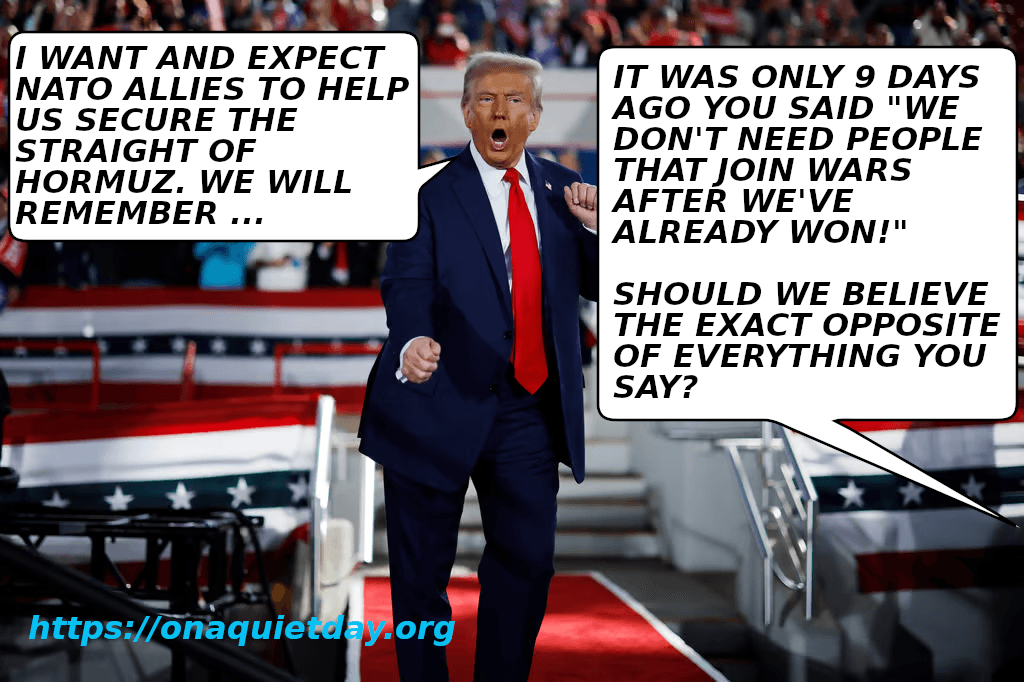
Donald Trump calls for help from NATO allies in securing the Straight of Hormuz despite saying on 7 March 2026 that they don’t need people to join wars after they’ve already won. He’s challenged with the claim that he lies as much as the IDF.Keir Starmer explains that UK is actively supporting Israel’s genocidal expansion and repeats his previous quotation that he supports Zionism “without qualification”. Keir Starmer said “I said it loud and clear – and meant it – that I support Zionism without qualification.” here: https://www.jewishnews.co.uk/keir-starmer-interview-i-will-work-to-eradicate-antisemitism-from-day-one/
This work by Middle East Monitor is licensed under a Creative Commons Attribution-NonCommercial-ShareAlike 4.0 International License.
Hundreds of pro-Iranian demonstrators take streets to protest against Israeli-US attacks on Iran and Middle East, in San Francisco, California, United States on April 8, 2026. [Tayfun Coşkun – Anadolu Agency]
Israel, along with its ally the US, is preparing for a possible collapse of the ceasefire with Iran, with energy facilities could be potential targets, local media reported on Sunday, Anadolu reports.
“There is close coordination between the two sides, and if fighting resumes, the targets will also include Iranian energy facilities,” the Israeli newspaper Maariv said, citing a senior unnamed Israeli military official.
“Iran insists on its previous position regarding its right to uranium enrichment, and there is no optimism among mediators” in talks between Washington and Tehran, the report claimed.
On Feb. 28, the US and Israel launched a joint offensive on Iran, killing more than 3,300 people. Tehran retaliated with strikes on Israel and other regional countries hosting US assets.
The war was brought to a halt on April 8 under a two-week ceasefire mediated by Pakistan.
Washington and Tehran held rare direct talks in Pakistan last weekend, but the talks ended without any agreement. Mediators are seeking to hold another round of discussions in Islamabad.
Iranian Parliament Speaker Mohammad Bagher Qalibaf said Sunday that major differences remain between Tehran and Washington despite progress in negotiations.
This work by Middle East Monitor is licensed under a Creative Commons Attribution-NonCommercial-ShareAlike 4.0 International License.
Donald Trump calls for help from NATO allies in securing the Straight of Hormuz despite saying on 7 March 2026 that they don’t need people to join wars after they’ve already won. He’s challenged with the claim that he lies as much as the IDF.Keir Starmer explains that UK is actively supporting Israel’s genocidal expansion and repeats his previous quotation that he supports Zionism “without qualification”. Keir Starmer said “I said it loud and clear – and meant it – that I support Zionism without qualification.” here: https://www.jewishnews.co.uk/keir-starmer-interview-i-will-work-to-eradicate-antisemitism-from-day-one/
US President Donald Trump addresses a Turning Point USA event at Dream City Church in Phoenix, Arizona, on April 17, 2026. (Photo by Jim Watson/AFP via Getty Images)
“Whether he means it or not, his saying it is an indelible moral stain on our country,” said one law professor.
President Donald Trump on Sunday renewed his threat to carry out a genocidal attack on Iran, pledging to “blow up” the “whole country” of over 90 million people and to demolish critical civilian infrastructure if it does not sign a peace deal by Wednesday.
“If they don’t sign the deal, then the whole country is going to get blown up,” Trump said, according to Fox News correspondent Trey Yingst, who relayed the comments on air Sunday morning.
Trump also reportedly said that the US was “preparing to hit [Iran] harder than any country has ever been hit before because you cannot let them have a nuclear weapon.”
Spoke with President Trump this morning about Iran for 20 minutes.
"If they don't sign this deal, the whole country is going to get blown up," he told me.
The President said that Special Envoys Witkoff and Kushner will travel to Islamabad, Pakistan for talks this week. pic.twitter.com/kem9GACE6D
The comments came after Iran once again closed the Strait of Hormuz on Saturday in response to the continued US blockade of Iranian ports, which Iranian officials said violated the terms of the agreement reached between the two countries.
After renewing the blockade, Iranian gunboats fired upon a pair of Indian-flagged ships attempting to travel through the strait Saturday.
In response, Trump issued a furious post on Truth Social Sunday morning, saying that he would send a team of negotiators—Vice President JD Vance, his son-in-law Jared Kushner, and special envoy to the Middle East Steve Witkoff—to Islamabad on Monday for another round of negotiations.
“We’re offering a very fair and reasonable DEAL, and I hope they take it because, if they don’t, the United States is going to knock out every single Power Plant, and every single Bridge, in Iran,” Trump wrote. “NO MORE MR. NICE GUY!”
“They’ll come down fast, they’ll come down easy and, if they don’t take the DEAL, it will be my Honor to do what has to be done, which should have been done to Iran, by other Presidents, for the last 47 years,” he continued.
It echoed the similarly genocidal threat made by Trump earlier in April that “a whole civilization will die… never to be brought back again,” if Iran did not agree to a deal, which drew worldwide condemnation and sparked efforts by some members of Congress to pursue impeachment or push for Trump’s cabinet to remove him via the 25th Amendment.
Trump has appeared eager to end the war with Iran after it caused economic upheaval and pushed his already dire approval rating even lower. But he has also backed Israel when it sought to undermine key points of the agreement, prompting retaliation from Iran.
The ceasefire announced earlier this month between the US and Iran initially included a halt to the hostilities between Israel and Lebanon. But within hours, Israel unleashed its most punishing set of attacks against Lebanon since the war began in March. Trump then backed Israeli Prime Minister Benjamin Netanyahu when he claimed that Lebanon was never part of the deal.
Iran only agreed to open the Strait of Hormuz on Friday after Israel and Lebanon appeared to agree to a 10-day ceasefire. But Israel has already violated that agreement several times, continuing to raze Lebanese villages and fire upon people approaching its newly imposed “yellow line.”
In addition to calling for the reopening of the Strait of Hormuz, which was open before he launched the war in late February, Trump has demanded that Iran make a deal to hand over all of its enriched uranium, which he refers to as “nuclear dust.”
A spokesperson for Iran’s Islamic Revolutionary Guard Corps (IRGC) has said such a proposal would violate Iran’s sovereignty: “Iran’s uranium is Iran’s asset. It is our responsibility, our energy, our sovereign right.”
An end to the attacks against Lebanon has been described as another central demand from Iran, although officials said the decision to close the strait again on Saturday was in response to Trump’s continued blockade of Iranian ports.
Mike Waltz on Trump's latest threat to blow up Iran's civilian infrastructure: "Everything is on the table, and the president has made it very clear he's prepared to escalate to deescalate this conflict, as he should be … we have a long history of taking down bridges, power… pic.twitter.com/zM6iGuW8zc
International law strictly prohibits indiscriminate attacks on civilian infrastructure with no military objective, including bridges and power plants that are critical to human life.
Trump’s previous threats to bomb Iran “back to the Stone Ages” suggest that the latest threats are less about accomplishing a specific military objective than about inflicting suffering on Iranian society as leverage.
Last time Trump made such a threat, a coalition of more than 200 groups, including Amnesty International, Human Rights Watch, Refugees International, and Oxfam America, wrote in an urgent letter stating that if carried out, such attacks would constitute “a grave atrocity” and that “a threat to wipe out ‘a whole civilization’ may amount to a threat of genocide.”
Human Rights Watch said that, if acted upon, “the statement could be indicative of criminal intent if Trump were ever prosecuted by the International Criminal Court.
The last time Trump threatened to unleash an apocalyptic attack on Iran, the threat preceded a deal that, at least in principle, involved the US agreeing to negotiate based on a set of terms laid out by the Iranians. This led manyobservers to characterize the threats as bluster meant to save face before capitulation rather than a sincere pledge to annihilate Iran.
However, Adil Haque, a law professor at Rutgers and the executive editor at Just Security, said that, “Whether he means it or not, his saying it is an indelible moral stain on our country.”
Keir Starmer explains that UK is actively supporting Israel’s genocidal expansion and repeats his previous quotation that he supports Zionism “without qualification”. Keir Starmer said “I said it loud and clear – and meant it – that I support Zionism without qualification.” here: https://www.jewishnews.co.uk/keir-starmer-interview-i-will-work-to-eradicate-antisemitism-from-day-one/Donald Trump sings and dances, says that it’s fun to kill everyone …Orcas discuss Genocide-supporting and complicit Zionists. Donald Trump, Keith Starmer, David Lammy, Rachel Reeves, Angela Rayner and Wes Streeting are acknowledged as evil genocide-complicit and supporting cnuts.