This work by Middle East Monitor is licensed under a Creative Commons Attribution-NonCommercial-ShareAlike 4.0 International License.
Commercial ships anchor off the coast of the United Arab Emirates due to navigation disruptions in the Strait of Hormuz, Dubai on March 2, 2026. [Stringer – Anadolu Agency]
Russia, China and France have blocked a broad Arab initiative aimed at securing international backing for military action against Iran to reopen the Strait of Hormuz, The New York Times reported.
According to a diplomat and senior United Nations official, Arab states sought a resolution “authorising the use of force” to ensure global freedom of navigation. However, the effort failed due to opposition from the three countries, which hold veto power.
Russia, China and France said their stance was based on a “principled opposition to any language authorising force”. This position has been widely interpreted as effectively allowing Iran to continue holding the global economy hostage and restricting the flow of oil and goods.
The development highlights deep divisions within the international community. France aligned with Russia and China in blocking what was described as a necessary military decision against Tehran, while the United States and Israel continue their military actions against Iran and reject calls for a ceasefire.
This work by Middle East Monitor is licensed under a Creative Commons Attribution-NonCommercial-ShareAlike 4.0 International License.
Relates to a UN Security Council resolution which was defeated – through being opposed – by Russia, China and France.
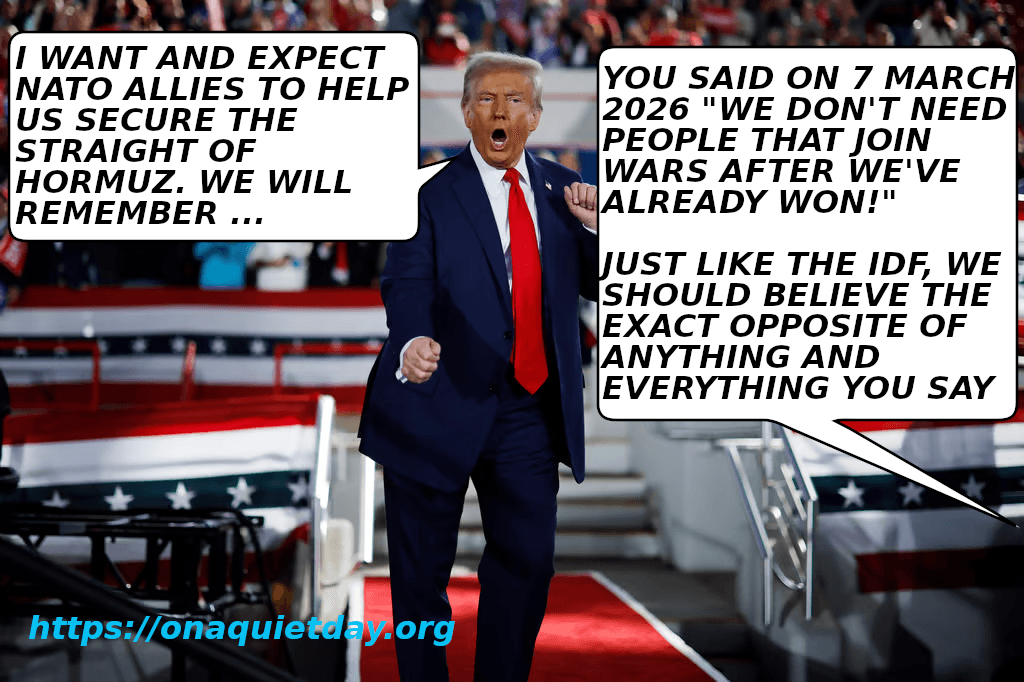
Donald Trump calls for help from NATO allies in securing the Straight of Hormuz despite saying on 7 March 2026 that they don’t need people to join wars after they’ve already won. He’s challenged with the claim that he lies as much as the IDF.Keir Starmer explains that UK is actively supporting Israel’s genocidal expansion and repeats his previous quotation that he supports Zionism “without qualification”. Keir Starmer said “I said it loud and clear – and meant it – that I support Zionism without qualification.” here: https://www.jewishnews.co.uk/keir-starmer-interview-i-will-work-to-eradicate-antisemitism-from-day-one/
Climate science denier Donald Trump confirms that he knows nothing about democracy and that more liquid gold is being secured according to his policy of global privateering.
Keir Starmer explains that UK is actively supporting Israel’s genocidal expansion and repeats his previous quotation that he supports Zionism “without qualification”. Keir Starmer said “I said it loud and clear – and meant it – that I support Zionism without qualification.” here: https://www.jewishnews.co.uk/keir-starmer-interview-i-will-work-to-eradicate-antisemitism-from-day-one/Donald Trump sings and dances, says that it’s fun to kill everyone …Climate science denier Donald Trump confirms that he knows nothing about democracy and that more liquid gold is being secured according to his policy of global privateering.
This work by Middle East Monitor is licensed under a Creative Commons Attribution-NonCommercial-ShareAlike 4.0 International License.
In this photo illustration the Amazon logo is displayed on a mobile phone screen in front of the Amazon company icons in Ankara, Turkiye on October 20, 2025. [Hakan Nural – Anadolu Agency]
Amazon’s cloud computing operation in Bahrain was damaged in an Iranian strike, according to a report Wednesday by the Financial Times, which cited someone familiar with the matter.
Bahrain’s Interior Ministry said earlier that civil defense teams were “extinguishing a fire in a facility of a company as a result of the Iranian aggression,” but did not identify the company or provide details on the extent of the damage. Amazon declined to comment on any specific strike, according to the report.
The attack is the latest sign that the conflict between the US, Israel and Iran is spilling into the Gulf’s commercial technology infrastructure.
The development came one day after Iran’s Islamic Revolutionary Guard Corps (IRGC) threatened to target major US technology companies operating in the Middle East, including Amazon, Microsoft, Google and Apple, widening concerns that digital and economic assets may increasingly come into the line of fire.
Amazon said on March 2 that two of its data center facilities in the United Arab Emirates and one in Bahrain sustained physical impacts from drone strikes.
Amazon Web Services (AWS) launched its Middle East (Bahrain) Region in July 2019 as its first cloud region in the Middle East. AWS said the Bahrain region consists of three Availability Zones and serves customers seeking lower-latency cloud infrastructure in the region.
This work by Middle East Monitor is licensed under a Creative Commons Attribution-NonCommercial-ShareAlike 4.0 International License.
Donald Trump calls for help from NATO allies in securing the Straight of Hormuz despite saying on 7 March 2026 that they don’t need people to join wars after they’ve already won. He’s challenged with the claim that he lies as much as the IDF.Keir Starmer explains that UK is actively supporting Israel’s genocidal expansion and repeats his previous quotation that he supports Zionism “without qualification”. Keir Starmer said “I said it loud and clear – and meant it – that I support Zionism without qualification.” here: https://www.jewishnews.co.uk/keir-starmer-interview-i-will-work-to-eradicate-antisemitism-from-day-one/Climate science denier Donald Trump confirms that he knows nothing about democracy and that more liquid gold is being secured according to his policy of global privateering.
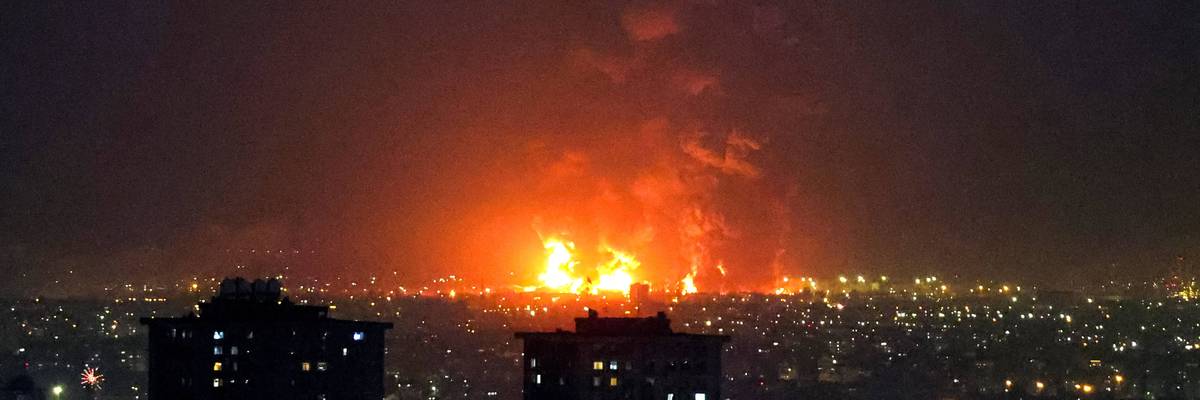
Explosions erupt following strikes at Tehran Oil Refinery in Tehran on March 7, 2026. (Photo by Atta Kenare/ AFP via Getty Images)
It’s a dirty business that’s ruining the planet and jeopardizing our futures in countless ways, of which this despicable war in Iran is just the latest and highest profile.
Oil is both a major driver of this war and, for now at least, the primary way Americans are feeling its effects. The war drives home the grim reality that we are hostage to this toxic ooze that burns dirty, poisons wildlife, causes cancer, and accelerates climate change. The necessity to wean ourselves off of it, as quickly and completely as possible, has never been more apparent.
An Oil Crisis of Trump’s Own Making
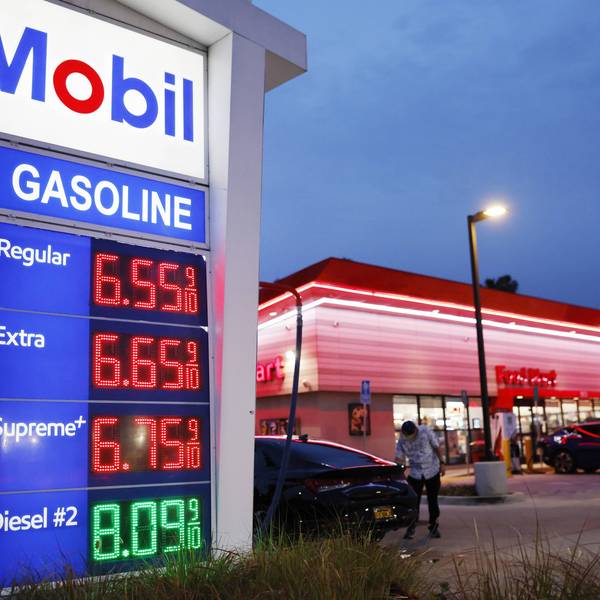
Even Trump is subservient to the whims and demands of the oil economy. Since he started the war, he’s tried desperately to control the chaotic effect his bombing campaign has had on global oil markets. Trump may not be bright, but he understands one very basic political reality: He can cover up the Epstein files, get away with all manner of fraud and graft, and even commit war crimes—but he cannot let the price of gas get too high.
Oil makes all our lives dirtier and less safe. Fighting wars so we can dig it up until it’s all gone—or until we are—is as stupid, reckless, and self-destructive a thing as any animal has ever done.
From a strategic perspective, then, the focal point of the war quickly became the Strait of Hormuz, a narrow passageway out of the Persian Gulf that pinches down between southern Iran and the Omani Musandam Peninsula. The strait is an essential shipping lane for 20% of the world’s liquefied natural gas (LNG), as well as a third of the global fertilizer trade. With essentially uncontested control of the strait, Iran has closed it to “enemy-linked” ships. Iran insists that non-hostile ships pay a toll in Chinese yuan, which is an attempt to undermine the supremacy of the petrodollar.
The crisis at the Strait of Hormuz is entirely of Trump’s own making, and has triggered an erratic series of threats, pleas, lies, and bargaining from him as he tries to keep his stupid war from grinding the global economy to a halt. Trump has even threatened to deploy the US Navy to escort ships through the strait. One has to wonder how sailors feel about being offered up as bodyguards for Qatari tankers, thrown into a situation where they would be wide open for Iranian drone and missile attacks.
Trump the Oil Imperialist
Trump sees this war almost entirely through the lens of oil. As part of alleged ceasefire negotiations, Trump claimed Iran “gave us a present… worth a tremendous amount of money… it was oil-and-gas related.” That turned out to be Iran allowing 10 oil ships through the Strait of Hormuz. Trump also implied that those high gas prices causing so many people pain at the pump are actually good for the country. Because the US is a net exporter of oil, Trump said, “When oil prices go up, we make a lot of money”—perhaps forgetting that most Americans do not own oil companies.
Compare Trump’s constant talk of oil with the Bush administration’s 2003 invasion of Iraq. In 2003-06, calling Iraq a war for oil was considered a conspiracy theory. Dissidents and war critics were driven out of polite conversations for even bringing it up. Insinuating that the troops would ever be deployed for such an ignoble purpose was treated as beyond the pale, if not treasonous, by Fox News and the Bush White House.
This time, there’s next to no pretense of nobility in Trump’s war. While lots of motivations, with varying degrees of believability and logic, have been given—ranging from halting Iran’s nuclear capabilities to ushering in Armageddon—the Trump administration is perfectly open about the centrality of oil to their war mission. In a way, it’s almost refreshing to hear a politician speak so forwardly about their imperialist intent, even if it does lay bare the villainy of the US empire.
In addition to the Strait of Hormuz, Trump is focused on Kharg Island, a small island in the Persian Gulf that handles up to 90% of Iran’s crude oil exports. Sen. Lindsey Graham (R-SC), who is among the most bloodthirsty war hawks on the planet, encouraged Trump to seize Kharg Island (and compared such an operation to Iwo Jima, in which 7,000 Marines died—no skin off Lindsey Graham’s back). Trump himself then said, while discussing his military options, “My favorite thing is to take the oil in Iran.”
Trump has long openly fantasized about using the military to conquer oil fields. In 2013, before his political career really started, he tweeted, “I still can’t believe we left Iraq without the oil,” and he repeated this urge to plunder Iraq’s oil during the 2016 election. To Trump, this is just how the world works: If your guns and bombs make bigger holes and explosions, you get to just take whatever you want, anywhere in the world. There is no right, no wrong, no law.
This also tracks with how Trump has handled the oil industry in Venezuela. Last year, Trump started claiming that Venezuela had stolen, or “unilaterally seized and sold American oil.” This claim was a reference to Venezuela nationalizing their oil industry and evicting American oil companies. Then, in January, the US military abducted Venezuelan President Nicolás Maduro, an astonishing breach of international norms. With Maduro gone, Trump began shadily directing Venezuelan oil revenue into an offshore Qatari account.
The Need to Wean Ourselves off of Oil
Such oil imperialism long predates Trump. Just ask other offenders of the US oil monopoly, like Muammar Gaddafi or Saddam Hussein. Oil is the locus of US foreign policy. The US military itself is the single largest institutional polluter and user of fossil fuels. It’s a dirty business that’s ruining the planet and jeopardizing our futures in countless ways, of which this despicable war in Iran is just the latest and highest profile.
The simple answer to all this madness is to wean ourselves off of oil. It won’t be easy, and we’ll probably never be fully rid of it, but we aren’t even trying. There are a million ways we could start cutting back, a million investments we could make toward a future that is as oil free as possible. But Trump is doing everything he can to keep us addicted to it, including starting an unpopular and illegal war.
Trump has always been particularly pro-fossil fuel. He loves the nonsensical phrase “beautiful clean coal.” He calls green energy a “scam” and has repeatedly made the utterly deranged claim that windmills cause cancer. His administration displays a psychotic obsession with destroying green energy initiatives, most recently paying a French energy company $1 billion to cancel a wind farm and instead invest in oil and gas.
Oil makes all our lives dirtier and less safe. Fighting wars so we can dig it up until it’s all gone—or until we are—is as stupid, reckless, and self-destructive a thing as any animal has ever done. With a little bit of will and some leadership, we could control our greed and addiction. If we were able to do that, we might not find ourselves charging into the Middle East on such a regular basis, burning through American lives and treasure, killing countless men and women and children, and making the rest of the world hate us.
Climate science denier Donald Trump confirms that he knows nothing about democracy and that more liquid gold is being secured according to his policy of global privateering.Donald Trump urges you to be a Climate Science denier like him. He says that he makes millions and millions for destroying the planet, Burn, Baby, Burn and Flood, Baby, Flood.Orcas comment on killer apes destroying the planet by continuing to burn fossil fuels.
This work by Middle East Monitor is licensed under a Creative Commons Attribution-NonCommercial-ShareAlike 4.0 International License.
Minister of National Defence of Poland Wladyslaw Kosiniak-Kamysz attends the E5 Group Ministers of Defence meeting in Krakow, Poland, on February 20, 2026. [Jakub Porzycki – Anadolu Agency]
Poland will not send any of its Patriot air-defense batteries to the Middle East, Defense Minister Wladyslaw Kosiniak-Kamysz said on Tuesday, after reports that the United States had informally asked Warsaw to consider doing so, Anadolu reports.
Polish daily Rzeczpospolita reported on Tuesday that Washington had unofficially sounded out Poland about deploying one of its two Patriot batteries amid the escalating conflict with Iran and rising missile attacks on US forces and allies in the region.
Kosiniak-Kamysz quickly rejected the idea, writing on X that Poland’s Patriots “serve to protect Polish skies and NATO’s eastern flank.”
“Nothing is changing in this regard, and we are not planning to relocate them anywhere,” he wrote. “Our allies understand perfectly well how important the tasks we have here are. Poland’s security is an absolute priority.”
The ministry also denied suggestions that the United States had pressured Warsaw. Janusz Sejmej, spokesman for the Defense Ministry, told Rzeczpospolita, “The Americans are not pressuring us in any way on these matters.”
Poland’s chief of the general staff, Wieslaw Kukula, also dismissed the reports, writing on X that “no one is asking for it.”
Poland currently has two operational Patriot batteries, both reaching full operational readiness at the end of 2025 after integration into the Wisla air-defense system and the US-made IBCS command network.
Based with the 37th Air Defense Missile Squadron in Sochaczew, the batteries can intercept aircraft and missiles at distances up to 100 kilometers.
Warsaw has long argued that, as NATO’s main eastern-flank state bordering Russia, Belarus, and Ukraine, it cannot afford to weaken its own air-defense capability.
Kosiniak-Kamysz made a similar point last year when reports emerged that American Patriots protecting the Rzeszow logistics hub could be moved elsewhere, insisting that “Polish Patriots also remain in Poland.”
The issue highlights growing global pressure on Patriot systems as the conflict with Iran intensifies. Poland has ordered six additional batteries, due to be delivered between 2027 and 2029, but there are concerns the Middle East war could delay missile deliveries because of sharply rising demand from the US and Gulf states.
Prime Minister Donald Tusk has also ruled out Polish military involvement in the conflict, saying previously that Poland would not send troops to Iran.
Donald Trump calls for help from NATO allies in securing the Straight of Hormuz despite saying on 7 March 2026 that they don’t need people to join wars after they’ve already won. He’s challenged with the claim that he lies as much as the IDF.Keir Starmer explains that UK is actively supporting Israel’s genocidal expansion and repeats his previous quotation that he supports Zionism “without qualification”. Keir Starmer said “I said it loud and clear – and meant it – that I support Zionism without qualification.” here: https://www.jewishnews.co.uk/keir-starmer-interview-i-will-work-to-eradicate-antisemitism-from-day-one/
Donald Trump warns against following the https://onaquietday.org blog, says that it’s easy atm, she only needs to report war crimes supporting Israel’s genocidal expansion.