This work by Middle East Monitor is licensed under a Creative Commons Attribution-NonCommercial-ShareAlike 4.0 International License.
File picture dated April 3, 2007 shows an Iranian flag outside the building housing the reactor of the Bushehr nuclear power at plant Natanz facility [BEHROUZ MEHRI/AFP FILES/AFP via Getty Images]
The possibility of Iran’s withdrawal from the Nuclear Non‑Proliferation Treaty (NPT) is under discussion in Tehran, Iranian media reported on Saturday, Anadolu reports.
Relevant government bodies, including parliament, are currently “urgently” mulling withdrawal, Iran’s semi-official Tasnim News Agency reported.
On the US social media company X, Tehran Deputy Malek Shariati said an “emergency plan to support the nuclear rights” of Iran has three main areas.
These include a declaration of withdrawal from the NPT, the cancellation of the countermeasure law in implementing the 2014 Iran nuclear deal, and support for a new international agreement with like-minded countries for the development of peaceful nuclear technologies, including Shanghai and the BRICS bloc of Brazil, Russia, India, China, South Africa, and others.
The possibility of withdrawal comes with the entire region on alert since the US and Israel launched an air offensive on Iran on Feb. 28, since killing over 1,340 people, including then-Supreme Leader Ali Khamenei.
Though analysts say the US has not been clear in its objectives in the war, Washington has long objected to Iran enriching nuclear material to weapons-grade.
Iran responded to the offensive with drone and missile attacks targeting Israel, as well as Jordan, Iraq, and Gulf countries hosting US military bases, causing casualties, infrastructure damage, and disruption to global markets and aviation.
Donald Trump calls for help from NATO allies in securing the Straight of Hormuz despite saying on 7 March 2026 that they don’t need people to join wars after they’ve already won.Keir Starmer explains that UK is participating defensively in Trump and Israel’s criminal war for Israel’s genocidal expansion in Iran and states that he supports Zionism “without qualification”. Keir Starmer said “I said it loud and clear – and meant it – that I support Zionism without qualification.” here: https://www.jewishnews.co.uk/keir-starmer-interview-i-will-work-to-eradicate-antisemitism-from-day-one/Orcas discuss how Trump was re-elected and him being an obviously insane, xenophobic Fascist.
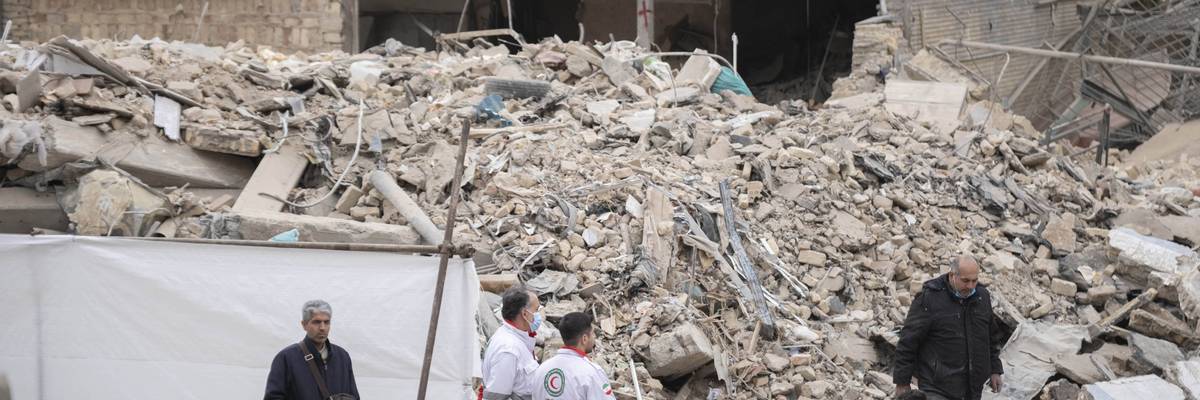
Two members of the Iranian Red Crescent Society stand among others on the ruins of buildings in a residential area in Tehran, Iran, on March 15, 2026. (Photo by Morteza Nikoubazl/NurPhoto via Getty Images)
“The end of the war will occur when Iran decides it should end, not when Trump envisions its conclusion,” said an Iranian official.
Iranian state media reported Wednesday that Iran has rejected the Trump administration’s 15-point ceasefire plan, and a senior official outlined five conditions for ending the war, which the US and Israel launched late last month.
As President Donald Trumpsent thousands more troops to the Middle East, the ceasefire plan “was submitted to Iran by intermediaries from Pakistan, who have offered to host renewed negotiations between Washington and Tehran,” The Associated Press reported early Wednesday, citing an unnamed source briefed on the US proposal.
As experts warn that a global recession could occur if Iran continues to restrict the flow of fossil fuels through the Strait of Hormuz, Reuters highlighted that elevated “oil prices sank about 5% on Wednesday after reports the United States had sent Iran a 15-point proposal aimed at ending the war.”
However, “Iran has responded negatively to an American proposal aimed at ending the ongoing imposed war,” according to the Iranian state-run Press TV, which spoke with a senior political-security official.
Characterizing previous negotiations with the US—including nuclear talks in the lead-up to the current war—as deceptive, the official said that “Iran will end the war when it decides to do so and when its own conditions are met.”
In addition to the Iranian government’s demands from the recent negotiations in Geneva, the official said, the five conditions under which Iran would now agree to end the war are:
A complete halt to “aggression and assassinations” by the enemy;
The establishment of concrete mechanisms to ensure that the war is not reimposed;
Guaranteed and clearly defined payment of war damages and reparations;
The conclusion of the war across all fronts and for all resistance groups involved throughout the region; and
Iran’s exercise of sovereignty over the Strait of Hormuz is and will remain Iran’s natural and legal right, and it constitutes a guarantee for the implementation of the other party’s commitments, and must be recognized.
A ceasefire is contingent upon acceptance of those conditions, and “no negotiations will be held prior to that,” the official told Press TV. “The end of the war will occur when Iran decides it should end, not when Trump envisions its conclusion.”
The Iranian government this week put the death toll from the US-Israeli assault at over 1,500. According to Reuters, the news agency of the US-based Human Rights Activists in Iran said at least 3,291 people, including 1,455 civilians, are dead. US and Israeli bombings have also damaged tens of thousands of civilian locations, including homes, schools, medical facilities, energy installations, courthouses, and United Nations Educational, Scientific, and Cultural Organization World Heritage sites.
There have also been civilian and military casualties across the region, including more than 1,000 people slaughtered in Israel’s bombing of Lebanon, 16 killed in Israel, and 13 confirmed deaths of US service members, according to the AP.
Speaking at UN headquarters in New York on Wednesday, Secretary-General António Guterres renewed his call for the US and Israel to end their war on Iran, which he said is “out of control” and “has broken past the limits even leaders thought unimaginable.”
“The world is staring down the barrel of a wider war, a rising tide of human suffering, and a deeper global economic shock. This has gone too far,” Guterres said. “It is time to stop climbing the escalation ladder—and start climbing the diplomatic ladder, and return to full respect of international law.”
“I have remained in close contact with many from the region and around the world. A number of initiatives for dialogue and peace are underway. They must succeed,” he continued. “My message to the United States and Israel is that it is high time to end the war—as human suffering deepens, civilian casualties mount, and the global economic impact is increasingly devastating. My message to Iran is to stop attacking their neighbors that are not parties to the conflict.”
The UN chief then turned to Lebanon, which he recently visited: “There, too, the war must stop. Hezbollah must stop launching attacks into Israel. And Israel must stop its military operations and strikes in Lebanon, which are hitting civilians the hardest. The Gaza model must not be replicated in Lebanon.”
Donald Fuhrump says that Amerikkka doesn’t bother with crimes or charges anymore, not being 100% Amerikkkan and opposing his real estate intentions is enough.Donald Trump sings and dances, says that it’s fun to kill everyone …Orcas discuss Donald Trump and the killer apes’ concept of democracy. Front Orca warns that Trump is crashing his country’s economy and that everything he does he does for the fantastically wealthy.
This work by Middle East Monitor is licensed under a Creative Commons Attribution-NonCommercial-ShareAlike 4.0 International License.
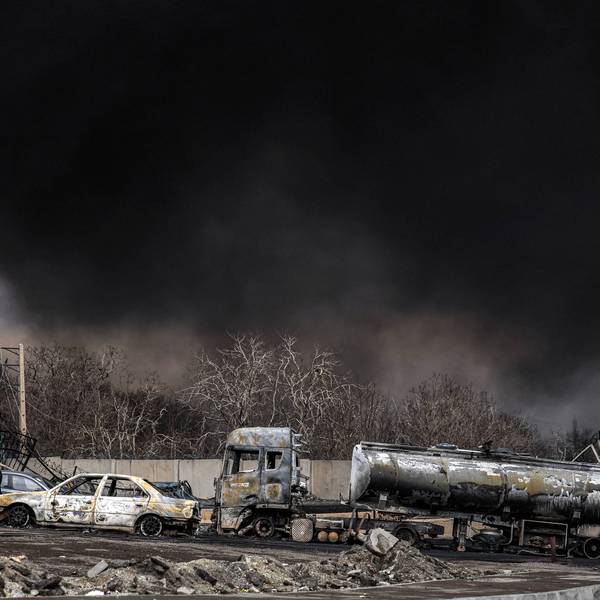
Smoke rises after Iranian-sourced unmanned aerial vehicle (UAV) carried out an attack on a fuel depot at Kuwait International Airport in Kuwait City, Kuwait on March 25, 2026. [Stringer – Anadolu Agency]
The Gulf countries and Jordan on Wednesday strongly denounced Iranian attacks as a “flagrant violation” of their sovereignty and territorial integrity, affirming their full right to self-defense, Anadolu reports.
In a joint statement, Kuwait, the United Arab Emirates, Bahrain, Saudi Arabia, Qatar and Jordan said attacks carried out by Iran or its proxies constitute “a violation of international law, international humanitarian law, and the United Nations Charter.”
They particularly cited attacks launched by Iran-backed armed groups in Iraq as “a breach of international laws and conventions,” and “a blatant violation” of UN Security Council 2817, which demands Iran cease all assaults and threats against neighboring countries.
The statement called on the Iraqi government to take “the necessary measures” to halt attacks by armed groups against neighbors “in order to preserve fraternal relations and prevent further escalation.”
Signatories reaffirmed their full right to self-defense “against these criminal attacks,” and to take all necessary measures “to preserve their sovereignty, security, and stability.”
They also condemned acts and activities “that undermine the security and stability of the region’s countries, planned by sleeper cells loyal to Iran and terrorist organizations linked to Hezbollah.”
Regional escalation has continued to flare since the US and Israel launched a joint offensive on Iran on Feb. 28, killing so far over 1,340 people, including then-Supreme Leader Ali Khamenei.
Tehran has retaliated with drone and missile strikes targeting Israel, along with Jordan, Iraq, and Gulf countries hosting US military assets, causing casualties and damage to infrastructure while disrupting global markets and aviation.
This work by Middle East Monitor is licensed under a Creative Commons Attribution-NonCommercial-ShareAlike 4.0 International License.
Orcas discuss rotting brain. Front Orca says “Wish someone would lock him up”.Donald Trump warns against following the https://onaquietday.org blog, says that it’s easy atm, she only needs to report war crimes supporting Israel’s genocidal expansion.Keir Starmer explains that UK is participating defensively in Trump and Israel’s criminal war for Israel’s genocidal expansion in Iran and states that he supports Zionism “without qualification”. Keir Starmer said “I said it loud and clear – and meant it – that I support Zionism without qualification.” here: https://www.jewishnews.co.uk/keir-starmer-interview-i-will-work-to-eradicate-antisemitism-from-day-one/
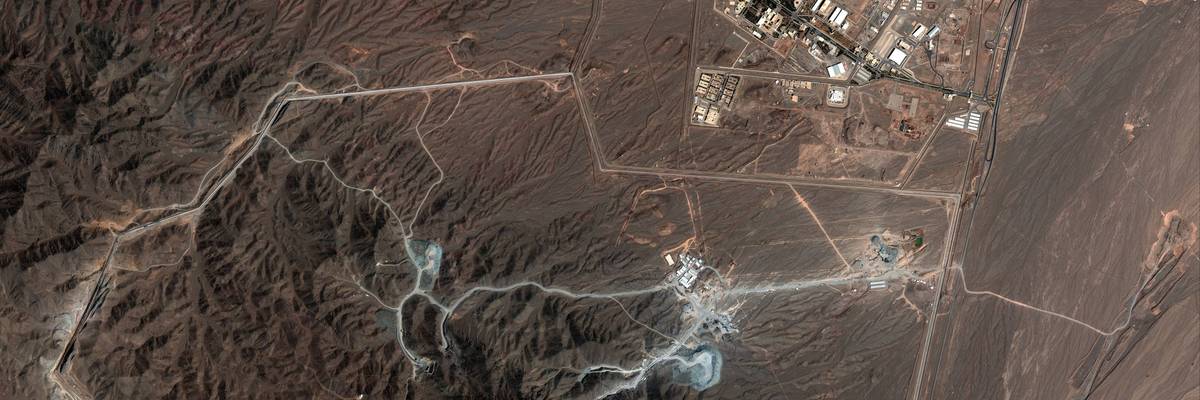
A satellite image shows the Natanz nuclear facility and adjacent underground tunnel complex in a mountainous area of Iran on September 16, 2025. (Photo by Vantor/Getty Images)
After Israel’s military suggested that the United States bombed the enrichment complex, Iran launched a ballistic missile attack on an Israeli city that’s home to a nuclear research center.
The head of the United Nations nuclear watchdog issued a fresh demand for restraint on Saturday after the Atomic Energy Organization of Iran announced that the Shahid Ahmadi-Roshan uranium enrichment complex in Natanz “was subjected to a renewed attack” as the United States and Israel continue to bomb the Middle Eastern country.
The Iranian agency said that “technical assessments indicate that no radioactive material leakage has occurred and there is no danger to residents of the surrounding areas,” but the attack was a “violation of international laws and commitments,” including the Nuclear Nonproliferation Treaty.
The International Atomic Energy Agency “has been informed by Iran that the Natanz nuclear site was attacked today,” the UN watchdog confirmed on social media. “No increase in off-site radiation levels reported. IAEA is looking into the report.”
“IAEA Director General Rafael Grossi reiterates call for military restraint to avoid any risk of a nuclear accident,” the agency added.
The Times of Israel reported that “in response to a query… the Israel Defense Forces said that it did not conduct any strikes in the area and that it could not comment on American activities.”
The Israeli newspaper also noted that “Israel’s Kan news reported that the US had indeed struck the facility, using ‘bunker buster’ bombs to target the site. It cited unspecified sources.”
Later Saturday, The Times of Israel reported that at least 20 people were wounded in an Iranian ballistic missile attack on the Israeli city of Dimona, home to Shimon Peres Negev Nuclear Research Center.
The United States previously bombed Iran’s Natanz facility last June. The Associated Press highlighted Saturday that satellite images also suggest the site was damaged during the first week of the current war, which President Donald Trump and Israeli Prime Minister Benjamin Netanyahu launched on February 28.
Condemning the Saturday strike on Iran’s complex, Russian Foreign Ministry spokesperson said that “this is a brazen violation of international law, the charters of the UN and the International Atomic Energy Agency, as well as relevant resolutions of the UN Security Council and the agency’s General Conference.”
Russia has notably also generated fears of a nuclear accident with its ongoing invasion of Ukraine, launched in February 2022.
Trump has sent mixed messages about the US-Israeli war on Iran, both sending thousands more troops to the region this week while also saying on his Truth Social platform Friday that “we are getting very close to meeting our objectives as we consider winding down our great Military efforts in the Middle East with respect to the Terrorist Regime of Iran.”
According to the AP: “Iran’s capital saw heavy airstrikes overnight and into the morning, residents said, as thousands of worshippers converged on Tehran’s grand mosque for prayers marking the end of the holy month of Ramadan. Israeli Defense Minister Israel Katz said attacks would ‘increase significantly’ next week.”
Donald Trump warns against following the https://onaquietday.org blog, says that it’s easy atm, she only needs to report war crimes supporting Israel’s genocidal expansion.Donald Trump sings and dances, says that it’s fun to kill everyone …Climate science denier Donald Trump confirms that he knows nothing about democracy and that more liquid gold is being secured according to his policy of global privateering.