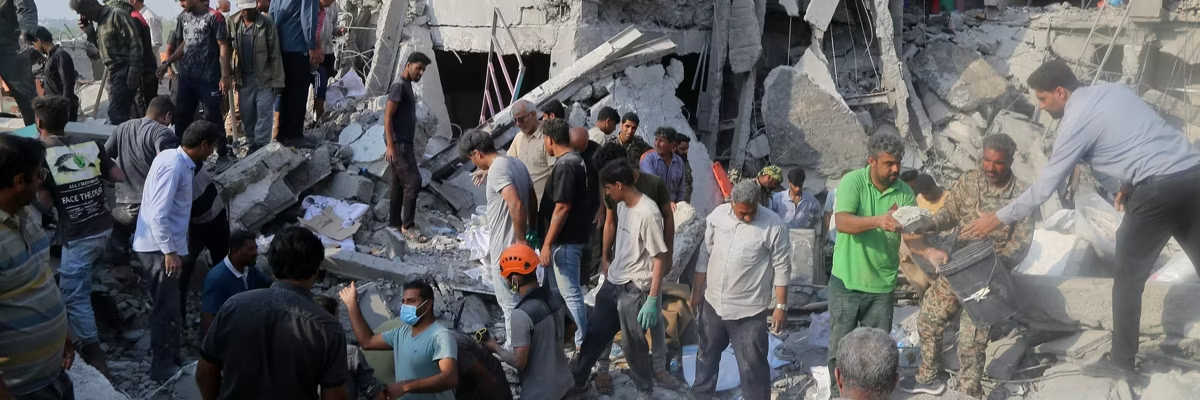
Firefighters work at the scene of an Israeli airstrike on the Haziz power station in southern Sanaa, Yemen, December 19, 2024
ISRAELI bombers pounded Yemen’s capital Sana’a and its port Hodeida today, killing at least nine as they sought to break the Houthi forces, which have launched attacks in solidarity with Palestine.
The bombing raids followed a Houthi missile strike against Israel. The military said it targeted infrastructure in Hodeida, another port Salif, and the Ras Isa oil terminal, then took out energy infrastructure in Sana’a.
Targeting civilian energy infrastructure is a war crime.
“After Hamas, Hezbollah and the Assad regime in Syria, the Houthis are almost the last remaining arm of Iran’s axis of evil,” Israeli Prime Minister Benjamin Netanyahu declared.
“Whoever raises a hand against the state of Israel, his hand will be cut off,” Israeli Defence Minister Israel Katz added. “Whoever harms us will be harmed sevenfold.”
Heads of State Summit of ALBA-TCP in Caracas, Venezuela. Photo: ALBA-TCP
ALBA-TCP was founded in 2004 in an attempt to counter the US proposal of creating a “free trade zone of the Americas
December 14 marked the 20th anniversary of the creation of the Bolivarian Alliance for the Peoples of Our America-People’s-Trade Agreement (ALBA-TCP). ALBA-TCP was created in 2004 as a geopolitical alternative to the devastating advance of neoliberalism in the region.
The project was founded on December 14, 2004, in Havana by Cuban President Fidel Castro and Venezuelan President Hugo Chávez. Currently, the organization has 10 member countries and four countries considered “special guests.” In 2006, Bolivia signed its membership; in 2007, Nicaragua; in 2008, Dominica; in 2009, Antigua and Barbuda and St. Vincent and the Grenadines; in 2014, St. Kitts and Nevis and Grenada; and in 2021, St. Lucia. The special invited countries are Syria, Haiti, Suriname, and now Palestine.
To commemorate the 20 years, social movements, political parties, and heads of state gathered in Caracas, Venezuela for the 24th Heads of State Summit as well as parallel meetings. The event was attended by the host, Venezuelan President Nicolás Maduro; Bolivian President Luis Arce; Cuban President Miguel Díaz-Canel; Nicaraguan President Daniel Ortega; Prime Minister of St. Vincent and the Grenadines, Ralph Gonsalves; Prime Minister of Dominica, Roosevelt Skerrit; and the Prime Minister of Antigua and Barbuda, Gaston Browne.
Independence and solidarity among countries
In their addresses during the Summit on December 14, the heads of state and invited countries stressed the importance of solidarity among countries seeking alternative ways of development and the need for unrestricted solidarity among people struggling against imperialist attacks. They also demonstrated their support for Nicolás Maduro and his victory in the last presidential elections.
Miguel Díaz-Canel said “We reiterate the strongest support for the Bolivarian revolution, led by President Nicolás Maduro…We also call for the elimination of the blockade against Cuba …We cry out for a free Puerto Rico and declare our solidarity with Haiti, our Cuban doctors are there…We reiterate our demand for a ceasefire in Gaza and condemn the attacks perpetrated by Israel against Lebanon, Syria, and Iran.”
The Bolivian President, Luis Arce, highlighted the historical importance of ALBA in its fight against economic projects promoted by the United States such as the FTAA (Free Trade Area of the Americas): “The embrace of Hugo Chávez and Fidel Castro not only marked history but also manifested the defeat of the hegemonic project of the FTAA. ALBA was born, ALBA placed the human being at the center, promoting that a better world is possible. Bolivia reaffirms, once again, its commitment to ALBA-TCP, because it is a resistance that raises its voice against the unjust and criminal blockade against Cuba…ALBA is also a firm voice against the arbitrary and unilateral measures imposed against Venezuela and Nicaragua, which affect the welfare of our peoples.”
Nicolás Maduro said, “We must win the battle of life and truth in the streets, networks, media, and walls, as well as in the conscience and spirituality of the people.” He also added the importance of the struggle of the people to be masters of their destiny without imperial impositions or impositions of any kind. In the same line of discourse, Nicaraguan President Daniel Ortega said “From Nicaragua we reaffirm our commitment to ALBA. We will continue to fight the battle.”
The Prime Minister of Dominica, Roosevelt Skerrit stated “We congratulate the electoral triumph of President Nicolas Maduro on July 28. We wish him all the best…We also want to reaffirm our solidarity with the people of Cuba, a brave people for whom we have our greatest respect and love; we will never cease to lend our voice against the United States to eliminate the blockade against Cuba.”
Ralph Gonsalves, Prime Minister of St. Vincent and the Grenadines, harshly criticized US interference in the development of the past Venezuelan elections “Perhaps [the US government] thinks it is superior,” he said in this regard. He also stressed that the creation of ALBA-TCP was a fundamental invention for the emancipation of the American people, “ALBA is the product of the geniuses of our peoples.”
Inclusion of Palestine to ALBA-TCP
At the current summit, it was announced that Palestine had been included as a “brotherly country” and was included as a “permanent guest”. According to the resolution of the Heads of State, ALBA-TCP condemns the attacks against the Palestinian population and the “illegally occupied territories” and rejects “the merciless and inhuman genocide committed by the State of Israel, the occupying power, as well as its plan of spoliation, invasion, and domination.” Likewise, they denounced the support of several governments currently collaborating with the actions of the Israeli army and called for an “immediate ceasefire…From the heart of the peoples and governments of this alliance, we declare Palestine a brother country of the ALBA-TCP, and reaffirm our commitment to the defense of the Palestinian cause, which is the defense of humanity,” reads the resolution.
In this regard, Riyad al-Malki, advisor to the President of State for International Affairs of Palestine said “History will remember those who stood on the side of justice, ALBA’s lasting solidarity with Palestine is a testimony of freedom and collective resistance.” Furthermore, Malki added “This Alliance is a living testimony of collective integration to challenge imperialism and ensure a just world. These values resonate with the Palestinian struggle, an end to the illegal occupation.”
A call for counter-hegemonic struggle
The joint document signed by all the countries highlights the historical importance of ALBA-TCP in the struggle for a more equitable world: “Twenty years after this giant step, we pay homage to the founding leaders, Hugo Chávez Frías and Fidel Castro Ruz, who adopted that December 14, 2004, in Havana, Cuba, the vision of the future embodied in the founding documents of ALBA, which have allowed us to walk united until the present, animated by the ancestral force that led our peoples to be free and that encourages us to continue integrated in this Alliance for Life.”
Similarly, it was stressed that the existence of this multilateral organization operates as a possibility to create a region that resists the impositions of the most developed countries: “Today, we want to ratify before our peoples, the counter-hegemonic, democratic, anti-imperialist and anti-fascist nature of our Alliance and renew our commitment to help and protect each other, to continue building together a future of shared goals under the founding principles of complementarity, cooperation, social justice, defense of our sovereignty and solidarity.”
In this sense, Luis Arce stressed that “In the face of the challenges of a world threatened by fascism and neo-fascism, ALBA is not an option, ALBA is a necessity that must continue with firm steps, reaffirming the founding principles of solidarity, justice, and cooperation…ALBA is not only an alliance, it is a promise for the future, a living resistance, an instrument for the most dispossessed, and a reminder that together, as peoples, we are invincible.”
Objectives and principles of ALBA-TCP
According to ALBA’s official website, the fundamental objective of the project is “to achieve integral development, ensure social equality and contribute to guaranteeing the quality of life, good living, independence, self-determination and identity of the peoples.” For this very reason, the principles of ALBA-TCP propose that political decisions be made horizontally and take into account the economic differences of its members without meaning that the importance of each of the members is underestimated.
The principles shared by the countries are “trade and investment should not be ends in themselves, but instruments to achieve sustainable development; special and differentiated treatment, according to the level of development of the various countries; economic complementarity and cooperation; cooperation and solidarity; the creation of the Social Emergency Fund; the integrative development of communications and transportation; the sustainability of development; energy integration; the promotion of investments of Latin American capital in the region; the defense of Latin American and Caribbean identity and culture; respect for intellectual property; and the agreement of multilateral positions and in negotiations with countries and blocs in other regions.”
Original article by Abdul Rahman republished from people dispatch under a Creative Commons Attribution-ShareAlike 4.0 (CC BY-SA) license.
Source: IRNA
Israel is one of only four countries in the world that refuse to ratify the Chemical Weapons Convention. It has also been accused of using banned substances against civilians in Gaza and Lebanon
Iran raised the issue of Israel’s refusal to ratify the Chemical Weapons Convention (CWC) on Monday, November 25, claiming that this lack of accountability poses a grave risk to global peace and stability.
Iran’s Deputy Minister for Legal and International Affairs, Kazem Gharibabadi, addressed the 29th session of the Conference of the State Parties to the CWC, which began in The Hague on Monday. He also called for international action against Israel for using chemical weapons, which are banned by international conventions, in Palestine and in Lebanon.
The CWC prohibits the development, production, storage, and use of all types of chemical weapons. It came into force in 1997 and has been signed and ratified by 193 countries. The Organization for the Prohibition of Chemical Weapons (OPCW), based in The Hague, serves as the implementing body of the CWC.
Gharibabadi alleged that Israel has used chemical weapons and other hazardous substances, including white phosphorus and depleted uranium, against Palestinians in Gaza and against people in Lebanon during its ongoing genocidal war. He called on the OPCW to conduct an investigation and take necessary steps to protect civilians.
“This regime, with the unconditional support of some Western countries, especially the United States, continues its crimes and enjoys immunity,” Gharibabadi said.
Israel is one of only four countries in the world that are not party to the CWC. While it has signed the convention, it has refused to ratify it. Egypt, North Korea, and South Sudan have neither signed nor ratified the treaty.
There have been several instances where international investigations have established Israel’s use of chemical weapons against civilians in Gaza and Lebanon. During the ongoing war, Human Rights Watch (HRW) has reported Israel’s use of white phosphorus, a highly toxic substance, against civilians in Gaza. Although white phosphorus is not banned under the CWC, its use against civilians is considered illegal. Similarly, in September, the Syndicate of Chemists in Lebanon accused Israel of using depleted uranium during the bombings in Beirut. The use of depleted uranium is prohibited under international law.
Iran called for immediate UN sanctions on Israel for its continued violations of international humanitarian laws, as well as a complete economic, political, and military boycott of the Zionist regime.
The CWC should be universal
Iran emphasized the need for the universality of the CWC, claiming that Israel possesses a chemical weapons arsenal that threatens global peace and stability. It demanded the establishment of mechanisms to hold Israel accountable. Iran urged the international community to pressure Tel Aviv to join the CWC and place all its chemical weapons under the supervision of the OPCW.
Gharibabadi also rejected allegations made by the US and other Western countries regarding Iran’s alleged use of chemical weapons. He asserted that Tehran has fully complied with its obligations under the CWC and has placed all its chemical weapons under OPCW supervision.
The US has repeatedly accused Iran of developing chemical weapons. In July this year, the US imposed sanctions on an Iranian company, alleging that it was assisting the Iranian government in developing such substances.
In turn, Iran accused the US of violating the CWC on multiple occasions, including during its 2003 invasion of Iraq and by supplying weapons to Israel that are prohibited under OPCW regulations. The US has supplied billions of dollars worth of weapons to Israel since the beginning of the genocide in Gaza in October 2023, despite acknowledging that their use by Israel may have violated international humanitarian laws.
Gharibabadi claimed that the allegations against Iran are intended to divert global attention from the repeated use of chemical weapons by Israel or by groups supported by the US in the Middle East, such as armed factions fighting against state forces in Syria and Iraq, IRNA reported.
He also highlighted the US support for Iraq’s President Saddam Hussein during the war against Iran in the 1980s, despite being aware of Iraq’s use of chemical weapons against Iranian forces. Estimates suggest that over 7,000 Iranians were killed as a result of these attacks. Nearly 75,000 Iranians are still receiving treatment for injuries caused by chemical weapons during the Iran-Iraq war.
Gharibabadi called for accountability for all countries, including the US, that supported Iraq’s use of chemical weapons against Iran. He demanded that they be held responsible for their “illegal actions” and urged them to “take steps to compensate” Iranian victims.
Iran also highlighted how illegal US sanctions, imposed over time, have hindered the treatment of Iranian victims affected by chemical weapons attacks. It called on the OPCW to intervene and assist the victims.
Original article by Abdul Rahman republished from people dispatch under a Creative Commons Attribution-ShareAlike 4.0 (CC BY-SA) license.
Original article republished from MEMO under a Creative Commons Attribution-NonCommercial-ShareAlike 4.0 International License.
Simon Walters, UK Ambassador to Israel, speaks at the “International Rally – United We Bring Them Home” rally in Hostage Square on May 18th, 2024 in Tel Aviv, Israel. [ Alexi J. Rosenfeld/Getty Images]
British military personnel will be put in “harm’s way” to defend Israel against Iran, the UK’s Ambassador to Israel has declared in a stark admission that could see British forces ordered to risk their lives defending the apartheid state.
Speaking to Israeli journalists at his Ramat Gan residence, Ambassador Simon Walters made the extraordinary commitment that “the United Kingdom will be a close ally and is prepared to put its own aircraft and its own personnel in harm’s way to defend Israel.”
Walters revealed that British forces have already been actively involved in military operations supporting Israel, noting that the Royal Air Force flew alongside Israeli and US pilots during Iran’s missile and drone attack in April. “Without going into detail, on October 1, the British armed forces again played a role in trying to disrupt the Iranian attack on Israel,” Walters disclosed.
These revelations come as an Al Jazeera investigation has exposed the extent of British military support for Israel’s genocide in Gaza. The investigation found that the UK and the US have established an air bridge crucial for sustaining Israel’s military campaign. In revelations that are highly controversial, British forces have conducted nearly half of all reconnaissance missions over Gaza since Israel’s assault on Gaza began. Reconnaissance carried out by the UK is said to have surpassed Israel’s own surveillance operations by more than double.
With Israel facing genocide charges at the International Court of Justice (ICJ) and Prime Minister Benjamin Netanyahu and former Defence Minister Gallant having been served arrest warrants by the International Criminal Court (ICC) for war crimes and crimes against humanity, Britain’s direct military support could expose London to allegations of complicity in international crimes. Under international law, states providing material assistance to forces committing serious violations can be held responsible as accomplices
Addressing the ongoing controversy over British arms sales to Israel, Walters acknowledged that the risk of violations of international law “is evidently present here”. He noted that UK NGOs are currently pursuing legal action against the government to force additional restrictions on arms exports to Israel, battles which the government is actively contesting in court.
The Ambassador also expressed concerns about Israel’s treatment of Palestinian prisoners, pointing out that Israel has denied Red Cross access to detainees from Gaza. “Had the Red Cross visited regularly, it would provide reassurance of the conditions, it would not only protect the prisoners,” he stated, adding that such visits would also protect guards from accusations.
Israel is accused of torture and sexual abuse of Palestinians, including rape of detainees in prisons. Famous Gaza surgeon, Dr Adnan Al-Bursh, is the latest high-profile figure who was killed by Israel while in detention. Al Bursh is said to have been severely tortured. His body was left naked from waist down suggesting that he was also raped by the Israeli army.
On the situation in Gaza, Walters challenged the notion that military pressure alone could achieve Israel’s objectives. “I hear people calling for the continuation of the war until Hamas is destroyed and I think they are kidding themselves,” he said. “They are imagining an outcome that will never come.”
Walters also highlighted concerns about Palestinian rights in the illegally Occupied West Bank, particularly regarding restrictions around olive harvesting and attacks by Israeli extremists. “At the end of the day, this is an aspect of the Occupation, which many Israelis do not see and are not aware of,” he concluded.
Original article republished from MEMO under a Creative Commons Attribution-NonCommercial-ShareAlike 4.0 International License.
Genocide denier and Current UK Prime Minister Keir Starmer is quoted that he supports Zionism without qualification. He also confirms that UK air force support has been essential in Israel’s mass-murdering genocide. Includes URLs https://www.declassifieduk.org/keir-starmers-100-spy-flights-over-gaza-in-support-of-israel/ and https://youtu.be/O74hZCKKdpAGenocide denying UK Foreign Secretary David Lammy says that UK is suspending 30 of 350 arms licences to Israel. He also confirms the UK government’s support for Israel’s Gaza genocide and the UK government and military’s active participation in genocide.
Border force and police officers take people to shore after they arrived in Kent in October 2022 | Stuart Brock/Anadolu Agency/Getty Images. All rights reserved
I was labelled a ‘smuggler’ and spent over two years in prison for touching the tiller on a dinghy. That’s not justice
Samyar Bani, 42, is an Iranian refugee who travelled to the UK in a dinghy on 1 June 2019. He was arrested on arrival and convicted of assisting unlawful entry into the UK in November 2019. His initial sentence of six years was later reduced to five. An appeal hearing in December 2021 then acquitted him of all charges. The appeals judge determined that the law had been interpreted incorrectly, as Bani and co-passengers had intentionally been picked up by police before disembarking on UK shores. This interview has been edited for clarity and length, and the final transcript was reviewed by Samyar before publication. It is part of the seriesHow migration became a criminal offence.
Melissa Pawson (BTS): Can you tell us why you left Iran?
Samyar Bani: I had a problem with the government there. So I came to England to ask for help as an asylum seeker.
Melissa:What was the journey from Iran like?
Samyar: I left my home country on 1 January 2017. First, I went to Turkey and stayed there for six months. Then I went to Greece. There are so many refugees in Greece. I tried to claim asylum there, but they didn’t accept my claim.
I like Greece. They have good weather, and Athens reminds me of my city, Shiraz. But I wasn’t allowed to stay. So I went to Germany. I was there for four months, but I couldn’t stay there either. They made a mistake in my asylum claim and rejected me as well.
I liked living in Germany, because I have a sister there. But Germany doesn’t like me. So I came to England.
Melissa:Did you travel through Calais?
Samyar: Yes, I lived in the Jungle there for around two months. There were too many people in the Jungle, and everyone was planning to go to England to claim asylum.
Editor’s note: the Jungle was the nickname of a large informal encampment on the outskirts of Calais, France. It was demolished in 2016 but undocumented peoplecontinued to live in the area.
When I was going to France from Germany on the train, I was searching on Google and Telegram and Facebook, and I found lots of information telling me that England supports people like me. I read that England understands that Iran isn’t a democracy. Because of that, I thought UK would support me.
So me and four other Iranians bought a boat together to come here.
Melissa:Why did you decide to buy the boat by yourselves?
Samyar: Because smugglers are so expensive. I think they charge around £2,500 per person. I don’t have that kind of money. Instead, each of us put in £500 for the boat to come here. We were six in the boat, including a child around 10 years old.
Melissa: So you crossed the English Channel and were picked up by the UK Border Force boat. Did they arrest you straight away?
Samyar: The police arrested everyone and sent us to the immigration detention centre. We stayed there the first night, and they transferred me to a hotel in London the next day.
They arrested me at the hotel after I’d been there for just one night. It was 6 or 7pm. Six people came to the hotel. One of them had a gun – it was a big one like a machine gun. There was no interpreter. They put my hands behind my back and arrested me. Then they transferred me to Kent police station.
I touched the tiller for maybe four or five seconds, that’s it
Melissa:You must have been very confused and scared.
Samyar: I was really confused. I was lying awake in the cell thinking maybe I’m not in England. Maybe I came to a different country. Every night after that I was talking to myself, asking, why does England think I’m a smuggler, why did England arrest me? This is wrong. This isn’t Iran, it’s not a dictatorship.
I kept thinking maybe the police would come to apologise. They would tell me, Mr. Bani, we were wrong. Sorry, you’re free now. Later, this just became a wish.
I was scared and stressed. It was a very dark time for me. I was alone, with no family or friends. I didn’t speak English.
Melissa: Did an interpreter and a lawyer explain what was happening at any point?
Samyar: After I’d been in the police station for two days, an interpreter came to speak to me. But he was from Afghanistan and spoke Pashto – I speak Farsi, which is a completely different language. Then a solicitor came. Then I got a different solicitor. I wasn’t allowed to choose either of them, they were just assigned to me. The second solicitor didn’t have time for me, he was really busy. He just came once and spoke to me for a short time. My case was very serious, but he barely gave me any time.
Melissa: Did they tell you what you had been accused of?
Samyar: They said I’m a smuggler. But I’m not a smuggler, I’m not trafficking people. They said they had video evidence showing me driving the boat, but the video was very short. When I took the tiller I was just following the orders of the police who were directing our boat. Before they took the video, there were different people driving boat.
We had bought the boat together. I wasn’t in command of this trip. I’m not a boat driver – I don’t even know how to swim, and I’d never seen a boat before the day we bought one. But I sat in the wrong place in the dinghy, near the engine, and ended up touching the tiller for maybe four or five seconds. That’s it. But that was enough.
The police know that real smugglers don’t come to England, but every boat has to be steered somehow. The people on board do that. So why not put everyone in jail? Why just me?
Melissa: Did you see the police recording you while you were in the boat?
Samyar: Yes, we saw them. And when the police took us onto their boat, everybody was scared. But I told them, “the police won’t kill you.” They want to help refugees.
Melissa: Were you able to speak to your family while you were being held?
Samyar: No, because I didn’t have their phone number. I had saved their number on my phone, like anyone else would, but the police took it from me when I went into custody.
I couldn’t speak to my wife for three years. She thought I’d died.
I wrote dozens of applications to ask my caseworker, my solicitor, anyone, to please get me back my mobile. Just so I can write the number down and then they could take back it again.
Melissa: That must’ve been incredibly difficult for you and your family. How did you find her number again?
Samyar: My sentence finished in December 2021, but they didn’t give me my phone back right away. I was living on the streets, with nowhere to go, when I found out about a charity called Care4Calais. They helped me to contact a solicitor and I was transferred to a hotel.
That solicitor wrote to the court so many times. It took maybe five months for the police to give my phone back. Maybe the police just really liked my mobile, I don’t know.
It hadn’t been used in more than two years and wouldn’t turn on at first. But I finally got the phone numbers from it and I called my wife.
Melissa: What was that phone call like?
Samyar: She was very confused. She asked me why I hadn’t spoken to her in three whole years. It was very, very hard.
I was so scared I’d be recognised. All the newspapers said I’m a smuggler. My picture was in the BBC
Melissa: How is your wife now, is she okay?
Samyar: She’s doing better now. She was struggling with depression before because I had disappeared.
Melissa: And how did the sentencing affect you?
Samyar: I changed my hair and my beard because I was so scared I’d be recognised. All the newspapers said I’m a smuggler, and my picture was in the BBC.
That wasn’t all undone when the appeal went through. I didn’t see any big headlines saying, ‘Bani is not guilty, he’s not a smuggler’. So I didn’t feel safe, even though I was free again.
It’s not been easy. I’m doing better now at least – better than prison.
Melissa: Can you tell us what your time in prison was like?
Samyar: I was in prison for just over two years after the sentencing. Including my time in remand, I was in prison for two and a half years.
Prison is bad for everybody. But for people who are not guilty, it’s so much worse. All the time, you’re thinking, why am I here?
I was in there with people who had been jailed for life. Some of them had murdered people, committed rape, attacked people, robbed, laundered money, run drugs operations. I remember asking someone what they’d done and they said, “I just killed one person”.
It was terrible.
Melissa: This sounds like a really scary experience. Can you tell us about the appeal?
Samyar: I went to the Royal Courts of Justice in London, and three judges reviewed my case. Three or four days later, they all agreed that a big mistake had been made because I hadn’t broken the law. They said I hadn’t come here illegally because we were transferred to the port by the police.
So then I was free. But I had to wear an electronic tag on my leg for six months. The Home Office said this is an immigration tag, but if that’s the case then I don’t understand why they don’t make everyone wear one. Surely the law is for everybody?
And when I got to the hotel two weeks later, there were lots of other asylum seekers there. But I was the only one with an electronic tag.
In Iran, if you change your religion the government will put you in prison and you could get the death penalty. That’s if people don’t kill you first
Melissa: You said you were first homeless after you were released – where were you sleeping?
Samyar: I slept on the streets for two weeks. It was rainy and people were everywhere getting ready for Christmas. It was a very hard time.
I went to a church and I told them I’m homeless. I showed them my immigration papers, but they said they couldn’t help because I didn’t have refugee status or a visa. And I wasn’t allowed to rent a house – I could only get support from the Home Office.
Melissa: What happened after that?
Samyar: My solicitor wrote lots of letters to the Home Office, and finally they helped me to get accommodation in a hotel.
But it wasn’t a hotel for asylum seekers, it was a quarantine hotel. So many people had Covid 19, and I caught it too. I had a very high temperature, I felt like I was dying. I was there for maybe two months, and then I was transferred to a hotel in Newcastle. After that they sent me to a shared house in Stockton-on-Tees.
Six months after I was released from prison, the Home Office sent me a letter telling me I have leave to remain for five years. That was in June 2022. I had good evidence and lots of paperwork, because I changed my religion in Iran.
I don’t believe in Islam, so I converted to Christianity. But in Iran, if you change your religion the government will put you in prison and you could get the death penalty. That’s if people don’t kill you first. Some people think that if they kill a convert, they’ll be rewarded by Allah.
This is fake. My religion is for me, and your religion is for you.
Melissa: Was this one of the reasons why you had to leave Iran?
Samyar: Yes, because I was scared that the government would arrest me and kill me. Then I came to England, and it was the same thing I was afraid of in Iran. I wasn’t guilty, but I was in prison anyway.
Melissa: And what’s your situation like now in Birmingham?
Samyar: I had to leave the Home Office accommodation two months after I got my visa, but I had no way of renting a place without help. I needed council support because I don’t have a guarantor.
I went to a charity called Open Door and they supported me to rent a shared room. I was 40 years old at the time – it’s hard to be sharing.
Then later an Iranian person helped me to rent a room in a house in Birmingham.
I haven’t started work yet because of my mental health and the arthritis in my back. I often get flashbacks from my time in prison – maybe one day is good, then the next day is bad. The Job Centre supports me but it’s not very much. I get around £300 in benefits for food and everything, and some of that has to go towards rent.
I’d like to get back into work, and I have lots of skills. I’m a tradesman – I design and fit kitchens. In Iran I had a house fitting company, and we did tiling, plumbing, plastering.
The Job Centre said I should do a very basic job like cleaning, but I can do more than that. I tried to take the certificates for plumbing and carpentry. I tried three times. But they refused me because my English isn’t good enough.
I’m working on that. I’m doing an English course, but my brain is so busy worrying about my family. Maybe after my family comes and we live together, I’ll feel well enough to focus on my courses, and I can get the certificate to do a carpentry job.
Melissa: Are you applying for your wife and daughter to join you in the UK?
Samyar: I already did, but it was refused. It’s because I had an Islamic marriage. I don’t believe in Islam, and I didn’t want an Islamic marriage. But if I’d had a different marriage in Iran, the government would’ve arrested me. My mother and father are Muslim, so I had no choice.
This has created a big problem for me. The Home Office said I didn’t have the right evidence, but I do. I have the marriage contract, and I have pictures and evidence showing that me and my wife lived together for a long time.
I’m appealing, but my solicitor said there’s a waiting list. It could be two years, it could be ten years. I don’t know. I just have to wait.
Melissa: It must be very hard, having been apart from them for so long.
Samyar: I have no choice. I can just talk to my wife on the phone. We can’t live together. The courts and immigration offices in this country, they don’t care about love. All they’re interested in is evidence.
Police understand who a smuggler is, and they don’t sit in the boat. They just do this so they can close the border to refugees
Melissa: We spoke before about how the courts decided you were a smuggler. What does the word ‘smuggler’ mean to you?
Samyar: A smuggler lives in France or a different country. You’ll never see a smuggler. They’re very clever, they won’t sit in the boat because it’s dangerous. A smuggler is someone who just likes money. They just take money.
Police understand who a smuggler is, and they don’t sit in the boat. They just pretend it’s different so they can close the border to refugees. It’s the same as the plan for Rwanda.
It’s not good for human rights. A better plan would be a visa for refugees, so we don’t have to make this journey in the first place.
Melissa: How would life have been different if this kind of visa had been available to you?
Samyar: I didn’t want to sit in the dinghy to come to UK. But I didn’t have a choice. Humans need life. My country wasn’t safe for me, so I came to the UK. That’s why I left my father, my mother, my wife and my daughter. I didn’t come here for money. I just came here to get help because Iran isn’t safe for me.
I had a good job in Iran – I liked my work, I liked my city. Shiraz is very beautiful, and it has good weather. All my family live there too – I have a big family. Now I’m alone here.
I like human rights, and I thought I might have mine respected here. But this is just a wish now. No country has real human rights.
Explore the rest of the series
This series looks at how the UK, EU and bordering countries are increasingly treating migration as a criminal offence, and targeting migrants and solidarity actors in the name of ‘anti-smuggling’ and ‘border control’.