Analysis of Major Polls Shows Trump’s War on Iran Is Historically Unpopular

Spread the love

Original article by Brad Reed republished from Common Dreams under Creative Commons (CC BY-NC-ND 3.0).

People attend a protest against US-Israeli attacks on Iran in New York on February 28, 2026. (Photo by Zhang Fengguo/Xinhua via Getty Images)

“Not merely negative-number-so-what unpopular, but worst-ever-support-for-war-when-it-started unpopular.”

President Donald Trump’s unprovoked and unconstitutional war against Iran is historically unpopular among US voters.

In an analysis published Friday, polling expert G. Elliott Morris calculated an average of eight high-quality polls conducted over the last week about the war and found just 38% of Americans approve of the military strikes against Iran, while 49% are opposed.

RECOMMENDED…

Protesters rally outside White House against US and Israeli strikes on Iran

Only 25% of Americans Support Trump Attack on Iran: Poll

US-POLITICS-CONGRESS-DEMOCRATS

As Trump Marches US Toward Iran War, Critics Ask: Where’s the ‘Pushback’ From Dems and Media?

Morris noted that there is simply no precedent for a US war being this unpopular from the very outset.

“The big takeaway from these numbers is that the new war in Iran is very unpopular,” he wrote. “Not merely negative-number-so-what unpopular, but worst-ever-support-for-war-when-it-started unpopular. With just 38% of Americans in favor, support for bombing Iran is lower than retrospective support for the war in Iraq was in 2014.”

Morris then offered some comparisons to past US military conflicts to show that the lack of support for Trump’s Iran war is simply in uncharted territory.

“No president in modern polling history has launched a major military operation with the public already against him,” he wrote. “After the September 11 attacks, a November 2001 Gallup poll found 90% of Americans approved of military action in Afghanistan, with just 5% opposed. The Gulf War in 1991 hit 79-80% approval. Gallup measured 76% support for the invasion of Iraq in March 2003 (Pew had it at 71%).”

Even comparatively unpopular operations, such as Trump’s strikes against Syria in 2017 or former President Barack Obama’s 2011 military operation in Libya, still had net-positive approvals at the times they occurred.

Morris added that Trump should be concerned about this because historically “wars only get less popular” over time as “casualties mount and costs become clear.”

CBS News polling director Anthony Salvanto on Tuesday also highlighted this phenomenon when analyzing a poll on the Iran war commissioned by his network that showed US voters’ support for the conflict dropped precipitously the longer they believed it would last.

“If you think it’s going to be a long conflict, months, even years… the numbers tilt toward disapproval overall,” he said.

Trump so far has not offered any kind of timeline for his war against Iran, and Politico reported on Wednesday that the US military is preparing for the conflict to last until at least September.

Trump on Friday insisted he would not end the conflict with Iran until its government offered its “unconditional surrender.”

Original article by Brad Reed republished from Common Dreams under Creative Commons (CC BY-NC-ND 3.0).

Orcas discuss Donald Trump and the killer apes' concept of democracy. Front Orca warns that Trump is crashing his country's economy and that everything he does he does for the fantastically wealthy.
Orcas discuss Donald Trump and the killer apes’ concept of democracy. Front Orca warns that Trump is crashing his country’s economy and that everything he does he does for the fantastically wealthy.
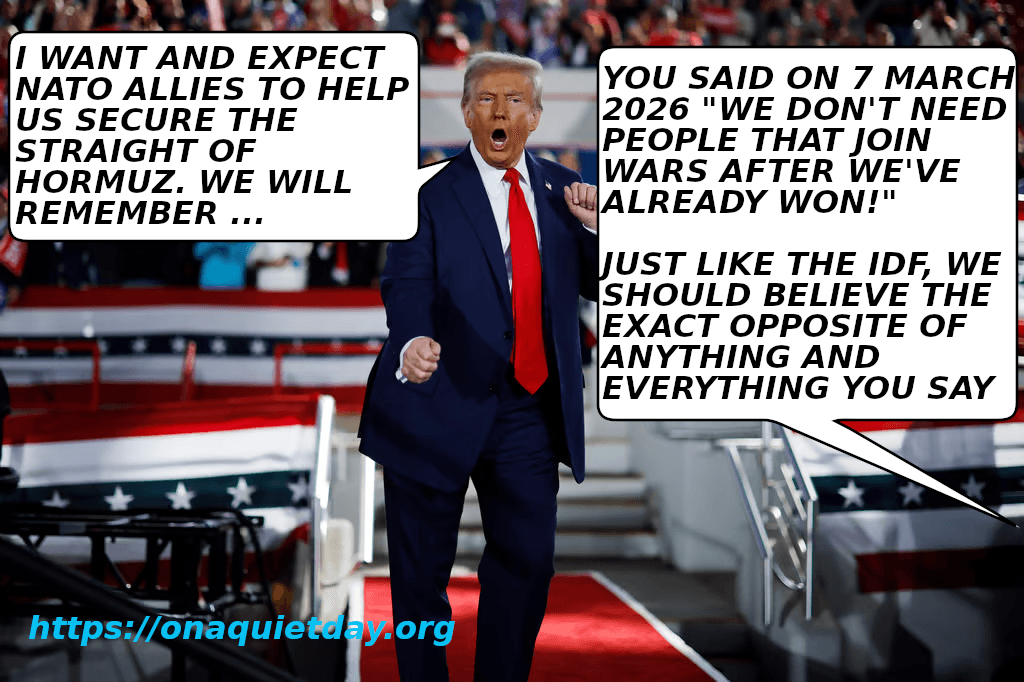
Donald Trump warns against following the https://onaquietday.org blog, says that it's easy atm, she only needs to report war crimes supporting Israel's genocidal expansion.
Donald Trump warns against following the https://onaquietday.org blog, says that it’s easy atm, she only needs to report war crimes supporting Israel’s genocidal expansion.
Orcas discuss rotting brain. Front Orca says "Wish someone would lock him up".
Orcas discuss rotting brain. Front Orca says “Wish someone would lock him up”.

Continue ReadingAnalysis of Major Polls Shows Trump’s War on Iran Is Historically Unpopular

What Americans think of the war in Iran

Spread the love
Aashish Kiphayet/Alamy Live News

Paul Whiteley, University of Essex

The American people are bitterly divided over the conflict in Iran. The US president, Donald Trump, won office in 2024 after campaigning on a message of “no new wars”. So the conflict that began with airstrikes conducted with the Israeli military in the early hours of February 28, and which has quickly spread into the rest of the region, has polarised opinion across the country.

An Economist/YouGov poll completed on March 2 provides early information about what Americans think of the war so far. The poll asked the following question: “Would you support or oppose the US using military force to overthrow the government of Iran?”

There is a great deal of confusion about what the objectives of the war are, since the messaging from Trump, and his senior officials, has veered from preventing Iran from developing nuclear weapons, to destroying the country’s ballistic missile capability, to regime change.

But, from the point of view of polling, this is as good a question as any for finding out what Americans think. Altogether 32% of them support the war and 45% oppose it.

A divided society

The responses to this question analysed by gender, race, age and education appear in the graph. Those who were uncertain are not included in the totals. The graph shows that large variations exist among the different groups in relation to their attitudes to the war.

The relationship between attitudes to the war and the social backgrounds of respondents

YouGov/Economist, Author provided (no reuse)

The largest differences are in relation to race. Some 37% of white respondents support the war and 44% oppose it. In contrast 7% of black people support it and 60% oppose. Hispanics were in between these two, but rather closer to whites than to blacks.

The was a large gender difference in the responses as well with 37% of men in support but only 26% of women. A marked age difference existed too with only 21% of 18-to-29 year olds supporting and 50% opposed. At the same time some 40% of those over the age of 65 supported the war with 49% opposed. Finally, 34% of those without a college degree were in support compared with 27% with a college degree. Overall, young black women with a college degree were most likely to oppose the war, whereas older white men without a college degree were most in support.

A question of politics

The social backgrounds and attitudes to the war of respondents are interesting, but they are overshadowed by the polarisation of opinion among supporters of the political parties and ideological factions. These appear in the second chart.

The relationship between attitudes to the war and the political affiliations of respondents

YouGov/Economist, Author provided (no reuse)

The striking feature of this chart is the difference between respondents who identify with the Democrats and those who identify with the Republicans. Only 8% of Democrats support the war compared with 64% of Republicans. The highest level of support comes from respondents who are Maga (Make American Great Again) supporters. No less that 75% of them support the war and only 10% oppose it.

There is similar polarisation among liberals, which refers to anyone on the left of the ideological spectrum in the US, and conservatives. Only 8% of liberals support the war compared with 66% of conservatives. Moderates are in between the two with 25% of them supporting and 50% opposing the war.

What it could mean for November’s mid-term elections

One theory of elections argues that individuals have a set of well-defined preferences over policies and so they support the party which is closest to them in relation to these policies. In this analysis, policy preferences are summarised by the left-right ideological dimension, or alternatively by the liberal-conservative dimension in politics.

In fact, it appears that in reality the reverse is true with voters choosing a party or leader and then changing their views to fit in with those of their newly adopted party. The 47th US president is an extreme case of this, because he constantly changes his mind. Before he was elected, he promised that the US would not get involved in any more wars in the middle east. It appears that most Republicans and nearly all the Maga supporters are quite willing to go along with the U-turn and agree with anything he does.

This is a big advantage for a president who is so polarising, since it means that he can rely on a body of loyal supporters even when they don’t know the latest policy changes. However, it is a weakness when it comes to elections because the Democrats and Independents together easily outnumber the Republicans and Maga supporters in the electorate.

The Cooperative Election Study, a large-scale survey conducted at the time of the presidential election in 2024 showed that 32% of respondents in their national survey identified with the Democrats, 27% with the Independents and 30% with the Republicans. In short, the Republicans are up against a coalition of Democrats and Independents who make up just under 60% of the voters. Add the factor that many Americans are outraged by the president’s behaviour and you have a winning coalition for the opposition in the mid-term elections.

Whatever happens in the war, Trump is unlikely to recover his popularity for the Republicans not to lose control of the House of Representatives – and possibly the Senate – in the mid-term elections in November.

Paul Whiteley, Professor, Department of Government, University of Essex

This article is republished from The Conversation under a Creative Commons license. Read the original article.

Elon Musk urges you to be a Fascist like him, says that you can ignore facts and reality then.
Donald Trump explains why he established his Bored of Peace
Orcas discuss rotting brain. Front Orca says "Wish someone would lock him up".
Orcas discuss rotting brain. Front Orca says “Wish someone would lock him up”.
Continue ReadingWhat Americans think of the war in Iran

Left MPs move to block drive to another Middle East war

Spread the love

https://morningstaronline.co.uk/article/left-mps-move-block-drive-another-middle-east-war

 An F-35 arriving back at RAF Akrotiri in Cyprus, June 2019

Corbyn tables Commons Bill requiring Parliament’s approval before allowing foreign militaries to use British bases

LEFT MPs moved today to block Britain from being dragged deeper into the escalating attack against Iran.

Former Labour leader Jeremy Corbyn tabled a Commons Bill to require MPs’ approval before allowing foreign militaries to use British military bases.

The move comes as not only are US forces using the bases to pursue their illegal aggression, but British military forces are increasingly becoming directly involved in the conflict.

Mr Corbyn’s Military Action (Parliamentary Approval) Bill is co-sponsored by Labour, Green and Independent Alliance MPs and a response to PM Sir Keir Starmer’s agreement to allow US use of the bases. 

While it has scant chance of becoming law, it signals growing disquiet in Labour’s ranks and beyond about Britain getting bogged down in supporting US President Donald Trump’s attack.

It would “require parliamentary approval for the deployment of UK armed forces and military equipment for armed conflict” and “require parliamentary approval for the granting of permission by ministers for use of UK military bases and equipment by other nations for armed conflict.”

Its co-sponsors are new Green MP Hannah Spencer and her colleague Ellie Chowns, Adnan Hussein and Ayoub Khan from the Independent Alliance and Labour’s Bell Ribeiro-Addy, Brian Leishman, John McDonnell, Richard Burgon, Apsana Begum, as well as suspended Labour MP Diane Abbott.

Sir Keir is under growing pressure from Mr Trump to fall in line as British governments usually do, forcing the premier to assert in the Commons that the “special relationship” did not “depend on hanging on to President Trump’s latest word.”

Article continues at https://morningstaronline.co.uk/article/left-mps-move-block-drive-another-middle-east-war

Experiencing issues with this image not appearing. I suspect because it's so critical of Zionist Keir Starmer's support of and complicity in Israel's genocides.
Genocide denier and Current UK Prime Minister Keir Starmer is quoted that he supports Zionism without qualification. He also confirms that UK air force support has been essential in Israel’s mass-murdering genocide. Includes URLs https://www.declassifieduk.org/keir-starmers-100-spy-flights-over-gaza-in-support-of-israel/ and https://youtu.be/O74hZCKKdpA
Donald Trump explains why he established his Bored of Peace
Orcas discuss rotting brain. Front Orca says "Wish someone would lock him up".
Orcas discuss rotting brain. Front Orca says “Wish someone would lock him up”.
Continue ReadingLeft MPs move to block drive to another Middle East war

Rubio Suggests Trump Joined Israel’s Planned Attack on Iran Instead of Stopping It

Spread the love

Original article by Jessica Corbett republished from Common Dreams under Creative Commons (CC BY-NC-ND 3.0).

US Secretary of State Marco Rubio talks to reporters ahead of a congressional briefing about strikes on Iran at the Capitol in Washington, DC on March 2, 2026.
 (Photo by Nathan Posner/Anadolu via Getty Images)

“This is the most insane and absurd definition of an ‘imminent threat’ I have ever heard in my life,” said one journalist.

“What the fuck happened to America First?” US Sen. Ruben Gallego asked on social media Monday in response to a video of Secretary of State Marco Rubio attempting to justify President Donald Trump and Israeli Prime Minister Benjamin Netanyahu’s war on Iran.

As the death toll climbed above 550 in Iran, with at least six US service members killed, Rubio told reporters on Capitol Hill that “there absolutely was an imminent threat, and the imminent threat was that we knew that if Iran was attacked, and we believed they would be attacked, that they would immediately come after us. And we were not gonna sit there and absorb a blow before we responded.”

RECOMMENDED…

Marco Rubio

Reporting Says Rubio ‘Deliberately’ Lying to Trump About US-Cuba Talks

President Donald Trump oversees Iran assault

Experts Pillory Trump Case for War on Iran: ‘Flimsiest Excuse for Initiating a Major Attack’ in Decades

According to Rubio, the US Department of Defense assessed that “if we waited for them to hit us first after they were attacked… by someone else—Israel attacked them, they hit us first, and we waited for them to hit us—we would suffer more casualties and more deaths. We went proactively, in a defensive way, to prevent them from inflicting higher damage. Had we not done so, there would’ve been hearings on Capitol Hill about how we knew that this was gonna happen, and we didn’t act preemptively to prevent more casualties and more loss of life.”

In a follow-up post, Gallego (D-Ariz.), an Iraq War veteran, added: “So Netanyahu now decides when we go to war? So much for America First.”

The senator wasn’t alone in ripping Rubio’s remarks. Congresswoman Sarah Jacobs (D-Calif.) said that “Secretary Rubio says the quiet part out loud: This is an unnecessary war of choice. Israel forced our hand—there was no imminent threat to the United States. And instead of talking Israel out of going to war, President Trump went along with it and put US lives at risk.”

Stanford University political science professor Michael McFaul said: “Such strange logic. We had to go to war because Israel was going to attack Iran? So Bibi gets a say as to whether the US goes to war but the US Senate and the American people do not?”

Zeteo editor-in-chief Mehdi Hasan declared: “This is the most insane and absurd definition of an ‘imminent threat’ I have ever heard in my life. Our ally and proxy, Israel, that we arm and fund, was about to illegally attack Iran so we joined in the attack because that illegal attack would have led to an attack on us.”

Progressive organizer and attorney Aaron Regunberg also weighed in on social media: “Quite literally—and I’ve used that word too freely in the past, but in this case I mean literally—Rubio is saying they’ve made America into Netanyahu’s bitch. We go where Bibi points, regardless of the American blood it will cost. Trump is an absolute cuck. Pathetic.”

While critics of Trump’s “Operation Epic Fury” have slammed it as illegal and clearly motivated by regime change, Rubio claimed that the Trump administration would welcome a new government in Iran, but the war—which has taken out top Iranians, including the supreme leader, Ayatollan Ali Hosseini Khamenei—is about preventing the Middle Eastern nation from developing a nuclear weapon.

A year ago, a US intelligence report said that “we continue to assess Iran is not building a nuclear weapon and that Khamenei has not reauthorized the nuclear weapons program he suspended in 2003, though pressure has probably built on him to do so.” Despite that conclusion, the Trump administration bombed the country’s nuclear facilities a few months later—and, as CNN‘s Aaron Blake pointed out last week, Trump has repeatedly said that his June airstrikes “obliterated” Iran’s program.

There are now mounting calls for the Republican-controlled Senate and House of Representatives to end Trump’s assault on Iran by passing a war powers resolution. Despite the US Constitution giving Congress clear authority to declare war, several presidents have taken military action without any such declaration.

Discussing the administration’s interaction with Congress about Iran, Rubio said Monday that “we notified the Gang of Eight,” which is made up of the Senate and House leaders for both major parties, as well as the chairs and ranking members of each chamber’s intelligence panel. Before taking on his current role, the secretary was the top Republican on the Senate Intelligence Committee.

“There’s no law that requires us to do that. The law says we have to notify them 48 hours after beginning hostilities. We’ve done that,” Rubio said, referring to a requirement in the War Powers Act of 1973. “But we can’t notify 535 members of Congress.”

“If they want to take a war powers vote, they can do that. They’ve done that. They’ve done that a bunch of times,” he added. “There’s no law that requires the president to have done anything with regards to this… No presidential administration has ever accepted the War Powers Act as constitutional—not Republican presidents, not Democratic presidents.”

Congressman Ted Lieu (D-Calif.) responded: “Dear Secretary Rubio: There is a law. It’s called the frickin’ Constitution of the United States.”

Separately on Monday, the State Department urged Americans to leave a list of Middle Eastern countries.

Lieu responded: “Dear Secretary Rubio: You told Americans to depart now via commercial means when you know many airports/airspace are closed. YOU MUST IMMEDIATELY SCHEDULE US GOVERNMENT EVACUATION FLIGHTS FOR THE STRANDED AMERICANS IN DANGER. Maybe you should have thought of a frickin’ plan first.”

Original article by Jessica Corbett republished from Common Dreams under Creative Commons (CC BY-NC-ND 3.0).

Orcas discuss Donald Trump and the killer apes' concept of democracy. Front Orca warns that Trump is crashing his country's economy and that everything he does he does for the fantastically wealthy.
Orcas discuss Donald Trump and the killer apes’ concept of democracy. Front Orca warns that Trump is crashing his country’s economy and that everything he does he does for the fantastically wealthy.
Donald Trump explains why he established his Bored of Peace
Orcas discuss rotting brain. Front Orca says "Wish someone would lock him up".
Orcas discuss rotting brain. Front Orca says “Wish someone would lock him up”.
Continue ReadingRubio Suggests Trump Joined Israel’s Planned Attack on Iran Instead of Stopping It

Strait of Hormuz: if the Iran conflict shuts world’s most important oil chokepoint, global economic chaos could follow

Spread the love
US warship Thomas Hudner launches a Tomahawk missile as the American military strikes targets in Iran, March 1 2026. U.S Navy/U.S. Navy Photo/Alamy Live News

Sarah Schiffling, Hanken School of Economics

The reported sinking of several Iranian warships by US missiles in the Gulf of Oman serves as a reminder of the maritime aspect of the conflict which began February 28 with a barrage of Israeli and American missiles targeting Iran. Two other vessels, believed to be tankers, have also been reported as having been hit by missiles, of an as yet undetermined source, in the vicinity of the strait of Hormuz, underlining the importance of this vital shipping lane – which is likely to play an key part in all sides’ calculations.

Full details have yet to emerge of the incidents. But there are already signs that the strait will become a major focus of concern because of the huge implications should the conflict disrupt maritime traffic through this the narrow outlet of the Persian Gulf. Ships crossing the strait of Hormuz carry around one-fifth of global oil supplies. That’s about 20 million barrels per day. This makes the strait the most critical energy chokepoint.

There are a small number of strategic passageways, or chokepoints on which global trade depends and which are vulnerable to disruption. Any disruption reverberates instantly through global markets and supply chains. With conflict raging in Iran and attacks across the Middle East, traders, governments and businesses will be watching oil prices closely as the markets open.

After Israel and the US launched attacks on Iran on February 28, prompting retaliatory strikes across the region from Iran, Tehran broadcast to vessels in the region claiming that the strait of Hormuz was closed.

Although the shipping lanes are only about two miles wide, actually physically closing them would be difficult to achieve. The most decisive action Tehran could take would be to mine the shipping lanes. With the large US naval presence in the area, this would be very difficult for Iran to achieve.

But a formal blockade is not necessary to stop traffic. When perceived threat levels rise, ships stay away. Big shipping companies such as Hapag Lloyd and CMA CGA have already suspended transit through the strait and advised their ships to proceed to shelter.

Vessel tracking already shows reduced movements in the strait of Hormuz. Ships are waiting to enter or exit the Persian Gulf or diverting away from the region. An advisory from the United Kingdom Maritime Trade Operations (UKMTO) Centre has warned of the “increased risk of miscalculation or misidentification, particularly in proximity to military units”.

Several ports have suspended operations after debris from an intercepted missile sparked a fire at Dubai’s Jebel Ali Port. While other ports continue to operate, the risk and uncertainty are disrupting shipping in the region.

Supply chain disruption

Hormuz is dominated by oil tankers and liquid natural gas carriers, so disruption directly hits global energy supplies. In addition, a lesser-known dependency is that one-third of the world’s fertiliser trade passes through the strait. Both energy and agricultural supply chains have already been destabilised by the Ukraine war. Further price rises could have far-reaching consequences.

Map of Straits of Hormuz
The Strait of Hormuz is one of the world’s most important waterways, with 20% of the global trade in oil flowing through a narrow maritime channel. Wikimedia Commons

The main destinations for oil and gas flowing through Hormuz are China, India, Japan, and South Korea. India, which imports about half of its crude oil through the strait, has activated contingency plans to safeguard energy supplies.

But apart from amassing strategic national stockpiles to weather immediate disruptions, there may be limited alternatives for countries dependent on getting their energy supplies through the strait. Saudi Arabia and the UAE have some pipelines for both oil and gas that can bypass the Hormuz. There is an estimated spare capacity of 2.6 million barrels per day for these pipelines. But that’s a fraction of what is normally shipped through the strait.

Oil and gas are traded globally. So even countries whose energy needs are not met by imports from the Persian Gulf will be affected by price increases. Oil prices are expected to increase to up to US$100 (£74) per barrel when markets open on Monday. Opec has agreed to modestly boost oil output in a bid to stabilise markets. But the group of oil producing countries has limited options as key members are affected by the fallout of the attacks on Iran.

Energy price increases will hit consumers directly when filling up their cars or heating their homes. They also affect companies across a wide range of industries. This has the potential to cause further supply chain disruptions.

Supply chains rely on predictability. The persistent geopolitical uncertainty has complicated operations worldwide. Limited alternatives make the de facto closure of the strait of Hormuz all the more impactful. The longer the disruption persists, the more significant and structural the economic damage will become.

Potential for escalation

There is still a potential for a catastrophic escalation in the strait of Hormuz. The sinking of a tanker would have dramatic consequences for the environment and would likely halt navigation for an extended period of time.

But prolonged instability may also prove destructive for the global economy. Previously, Iran closing the strait was seen as unlikely considering the global backlash and economic harm to Iran itself. But with regime change now the stated goal of the US-Israeli attacks, the cost of holding the world economy hostage might seem justified to the rulers in Tehran.

Sarah Schiffling, Deputy Director of the HUMLOG (Humanitarian Logistics and Supply Chain Management Research) Institute, Hanken School of Economics

This article is republished from The Conversation under a Creative Commons license. Read the original article.

Orcas discuss rotting brain. Front Orca says "Wish someone would lock him up".
Orcas discuss rotting brain. Front Orca says “Wish someone would lock him up”.
Donald Fuhrump says that Amerikkka doesn't bother with crimes or charges anymore, not being 100% Amerikkkan and opposing his real estate intentions is enough.
Donald Fuhrump says that Amerikkka doesn’t bother with crimes or charges anymore, not being 100% Amerikkkan and opposing his real estate intentions is enough.
Elon Musk urges you to be a Fascist like him, says that you can ignore facts and reality then.

Continue ReadingStrait of Hormuz: if the Iran conflict shuts world’s most important oil chokepoint, global economic chaos could follow