Heads of US CENTCOM, Israeli army discuss boosting defense cooperation

Spread the love

This work by Middle East Monitor is licensed under a Creative Commons Attribution-NonCommercial-ShareAlike 4.0 International License.

Chief of the General Staff of the Israel Defense Forces Eyal Zamir (C) conducts a field tour with senior commanders of the Israeli army. [Israel Defense Forces (IDF) – Anadolu Agency]

US Central Command (CENTCOM) chief Brad Cooper and Israeli army Chief of General Staff Eyal Zamir have discussed boosting defense cooperation between the two sides, Anadolu reports.

The talks took place during an extended meeting held on the sidelines of Cooper’s visit to Israel, which began on Saturday, Israeli army spokesperson Avichay Adraee said in a statement on Sunday.

Adraee said Adm. Cooper held “a lengthy personal meeting” with Zamir, followed by a broader session attended by senior commanders.

He said the meeting served as “an additional factor strengthening the personal relationship between the two commanders, the close strategic relationship between the Israeli and US militaries, and the continued enhancement of defense cooperation between the two countries.”

During his visit to Israel, whose duration has not been specified, Cooper is also scheduled to meet Israeli Air Force Commander Tomer Bar, according to Israel’s Channel 12.

The visit comes amid growing concerns in Israel over the possibility that Iran could carry out a preemptive attack, alongside rising fears that Tehran may be close to being targeted by a potential US military strike, as the US continues to build up its forces in the region.

READ: Egypt calls for Israeli withdrawal from Gaza, reopening Rafah crossing

This work by Middle East Monitor is licensed under a Creative Commons Attribution-NonCommercial-ShareAlike 4.0 International License.

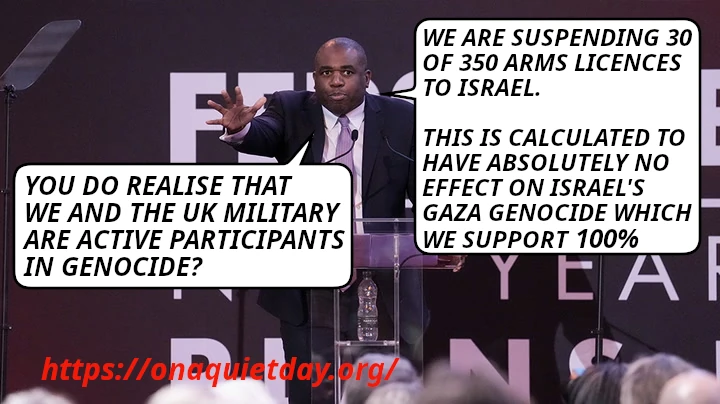
Experiencing issues with this image not appearing. I suspect because it's so critical of Zionist Keir Starmer's support of and complicity in Israel's genocides.
Genocide denier and Current UK Prime Minister Keir Starmer is quoted that he supports Zionism without qualification. He also confirms that UK air force support has been essential in Israel’s mass-murdering genocide. Includes URLs https://www.declassifieduk.org/keir-starmers-100-spy-flights-over-gaza-in-support-of-israel/ and https://youtu.be/O74hZCKKdpA
Keir Starmer objects to criticism of the IDF. He asks how could anyone object to them starving people to death, forced marches like the Nazis did, bombing Gaza's hospitals and universities, mass-murdering journalists, healthworkers and starving people queuing for food, killing and raping prisoners and murdering children. He calls for people to stop obstructing his genocide for Israel.
Keir Starmer objects to criticism of the IDF. He asks how could anyone object to them starving people to death, forced marches like the Nazis did, bombing Gaza’s hospitals and universities, mass-murdering journalists, healthworkers and starving people queuing for food, killing and raping prisoners and murdering children. He calls for people to stop obstructing his genocide for Israel.
Orcas discuss Genocide-supporting and complicit Zionists. Donald Trump, Keith Starmer, David Lammy, Rachel Reeves, Angela Rayner and Wes Streeting are acknowledged as evil genocide-complicit and supporting cnuts.
Continue ReadingHeads of US CENTCOM, Israeli army discuss boosting defense cooperation

Trump Isn’t the First to Be Gifted a Nobel Prize He Didn’t Win—Joseph Goebbels Got One Too

Spread the love

Original article by Brett Wilkins republished from Common Dreams under Creative Commons (CC BY-NC-ND 3.0). 

US President Donald Trump holds a framed Nobel Peace Prize medal given to him by Venezuelan opposition leader María Corina Machado—the actual 2025 winner—at the White House in Washington, DC on January 15, 2026. (Photo by the White House)

In 1943, the Norwegian writer Knut Hamsun gave his Nobel Prize for Literature to the infamous Nazi criminal.

Venezuelan opposition leader María Corina Machado’s gifting of her 2025 Nobel Peace Prize to US President Donald Trump raised eyebrows around the world Friday—but it wasn’t the first time that the winner of the prestigious award gave it away.

Last month, the Norwegian Nobel Committee awarded the peace prize to the 58-year-old opposition leader “for her tireless work promoting democratic rights for the people of Venezuela and for her struggle to achieve a just and peaceful transition from dictatorship to democracy.”

RECOMMENDED…

President Trump Meets With Israeli PM Netanyahu At His Palm Beach Estate

Trump Bemoans Not Winning Nobel Peace Prize During Netanyahu Hot Mic

President Trump Speaks At Inaugural Pennsylvania Energy And Innovation Summit

‘Corruption, Pure and Simple’: Probe Identifies Rich Donors Benefiting From Trump Presidency

Machado joined a notorious group of Nobel Peace laureates who either waged or advocated for war, as she backed Trump’s aggression against her country. This has included a massive troop deployment, military and CIA airstrikesbombing of boats allegedly transporting drugs, and the abduction earlier this month of Venezuelan President Nicolás Maduro and his wife, Cilia Flores.

Trump has ordered the bombing of nine other countries during his two terms, more than any other president in history. US forces acting on his orders have killed thousands of civilians in Afghanistan, Iran, Iraq, LibyaNigeriaPakistanSomaliaSyria, Venezuela, and Yemen. While running for president in 2016, Trump vowed to “bomb the shit out of” Islamic State militants and “take out their families,” and then followed through on his promise.

Despite being passed over by Trump for installation in any leadership role in Venezuela so far, Machado presented Trump with her framed Nobel medal along with a certificate of gratitude during a Thursday meeting at the White House. Trump subsequently posted on his Truth Social network that “María presented me with her Nobel Peace Prize for the work I have done. Such a wonderful gesture of mutual respect.”

In 1943!!!“Nobel Literature laureate Knut Hamsun famously gave his Nobel medal and diploma to Nazi propaganda minister Joseph Goebbels as a gesture of admiration for the Nazi regime, following his support for the occupation….”

Molly Jong-Fast (@mollyjongfast.bsky.social) 2026-01-16T18:56:54.507Z

That gesture prompted the Norwegian Nobel Committee to issue a statement noting that the prize cannot be given away.

“Even if the medal or diploma later comes into someone else’s possession, this does not alter who was awarded the Nobel Peace Prize,” the committee said. “A laureate cannot share the prize with others, nor transfer it once it has been announced. A Nobel Peace Prize can also never be revoked. The decision is final and applies for all time.”

The committee’s statement was extraordinary—but this is not the first time that a Nobel winner gave away their prize. In 1943, Norwegian author Knut Hamsun gifted his 1920 Nobel Prize for Literature—awarded for his novel Markens Grøde (Growth of the Soil)—to Nazi Propaganda Minister Joseph Goebbels after a trip to Germany. Other Nobel laureates have donated or sold their medals.

The progressive media outlet Occupy Democrats said on social media: “Clearly, the similarities between Trump and Goebbels extend beyond just a mutual admiration for fascism. Both men possess(ed) the kind of spiritually sick, egotistical temperament that allows one to accept a prize that someone else has earned.”

“Obviously, Donald Trump does not deserve the Nobel Peace Prize,” the outlet continued. “He has bombed Iran, Yemen, Nigeria, innocent fishing boats in the Caribbean, Venezuela, and is in the process of turning the United States into a war zone. That said, Machado doesn’t deserve it either.”

“Anyone spineless enough to surrender the prize to an evil man like Trump in the hopes of obtaining power is not someone we should be celebrating,” Occupy Democrats added.

Last month, Wikileaks founder and multiple Nobel Peace Prize nominee Julian Assange sued the Nobel Foundation—the Swedish organization that manages administration of the approximately $1.2 million-per-winner prize—in a bid to prevent Machado from receiving the money.

Machado’s win also sparked protests outside the Norwegian Nobel Institute in Oslo.

Elon Musk urges you to be a Fascist like him, says that you can ignore facts and reality then.
Donald Fuhrump says that Amerikkka doesn't bother with crimes or charges anymore, not being 100% Amerikkkan and opposing his real estate intentions is enough.
Donald Fuhrump says that Amerikkka doesn’t bother with crimes or charges anymore, not being 100% Amerikkkan and opposing his real estate intentions is enough.
Orcas discuss how Trump was re-elected and him being an obviously insane, xenophobic Fascist.

2009 Nobel Peace Prize

The 2009 Nobel Peace Prize was awarded to United States president Barack Obama (b. 1961) for his “extraordinary efforts to strengthen international diplomacy and cooperation between peoples”.

Continue ReadingTrump Isn’t the First to Be Gifted a Nobel Prize He Didn’t Win—Joseph Goebbels Got One Too

Iran condemns US attempts to exploit protests for political gain, as Trump seemingly backs off military threat

Spread the love

Original article by Abdul Rahman republished from peoples dispatch under a Creative Commons Attribution-ShareAlike 4.0 (CC BY-SA) license.

Iranian President Pezeshkian joins protests against US intervention. Photo: IRIB

Though anti-government protests have largely subsided, Iran claims there still persists a threat of possible external aggression from countries such as the US and Israel and has warned of strong retaliation.

Iranian Foreign Minister Abbas Araghchi said that the “exploitation of the protests to pursue political agendas, combined with the ongoing effects of illegal unilateral US sanctions, undermines Iranians’ basic rights” and is a “shameful” act.

Araghchi was addressing a letter to the UN Security Council, which is scheduled to meet on the afternoon of Thursday, January 15, to discuss the situation in Iran, where anti-government protests in the last few weeks have captured global attention.

Araghchi expressed concerns over “provocative and irresponsible statements” made by current and former US officials inciting violence and unrest in his country and reiterated accusations of the direct involvement of Israel’s secret agency Mossad in the same.

Earlier, in an interview with US TV channel Fox News, Araghchi reiterated that external elements were responsible for “escalating the situation by carrying out attacks against Iranian security forces and civilians.”

Araghchi reiterated that the protests, which began peacefully, turned violent in order to justify foreign intervention.

“They wanted to increase the number of deaths. Why? Because US President Donald Trump had “stated that if there were killings, he would intervene. Their goal was to drag the US into this conflict,” Araghchi claimed, asserting that it was a plot made by Israel.

Araghchi assured that the Iranian state had full control over the situation now and there were no fresh reports of violence in the country.

Meanwhile, threats of a strike by external forces still continue, with Iranian officials claiming they are fully prepared to face any situation.

Fear of US airstrikes

Though the anti-government protests have largely been replaced with millions-strong pro-government rallies since Monday, Iran is still apprehensive about possible air strikes from the US.

Iran had shut its airspace following strong indications of such possible airstrikes after Trump, addressing the protesters in Iran, claimed “help is on its way” on his social media post on Tuesday, asking the protesters to continue and “occupy institutions”.

The news of the withdrawal of some staff from the US military base in Qatar further escalated the fear of possible US strikes on Wednesday.

Several Iranian officials, including the speaker of the Iranian parliament, Mohammad Bagher Ghalibaf, warned that if Iran is targeted with a military strike, US bases and ships in the region, along with Israeli territories, would be a legitimate target.

Several countries, such as India, and some European nations issued travel warnings to their citizens, asking those who are already there in Iran to leave the country on Wednesday.

Though the airspace was opened after Trump toned down his rhetoric, claiming he was briefed that the violence against protesters had abated, Iran remained on high alert on Thursday, Al Jazeera reported.

Deliberate exaggerations about the number of casualties

Though anti-government protests have largely subsided, Iran continued to restrict internet services on the seventh day in a row on Thursday, with limited accessibility of international calls gradually being restored.

Iran imposed the restrictions after large-scale violence was recorded across the country on January 8.

During his interview with Fox News, Araghchi claimed that the number of people killed in the protests so far does not exceed a few hundred, which includes innocent bystanders killed and the security forces killed by the violent protesters.

Araghchi promised that the state would announce the exact figure soon, dismissing the very high figures quoted in some media outlets, such as CNN, as false.

Read more: Six points to navigate the turmoil in Iran

CNN and several other US media channels have been quoting the relatively unknown US-based Human Rights Activists New Agency (HRANA), claiming the death toll in Iranian protests was more than 2,400.

Araghchi also dismissed the news in the western media about possible hangings of some of the protesters arrested in the last few days.

Later, Iran’s judiciary also refuted the news reports and social media hype around the possible execution of one such protester, Erfan Soltani, arrested on January 10 for unlawful assembly and false propaganda against the state.

The judiciary’s media center called such reports fabricated as no death penalty exists for the crimes Soltani has been charged for in the Iranian laws.

Original article by Abdul Rahman republished from peoples dispatch under a Creative Commons Attribution-ShareAlike 4.0 (CC BY-SA) license.

Elon Musk urges you to be a Fascist like him, says that you can ignore facts and reality then.
Donald Fuhrump says that Amerikkka doesn't bother with crimes or charges anymore, not being 100% Amerikkkan and opposing his real estate intentions is enough.
Donald Fuhrump says that Amerikkka doesn’t bother with crimes or charges anymore, not being 100% Amerikkkan and opposing his real estate intentions is enough.
Orcas discuss how Trump was re-elected and him being an obviously insane, xenophobic Fascist.

Continue ReadingIran condemns US attempts to exploit protests for political gain, as Trump seemingly backs off military threat

Six points to navigate the turmoil in Iran

Spread the love

Original article by Vijay Prashad republished from peoples dispatch under a Creative Commons Attribution-ShareAlike 4.0 (CC BY-SA) license.

Aftermath of protests in Iran on January 10, 2025. Photo: IRIB

Vijay Prashad offers six points to make sense of the situation in Iran amid protests, violence, and threats of military intervention from Washington

Iran is in turmoil. Across the country, there have been protests of different magnitudes, with violence on the increase with both protesters and police finding themselves in the morgue. What began as work stoppages and inflation protests drew together a range of discontent, with women and young people frustrated with a system unable to secure their livelihood. Iran has been under prolonged economic siege and has been attacked directly by Israel and the United States not only within its borders, but across West Asia (including in its diplomatic enclaves in Syria). This economic war waged by the United States has created the situation for this turmoil, but the turmoil itself is not directed at Washington but at the government in Tehran.

There are reports – such as in the mainstream Israeli newspaper Ha’aretz in October 2025 about Israeli “influence operations aiming to install Reza Pahlavi as Shah of Iran” – that Israeli intelligence has a role in the protests, and the United States has openly told the protestors that it would bomb Tehran if the violence by the government increase. Last year, protests took place in twelve South Pars oil refineries, where 5,000 contract workers in the Bushehr Gas Refinery Workers Union marched with their families on December 9 in Asaluyeh to demand higher wages and better working-conditions. When the workers took their struggle to the National Parliament in Tehran, where they called for an end to the contract work system, the Israelis and the United States took advantage of these sincere protests to attempt to transform a legitimate struggle into a potential regime change operation.

To understand what is happening, here are six points of historical importance that are offered in the spirit of discussion. Since 1979, Iran has played a very important role in the movement beyond monarchies in the Arab and Muslim world, and it has been an important defender of the Palestinian struggle. Iran is no stranger to foreign interference, going back to the British control of Iran’s oil from 1901, the 1907 Anglo-Russian Convention that divided Iran into spheres of influence, the 1921 coup that put Reza Khan on the throne, the 1953 coup that installed his son, Mohammed Reza Shah Pahlavi to the throne, and then the hybrid war against the Iranian Revolution from 1979 to the present. Here are the six points:

1. The Iranian Revolution of 1978-79 overthrew the rule of the Shah of Iran Reza Pahlavi, and due to the strength of the religious clergy and its political formations resulted in the creation of the Islamic Republic in April 1979 with the Constitution of the Islamic Republic coming into effect in December 1979. The other currents in the revolution (from the communist left to the liberals) found themselves largely sidelined and even – in some cases – repressed. The March 1979 protests on International Women’s Day in Tehran followed the restrictions on women’s rights (particularly against the compulsory hijab policy), which forced the government to accept the demands of the protests – but this was a short-term win, since in 1983 a mandatory hijab law was passed.

2. The Revolution followed the military coup of Zia ul-Haq in Pakistan in 1977, the Saur Revolution in Afghanistan (August 1978), the establishment of the Yemeni Socialist Party (October 1978) that took the People’s Democratic Republic of Yemen into the Soviet sphere and that led to the North-South war in Yemen (February-March 1979), and the capture of power by Saddam Hussein Iraq in July 1979. The entire region of south-western and central Asia was catapulting in political somersaults. Some of these developments (Pakistan, Iraq) offered advantages to the United States, and the others (Afghanistan, Iran, Yemen) being counter to US objectives in the region. Very quickly, the United States attempted to press its advantages by trying to overthrow the Islamic Republic of Iran, the People’s Democratic Republic of Yemen, and the Democratic Republic of Afghanistan.

3. The pressure by the United States on these processes led to a war-like situation in all three countries: the US and its Gulf allies urged Iraq to invade Iran unprovoked in September 1980, starting a war that lasted till 1988; the Gulf Arab states urged North Yemen to invade South Yemen after the assassination of Salim Rubaya Ali (a Maoist who was negotiating the merger of the two Yemens); finally, in Afghanistan, the US began to fund the mujahideen to start an assassination campaign against cadre of the People’s Democratic Party of Afghanistan. Iran, Afghanistan, and Yemen saw their social projects narrowed by the attacks they faced from outside. Afghanistan crashed into over forty years of terrible violence and war, even though the Democratic Republic of Afghanistan remained in place for 18 years; the Marxist government in South Yemen remained until 1990, but it was a pale shadow of its own expectations; Iran, meanwhile, saw its Islamic Republic survive a harsh sanctions policy that followed the end of the war by Iraq (in 1988).

4. The Islamic Republic faced several important, consecutive challenges:

The most important came from US imperialism, which not only fully spurred Iraq’s war, but supported initiatives by the former Iranian elites to restore their rule and supported Israeli attempts to undermine the Islamic Republic (including direct attacks on Iran, sabotage operations, and assassinations of key figures from the science professions and military). It is the United States and Israel that have been systematically trying to erode Iran’s power in the region, with the assassination of General Qassem Soleimani in 2020, the harsh attack on Hezbollah during the Israeli genocide and the assassination of Sayyed Hassan Nasrallah in 2024, and the overthrow of the government in Syria in December 2024 with the installation of the former al-Qaeda chief as President in Damascus.

The old Iranian elites, led by the Shah at first till his death in 1980 and then his son, so-called Crown Prince Reza Pahlavi, joined with the Europeans and the US to restore their rule. It is important to know that while the Shah had sat on the Peacock Throne from 1941, he was forced to accept a democratic government from 1951 to 1953 – which was overthrown by Western intelligence services and then the Shah was encouraged to exercise absolute rule from 1953 to the revolution of 1978-79. The Shah’s bloc has consistently wanted to return to power in Iran. While the Green Movement of 2009 had a very small monarchical element, it represented the dominant classes who wanted political reforms against the more plebeian presidency of Mahmoud Ahmadinejad. It is telling that the United States has ‘chosen’ the Shah’s son, who lives in Los Angeles, as the figure of this uprising.

Limitations to the republic’s transformative social agenda were present as it tolerated sections of the old elite, allowing them to hold their property, and therefore allowing the formation of a stratified class system that benefited sections of these property owners and an emergent middle class. After the death of Ayatollah Ruhollah Khomeini in June 1989 and the end of the Iran-Iraq War, the government adopted large parts of the International Monetary Fund’s structural adjustment policies, which – one way or the other – remained in place for decades (the policy was driven by Mohsen Nourbaksh, who was the Minister of Economic Affairs from 1989 to 1994 and then head of the Central Bank from 1994 to 2003). The economy was not organized along socialist lines in 1979, but it had built a strong role for the state and for public planning due to the needs of the war economy and due to the commitment to Islamic social welfare. Nourbaksh could not totally dismantle the state, but he conducted currency and banking reform as well as he did cautiously integrate Iran into the global economy. The class divergence and the difficulties of life for the majority of Iranians increased due to the combined impact of the US-European sanctions regime, the military threats by the US-Israelis (that has led to high military spending in Iran – still at around 2.5% of GDP it is much lower than the 12% of GDP during the reign of the Shah), and to the neoliberal policies pursued by the increasingly neoliberal finance ministers of the government (such as Ali Tayebnia from 2013 to 2017 and Ali Madanizadeh from 2025). It was this limitation of the Islamic Republic that has led to cycles of economic protest: 2017-2018 (around inflation and subsidy cuts), 2019 (around fuel price hike), 2025 (by bakers), and 2025-26 (soaring inflation and the collapse of the Iranian rial).

5. While the current protests are largely driven by a record-high Rial to USD exchange and a 60% food inflation rate, the transition from labor strikes in South Pars to coordinated urban violence points towards a deeper level of intervention. The administration has favored sections of the import-export sector, which has worked in the context of the sanctions, to assist the commodity-exporters at the expense of the importers – a situation that is not easy to correct. Yet the abrupt 30-40% currency drop is a classic hallmark of external financial manipulation. Therefore, what began as business owners protesting the Central Bank without interference, soon morphed into a violent, top-down assault on the state fabric. The “protests” shifted overnight from peaceful assemblies to high-intensity urban sabotage resulting in the deaths of roughly 100 law enforcement officers, with claims that some officers were burned alive, a security member was beheaded, and a medical clinic was torched, claiming the life of a nurse, for instance. The use of close-range small arms fire against civilians further suggests an attempt to maximize domestic tension and provide a pretext for foreign intervention. The geopolitical orchestration behind the chaos became undeniable as the US State Department and Mossad openly cheered the violence in real-time. Once authorities disabled Internet access, the protests significantly lost strength, which places into question the spontaneity of the movement and lends truth to the thesis that there is a destabilization strategy at play, seeking to benefit from the current international conjuncture.

6. The opposition has taken to the streets but recognizes that it does not have the strength to seize power. There are reports of US and Israeli interference, and it does not help the opposition that the Shah’s son has been both claiming credit for the protests and seeing himself as its beneficiary. With Trump at the helm of hyper-imperialism, and with Israel amid a period of what it feels are endless victories, it is impossible to know what these dangerous cliques will do. As the mobilizations lose steam, which will take place, the US-Israel might take advantage of the situation to strike Tehran and other cities with more force than it did in June 2025. This should be a worry not only for the people in Iran, the vast mass of whom do not wish an attack on their country, but also the people of the Global South – who will find themselves as the next target after Venezuela and Iran.

Real problems bedevil the population, but these problems are not going to be solved through a hyper-imperialist aerial bombardment by the United States and Israel. The Iranians will need to sort out their own problems. The sanctions regime and the threats of violence do nothing to allow that to happen. It is easy to say “solidarity to the Iranians” in the West, where protesters are being beaten and even killed for their support of the Palestinians and their anger at the anti-immigration policies. And somehow, it seems to be much harder to say “end the sanctions,” and therefore allow the Iranian people to breathe into their own future.

Vijay Prashad is an Indian historian, editor, and journalist. He is a writing fellow and chief correspondent at Globetrotter. He is an editor of LeftWord Books and the director of Tricontinental: Institute for Social Research. He has written more than 20 books, including The Darker Nations and The Poorer Nations. His latest books are On Cuba: Reflections on 70 Years of Revolution and Struggle (with Noam Chomsky), Struggle Makes Us Human: Learning from Movements for Socialism, and (also with Noam Chomsky) The Withdrawal: Iraq, Libya, Afghanistan, and the Fragility of US Power. Chelwa and Prashad will publish How the International Monetary Fund is Suffocating Africa later this year with Inkani Books.

This article was produced by Globetrotter.

15 Jan 2026 2.25am UK: The inclusion of this article should not be regarded as approval of it’s analysis. It is instead included for the historical context and standard of discussion provided.

Original article by Vijay Prashad republished from peoples dispatch under a Creative Commons Attribution-ShareAlike 4.0 (CC BY-SA) license.

Elon Musk urges you to be a Fascist like him, says that you can ignore facts and reality then.
Donald Fuhrump says that Amerikkka doesn't bother with crimes or charges anymore, not being 100% Amerikkkan and opposing his real estate intentions is enough.
Donald Fuhrump says that Amerikkka doesn’t bother with crimes or charges anymore, not being 100% Amerikkkan and opposing his real estate intentions is enough.
Orcas discuss how Trump was re-elected and him being an obviously insane, xenophobic Fascist.

Continue ReadingSix points to navigate the turmoil in Iran

Israel raises alert for Air Force after reports of possible US strike on Iran

Spread the love

This work by Middle East Monitor is licensed under a Creative Commons Attribution-NonCommercial-ShareAlike 4.0 International License.

A view of fighter jet being prepared ahead of Israeli army’s attack on Iran, on October 26, 2024 in Israel. [Israel Defense Forces (IDF) – Anadolu Agency]

Israel has raised its alert level for the Air Force and army troops in anticipation of a possible US strike on Iran, media reports said Tuesday, Anadolu Agency reports.

The Maariv newspaper, citing Israeli military sources, said the alert level was raised in the Air Force, the Military Intelligence Service and the Northern Command.

No decision, however, was made to change the level of readiness on the home front.

The army “continues to closely monitor developments in Iran amid concerns that the US military may launch an attack on Tehran,” said the newspaper.

Israel’s army is currently coordinating with US Central Command (CENTCOM) regarding any possible attack on Iran, according to the report.

Reports have emerged of a potential US strike on Iran, where anti-government protests have continued since late last month.

Iranian officials have accused the US and Israel of backing “riots” and “terrorism.”

There are no official casualty figures, but the Human Rights Activists News Agency (HRANA), a US-based rights group, estimates that the death toll has reached more than 2,000, including security forces and protesters.

READ: Saudi Arabia leads Gulf efforts to dissuade Washington from striking Iran

This work by Middle East Monitor is licensed under a Creative Commons Attribution-NonCommercial-ShareAlike 4.0 International License.

Elon Musk urges you to be a Fascist like him, says that you can ignore facts and reality then.
Donald Fuhrump says that Amerikkka doesn't bother with crimes or charges anymore, not being 100% Amerikkkan and opposing his real estate intentions is enough.
Donald Fuhrump says that Amerikkka doesn’t bother with crimes or charges anymore, not being 100% Amerikkkan and opposing his real estate intentions is enough.
Orcas discuss how Trump was re-elected and him being an obviously insane, xenophobic Fascist.
Continue ReadingIsrael raises alert for Air Force after reports of possible US strike on Iran