‘The Whole Country’s Going to Get Blown Up’: Trump Renews Genocidal Threats to Iran as Ceasefire Collapses

Spread the love

Original article by Stephen Prager republished form Common Dreams under Creative Commons (CC BY-NC-ND 3.0).

US President Donald Trump addresses a Turning Point USA event at Dream City Church in Phoenix, Arizona, on April 17, 2026. (Photo by Jim Watson/AFP via Getty Images)

“Whether he means it or not, his saying it is an indelible moral stain on our country,” said one law professor.

President Donald Trump on Sunday renewed his threat to carry out a genocidal attack on Iran, pledging to “blow up” the “whole country” of over 90 million people and to demolish critical civilian infrastructure if it does not sign a peace deal by Wednesday.

“If they don’t sign the deal, then the whole country is going to get blown up,” Trump said, according to Fox News correspondent Trey Yingst, who relayed the comments on air Sunday morning.

RECOMMENDED…

Destruction at Tehran's Sharif University of Technology, targeted by the US-Israel

Trump Issues Openly Genocidal Threat to Wipe Out ‘Whole Civilization’ of Iran

Iranians protest Trump, who is shown on a placard with bloody hands

Iran Says ‘Self-Restraint Is Over’ If Trump Fulfills Civilization-Ending Threat

Trump also reportedly said that the US was “preparing to hit [Iran] harder than any country has ever been hit before because you cannot let them have a nuclear weapon.”

The comments came after Iran once again closed the Strait of Hormuz on Saturday in response to the continued US blockade of Iranian ports, which Iranian officials said violated the terms of the agreement reached between the two countries.

After renewing the blockade, Iranian gunboats fired upon a pair of Indian-flagged ships attempting to travel through the strait Saturday.

In response, Trump issued a furious post on Truth Social Sunday morning, saying that he would send a team of negotiators—Vice President JD Vance, his son-in-law Jared Kushner, and special envoy to the Middle East Steve Witkoff—to Islamabad on Monday for another round of negotiations.

“We’re offering a very fair and reasonable DEAL, and I hope they take it because, if they don’t, the United States is going to knock out every single Power Plant, and every single Bridge, in Iran,” Trump wrote. “NO MORE MR. NICE GUY!”

“They’ll come down fast, they’ll come down easy and, if they don’t take the DEAL, it will be my Honor to do what has to be done, which should have been done to Iran, by other Presidents, for the last 47 years,” he continued.

It echoed the similarly genocidal threat made by Trump earlier in April that “a whole civilization will die… never to be brought back again,” if Iran did not agree to a deal, which drew worldwide condemnation and sparked efforts by some members of Congress to pursue impeachment or push for Trump’s cabinet to remove him via the 25th Amendment.

https://truthsocial.com/@realDonaldTrump/116431297579272777/embed

Trump has appeared eager to end the war with Iran after it caused economic upheaval and pushed his already dire approval rating even lower. But he has also backed Israel when it sought to undermine key points of the agreement, prompting retaliation from Iran.

The ceasefire announced earlier this month between the US and Iran initially included a halt to the hostilities between Israel and Lebanon. But within hours, Israel unleashed its most punishing set of attacks against Lebanon since the war began in March. Trump then backed Israeli Prime Minister Benjamin Netanyahu when he claimed that Lebanon was never part of the deal.

Iran only agreed to open the Strait of Hormuz on Friday after Israel and Lebanon appeared to agree to a 10-day ceasefire. But Israel has already violated that agreement several times, continuing to raze Lebanese villages and fire upon people approaching its newly imposed “yellow line.”

In addition to calling for the reopening of the Strait of Hormuz, which was open before he launched the war in late February, Trump has demanded that Iran make a deal to hand over all of its enriched uranium, which he refers to as “nuclear dust.”

A spokesperson for Iran’s Islamic Revolutionary Guard Corps (IRGC) has said such a proposal would violate Iran’s sovereignty: “Iran’s uranium is Iran’s asset. It is our responsibility, our energy, our sovereign right.”

An end to the attacks against Lebanon has been described as another central demand from Iran, although officials said the decision to close the strait again on Saturday was in response to Trump’s continued blockade of Iranian ports.

International law strictly prohibits indiscriminate attacks on civilian infrastructure with no military objective, including bridges and power plants that are critical to human life.

Trump’s previous threats to bomb Iran “back to the Stone Ages” suggest that the latest threats are less about accomplishing a specific military objective than about inflicting suffering on Iranian society as leverage.

Last time Trump made such a threat, a coalition of more than 200 groups, including Amnesty InternationalHuman Rights Watch, Refugees International, and Oxfam America, wrote in an urgent letter stating that if carried out, such attacks would constitute “a grave atrocity” and that “a threat to wipe out ‘a whole civilization’ may amount to a threat of genocide.”

Human Rights Watch said that, if acted upon, “the statement could be indicative of criminal intent if Trump were ever prosecuted by the International Criminal Court.

The last time Trump threatened to unleash an apocalyptic attack on Iran, the threat preceded a deal that, at least in principle, involved the US agreeing to negotiate based on a set of terms laid out by the Iranians. This led many observers to characterize the threats as bluster meant to save face before capitulation rather than a sincere pledge to annihilate Iran.

However, Adil Haque, a law professor at Rutgers and the executive editor at Just Security, said that, “Whether he means it or not, his saying it is an indelible moral stain on our country.”

Original article by Stephen Prager republished form Common Dreams under Creative Commons (CC BY-NC-ND 3.0).

Keir Starmer explains that UK is actively supporting Israel's genocidal expansion and repeats his previous quotation that he supports Zionism "without qualification". Keir Starmer said “I said it loud and clear – and meant it – that I support Zionism without qualification.” here: https://www.jewishnews.co.uk/keir-starmer-interview-i-will-work-to-eradicate-antisemitism-from-day-one/
Keir Starmer explains that UK is actively supporting Israel’s genocidal expansion and repeats his previous quotation that he supports Zionism “without qualification”. Keir Starmer said “I said it loud and clear – and meant it – that I support Zionism without qualification.” here: https://www.jewishnews.co.uk/keir-starmer-interview-i-will-work-to-eradicate-antisemitism-from-day-one/
Donald Trump sings and dances, says that it's fun to kill everyone ...
Donald Trump sings and dances, says that it’s fun to kill everyone …
Orcas discuss Genocide-supporting and complicit Zionists. Donald Trump, Keith Starmer, David Lammy, Rachel Reeves, Angela Rayner and Wes Streeting are acknowledged as evil genocide-complicit and supporting cnuts.

Continue Reading‘The Whole Country’s Going to Get Blown Up’: Trump Renews Genocidal Threats to Iran as Ceasefire Collapses

Ceasefire Collapsing as Iran Shuts Down Strait of Hormuz Again, Accusing US of ‘Piracy’

Spread the love

Original article by Stephen Prager republished form Common Dreams under Creative Commons (CC BY-NC-ND 3.0).

Iranians walk past a large billboard referring to the Strait of Hormuz in Tehran’s Vanak Square on April 15, 2026. (Photo by AFP via Getty Images)

Trump’s recent actions have convinced Tehran that the US is not “a trustworthy partner for any kind of deal,” according to one Iranian professor.

The ceasefire between the US and Iran is in grave peril after Iran announced on Saturday that, in response to the continued US blockade, it would once again impose travel restrictions on the Strait of Hormuz after briefly reopening it on Friday.

Iran has used the strait—through which about 20% of the world’s oil passes—as a chokepoint on Western commerce in response to the illegal US-Israeli war launched in February, and it has been the linchpin of the two-week ceasefire between the two sides, which is scheduled to end Wednesday.

RECOMMENDED…

U.S. Vice President JD Vance Leads U.S. Delegation In Peace Talks With Iran In Pakistan

‘Designed-to-Backfire’: Trump Slammed for Closure of Hormuz Strait as Iran Talks Falter

A ship is seen in the Persian Gulf

As US Blockades Strait of Hormuz, Iran Military Warns of Weapons ‘Enemy Has No Idea About’

Tehran announced Friday that the strait was “completely open” again in response to a ceasefire between Israel and Lebanon, which had taken effect. That agreement is also already falling apart following a slew of apparent violations by Israel, which has continued shelling southern Lebanon and demolishing homes even as displaced civilians return.

Iranian officials said they opted to reimpose their blockade of the strait because they believe that by continuing its own naval blockade of Iranian ports and vessels, which began over the past weekend, the US is not upholding its end of the deal.

According to a social media post from US Central Command on Saturday, the US military has already turned around at least 23 ships near the strait since its blockade began on April 13.

US President Donald Trump claimed Friday that Iran had agreed to reopen the strait without conditions, but that the US blockade would “remain in full force” until a broader deal was reached surrounding Iran’s nuclear program.

But Iranian Deputy Foreign Minister Saeed Khatibzadeh said during a panel Saturday that “That is not the term we agreed on.”

Iran’s military headquarters later issued a formal statement declaring that it would begin limiting travel through the strait.

“The Islamic Republic of Iran, following previous agreements met in the negotiations conducted in good faith, agreed to manage the passage of a limited number of oil and commercial ships through the Strait of Hormuz,” the statement said. “Unfortunately, the Americans, with their repeated breaches of trust that are part of their history, continue their acts of piracy and maritime theft under the pretext of a so-called blockade.”

“This strategic waterway is under strict management and control by the armed forces,” it continued. “As long as the United States does not end the complete freedom of movement for vessels from Iran to their destinations and back, the situation in the Strait of Hormuz will remain under strict control and will remain as it was before.”

Islamic Revolutionary Guard Corps (IRGC) gunboats later opened fire on an oil tanker traveling through the strait on Saturday. No injuries were reported.

As Al Jazeera reporter Ali Hashem described, talks between the US and Iran have been brought “back to square one.”

The gap appears increasingly unlikely to be bridged by Wednesday, as Trump continues to demand that Iran allow the US to remove all its enriched uranium, which Iran has said is a nonstarter.

US and Israeli strikes in Iran have already killed more than 1,700 civilians, according to the US-based Human Rights Activist News Agency, and more than 3 million Iranians have been displaced since the war began, according to the United Nations Refugee Agency.

Trump said Friday that perhaps he “won’t extend” the ceasefire and that “the blockade is going to remain. If an agreement is not reached by Wednesday, he said, ”unfortunately, we’ll have to start dropping bombs again.“

The president said that Iran “got a little cute” on Saturday by closing the strait again, but said Iran “can’t blackmail us.”

Shutting the waterway has, however, proven to be one of Iran’s most effective points of leverage against the US. It has caused gas prices to soar above $4 and inflation to ripple through the entire Western economy, further tanking Trump’s already grim approval ratings as the US midterm elections approach.

Jennifer Parker, an adjunct fellow in naval studies at the University of New South Wales, told Al Jazeera that the US blockade of the strait does not have the ability to cripple Iran in the same way Iran can cripple the US.

“It is not the US blockade on Iranian ports that is impacting the majority of shipping going through that strait. It is the attacks the Iranian navy and IRGC have undertaken on civilian ships,” she said. “To solve the problem in the Strait of Hormuz, there either needs to be an agreement for Iran to stop attacking vessels, or a forcible military intervention that stops them from attacking vessels, and then general reassurance across the strait that it is clear of mines and that if the IRGC start trying to attack merchant ships, they will be defended… We are a long way from all of that.”

Iranian professor Mostafa Khoshcheshm said that Trump’s contradictory statements surrounding the ceasefire have convinced Tehran that the United States is not “a trustworthy partner for any kind of deal,” and that, as Trump continues to behave erratically, “Iran will continue the war.”

He told Al Jazeera: “Iran believes it has the upper hand and that this must be established in any future confrontation.”

Original article by Stephen Prager republished form Common Dreams under Creative Commons (CC BY-NC-ND 3.0).

Keir Starmer explains that UK is actively supporting Israel's genocidal expansion and repeats his previous quotation that he supports Zionism "without qualification". Keir Starmer said “I said it loud and clear – and meant it – that I support Zionism without qualification.” here: https://www.jewishnews.co.uk/keir-starmer-interview-i-will-work-to-eradicate-antisemitism-from-day-one/
Keir Starmer explains that UK is actively supporting Israel’s genocidal expansion and repeats his previous quotation that he supports Zionism “without qualification”. Keir Starmer said “I said it loud and clear – and meant it – that I support Zionism without qualification.” here: https://www.jewishnews.co.uk/keir-starmer-interview-i-will-work-to-eradicate-antisemitism-from-day-one/
UK Labour Party government ministers Keir Starmer, Angela Rayner and Rachel Reeves explain that they are partners complicit in Israel's Gaza genocide. The UK has provided Israel with arms, military and air force support. They explain that they don't do gas chambers but do do forced marches, starvation, destroy hospitals, mass-murders of journalists and healthcare workers.
UK Labour Party government ministers Keir Starmer, Angela Rayner and Rachel Reeves explain that they are partners complicit in Israel’s Gaza genocide. The UK has provided Israel with arms, military and air force support. They explain that they don’t do gas chambers but do do forced marches, starvation, destroy hospitals, mass-murders of journalists and healthcare workers.
Orcas discuss Genocide-supporting and complicit Zionists. Donald Trump, Keith Starmer, David Lammy, Rachel Reeves, Angela Rayner and Wes Streeting are acknowledged as evil genocide-complicit and supporting cnuts.

Continue ReadingCeasefire Collapsing as Iran Shuts Down Strait of Hormuz Again, Accusing US of ‘Piracy’

US naval blockade of Strait of Hormuz: what it involves and the risks attached

Spread the love
The US blockade of the Strait of Hormuz aims to cut off Iran’s oil exports and punish any ship that pays a toll for transiting the waterway. somkanae sawatdinak/Shutterstock

Basil Germond, Lancaster University

A US-sanctioned tanker with links to China, the Rich Starry, has transited the Strait of Hormuz, despite the US blockade of the waterway. According to the respected maritime news and intelligence agency Lloydslist, the Rich Starry is falsely registered in Malawi, but is Chinese owned and carrying a Chinese crew. It is subject to US sanctions for carrying Iranian goods. It is not known what the vessel is currently transporting.

Having been anchored off the UAE, the Rich Starry is not technically in breach of the blockade, but the incident has raised fears of a potential confrontation between the US and China in the region. Other vessels are reported to be waiting to transit the Strait, despite the US blockade.

The decision to impose a blockade on Iranian ports in the vicinity of the Strait was announced by the US president, Donald Trump, following the breakdown of US-Iran peace talks in Islamabad on April 11. Trump’s announcement was clarified by a statement on April 12 from US Central Command, which stipulated that the operation would prevent ships entering and exiting Iranian ports and coastal areas while not impeding vessels transiting the Strait to and from non‑Iranian ports.

Trump also announced that: “I have also instructed our Navy to seek and interdict every vessel in International Waters that has paid a toll to Iran. No one who pays an illegal toll will have safe passage on the high seas.” It remains unclear as to whether this will be implemented.

The Strait of Hormuz has been as good as closed since shortly after the US and Israel launched their attacks on Iran at the end of February. Most ship owners, charterers and insurers are unwilling to accept the financial risk – and risk to human life – that transiting the Strait under threat of Iranian attack would entail.

Blockades are used to convert naval dominance into advantage on land by preventing imports and exports of goods, in Iran’s case oil, to put pressure on an adversary’s population and government by hurting their economy. Likewise, Iran’s strategy of closing down the Strait after it was attacked intended to disrupt the global economy in order to put international pressure on the Trump administration.

Iran has long threatened to use its geographical proximity to the Strait of Hormuz to close it down. Having demonstrated how effective this can be in disrupting oil and liquid natural gas prices, Tehran has been flexing its muscles by demanding that ships wanting to transit the waterway pay a tariff of up to US$2 million (£1.5 million). Lloydslist reported on March 25 that “a total of 26 vessel transits through the strait have followed a route pre-approved under an IRGC [Islamic Republican Guard Corps] ‘toll booth’ system that requires the ship operators to submit to a vetting scheme”.

This was reportedly a sticking point in negotiations between the US and Iran in Pakistan on April 11. Tehran wants to retain control of the Strait and the ability to levy tolls from transiting ships. The US is demanding that the maritime right of free passage must be enforced. It was when the first round of talks ended in deadlock that the US president decided to impose the naval blockade.

Former US diplomat to the Middle East, David Satterfield, told the BBC on April 13 that it was now about which country could absorb more pain, adding: “The Iranians believe … that they can absorb more pain for a longer period than their opponents can.”

Expensive – and risky – gambit

The cost calculus is asymmetric. It will be more expensive for the US to maintain its blockade than it was for Iran to close the Strait. The question will be whether Washington can sustain interdiction long enough to effectively undermine the regime – always remembering that the Islamic Republic has potentially had decades to prepare for this sort of scenario.

A prolonged crisis in the Gulf will inevitably affect prices and disrupt the global economy. Justin Ng/Alamy Live News

If the blockade can be implemented effectively, it could – in time – have an effect on an economy wrecked by years of sanctions and further weakened by the recent war and nationwide protests in January. The question is how long that might take.

To be effective, the blockade will require considerable naval resources. The US is reported to have as many as 21 warships in the Middle East, including the aircraft carrier USS Abraham Lincoln and the USS Tripoli, an amphibious assault ship with a complement of marines who are trained to board ships using helicopters and small boarding craft.

This introduces another layer of risk as assets operating near to the Iranian coasts will need to be protected against Iranian missiles, drones and fast attack craft. So, this would be resource‑intensive, operationally demanding and thus politically exposed for the US.

How the US will go about enforcement remains to be seen. In December and January, US naval and coastguard ships boarded and seized several vessels linked to Venezuela’s shadow fleet that had broken America’s blockade. Whether it would pursue the same action with a vessel linked to China is another matter though. And while another option would be to fire warning shots, these can be dangerous around tankers because of the risk of oil spillage, as well as the obvious political risk attached to Chinese-linked vessels.

It’s not clear at present that imposing a blockade on the Strait of Hormuz will restore free navigation of the waterway any time soon. But it now appears that, in the absence of free navigation, some countries have decided to call America’s bluff and attempt to transit the waterway in defiance of the US blockade. And the big concern must be the serious risk of escalation if the US attempts to enforce the blockade on a Chinese-owned vessel.

None of this will be welcomed by the US president and his national security team.

Basil Germond, Professor of International Security, School of Global Affairs, Lancaster University

This article is republished from The Conversation under a Creative Commons license. Read the original article.

Climate science denier Donald Trump confirms that he knows nothing about democracy and that more liquid gold is being secured according to his policy of global privateering.
Keir Starmer explains that UK is actively supporting Israel's genocidal expansion and repeats his previous quotation that he supports Zionism "without qualification". Keir Starmer said “I said it loud and clear – and meant it – that I support Zionism without qualification.” here: https://www.jewishnews.co.uk/keir-starmer-interview-i-will-work-to-eradicate-antisemitism-from-day-one/
Keir Starmer explains that UK is actively supporting Israel’s genocidal expansion and repeats his previous quotation that he supports Zionism “without qualification”. Keir Starmer said “I said it loud and clear – and meant it – that I support Zionism without qualification.” here: https://www.jewishnews.co.uk/keir-starmer-interview-i-will-work-to-eradicate-antisemitism-from-day-one/

Continue ReadingUS naval blockade of Strait of Hormuz: what it involves and the risks attached

Why the US and Israel’s alliance endures – even when it strains

Spread the love

Bamo Nouri, City St George’s, University of London and Inderjeet Parmar, City St George’s, University of London

Israeli and US flags hang at Ben Gurion Airport ahead of the arrival of the US president, Donald Trump, to Israel in October 2025. Abir Sultan / EPA

Israel and the US have maintained a close alliance for decades. Their recent joint air campaign in Iran has once again underscored the depth of this partnership. Yet while the strength of their relationship is widely acknowledged, the reasons behind it remain contested.

At the centre of this debate lies the question of whether US support for Israel is driven primarily by domestic political forces, particularly lobbying organisations such as the American Israel Public Affairs Committee (Aipac), or whether it reflects broader strategic imperatives within US foreign policy.

Aipac’s historical influence is well documented. It emerged in the 1950s from the American Zionist Committee for Public Affairs and developed into a powerful lobbying organisation. By the 1970s it had become instrumental in securing substantial US military and economic aid, as well as favourable legislative outcomes, for Israel.

US aid to Israel now includes approximately US$3.3 billion (£2.4 billion) annually in military financing and an additional US$500 million for missile defence. Aipac, which has embedded itself across Democratic and Republican political networks, has played a central role in maintaining this flow of support.

But the claim that Aipac drives US policy, which former US counterterrorism official Joe Kent suggested in March when resigning from the Trump administration in opposition to the Iran war, misreads how power operates in Washington.

As scholars of American power, we argue that the US-Israeli alliance has been driven primarily by Israel’s demonstrated value as a strategic asset for the US, rather than solely by the influence of lobbying. Aipac has become effective because it aligns with this existing strategic consensus, not because it created it.

The former US national security advisor and secretary of state, Henry Kissinger, meets with Benjamin Netanyahu in Jerusalem in 2008. Anna Kaplan / EPA

Strategic US asset

This strategic consensus can be traced to the cold war. Israel’s decisive victory in the 1967 six-day war over a coalition of Arab states supported by and aligned with the Soviet Union revealed its utility as a regional proxy capable of advancing US interests in the Middle East.

From that point onward, US policymakers framed Israel as a pillar of their Middle East strategy – part of a broader effort to contain the influence of rival powers, project US power overseas and stabilise a region that is central to global energy supplies.

This framing became institutionalised in US policy in the late 1960s. Washington sharply increased arms transfers, supplying Israel with advanced aircraft such as F-4 Phantoms under President Lyndon B. Johnson. Intelligence-sharing arrangements were also expanded between the two countries.

The US perception of Israel as a strategic regional asset grew further in 1970. That year, the US requested that Israel prepare to intervene in Jordan on behalf of the government in its conflict with the Palestine Liberation Organization. Israel responded by moving troops to the border, with the presence of Israeli planes overhead often credited as having deterred invasion by Syrian forces.

Then, during the 1973 Yom Kippur war (again fought between Israel and Soviet-aligned Arab states), the US launched a large-scale airlift of military supplies into Israel. The operation signalled that Israel’s security was now directly tied to American strategy.

From the late 1970s, Israel was incorporated into a wider US-led regional security architecture alongside countries such as Egypt and Jordan. This followed the 1978 Camp David accords and 1979 Egypt-Israel peace treaty, which brought Egypt into a US-backed regional order. The US subsequently expanded joint military exercises, positioned military equipment in Israel and deepened defence coordination across these states.

Further evidence underscores the primacy of strategy in the US-Israeli relationship. President Ronald Reagan’s 1981 decision to sell surveillance aircraft to Saudi Arabia, for example, proceeded despite intense opposition from pro-Israel lobby groups. When core US strategic interests have been at stake, US policy has overridden lobbying pressure.

Formal agreements have reinforced the depth of the US-Israeli alliance. A 2016 memorandum of understanding committed US$38 billion in military aid over a decade. The US is also Israel’s largest trading partner, with bilateral trade approaching US$50 billion annually.

Cooperation extends across scientific, technological and industrial sectors, while both states are deeply integrated within international organisations. This dense web of ties cannot be reduced to lobbying influence alone.

People walk past damaged buildings in Corniche el-Mazraa, one of the areas of Beirut that were hit during a wave of Israeli airstrikes on April 8. Wael Hamzeh / EPA

Israel has played a significant role in destabilising the Middle East in recent years through its actions in Gaza, Lebanon and Iran. It has also effectively undermined the current ceasefire between the US and Iran by continuing to bomb Hezbollah targets in Lebanon.

In light of these developments, does the core premise of the US-Israeli alliance – that Israel helps underpin regional stability in line with US interests – still hold? Or are the foundations of US support for Israel beginning to strain under the pressures of a more volatile Middle East?

We argue that, instead of undermining the alliance, Israel’s continued attacks on Lebanon expose the underlying structure of the US-Israeli relationship. Israel said Lebanon was not included in the ceasefire, a stance that was reinforced by US officials including President Donald Trump and Vice-President J.D. Vance.

They backed Israel’s right to act against Hezbollah, with Trump calling the conflict in Lebanon a “separate skirmish”. This alignment suggests not divergence, but coordination within an asymmetric relationship in which the US provides the overarching strategic framework and Israel executes within it.

Rather than adding strain to the alliance, these developments illustrate its durability. Even where Israeli actions risk escalation or complicate diplomacy, US support remains intact – rooted in a broader convergence of interests centred on maintaining regional dominance.

Bamo Nouri, Honorary Research Fellow, Department of International Politics, City St George’s, University of London and Inderjeet Parmar, Professor in International Politics, City St George’s, University of London

This article is republished from The Conversation under a Creative Commons license. Read the original article.

Keir Starmer explains that UK is actively supporting Israel's genocidal expansion and repeats his previous quotation that he supports Zionism "without qualification". Keir Starmer said “I said it loud and clear – and meant it – that I support Zionism without qualification.” here: https://www.jewishnews.co.uk/keir-starmer-interview-i-will-work-to-eradicate-antisemitism-from-day-one/
Keir Starmer explains that UK is actively supporting Israel’s genocidal expansion and repeats his previous quotation that he supports Zionism “without qualification”. Keir Starmer said “I said it loud and clear – and meant it – that I support Zionism without qualification.” here: https://www.jewishnews.co.uk/keir-starmer-interview-i-will-work-to-eradicate-antisemitism-from-day-one/
Climate science denier Donald Trump confirms that he knows nothing about democracy and that more liquid gold is being secured according to his policy of global privateering.
Donald Trump sings and dances, says that it's fun to kill everyone ...
Donald Trump sings and dances, says that it’s fun to kill everyone …
Continue ReadingWhy the US and Israel’s alliance endures – even when it strains

Iran has ‘high’ incentive to maintain ceasefire, US forces remain ‘postured’: US defense chief

Spread the love

This work by Middle East Monitor is licensed under a Creative Commons Attribution-NonCommercial-ShareAlike 4.0 International License.

United States Secretary of War Pete Hegseth speaks during the press conference held by The United States President Donald Trump in the James S. Brady Press Briefing Room at the White House on April 6, 2026, in Washington DC, United States. [Celal Güneş – Anadolu Agency ]

US Defense Secretary Pete Hegseth said Thursday that Iran’s “motivation” to maintain the ceasefire is “very high,” while warning that US forces remain “maximally postured” to resume war if Tehran rejects a deal, Anadolu reports.

“Our forces are maximally postured to restart combat operations, should this new Iranian regime choose poorly and not agree to a deal,” Hegseth said during a Pentagon briefing.

He urged Iran to “choose wisely,” warning its military leadership that Washington is closely “watching” their actions.

Hegseth said Iran’s command and control capabilities are “highly degraded,” limiting its ability to coordinate operations, but noted that its “motivation to want to stay in the ceasefire is very high.”

“They understand that a violation of that ceasefire means a commencement,” he continued.

“We are reloading with more power than ever before, and better intelligence, even more importantly, better intelligence than ever before,” said Hegseth. “As you expose yourself with your movement to our watchful eye, we are locked and loaded on your critical dual-use infrastructure, on your remaining power generation and on your energy industry.”

“We’d rather not have to do it, but we’re ready to go at the command of our president and at the push of a button,” he added.

READ: Iran and US deny reports of preliminary ceasefire extension agreement

Strait of Hormuz

Hegseth also said the US Navy controls traffic in and out of the Strait of Hormuz, enforcing a blockade with “less than 10%” of America’s naval power.

Separately, Joint Chiefs Chair Dan Caine said the blockade applies to all vessels heading to or from Iranian ports, regardless of nationality, but stressed it does not constitute a blockade of the Strait of Hormuz itself.

The remarks came as the US and Iran have been holding negotiations to extend a two-week ceasefire announced last week, which is set to expire on April 22.

Shipping through the Strait of Hormuz has been severely disrupted since the US-Israeli war against Iran began Feb. 28, and a US naval blockade announced Monday, after Washington said talks last weekend failed to yield a deal.

About 20% of global oil supply passes through the strait daily, and heightened insecurity has driven up oil prices as well as shipping and insurance costs.

READ: Iran supreme leader’s adviser threatens to sink US ships in Strait of Hormuz

This work by Middle East Monitor is licensed under a Creative Commons Attribution-NonCommercial-ShareAlike 4.0 International License.
Keir Starmer explains that UK is actively supporting Israel's genocidal expansion and repeats his previous quotation that he supports Zionism "without qualification". Keir Starmer said “I said it loud and clear – and meant it – that I support Zionism without qualification.” here: https://www.jewishnews.co.uk/keir-starmer-interview-i-will-work-to-eradicate-antisemitism-from-day-one/
Keir Starmer explains that UK is actively supporting Israel’s genocidal expansion and repeats his previous quotation that he supports Zionism “without qualification”. Keir Starmer said “I said it loud and clear – and meant it – that I support Zionism without qualification.” here: https://www.jewishnews.co.uk/keir-starmer-interview-i-will-work-to-eradicate-antisemitism-from-day-one/
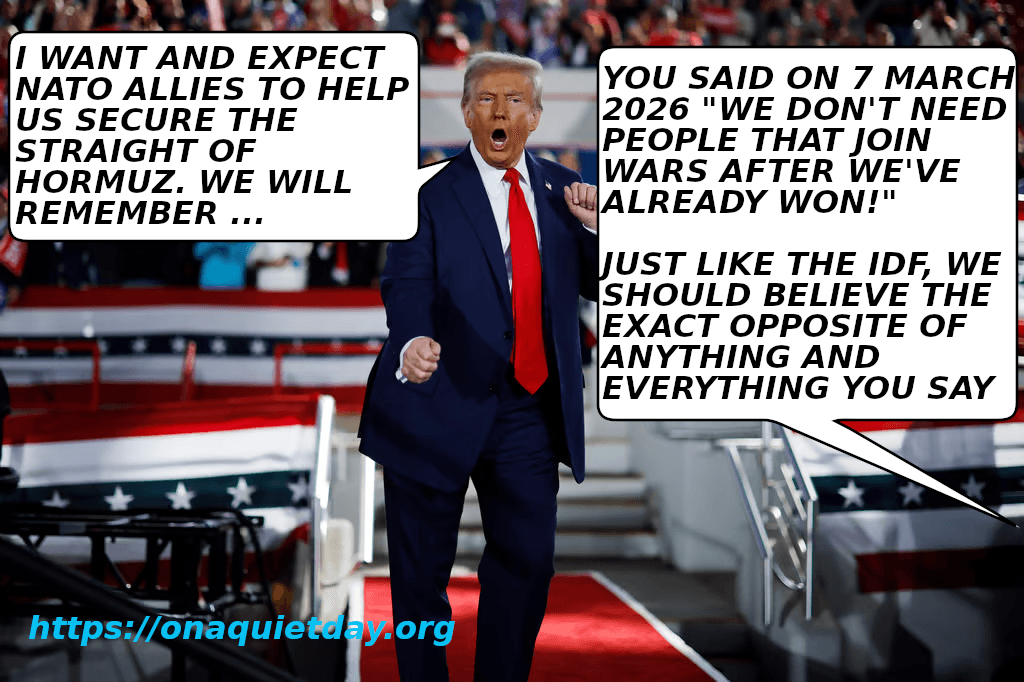
Donald Trump calls for help from NATO allies in securing the Straight of Hormuz despite saying on 7 March 2026 that they don't need people to join wars after they've already won. He's challenged with the claim that he lies as much as the IDF.
Donald Trump calls for help from NATO allies in securing the Straight of Hormuz despite saying on 7 March 2026 that they don’t need people to join wars after they’ve already won. He’s challenged with the claim that he lies as much as the IDF.
Orcas discuss how Trump was re-elected and him being an obviously insane, xenophobic Fascist.

Continue ReadingIran has ‘high’ incentive to maintain ceasefire, US forces remain ‘postured’: US defense chief