Elbit has an MoD contract to provide a simulation trainer for Challenger 3 tanks (Photo: Stephen Bardens / Alamy)
Ed Miliband’s decision to leave the military relationship with Israel intact raises serious concerns about Britain’s compliance with international law.
…
Genocide scholar Martin Shaw told Declassified: “The government’s acceptance that the occupation is illegal means that it should act against Israel itself, not just the settlers it has installed.
“The ICJ was clear that states must do nothing that provides ‘aid or assistance’ to Israel in maintaining the occupation, and must ‘ensure that any impediment’ that the occupation causes to the right of the Palestinian people to self-determination ‘is brought to an end’.
“Through the UK’s military alliance with Israel and its comprehensive military-industrial cooperation, Labour still appears to be failing in these legal duties, despite Miliband’s announcements”.
…
Omar Barghouti, co-founder of the Boycott, Divestment and Sanctions (BDS) movement for Palestinian rights, told Declassified: “This important investigation exposes precisely why the UK government’s recent measures are largely performative and designed to whitewash the multifaceted, shameless complicity of the UK with Israel’s regime of settler-colonialism, illegal occupation, apartheid and genocide.
“The UK has failed to end the economic relationships, trade agreements and academic relations with Israel that may contribute to its unlawful presence and apartheid regime in the occupied Palestinian territory, as it is obliged to do in order to comply with the ICJ ruling.
“It is absurd for the UK to sanction settlements while simultaneously purchasing and integrating Israeli surveillance and weapon systems that are field-tested on Palestinians into its own armed forces.
“Comparing these largely symbolic measures with the far-reaching sanctions imposed by the UK on Russia after its invasion of Ukraine affirms the UK’s colonial hypocrisy and loss of credibility on the international stage”.
…
In addition to military collaboration, Britain’s intelligence relationship with Israel will be untouched, according to Miliband, and there are no signs that either the 2020 UK-Israel military cooperation agreement, nor the 2023 Road Map for UK-Israel bilateral relations will be suspended.
In response to Britain’s sanctions, Israel has said it will close the British consulate in East Jerusalem, remove UK representatives from the International Gaza Support Centre in Kiryat Gat, and terminate Britain’s role in training Palestinian Authority forces in the West Bank.
Omar Barghouti added: “The UK has very clear obligations under international law, as triggered by the ICJ decisions of 2024 about Israel’s plausible genocide and its illegal occupation and apartheid.
“The UK must end all military, intelligence, trade, financial, academic and other relations with Israel that enable its illegal occupation, apartheid or genocide, as the ICJ has called for”.
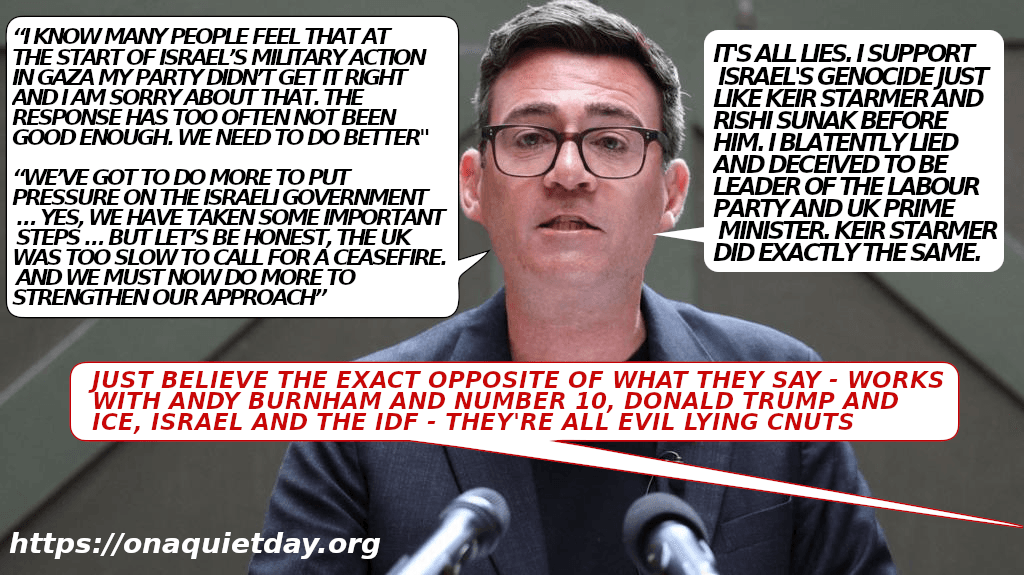
UK Prime Minister Andy Burnham admits to blatently lying and engaging in deception to become leader of the UK Labour Party and Prime Minister.Keir Starmer objects to criticism of the IDF. He asks how could anyone object to them starving people to death, forced marches like the Nazis did, bombing Gaza’s hospitals and universities, mass-murdering journalists, healthworkers and starving people queuing for food, killing and raping prisoners and murdering children. He calls for people to stop obstructing his genocide for Israel. New Labour UK Prime Minister Andy Burnham continues Labour party policy of active support and complicity in Israel’s genocide.Genocide denier and Current UK Prime Minister Keir Starmer is quoted that he supports Zionism without qualification. He also confirms that UK air force support has been essential in Israel’s mass-murdering genocide. Includes URLs https://www.declassifieduk.org/keir-starmers-100-spy-flights-over-gaza-in-support-of-israel/ and https://youtu.be/O74hZCKKdpA
This work by Middle East Monitor is licensed under a Creative Commons Attribution-NonCommercial-ShareAlike 4.0 International License.
Lebanese Civil Defense and fire crews respond as local residents inspect the site in the town of Kfar Shouba in the Nabatieh Governorate of southern Lebanon following an incursion and subsequent withdrawal by Israeli forces, on September 10, 2026. [Ramiz Dallah – Anadolu Agency]
The Israeli army carried out a series of explosions and shelling in southern Lebanon early Friday, including demolishing part of a school, despite the US-mediated framework agreement, Anadolu reports.
The escalation comes as Israel’s election campaign intensifies, with Prime Minister Benjamin Netanyahu seeking to rally and unite his right-wing bloc ahead of the Oct. 27 elections.
“Israeli forces blew up most of the public school in the town of Mansouri in Tyre district, leaving only a small part of the building standing,” Lebanon’s National News Agency (NNA) said.
Israeli aircraft also launched a strike on Mansouri at the same time as the large explosion at the school, the agency added.
At dawn, the Israeli army detonated explosives on the hill of Baraachit in Bint Jbeil district, coinciding with artillery shelling that targeted Wadi al-Hujair.
On Thursday evening, the Israeli army carried out a powerful explosion in the Ali al-Taher heights, causing ground tremors. It claimed the blast targeted a tunnel network and Hezbollah infrastructure extending more than 1.2 miles (2 kilometers).
Israeli Army Radio military correspondent Doron Kadosh said Israeli forces that had entered the Ali al-Taher heights had withdrawn and were stationed behind the front lines in the Beaufort Castle area.
In a post on the US social media company X on Friday, Kadosh claimed that the Israeli army had given fighters in the area a chance to surrender, but they refused, and that nearly 50 fighters were killed as Israeli forces prepared to withdraw and remotely control the hilltop.
He further claimed that Israeli forces intercepted supply shipments that Hezbollah tried to send to the fighters by drones.
Kadosh said the Israeli army destroyed the tunnels using 1,100 tons of explosives.
He quoted a senior Israeli officer who led the operation, without naming him, as saying it was “one of the most complex operations carried out by the army in recent years.”
On Thursday, Netanyahu claimed that Israel had destroyed what he described as “the largest Iranian site outside Iran,” referring to the Ali al-Taher tunnels.
The Ali al-Taher hill is located between the towns of Kfar Tibnit and Nabatieh al-Fawqa, north of the Litani River. It rises around 1,970 feet (600 meters) above sea level, giving it strategic importance as it overlooks wide areas of southern Lebanon.
Israeli attacks on southern Lebanon have continued despite a “framework formula” signed by Beirut and Tel Aviv on June 26, which provides for a gradual Israeli withdrawal from occupied territory in return for the deployment of the Lebanese army in those areas.
Israel occupies areas in southern Lebanon, some of them for decades and others since the war between 2023 and 2024, while expanding its presence inside Lebanese territory during its ongoing assault.
This work by Middle East Monitor is licensed under a Creative Commons Attribution-NonCommercial-ShareAlike 4.0 International License.
Donald Trump calls for help from NATO allies in securing the Strait of Hormuz despite saying on 7 March 2026 that they don’t need people to join wars after they’ve already won. He’s challenged with the claim that he lies as much as the IDF.
The change in policy is a direct result of sustained pressure from activists and organisers across the Palestine movement. But what comes next?
…
We can certainly retain our anger at the government’s complicity. No sanction can offset the foreign policy decisions made by the former prime minister Keir Starmer and former foreign secretary David Lammy, the repression of domestic pro-Palestine advocacy, or the sheer loss of life. But we must balance this with cautious optimism that the political tide is turning.
…
The necessary next step is a full arms embargo and an end to cooperation with Israeli security forces – to truly have teeth, these sanctions must not take with one hand and then give with another. Miliband has said that “we’ve already suspended over 30 arms licences used by the IDF in Gaza. That suspension remains fully in place”, and that the government will “now also refuse all licence applications for arms and other exports that materially contribute to the occupation”. But components of F-35 jets continue to be exported to Israel and used for operations in Gaza, as are surveillance technologies such as drones and radar made in the UK by Elbit Systems. This is a total dereliction of duty by the British government.
Miliband’s announcements were a necessary reminder that a just political future is possible and, within it, a reckoning with past crimes. As a campaigner, I have borne witness to Israel’s most egregious human rights violations: I have documented Israeli settlers committing pogroms against the community of Al-Mufaqara, sat in Palestinian villages threatened with home demolitions and army raids, and witnessed the ongoing daily misery of Israel’s apartheid policies. This has all strengthened my motivation to see the end of the Israeli occupation.
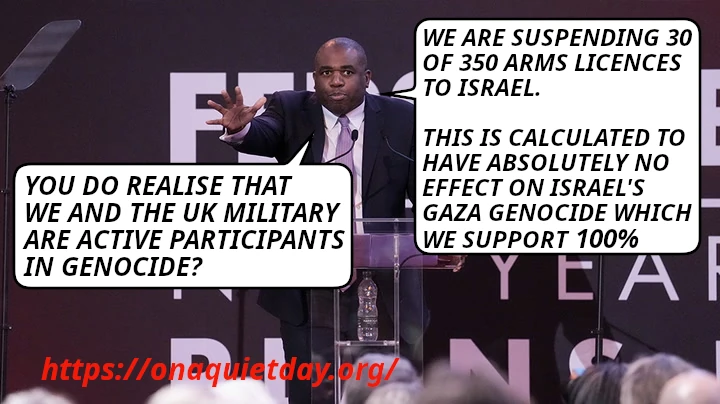
Genocide denier and Current UK Prime Minister Keir Starmer is quoted that he supports Zionism without qualification. He also confirms that UK air force support has been essential in Israel’s mass-murdering genocide. Includes URLs https://www.declassifieduk.org/keir-starmers-100-spy-flights-over-gaza-in-support-of-israel/ and https://youtu.be/O74hZCKKdpAKeir Starmer objects to criticism of the IDF. He asks how could anyone object to them starving people to death, forced marches like the Nazis did, bombing Gaza’s hospitals and universities, mass-murdering journalists, healthworkers and starving people queuing for food, killing and raping prisoners and murdering children. He calls for people to stop obstructing his genocide for Israel. New Labour UK Prime Minister Andy Burnham continues Labour party policy of active support and complicity in Israel’s genocide.Genocide denying UK Foreign Secretary David Lammy says that UK is suspending 30 of 350 arms licences to Israel. He also confirms the UK government’s support for Israel’s Gaza genocide and the UK government and military’s active participation in genocide.
This work by Middle East Monitor is licensed under a Creative Commons Attribution-NonCommercial-ShareAlike 4.0 International License.
Israeli far-right Finance Minister Bezalel Smotrich displays a map of an area near the settlement of Maale Adumim, a land corridor known as E1, outside Jerusalem in the occupied West Bank, on August 14, 2025. [Photo by MENAHEM KAHANA/AFP via Getty Images]
Far-right Israeli Finance Minister Bezalel Smotrich on Wednesday announced plans for 1,000 new settlement housing units in the northern occupied West Bank, a day after 12 Western countries said they intended to impose trade restrictions on goods from illegal Israeli settlements, Anadolu reports.
Smotrich said on US social media company X that 1,665 dunams (411.5 acres) had been added to the Kida and Havat settlements, allowing for the construction of 1,000 new housing units.
The leader of the Religious Zionism party described the move as “another historic step in the settlement revolution.”
Israel has occupied the West Bank, including East Jerusalem, since 1967. The international community considers Israeli settlements built on occupied Palestinian territory illegal under international law, a position rejected by Tel Aviv.
“After more than 25 years, the Kida and Havat settlements have finally reached the moment when the government is advancing procedures to legalize their status,” Smotrich said.
Kida and Havat were established in 2003 and 2001, respectively. The Israeli government decided to convert them into recognized settlements in December and March, respectively.
The government of Prime Minister Benjamin Netanyahu has touted that since taking office in late 2022, it has approved the establishment of 104 new settlements and established 160 agricultural settlement outposts in the occupied West Bank.
Around 750,000 Israeli occupiers live in 156 settlements and 360 outposts across the occupied West Bank, including occupied East Jerusalem, according to Palestinian figures.
On Tuesday, the UK, Canada, Denmark, Finland, France, Iceland, Ireland, Norway, Poland, Portugal, Spain and Sweden announced plans to impose trade restrictions on goods originating from the Israeli settlements.
This work by Middle East Monitor is licensed under a Creative Commons Attribution-NonCommercial-ShareAlike 4.0 International License.
Orcas discuss rotting brain, front Orca says Sundown Syndrome is a dead givaway and he wishes someone would Lock Him Up
Donald Trump calls for help from NATO allies in securing the Strait of Hormuz despite saying on 7 March 2026 that they don’t need people to join wars after they’ve already won. He’s challenged with the claim that he lies as much as the IDF.Climate science denier Donald Trump confirms that he knows nothing about democracy and that more liquid gold is being secured according to his policy of policy of global privateering.
This work by Middle East Monitor is licensed under a Creative Commons Attribution-NonCommercial-ShareAlike 4.0 International License.
Israeli Prime Minister Benjamin Netanyahu gives a speech in Washington, DC on September 29, 2025. [Will Oliver/EPA/Bloomberg via Getty Images]
The Yedioth Ahronoth newspaper in Israel on Wednesday described the announcement by 12 Western countries, led by Britain, to restrict trade with illegal Israeli settlements in the occupied West Bank as a “diplomatic setback and a significant failure” for Prime Minister Benjamin Netanyahu’s government.
Britain, Canada, Denmark, Finland, France, Iceland, Ireland, Norway, Poland, Portugal, Spain and Sweden announced Tuesday their intention to impose restrictions on trade in goods originating from illegal Israeli settlements.
In a statement, the 12 countries said the Israeli government’s actions in the occupied West Bank undermine the possibility of a two-state solution and urged Israel to immediately halt illegal settlement expansion and violence by occupiers.
Yedioth Ahronoth said that “with the European Union unable for months to reach consensus on sanctions that would ban imports from Israeli settlements, several European countries have begun pursuing restrictions independently, moving the issue from EU-wide diplomacy to national legislatures.”
The absence of an agreement in Brussels led governments supporting the restrictions to conclude that each country would need to enact its own legislation to ban imports from illegal settlements, it said.
The newspaper noted that “the Netherlands has already adopted such measures, although the Dutch order has been challenged in court on claims that it is discriminatory. It is scheduled to take effect Sept. 22.”
“Spain already has legislation in effect, although Israeli exports to the country from the West Bank are limited. Similar legislation is now being discussed in Luxembourg, while Sweden is pursuing its own process,” it added.
Belgium has announced plans for similar action but has not yet enacted legislation, “meaning no restrictions are currently in force there,” said the newspaper.
Yedioth Ahronoth said the growing number of countries supporting restrictions has “caused significant concern in Israel,” not because of the relatively limited volume of trade from illegal settlements, but because officials fear the measures could discourage European importers from altogether purchasing Israeli products.
“Under the new Dutch rules, importers of products originating in settlements could face up to six years in prison,” it added.
Israeli officials and business representatives fear some Dutch companies may choose to avoid Israeli goods entirely rather than verify whether individual products were manufactured inside Israel or in illegal settlements.
They warn that it “could effectively create a quiet, broader boycott.”
“The concern is that importers unwilling to assume the legal risk or administrative burden of establishing where Israeli goods were produced will simply stop purchasing them,” said the newspaper, adding that Israeli officials believe the secondary effects could have serious consequences for the economy as a whole.
The newspaper noted that Europe has long opposed Israeli settlement expansion, “but growing attention to attacks by extremist settlers against Palestinians has given fresh momentum to governments seeking punitive measures.”
Images of Israeli occupiers entering Palestinian villages and reports of violence “have intensified European pressure,” while inflammatory statements by far-right National Security Minister Itamar Ben-Gvir and Finance Minister Bezalel Smotrich “have further fueled criticism,” it said.
“From Israel’s perspective, the failure to effectively address reported incidents of settler violence has created a political boomerang: Extremists in the West Bank are strengthening the case of European governments and activists already opposed to settlements,” it said.
The occupied West Bank has witnessed escalating attacks by occupiers against Palestinians and their property, including incursions into towns and villages, and assaults on residents, vehicles and homes, under the protection of Israeli forces.
Yedioth Ahronoth warned that the potential economic consequences could eventually affect not only occupiers and companies operating in the West Bank, but the Israeli economy as a whole if importers begin viewing all Israeli products as potentially subject to restrictions.
The newspaper said domestic political considerations played a role in Britain’s decision, according to Israeli assessments, as the Labour government faces pressure from elements of its political base; “however, the more consequential development was Britain’s ability to assemble a coalition of 12 countries behind the initiative.”
The timing added another dimension to the controversy because the measures came during Israel’s election campaign.” Some Israeli political figures argue that international pressure on settlements could strengthen Prime Minister Benjamin Netanyahu and his right-wing allies electorally, and British officials had been warned about that possibility,” said the newspaper.
Nevertheless, the newspaper concluded that the decision by Britain and the 11 other Western countries was viewed “not only as a diplomatic setback but as a significant failure by Israel to prevent a coordinated international initiative.”
Palestinians warn that Israel is paving the way for formal annexation of the West Bank through army raids and attacks by occupiers, undermining the possibility of establishing a Palestinian state as stipulated in relevant UN resolutions.
This work by Middle East Monitor is licensed under a Creative Commons Attribution-NonCommercial-ShareAlike 4.0 International License.
Orcas discuss rotting brain, front Orca says Sundown Syndrome is a dead givaway and he wishes someone would Lock Him Up
Donald Trump calls for help from NATO allies in securing the Strait of Hormuz despite saying on 7 March 2026 that they don’t need people to join wars after they’ve already won. He’s challenged with the claim that he lies as much as the IDF.Climate science denier Donald Trump confirms that he knows nothing about democracy and that more liquid gold is being secured according to his policy of policy of global privateering.