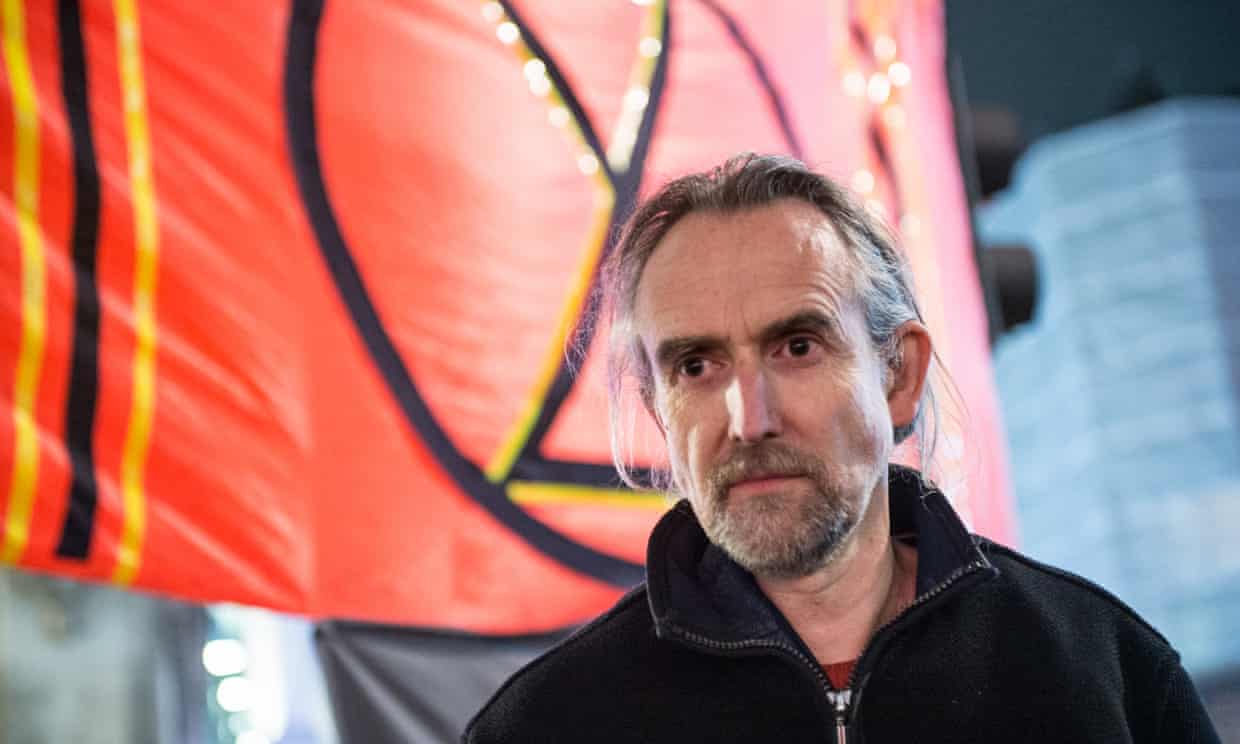
Roger Hallam, on trial for conspiring to block traffic on the M25 in 2022, said he wanted to ‘speak the whole truth’. Photograph: Ollie Millington/Getty
Accused speak out of turn about climate threat and challenge judge who orders jury to leave
There was chaos in the courtroom at a climate protest trial when two defendants stood and made statements defying the authority of the court.
At separate points during the trial on Thursday, Roger Hallam and Daniel Shaw, charged along with three others with conspiring to block traffic on the M25 in 2022, stood up in front of the jury and spoke out of turn.
Hallam, whose evidence was discontinued on Wednesday, stood up just as court got under way on Thursday and said: “I wish to communicate to the jury and the court that I was forcibly removed from the court yesterday for refusing to break my oath and speak the whole truth.”
Later on, while Louise Lancaster, a co-defendant, was in the witness box, Shaw, whose evidence was also discontinued on Wednesday, stood up from his place in the court and directly challenged the judge.
He said: “Climate change represents an existential threat to humanity. The court agrees with that. Why are you not trying the people causing this crisis?”
Each time the defendants continued speaking as the judge, Christopher Hehir, ordered the jury to leave the court.
Lancaster refused to submit to cross-examination by the prosecution, as Shaw and Hallam had done the previous day, prompting Hehir to discontinue her evidence.
Hehir told jurors: “Members of the jury, in your absence I had a discussion in open court with Miss Lancaster. In frank and straightforward terms she has told me she is not prepared to submit to cross-examination. In those circumstances her evidence is at an end.”
UN Special Rapporteur on Environmental Defenders under the Aarhus Convention and former UN Special Rapporteur on Human Rights Defenders Michel Forst is attending the ongoing trial of five Just Stop Oil supporters at Southwark Crown Court today. He is attending as an observer because of his serious concerns.
The special rapporteur’s office released a statement on 24th June detailing his views regarding the criminal prosecution of Daniel Shaw in this trial. The statement can be read here.
The Aarhus Convention, to which the UK is a signatory, aims to promote environmental democracy by ensuring public access to information, participation in decision-making, and access to justice in environmental matters. The Special Rapporteur monitors the implementation of the convention’s provisions by its parties, ensuring compliance with obligations related to access to justice. Additionally, the Special Rapporteur investigates complaints from individuals or groups alleging violations of their rights under the Aarhus Convention, assesses specific cases, and makes recommendations to ensure compliance.
Daniel Shaw, Cressie Gethin, Lucia De-Abreu-Whittaker, Louise Lancaster and Roger Hallam are currently on trial at Southwark Crown Court, charged with conspiracy to cause a public nuisance in connection with the M25 gantry actions in November 2022. They were arrested either pre-emptively in police raids at their homes after attending a Zoom call in which a Sun journalist was present, or arrested travelling near the M25 respectively. The Sun alleged it had ‘infiltrated’ the meeting and boasted of tipping off the police and enabling National Highways to secure a public injunction.
Some of these five were imprisoned for up to 113 days without trial. They were released subject to stringent conditions including a 10 pm to 7 am house curfew, not to be within a one-mile radius of the M25, no contact with other defendants and not to participate in any climate change demonstration.
In another trial involving Just Stop Oil supporters, which was the first under the new Public Order Act 2023 for a Section 7 offence, Judge Hehir who is overseeing the current proceedings barred all legal defences from the defendants and prohibited any mention of the climate crisis to the jury. This trial concluded with a conviction, and Judge Hehir is expected to sentence the defendants at a future date.
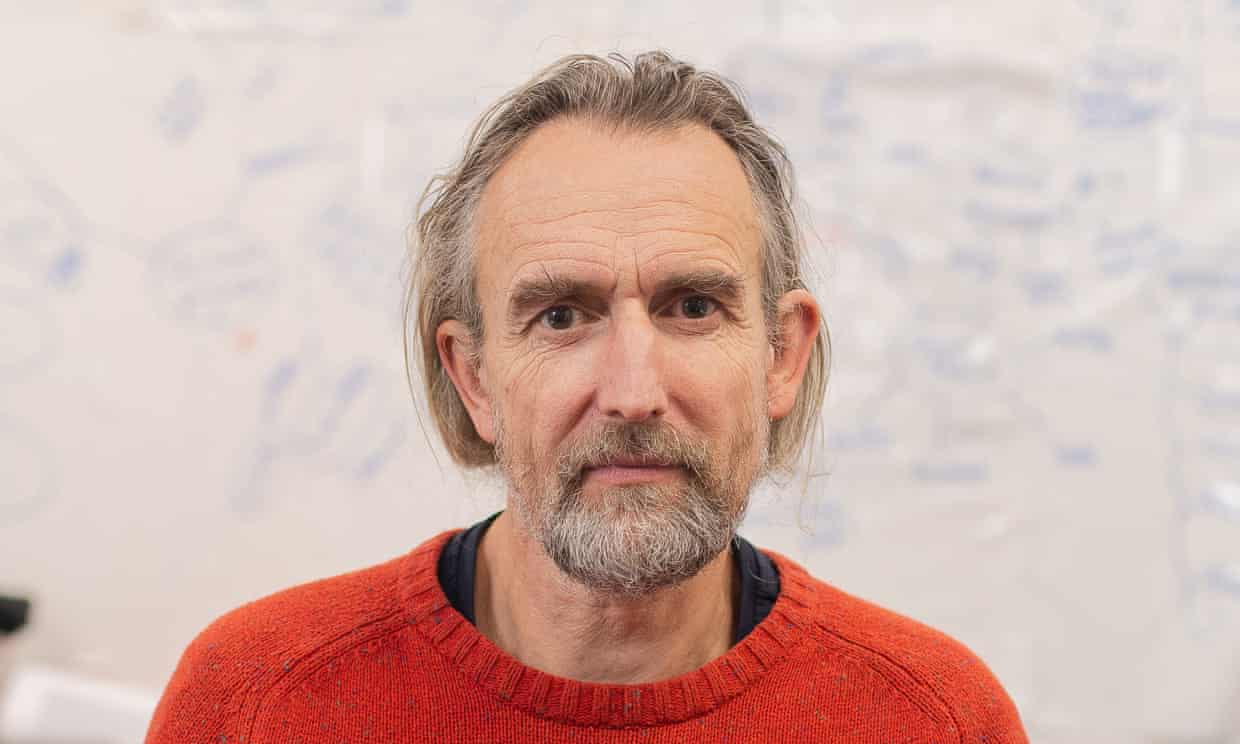
Roger Hallam is on trial with others accused of conspiracy to cause a public nuisance. Photograph: Alecsandra Raluca Drăgoi/The Guardian
A climate protester ignored a judge’s instructions and refused to leave the witness box, instead delivering an hours-long speech telling jurors that his alleged role in a conspiracy to block the M25 was justified by the risk of human extinction.
Roger Hallam, 58, spoke for more than two hours on why a judge was wrong to rule that he and co-defendants could not bring evidence in their defence on the impacts of climate breakdown, and why such evidence justified the sort of acts of which they are accused.
The judge Christopher Hehir sent out the jury three times during Hallam’s extended address, left the court himself once, and interrupted Hallam many times to make clear it was not his place to instruct jurors on points of law.
But Hehir eventually let Hallam continue, to the defendant’s apparent surprise. “I apologise to you if I’m a little bit incoherent,” Hallam told jurors towards the end of his address. “I didn’t actually expect that I was going to get this far.”
Hallam is on trial alongside Louise Lancaster, Daniel Shaw, Cressida Gethin and Lucia Whittaker-de-Abreu on a charge of conspiracy to cause a public nuisance for allegedly organising activists to climb gantries on the M25 over four days in November 2022.
…
Hehir repeatedly interrupted Hallam. “I’m not going to permit you to lecture the jury, wrongly or rightly, about the law,” he said.
Hehir had ruled that the defendants could not bring extensive evidence about the impacts of climate breakdown but that they could speak about their political or philosophical beliefs on the issue, to give context to actions.
Hallam’s speech led Hehir to send the jury out of the courtroom three times. Hehir told jurors they were to take instructions on the law only from him and that Hallam’s evidence about the impacts of climate change was not relevant.
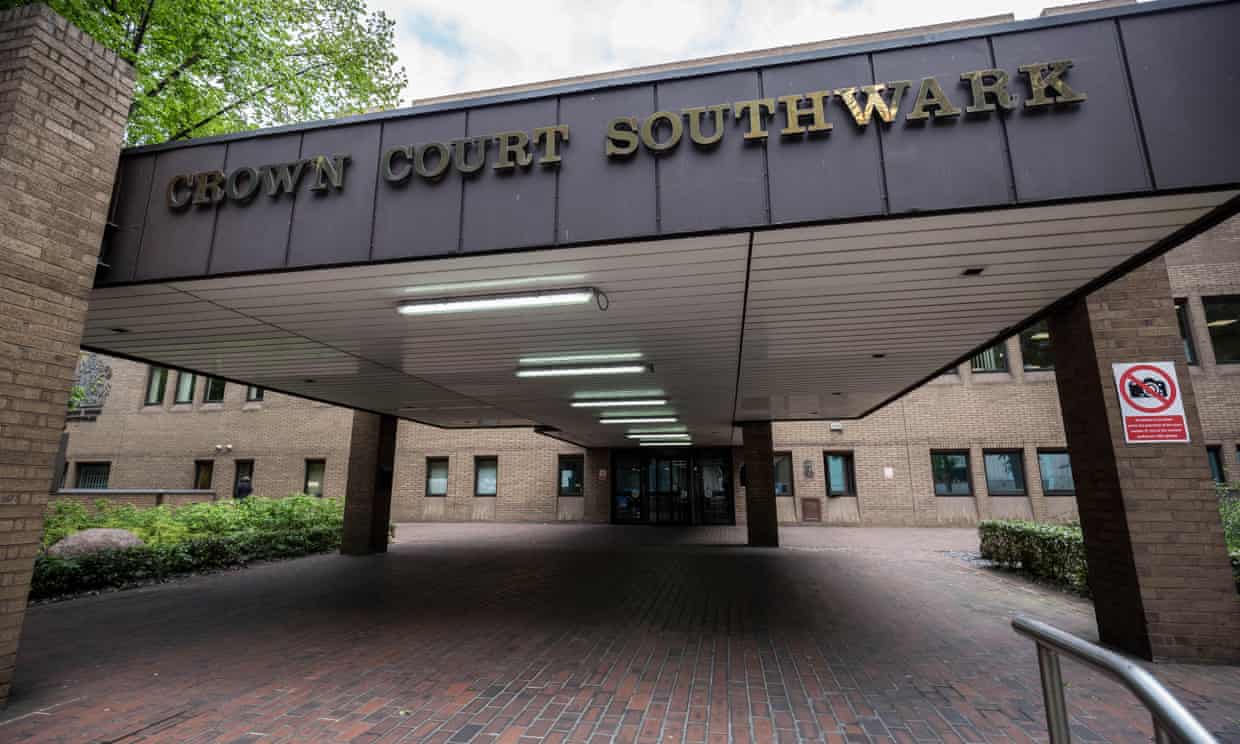
A judge released all the individuals on bail on condition they did not come within the vicinity of Southwark crown court until a contempt proceedings hearing on 27 September. Photograph: Guy Corbishley/Alamy
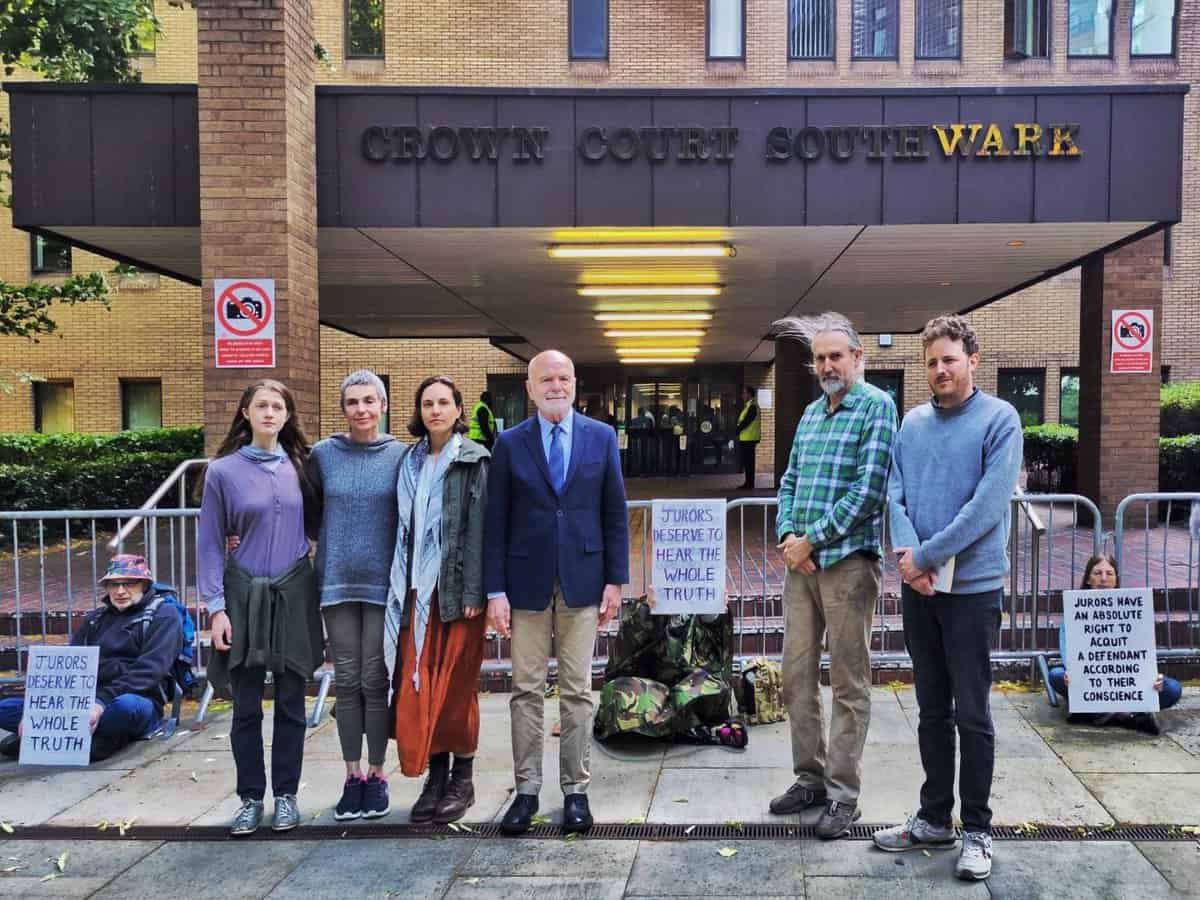
A group of 11 activists have been arrested on suspicion of contempt of court after they held up placards outside a crown court.
Police officers began detaining the protesters, who were standing on the pavement at English Grounds outside Southwark crown court in central London, on Tuesday morning after being given directions by a judge.
Messages on signs carried by protesters included “jurors deserve to hear the whole truth” and “jurors have an absolute right to acquit a defendant according to their conscience”.
…
A judge released all the individuals on bail on condition they did not come within the vicinity of Southwark crown court until a contempt proceedings hearing on 27 September.
The judge told them: “I hope that the time you’ve spent in detention in the precincts of the court is a salutary reminder that the court’s proceedings are not to be trifled with.”
dizzy: Sounds like this is about climate activists being refused the right to discuss the climate crisis as part of their defence i.e. why they did what they did.
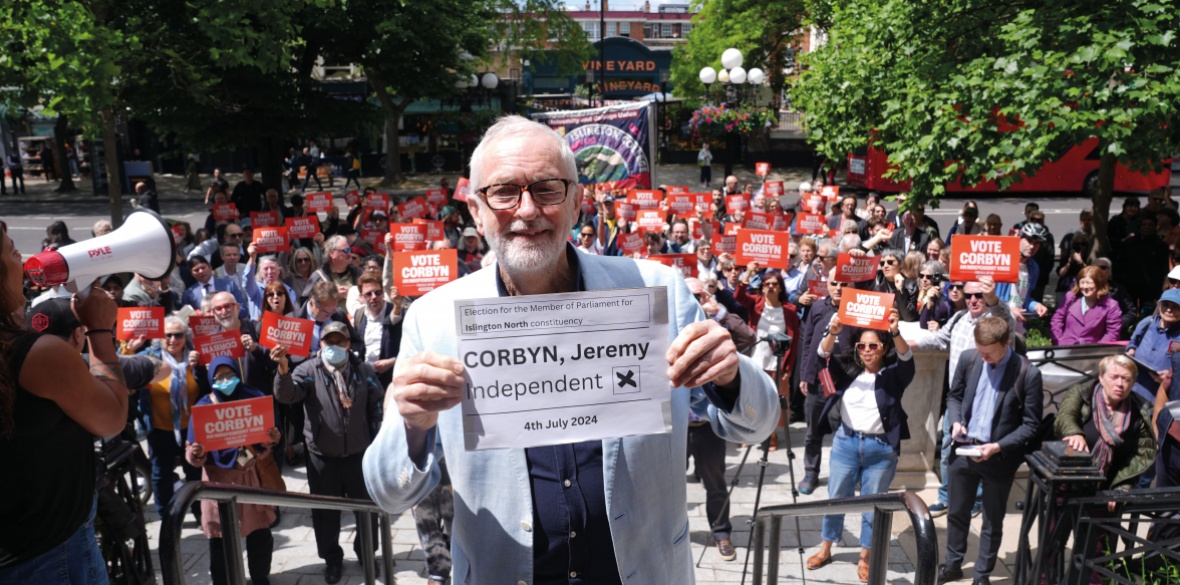
ALL TO PLAY FOR: Jeremy Corbyn poses outside Islington Town Hall, north London, after handing in his nomination papers for the general election
WILL Jeremy Corbyn win? It is the anxious question asked thousands of times a day by men and women on the left across Britain.
Across the world, come to that. The Islington North MP is recognised globally as one of the foremost champions for peace and social justice.
…
Five years ago he was leading Labour’s charge for office. His period as party leader did one thing the Establishment can never forgive — it gave them a fright. Keir Starmer is the instrument of their vengeance.
Interviewed by the Star in a cafe in the shadow of Finsbury Park station, near his campaign headquarters, he is invited to reflect on what has become of his party of nearly 60 years.
“It’s very sad. When I stepped down as leader it had 600,000 members, it was developing community organising, delayed for two years by officialdom.
“That was the direction we were going in — a broad, community-based grassroots campaigning party. Now it is a very centralised party. Local parties like Islington North have been treated with absolute disdain by the national party.”
His campaign has focused heavily on the local and has not really attacked his former party.
Prompted, Corbyn acknowledges that “if Labour loses that social milieu of people fighting for social justice and peace it just becomes a vehicle with no soul.”
That is the price of the consensus which Corbynism briefly shattered and is now in advanced restoration. Nationally, it is an arid campaign.
“The duopoly of the economic offer, both parties promise the same spending plans, same taxation regime, means the inequalities of the past 15 years are hard-wired into economic plans for the future.”
…
As ever, Jeremy Corbyn is most fluent, most at ease when discussing either the social problems on the ground, in his own constituency above all, or the dangers facing the world as a whole. I put to him George Galloway’s recent warning that Britain could be at war within six months.
“George is not wrong about that. We are moving towards a very very dangerous situation. Defence spending is by consensus to rise to 2.5 per cent and there are pretty loud voices saying it should go even more, to 3 per cent.”
He slates the bipartisan obsession “with Britain’s global military role — for what? We are building up to a cold war with China,” incurring vast spending on the Aukus nuclear submarine pact ”and not doing anything to bring about peace, not in the Ukraine war, not in Palestine.”
Re-elected, “I will be that voice for peace,” he pledges, a rare politician’s commitment that you can be absolutely sure will be honoured.
…
“The Gaza crisis has sorted a lot of people out. I think that the opportunity for politics coming back offered by the peace movement is going to be the future. People who come together for social justice.
“If you want to know what the future looks like, look at the demonstrations, people from all walks of life, communities, religions, races; all of this is a way forward.
“It includes a lot of people in the Labour Party who have radical political demands” but also the wave of independent candidates challenging Labour in this election.
“I would expect after the election to see a political grassroots movement, a community of activity from the grassroots.” In Islington, he pledges to establish a people’s assembly to render account to.
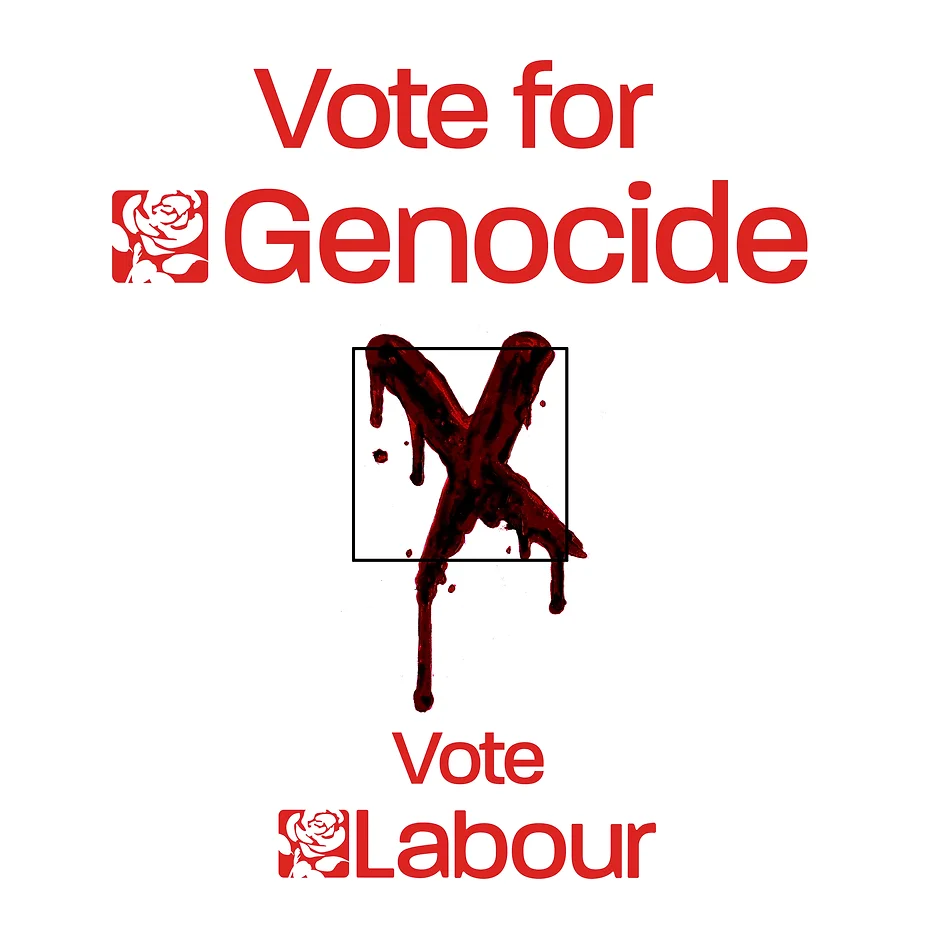
Zionist Keir Starmes is quoted “I support Zionism without qualification.” He’s asked whether that means that he supports Zionism under all circumstances, whatever Zionists do.