Israel Launches Massive Attack on Lebanon, Heightening Fears of All-Out War

Spread the love

Original article by JAKE JOHNSON republished from Common Dreams under Creative Commons (CC BY-NC-ND 3.0).

Smoke billows from the site of an Israeli airstrike on Zibqin in southern Lebanon on August 25, 2024. 
(Photo: Kawnat Haju/AFP via Getty Images

“Looks like Israel is now escalating in Lebanon in a major way in the hopes of kicking off a major war in the north that has thus far been kept to more limited exchanges,” warned one analyst.

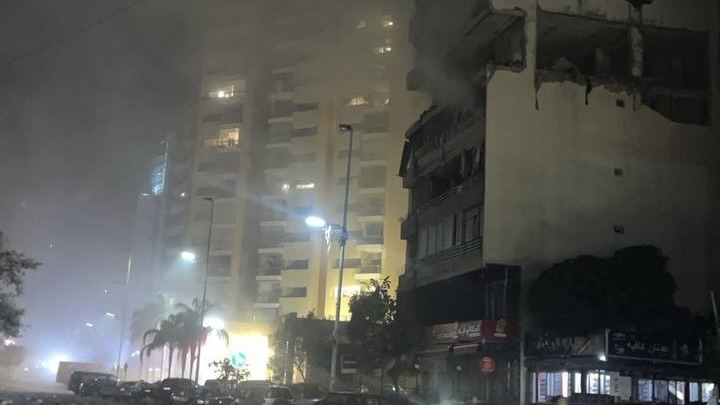
Israel’s military deployed around 100 fighter jets to launch a massive bombing campaign in southern Lebanon on Sunday, endangering tens of thousands of civilians and heightening the chances of an all-out regional war.

The Israel Defense Forces (IDF) characterized the wave of airstrikes as an effort to preemptively “remove the threat” posed by a purportedly imminent Hezbollah attack, but observers argued the Israeli bombing marked a serious escalation that could further undermine hopes of a cease-fire deal in Gaza.

“Looks like Israel is now escalating in Lebanon in a major way in the hopes of kicking off a major war in the north that has thus far been kept to more limited exchanges,” wrote political analyst Yousef Munayyer. “Just as negotiations for a cease-fire were reportedly advancing.”

Hezbollah said Sunday that it had fired hundreds of drones and rockets at Israeli military sites in retaliation for the assassination of one of the group’s senior commanders last month. Hezbollah said the “first phase” of its response was complete and rejected the IDF’s claim that it preempted the group’s retaliatory action.

The Associated Press reported that “by mid-morning, it appeared that the exchange had ended, with both sides saying they had only aimed at military targets.”

“At least three people were killed in the strikes on Lebanon,” AP noted, “while there were no reports of casualties in Israel.”

Israel Katz, the Israeli foreign minister, wrote on social media following the attack on Lebanon that he “sent a direct message to dozens of foreign ministers worldwide, urging them to support Israel against the Iranian axis of evil and its proxies, led by Hezbollah.”

Sunday’s dangerous back-and-forth, described by one newspaper as the two sides’ biggest exchange of fire since the 2006 war, further intensified concerns that the region is moving toward the precipice of an all-out conflict as Israel’s U.S.-backed assault on the Gaza Strip continues with no end in sight.

A White House spokesperson said Sunday that U.S. President Joe Biden is “closely monitoring events in Israel and Lebanon.”

“At his direction, senior U.S. officials have been communicating continuously with their Israeli counterparts,” the spokesperson said. “We will keep supporting Israel’s right to defend itself, and we will keep working for regional stability.”

One senior U.S. official said Israel did not give the White House advance notice of the Lebanon attack.

Monica Marks, professor of Middle East politics at New York University Abu Dhabi, wrote that the White House’s claim to be promoting regional stability “lands like a bad joke” given ongoing U.S. support for Israel’s “escalatory acts.”

“Lives on the ground are at stake. So are [Democratic presidential nominee Kamala] Harris‘ chances and Biden’s legacy,” Marks added. “D.C. is playing Middle East roulette.”

Israel’s bombardment of Lebanon came after another horrific day in the Gaza Strip, where the IDF killed dozens of Palestinians in southern Gaza. “Among the dead,” according to the AP, “were 11 members of a family, including two children, after an airstrike hit their home in Khan Younis.”

The atrocities preceded a fresh round of high-level cease-fire talks, negotiations that Israeli Prime Minister Benjamin Netanyahu has repeatedly thwarted with hardline demands.

The Washington Post reported Saturday that “Israel and Hamas were sending senior-level delegations to Cairo this weekend as U.S., Qatari, and Egyptian mediators prepared for a high-stakes summit they hope will break the deadlock in negotiations for a cease-fire in the Gaza Strip.”

“Hamas officials arrived in the Egyptian capital Saturday, while Israeli media reported that a team led by the head of Mossad, David Barnea, would travel there Sunday,” the Post added. “The summit, also on Sunday, will include CIA Director William J. Burns, Egyptian intelligence chief Abbas Kamel, and Qatari Prime Minister Mohammed bin Abdulrahman Al Thani.”

Original article by JAKE JOHNSON republished from Common Dreams under Creative Commons (CC BY-NC-ND 3.0).

Continue ReadingIsrael Launches Massive Attack on Lebanon, Heightening Fears of All-Out War

Netanyahu Isn’t Interested in Peace, So Why Does Biden Keep Pretending Otherwise?

Spread the love

Original article by JAMES ZOGBY republished from Common Dreams under Creative Commons (CC BY-NC-ND 3.0). 

Israeli Prime Minister Benjamin Netanyahu shakes hands with Rear Adm. David Saar Salama at the Ashdod Naval Base on October 29, 2023. (Photo: Office of Benjamin Netanyahu)

Instead of turning a blind eye to Israel’s behaviors that are deliberately designed to provoke more war, the U.S. needs to stop playing games and get serious about holding Israel accountable.

Why—in the midst of critical negotiations to implement U.S. President Joe Biden’s plan to bring about a cease-fire in Gaza, release Israelis held captive by Hamas and a significant number of Palestinians held by Israel, and move toward a negotiated permanent end to the conflict—would Israeli leader Benjamin Netanyahu decide to assassinate the chief Hamas negotiator while he was visiting Iran? And why—while the U.S. says it was working to deescalate tensions with Lebanon’s Hezbollah—would Israel choose to up the ante by assassinating Hezbollah’s number two?

We know the answers to both questions: Benjamin Netanyahu isn’t interested in peace. He doesn’t want a negotiated deal to release hostages and end the war on Gaza. He doesn’t want to deescalate the conflict there or in the north with Hezbollah. And he most certainly doesn’t want a “two-state solution” that would grant the Palestinian people independence in a sovereign state of their own.

There are two things Netanyahu does want, and, at this point, both are perversely connected. Above all, he desperately wants to remain in office, because should he lose his post as prime minister, the prosecution of the corruption charges against him will continue in full force. As the charges are so serious and the evidence so clear, he will likely be convicted and humiliated. This is not speculation—it’s widely discussed in Israel and was even hinted at by President Biden in a May 28 interview with Time Magazine. When he was asked “Is Netanyahu prolonging the war for political reasons?” Biden responded, “There is every reason for people to draw that conclusion.”

Why hasn’t the administration condemned the assassinations in Beirut and Iran when they know that they will surely sabotage the efforts of negotiators?

The second reason is that Netanyahu wants the war to continue and even be accelerated. He made this clear in his remarks before U.S. Congress and in an address to the Israeli public a few days ago. He seeks “total victory,” which he defines as more than the military defeat of Israel’s enemies. Without acknowledging any Israeli culpability, he charged that the Palestinians had created a hate-filled culture which in the post-war period would require massive deradicalization—the outcome of which would have Palestinians accepting Jewish hegemony in Eretz Israel and understanding their place as a conquered and subordinate people.

This is the messianic Zionist vision that has long driven Netanyahu and which he now sees as possible, but only if all of Israel’s enemies—meaning Iran and its surrogates—are brought to heel. And this can only be realized if Israel can involve the U.S. in their regional conquest.

Netanyahu’s worldview raises several additional questions that must be considered. If we know that Netanyahu has never accepted the terms of the Biden plan, why has the president continued to maintain that it was “Israel’s plan” and placed the burden on Hamas to accept it? And if we know that Netanyahu is unwilling to make any peace agreement for fear of losing his other extremist coalition partners (who have threatened to abandon his government should he accept any terms leading to peace), why do we continue to dance around that fact? Why hasn’t the administration condemned the assassinations in Beirut and Iran when they know that they will surely sabotage the efforts of negotiators? Why, when we know that Netanyahu has no intention of completing a deal to release those held captive, do we continue to allow him to exploit the pain of their families, pretending that negotiations are close to completion, when we know they aren’t? And why, when we know that the demands and actions of Netanyahu’s extremist coalition partners are wreaking havoc in the West Bank and Jerusalem—terrorizing the Palestinian population, annexing more land, building more settlements, and erasing the possibility of Palestinian self-determination—have we been so passive and tolerant in response?

Let’s be clear: Hamas and Hezbollah are not good actors. The former was born of the brutal and sustained Israeli occupation of Palestinian land. It was nurtured by Israel to create division in the Palestinian ranks and fueled by Israel’s ruthless decades-long strangulation of the population of Gaza. The latter was born of Israel’s invasion of Lebanon and by that country’s corrupt sectarian system that denied the Shia community adequate representation and resources. It was fueled by Israel’s decades-long occupation of Lebanon’s south and massive devastation of the country’s infrastructure in 2006. To be sure, both have engaged in condemnable actions. But to criticize only them, while absolving Israel of its far greater crimes, is hypocritical at best.

If the U.S. were serious about ending conflict in the region, instead of turning a blind eye to Israel’s behaviors that are deliberately designed to provoke more war, we need to stop playing games and get serious about holding Israel accountable. This leads to one final question: Why, when we continue to massively supply Israel with weapons and block all efforts to sanction their deplorable behaviors, do we expect that anything will change?

Original article by JAMES ZOGBY republished from Common Dreams under Creative Commons (CC BY-NC-ND 3.0). 

Continue ReadingNetanyahu Isn’t Interested in Peace, So Why Does Biden Keep Pretending Otherwise?

Rocket attack kills 12 children in Golan Heights – who are the Druze who live there?

Spread the love
Killed while playing football: a memorial service for the 12 dead children of Majdal Shams. AP Photo/Leo Correa

Erika Jiménez, Queen’s University Belfast

Israel’s prime minister, Benjamin Netanyahu, has threatened a harsh response to a rocket attack that on July 27 struck the Israeli-occupied Syrian Golan Heights, killing 12 children and injuring about 30 more.

Visiting the small town of Majdal Shams, where the children had been playing football when the strike occurred, Netanyahu blamed Hezbollah for the attack and said it would pay a “hefty price”. He said: “Our response will come, and it will be harsh.”

While Israel is claiming the attack targeted their citizens, all the victims of the strike were members of the Druze religious minority group located across Israel, Lebanon and Syria. Hezbollah has denied responsibility for the attack, but without an independent investigation, it remains unclear who fired the rocket.

The Golan Heights, a rocky 1,000 square kilometre region south-west of Damascus, was occupied by Israel after the 1967 Arab-Israeli war in a move that, half a century on, is often referred to as the “forgotten occupation”.

After defeating Egypt, Jordan, and Syria in the short conflict, Israel occupied the West Bank, Gaza and East Jerusalem as well as the Sinai desert and two-thirds of the Syrian Golan. Around 127,000 indigenous Syrians (95% of the population) – including Christians, Muslims and Druze – fled or were forcibly displaced. Depopulated villages were razed to the ground.

Later in 1981, Israel illegally annexed the territory, passing the Golan Heights Law. The UN security council immediately condemned this as illegal and passed resolution 497 (1981) calling on Israel to rescind its action, which would have “serious consequences for peace and security in the Middle East”.

Israel’s annexation of the Golan Heights was not recognised internationally until 2019 when the then US president Donald Trump released a “Proclamation on Recognizing the Golan Heights as Part of the State of Israel”.

Israel views its control over the Golan Heights as crucial to its security, as the region shares a border with Israel, Jordan and Lebanon. There is a buffer zone between the Israeli-occupied area of the Golan Heights and Syria, which is administered by the United Nations Disengagement Observer Force (Undof). The Golan gives whoever controls the land a vantage point overlooking Syria, which has never given up on its claim over the land.

Forgotten people

But what of the indigenous people of the Golan? Roughly 20,000 Druze people now remain, members of an Arab sect which is an offshoot of Islam that allows no intermarriage or joining from outside the religion. There are about 150,000 Druze in Israel and about 1 million across the Middle East. Druze men with Israeli citizenship are subject to military service.

Historically, Golanis have resisted the occupation via non-violent means, drawing on Druze religious beliefs, secular political ideas and the continuing assertion of their Syrian identity. The main industry in the region is agriculture and the area is known for its production of apples, cherries and olive oil.

Golanis in Majdal Shams participating in peaceful demonstration in solidarity with Palestinians. Al-Marsad

Resistance

In the years before annexation of the Golan, Israel attempted to introduce Israeli identity cards for the population. But this was rejected by Syrian communities in the Golan, who issued a wathiqa wataniya (Syrian national document), which asserted their Syrian-Arab national identity and connection to the land and opposed the annexation of the Golan.

The annexation also triggered what became known as the aldrab alkabir (great strike) that began in the February of 1982 and lasted almost six months. All segments of Golani society took part in demonstrations, discarded their Israeli ID cards and refused to pay taxes or participate in Israeli land surveys. The aim was to resist the imposition of Israeli citizenship and assert their Syrian identity.

Israel responded by placing curfews on the Druze villages, setting up blockades and restricting goods from entering, including milk and baby food. Some residents were arrested, including women who played a central role in the strike.

The Golani community responded to these restrictions by sharing resources and offering free services to one another. Palestinians also mobilised in support of Golanis by taking part in demonstrations and solidarity visits to the Golan.

This non-violent action was successful in achieving its primary aim and to this day around 80% of Golani Druze have rejected citizenship. They identify as Syrian and, unlike the Druze living in Israel, do not serve in the Israeli military.

This does mean that they are “stateless” (though not landless like many stateless people) and instead of passports they hold “laissez passer” travel documents that state their nationality is “undefined”. Without Israeli citizenship they are not allowed to vote, though they can attend Israeli educational institutions.

Meanwhile there are also an estimated 25,000 Jewish-Israelis living in the Golan Heights, across more than 30 settlements, considered illegal under international law. They are supported by the Israeli military and now together control 95% of the Golan, including much of its agriculture and industries.

Fear of escalation

There are now fears in the region that an Israeli retaliation against Hezbollah could significantly escalate the conflict. I’ve been working with local partners in the Golan Heights on a research project about Golani youth and human rights.

I spoke with a colleague in Majdal Shams this week. She told me that the people of the Golan “don’t want any other mother to scream and cry”. She said: “The Golani people are and have always been a peaceful people. Our message would be, ‘Stop the killing.’”

The 12 children were killed while playing football. Let that sink in. Then remember that it should not take their deaths to bring this forgotten occupation and these people who are forced to live under a foreign power to the world’s attention.

Erika Jiménez, Leverhulme Early Career Fellow at the School of Law, Queen’s University Belfast

This article is republished from The Conversation under a Creative Commons license. Read the original article.

Continue ReadingRocket attack kills 12 children in Golan Heights – who are the Druze who live there?

Rights campaigners claim Israel has used phosphorous shells on residential buildings in Lebanon

Spread the love

https://morningstaronline.co.uk/article/rights-campaigners-claim-israel-has-used-phosphorous-shells-residential-buildings

A shell that appears to be white phosphorus from Israeli artillery explodes over a house in al-Bustan, a Lebanese village along the border with Israel, on October 15, 2023

ISRAEL has broken international law by using white phosphorus incendiary shells on residential buildings in southern Lebanon, Human Rights Watch alleged today.

This coincided with United Nations agencies warning that over one million Palestinians in Gaza could face starvation by the middle of next month if there is no end to the current Israeli military offensive.

In a damning new report, the global human rights group says there is no evidence of burns injuries caused by white phosphorus in Lebanon, but that researchers have “heard accounts indicating possible respiratory damage.”

Human rights campaigners point out that it is a crime under international law to fire white phosphorus munitions into populated areas.

Israel maintains that it is used only as a smokescreen and not to target civilians.

https://morningstaronline.co.uk/article/rights-campaigners-claim-israel-has-used-phosphorous-shells-residential-buildings

Continue ReadingRights campaigners claim Israel has used phosphorous shells on residential buildings in Lebanon

UN Relief Chief Says All-Out War Is ‘Looming Dangerously Close’

Spread the love

Original article by JAKE JOHNSON republished from Common Dreams under Creative Commons (CC BY-NC-ND 3.0). 

A picture taken from Rafah on January 6, 2024 shows smoke billowing over Khan Younis in the southern Gaza Strip during Israeli bombardment.  (Photo: AFP via Getty Images)

“This war should never have started. But it’s long past time for it to end,” said United Nations emergency relief coordinator Martin Griffiths.

The United Nations’ emergency relief coordinator warned Friday that the threat of a broader conflict in the Middle East is growing rapidly as Israel’s assault continues in Gaza, which the U.N. official said has been rendered “uninhabitable” by near-constant airstrikes and a suffocating blockade.

“The specter of further regional spillover of the war is looming dangerously close,” Martin Griffiths, the U.N.’s under-secretary-general for humanitarian affairs, said in a statement, pointing to the humanitarian catastrophe in Gaza, mounting Israeli attacks in the West Bank, and rocket attacks on Israel. “Hope has never been more elusive.”

Griffiths, a longtime diplomat who has described the situation in Gaza as the worst humanitarian crisis he’s ever witnessed, issued his unsparing statement at the tail end of a week that saw Israel and the United States launch deadly strikes in Lebanon and Iraq, killing a senior Hamas official and the leader of an Iran-aligned militia.

On Saturday, Hezbollah responded to Israel’s drone strike on an office building in the Lebanese capital of Beirut by firing rockets at a military base in northern Israel, heightening fears of an escalatory spiral.

While the Biden administration insists it wants to avert a regional war, it continues to provide Israel with lethal military aid and oppose international efforts to enact a permanent cease-fire that analysts say is necessary to stop the conflict from spreading. The U.S. is also reportedly drafting plans to bomb Yemen in response to Houthi attacks on vessels in the Red Sea.

The Houthis have said the attacks will stop once Israel ends its catastrophic assault on the Gaza Strip.

Griffiths said Friday that the situation in Gaza is shockingly dire, with displaced families “sleeping in the open as temperatures plummet” and the territory’s remaining medical facilities “under relentless attack.”

“The few hospitals that are partially functional are overwhelmed with trauma cases, critically short of all supplies, and inundated by desperate people seeking safety,” said Griffiths. “Infectious diseases are spreading in overcrowded shelters as sewers spill over. Some 180 Palestinian women are giving birth daily amidst this chaos. People are facing the highest levels of food insecurity ever recorded. Famine is around the corner.”

“For children in particular,” Griffiths added, “the past 12 weeks have been traumatic: No food. No water. No school. Nothing but the terrifying sounds of war, day in and day out.”

Much of Gaza has been decimated by Israeli bombs, many of which were supplied by the United States. The Euro-Mediterranean Human Rights Monitor said Friday that around 68,000 housing units in Gaza have been completely destroyed by Israeli airstrikes.

Roughly 4% of Gaza’s population—more than 90,000 people—has been killed, wounded, or left missing by Israeli attacks since October 7, the group estimated.

“It is time for the parties to meet all their obligations under international law, including to protect civilians and meet their essential needs, and to release all hostages immediately,” Griffiths said. “It is time for the international community to use all its influence to make this happen. This war should never have started. But it’s long past time for it to end.”

Original article by JAKE JOHNSON republished from Common Dreams under Creative Commons (CC BY-NC-ND 3.0). 

Gaza Genocide Prolonged as US Hides Behind Rhetorical Push for Humanitarian Aid

CNN Admits ‘Disturbing’ Israel-Palestine Coverage Policy ‘Has Been in Place for Years’

Amid Fears of Wider War, US Reportedly Drafting Plans to Bomb Yemen

After US Rebuke, Top Israeli Ministers Double Down on Ethnic Cleansing Push

Palestinians—and the World—Will Never Forget US Complicity With Israel’s Genocide in Gaza

Continue ReadingUN Relief Chief Says All-Out War Is ‘Looming Dangerously Close’