Original article republished from MEMO under a Creative Commons Attribution-NonCommercial-ShareAlike 4.0 International License.
Israeli Prime Minister Benjamin Netanyahu (L) holds a meeting with the Security Cabinet after Iran’s missile attacks on Israel in West Jerusalem on October 01, 2024. [Avi Ohayon (GPO) / Handout – Anadolu Agency]
Israeli Prime Minister Benjamin Netanyahu has threatened Lebanon with “destruction and suffering” akin to that experienced by Palestinians in Gaza if the Lebanese people do not “free” themselves from Hezbollah. The ominous warning is interpreted widely as a threat to carry out a second genocide and stoke civil war in the already besieged nation.
Israel is currently under investigation by the International Court of Justice (ICJ) for genocide in Gaza. More than 42,000 people, mostly women and children, have been killed by the occupation state, in what experts have called a “textbook case of genocide”.
Netanyahu threatened to visit the same fate on the people of Lebanon. In a video address directed at the Lebanese people, the Israeli Prime Minister stated, “You have an opportunity to save Lebanon before it falls into the abyss of a long war that will lead to destruction and suffering like we see in Gaza.” He added, “I say to you, the people of Lebanon: Free your country from Hezbollah so that this war can end.”
Netanyahu’s threat comes as Israel ramps up its ground offensive against Hezbollah along the southern section of the Lebanese coast, deploying more troops and urging civilians in coastal areas to evacuate. More than a million people have been forced to flee due to the Israeli offensive. The escalation suggests that Israel has opted for a regional war rather than pursuing ceasefire deals and the return of Israeli hostages.
The widening of the conflict has not gone unnoticed within Israel’s own military ranks. Reports indicate that 130 Israeli soldiers have declared their refusal to serve unless the government actively pursues a hostage deal and ceasefire in Gaza.
Critics argue that Israel’s actions demonstrate a clear intent to provoke a regional war. Israel has expanded its military aggression beyond Gaza, conducting bombing campaigns in the illegally-occupied West Bank, Yemen, Lebanon, Iran and Syria. In Lebanon alone, Israeli strikes have killed more than 1,640 people and displaced more than one million since 23 September.
Adding to the controversy, Israel has killed a number of its own citizens being held hostage in Gaza during its genocide in the enclave, fuelling criticism further about its aggressive stance. Hezbollah, in response to the ongoing Israeli attacks, has threatened increased rocket fire on Israeli towns and cities if the bombing of Lebanese population centres continues.
Pro-Palestine protest outside the Democratic National Convention in Chicago in August 2024. | Fatih Aktas/Anadolu via Getty Images
A year on and no end in sight to genocide – thanks to US support for Israel, which will continue beyond election
A year on from the outset of Israel’s war on Gaza, Israeli forces have killed more than 42,000 Palestinians – and this is just the confirmed death toll. A recent study by the Lancet medical journal projected that the death toll could exceed 186,000 when counting indirect deaths – from starvation and diseases due to the Israeli blockade on humanitarian aid, food, water and medicines.
To take stock of where we’re at and whether this nightmare is likely to end any time soon, openDemocracy spoke to Tariq Kenney-Shawa, a foreign policy analyst based in New York and US Policy Fellow at Al-Shabaka: The Palestinian Policy Network.
openDemocracy: It’s been a year since this latest iteration of Israel’s war on Gaza commenced. Is the end in sight? What’s Israel’s end game?
Tariq: Unfortunately, I don’t see any light at the end of the tunnel here. There is no end in sight to Israel’s genocide in Gaza. And that’s mainly because Israel hasn’t faced an ounce of accountability or pressure to de-escalate from the international community (the US and other western benefactors) to end this.
I’ve tended to be doubtful when people insist that Israel doesn’t have a plan in Gaza and is just destroying and killing for the sake of it. Israel does have a plan and it has been acting on it. It truly sees this moment in history, as well as the blank check from the US, as a golden strategic opportunity to take leaps towards its ultimate goal of ‘maximum land with minimum Palestinians’ and wider regional domination through brute force.
Israel’s end game in Gaza is erasure, and for the last 12 months, they’ve been laying the foundation for a new reality in Gaza for us all to see. In addition to “thinning out the population,” as Netanyahu said, through genocide, collective punishment, and ethnic cleansing, Israel has been effectively chopping up the Strip into smaller, more controllable enclaves that will come to represent the new “facts on the ground.”
openDemocracy: Has anything about the conflict surprised you?
Tariq: I think one of the most surprising aspects about both the genocide in Gaza and now Israel’s escalation across the region is that it has gone on uninterrupted and without international intervention for so long, despite the fact that just about every massacre has been broadcast for the world to see on social media.
As someone who is part of a generation that grew up being taught that the phrase “never again” really meant something, this is what I have found most jarring. Of course, Gaza is not the first time the international “rules-based” order has been exposed as a crutch for Western hegemony. From Vietnam to Iraq, the West’s selective application of international law has long been exposed for what it is. But Gaza is the first postwar genocide both entirely perpetrated by a Western ally and funded, facilitated, and justified by the West itself, not to mention the first to be so thoroughly recorded for the world to see.
openDemocracy: Now with recent escalations including Iran, do you think realistically we’re on the verge of all-out war in the region?
Tariq: I think we are already seeing an all-out regional war by every definition of the term. Israeli fighter jets are bombing Gaza, the West Bank, Lebanon, Syria, Yemen, and Iran. This is not to mention the strikes the US, UK, and other Israeli benefactors have carried out on Israel’s behalf.
It boils down to this: Israel will continue to escalate across the region in hopes of achieving its extremist, expansionist goals as long as the US taxpayer continues to foot the bill and US assets and personnel are off the coast of Haifa to come to Israel’s defence if need be.
openDemocracy: It seems that the Biden administration actually gave Israel the green light to mount large-scale attacks on Lebanon. Has the US ever really been interested in stabilising the region? Does the US want an all-out war?
Tariq: The Biden Administration has either explicitly or implicitly (through uninterrupted weapons transfers and diplomatic shielding) given Israel the green light for a year of genocide and regional escalation.
I believe it is clear that the US ultimately shares the same strategic objectives as Israel, which range from silencing Palestinians once and for all to destroying groups like Hezbollah to causing significant damage to Iran. These are all outcomes that the US would celebrate (just take the public statement the US made following Israel’s assassination of Hassan Nasrallah as one example).
Does the Biden Administration wish Israel could go about some of their operations differently? Perhaps. But at the end of the day, the costs of Israel’s unparalleled violence, the mass death of Arabs and the destruction of their lands, is a price the US is willing to accept. If the US didn’t want an all-out war, they would stop giving Israel all the weapons and diplomatic space to keep escalating at will. Because while every US administration has been pro-Israel, other US presidents have stood up to Israel when they felt US interests were at risk.
openDemocracy: Do you think things will change after the US elections on November 5?
Tariq: Nothing will fundamentally change, regardless of who wins the elections on November 5. For Palestinians, the genocide will continue because neither candidate has exhibited any indication that they intend to hold Israel accountable for war crimes and genocide or use any of the ample leverage that the US has to influence Israel’s conduct.
In fact, it’s the opposite. Donald Trump insists he would let Israel “finish the job” in Gaza, while Kamala Harris promises that she will continue the Biden Administration’s policy of giving Israel “everything it needs” and continues to make it clear that she intends to be a carbon copy of the Biden Administration. The truth is, both Harris and Trump spell continued disaster for both Palestinians and the wider region, and there is no “lesser evil” here.
The truth is, the Biden administration’s resume on Israel-Palestine, even long before October 7, has in many ways mirrored that of Trump’s.
If Biden wanted to make good on his commitment to a “two-state solution,” he would have at least started by reversing the norm shattering pro-Israel policies of his predecessor. The Biden Administration has actually given Israel more military and diplomatic assistance than any previous administration.
The only substantial difference between Trump and Biden has been their rhetoric. But one could argue that Biden’s lofty, yet empty words actually does more harm than good by distracting us from the fact that he has given Israel everything it needed to get away with genocide right in front of our eyes. If Harris wins in November, it will be more of the same, and you don’t need to take my word for it, she has made it abundantly clear herself.
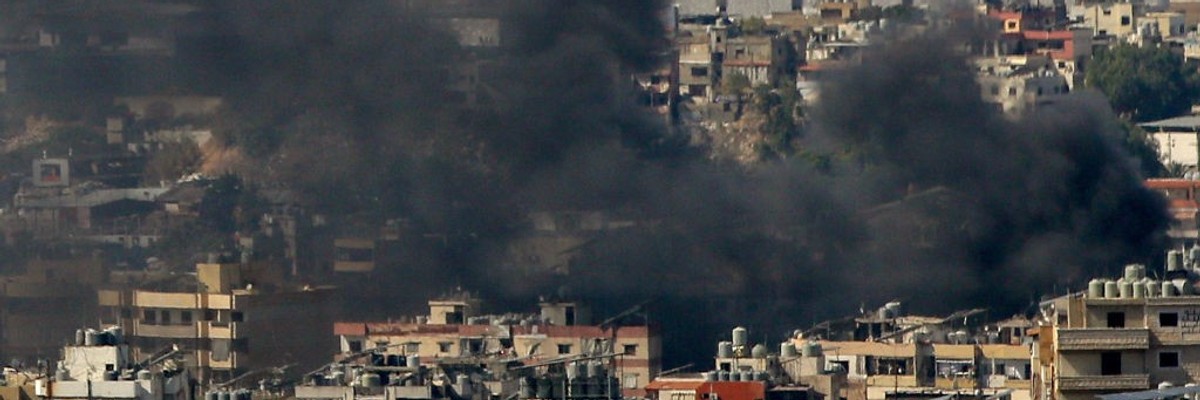
Heavy black smoke billows from the site of an Israeli air raid that targeted an area in a Beirut suburb on October 5, 2024. (Photo: Marwan Naamani/picture alliance via Getty Images)
“Complete blocks are being destroyed one after another,” Al Jazeera reported.
Israeli forces continued attacks on the outskirts of Beirut and in southern Lebanon on Saturday.
There were 13 Israeli strikes on the southern suburbs of Beirut overnight and another five on Saturday, one of which may have been targeted at paramedics, according toAl Jazeera. The number of casualties is not yet clear.
“There is increasing destruction and it’s clear that complete blocks are being destroyed one after another,” Al Jazeera‘s Ali Hashem reported from Beirut.
“One strike hit near the airport, and we understand another missile hit near a paramedic team to prevent them from getting to the scene of the bigger strike,” he reported.
The Israeli military issued evacuation warnings for certain suburban areas south of Beirut on Friday night, indicating attacks would follow, The New York Times reported.
Israeli forces unleashed a “huge strike” on the same area earlier Friday in an attempt to kill Hashem Safieddine, the presumed successor to recently assassinated Hezbollah leader Hassan Nasrallah, according to the Times. Al Jazeera reported that “bunker buster” bombs were believed to be used in the Friday attack, as they were in Nasrallah’s killing. It’s not clear if Safieddine was killed, though media reports indicate that he likely was.
Israel’s military also continued attacks in southern Lebanon on Saturday.
“From northern Israel, I can see dark gray clouds of dust and smoke rising above two [Lebanese] villages as warplanes zoom overhead and the sound of artillery echoes through the area,” the Times‘ Natan Odenheimer reported Saturday.
An Israeli strike in northern Lebanon killed Hamas commander Saeed Ali on Saturday, the armed Palestinian group said. Hamas has a longstanding presence in Lebanon.
According to Al Jazeera, which cited Israeli media reports, the Israeli military is planning to expand its ground incursion into southern Lebanon, which began earlier this week, and to conduct “large-scale assaults” on Lebanon, Iran, and Gaza. The media outlet didn’t provide details.
Iran fired nearly 200 ballistic missiles at Israel on Tuesday, principally targeting military facilities. Iran said the strikes were retaliation for Israeli assassinations of Hezbollah and Hamas leaders. Most of the strikes were intercepted by Israeli and U.S. forces.
Observers are now watching closely to see how Israel responds, and what role the U.S.—Israel’s chief diplomatic ally and military supplier—might play. President Joe Biden said Friday that he’d advise Israel to consider “alternatives” to striking Iranian oilfields.
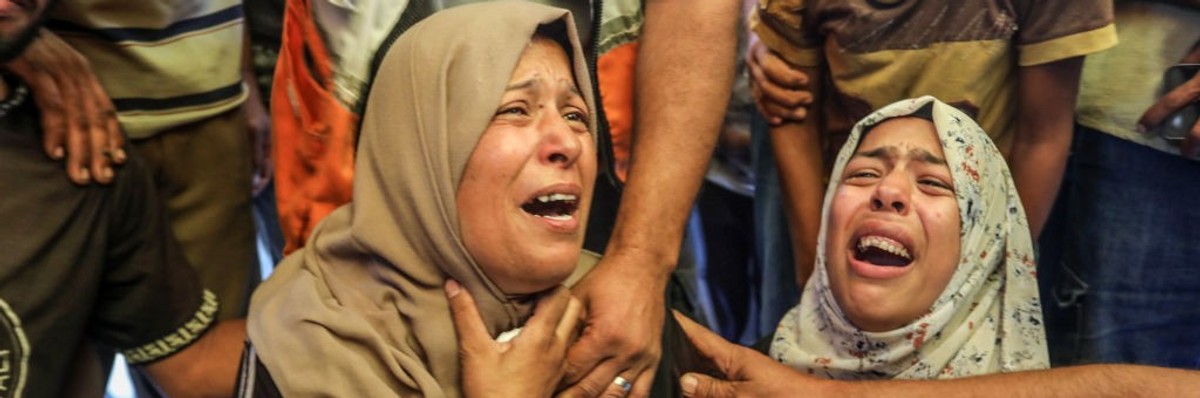
Palestinians mourn the loss of loved ones in Israeli attacks in Khan Younis, Gaza on October 6, 2024. (Photo: Abed Rahim Khatib/Anadolu via Getty Images)
The Israeli military announced a “new phase” of the war in Gaza while conducting its most severe airstrikes so far in Beirut.
Israeli forces stepped up attacks in both the Gaza Strip and Lebanon overnight and into Sunday.
Israeli forces bombed a mosque and a school-turned-shelter in Gaza, killing 26 and injuring dozens more, according to the Palestinian health ministry; the Israeli military described the two sites as Hamas “command and control centers” but provided no evidence.
The Israeli military also on Sunday announced a “new phase” of the war in Gaza, issuing new evacuation orders that cover most of the northern part of the enclave, The New York Timesreported. The military said it would send more soldiers and weapons to Gaza to “destroy terrorist infrastructures and undermine Hamas’ capabilities until all the war’s goals are achieved.”
Al Jazeera‘s Moath al-Kahlout reported that “the situation here in northern Gaza is deteriorating as the Israeli army intensifies its bombing.” He said that children, women, and journalists were among the victims.
“An entire family was killed by the Israeli army in the overnight attacks,” he added.
Meanwhile, Israel conducted the “most severe” airstrikes so far on Beirut, “pounding” the city overnight, according toThe Guardian. The strikes were in southern Beirut and its suburban outskirts, which are seen as a Hezbollah stronghold and have been heavily targeted by Israeli forces for the past two weeks.
Al Jazeera journalist Ali Hashem, reporting from Beirut, described a “massive air strike” on Sunday near the city’s international airport—an area that Israel has been bombarding for days. He said that daytime strikes are particularly harrowing.
“During the nights there are warnings,” Hashem reported. “During the days there are no warnings.”
Hashem said that emergency services have been prevented from getting into the suburban area where many of the strikes are taking place.
The Lebanese health ministry said Sunday that 23 people were killed and 93 injured in Israeli strikes on Saturday.
The Israeli military continues to advance its ground incursion in southern Lebanon. On Sunday, it ordered people in 25 villages to evacuate immediately, “signaling it’s expanding its ground offensive,” Al Jazeera reported
Filippo Grandi, the United Nations’ high commissioner for refugees, visited Beirut on Sunday and called for a cease-fire—saying it was “desperately needed”—and international humanitarian aid.
A broken stethoscope and surgical glove are seen after Israeli warplanes bombed a building in the Bachoura area of Beirut, Lebanon on October 3, 2024. (Photo: Murat Sengul/Anadolu via Getty Images)
“I’m afraid first about my safety and about my family’s safety because there’s no safe place in Lebanon now,” said one physician.
The head of the United Nations World Health Organization said Thursday that Israeli forces killed 28 healthcare workers in Lebanon over the previous 24 hours, and that 73 medical personnel are among the nearly 2,000 Lebanese killed during Israel’s bombing and invasion of its northern neighbor.
“In southern Lebanon, 37 health facilities have been closed, while in Beirut, three hospitals have been forced to fully evacuate staff and patients, and another two were partially evacuated,” WHO Director-General Tedros Adhanom Ghebreyesus said during a press conference in Geneva. “And yet healthcare continues to come under attack. In Lebanon alone, 28 health workers have been killed in the last 24 hours.”
Tedros said the WHO “calls on urgent facilitation of flights to deliver health supplies to Lebanon,” adding, “Lives depend on it!”
The health system’s capacity in #Lebanon is deteriorating. @WHO’s medical supplies cannot be delivered due to the almost complete closure of Beirut’s airport.
WHO calls on urgent facilitation of flights to deliver health supplies to Lebanon. Lives depend on it! pic.twitter.com/zyCdS1bVZF
Lebanese Health Minister Firas Al-Abiad said separately Thursday that more than 40 paramedics and firefighters have been killed by Israeli forces over the previous three days.
Dr. Abdinasir Abubakar, the acting WHO representative in Lebanon, said that “most of those healthcare workers killed in the last 24 hours, most of them—actually, all of them—were on duty.”
“Some of them were in the ambulances, some of them were in the health facilities,” Abubakar added. “They were on duty trying to help civilians who have been wounded in the conflict.”
Dr. Fathalla Fattouh, the head cardiovascular and thoracic surgeon at Rafik Hariri University Hospital (RHUH) in Jnah, just outside Beirut, described the chaos he witnessed firsthand, including “a surge of nearly identical injuries—amputations, eye trauma, and shattered hip and femur bones—straining the hospital’s capacity to a near-breaking point.”
“We were forced to make difficult decisions,” he added. “I believe that we did our best relying on available capacities, but with the escalation of events we need to plan for the worst.”
Sara, a surgeon at the hospital, said that “there are only two hospitals in Lebanon prepared to treat burn patients, and once they were at capacity, we were left with nowhere to send the patients we received.”
“It was a feeling of helplessness that we had never experienced before,” she added.
Some doctors admitted fearing for their lives.
“It’s hard to work in fear,” Dr. Mohammad Taoube, who heads the emergency room at an undisclosed hospital in southern Lebanon, told Sky News on Wednesday. “I’m afraid first about my safety and about my family’s safety because there’s no safe place in Lebanon now.”
According to figures provided by the WHO Regional Office for the Eastern Mediterranean, Israeli forces have killed 1,974 people in Lebanon—including at least 127 children—while wounding 9,384 others in recent weeks.
— WHO Regional Office for the Eastern Mediterranean (@WHOEMRO) October 4, 2024
At least one American has been killed by Israeli bombing of Lebanon this week. Hajj Kamel Ahmad Jawad, 56, of Dearborn, Michigan was killed Tuesday while in Nabatieth in southern Lebanon caring for his sick mother and volunteering to help elderly, disabled, and injured patients at a local hospital.
The Nabatieth area has come under heavy Israeli bombardment. Local journalists said the city’s main hospital “came under direct Israeli fire” on Friday and that two nurses were killed.
Lebanese officials said Friday that more than 1.2 million people have been forcibly displaced amid Israel’s recent bombing and invasion of their country. The Israeli campaign comes amid attacks by the political and paramilitary group Hezbollah, whose rockets and other projectiles have killed or wounded scores of Israelis and forced tens of thousands from their homes.
Residents of southern Lebanon described the terror of coming under Israeli bombardment and having to flee for their lives. One woman, Fatima, and her 14-year-old daughter Zeinab said they were in their home preparing for a school exam when the shelling started.
“My mother told us to pack our things quickly, and we left in a rush,” Zeinab told the U.N. Children’s Fund on Thursday. “My siblings were crying. The journey was terrifying.”
“The shelling was all around us, and the sound of explosions echoed everywhere,” she said while crying. “We miss home dearly and yearn to return.”
Tedros noted that since last October, when Hezbollah began launching rockets at Israel in solidarity with Gaza after Hamas-led militants attacked Israel, over 1 million Lebanese have been displaced, with many seeking refuge in neighboring Syria.
He also said that “since the 7th of October last year, more than 1,500 people have been killed in Israel, almost 42,000 in Gaza, and more than 700 in the West Bank.”
“In addition,” Tedros added, “more than 10,000 people are missing in Gaza, and 1.9 million people are displaced, while 101 hostages taken from Israel remain in Gaza.”
Hundreds of Palestinians working in the health sector have been killed in Gaza by Israeli forces, who have deliberately targeted medical workers. Israeli troops have also allegedly tortured doctors and other medical workers after kidnapping them from the coastal enclave.
Tedros on Thursday stressed the need for “deescalation of the conflict; for healthcare to be protected and not attacked; for access routes to be secured and supplies delivered; and for a cease-fire, a political solution, and peace.”