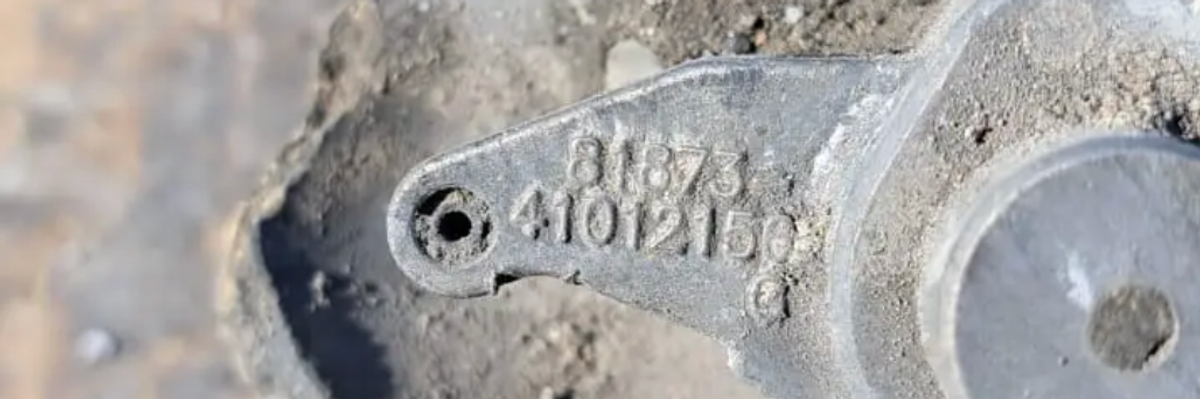
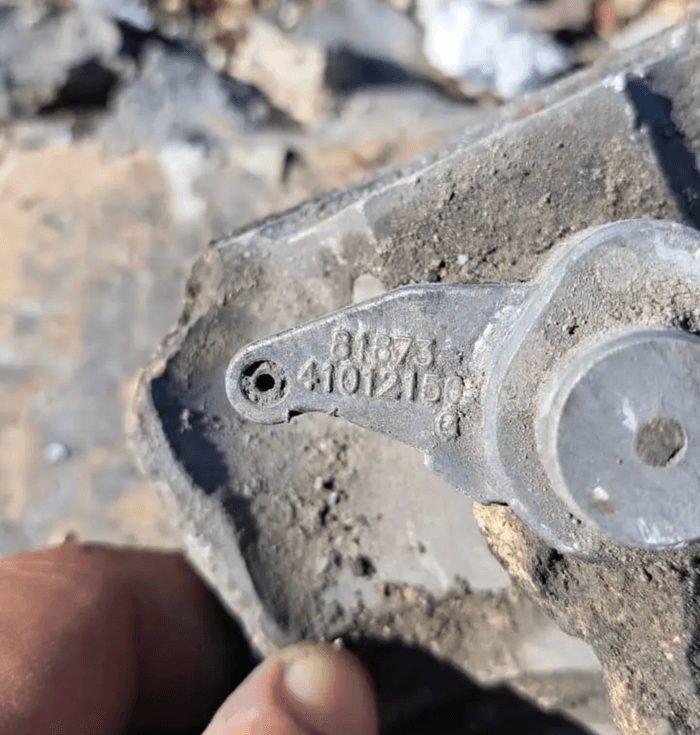
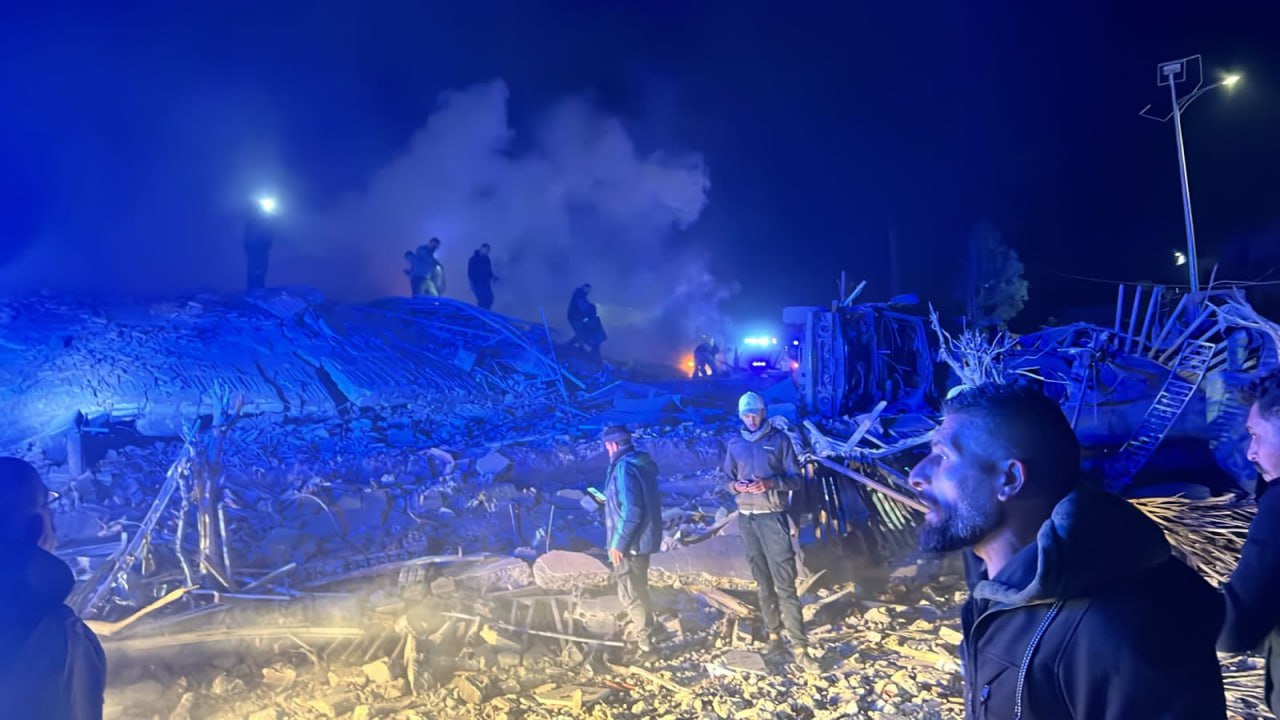
A bomb remnant retrieved following Israel’s October 25, 2024 attack on a compound housing journalists in southern Lebanon. (Photo: Anoir Ghaida via Human Rights Watch)
“Israel’s use of U.S. arms to unlawfully attack and kill journalists away from any military target is a terrible mark on the United States as well as Israel,” said a researcher from Human Rights Watch.
A leading international human rights organization said Monday that Israel’s deadly bombing of a Lebanese residential compound housing journalists last month was carried out using a munition guidance kit supplied by the United States.
Human Rights Watch (HRW) said its investigation determined that the October 25 strike in southern Lebanon, launched in the early hours of the morning as most of the journalists staying in the compound slept, was “most likely a deliberate attack on civilians and an apparent war crime.”
The group’s investigators visited the Hasbaya Village Club Resort, the target of the strike, and found no evidence that the compound was being used for military activity, undercutting Israel’s initial claim that it hit a building from which “terrorists were operating.”
HRW also said it reviewed information indicating that Israel’s military “knew or should have known” that journalists were staying in the compound. Journalists who were at the compound when Israel’s strike hit said the Israeli military did not issue a warning ahead of the attack.
“All the indications show that this would have been a deliberate targeting of journalists: a war crime.”
The airstrike killed at least three journalists and injured several others. Remnants from the scene of the strike collected by the targeted resort’s owner were “consistent” with Joint Direct Attack Munitions (JDAMs) that the U.S. has provided to the Israeli military.
One fragment, according to HRW “bore a numerical code identifying it as having been manufactured by Woodard, a U.S. company that makes components for guidance systems on munitions.” Boeing, a major U.S. military contractor, assembles and sells JDAMs, which are attached to bombs with the stated goal of making airstrikes more precise.
Other remnants HRW reviewed were consistent with materials from a 500-pound bomb equipped with a JDAM.
A bomb remnant retrieved following Israel’s October 25, 2024 attack. (Photo: Anoir Ghaida via Human Rights Watch)
Richard Weir, a senior researcher at HRW, said in a statement Monday that “Israel’s use of U.S. arms to unlawfully attack and kill journalists away from any military target is a terrible mark on the United States as well as Israel.”
“The Israeli military’s previous deadly attacks on journalists without any consequences give little hope for accountability in this or future violations against the media,” said Weir. “As evidence mounts of Israel’s unlawful use of U.S. weapons, including in apparent war crimes, U.S. officials need to decide whether they will uphold U.S. and international law by halting arms sales to Israel or risk being found legally complicit in serious violations.”
The Guardian conducted a separate investigation of the Israeli strike and reached conclusions mirroring HRW’s, reporting Monday that “Israel used a U.S. munition to target and kill three journalists and wound three.”
“On 25 October at 3:19 am, an Israeli jet shot two bombs at a chalet hosting three journalists—cameraman Ghassan Najjar and technician Mohammad Reda from pro-Hezbollah outlet al-Mayadeen, as well as cameraman Wissam Qassem from the Hezbollah-affiliated outlet al-Manar,” the newspaper observed. “All three were killed in their sleep in the attack which also wounded three other journalists from different outlets staying nearby. There was no fighting in the area before or at the time of the strike.”
Nadim Houry, a human rights lawyer and executive director of the Arab Reform Initiative, told The Guardian that “all the indications show that this would have been a deliberate targeting of journalists: a war crime.”
“This was clearly delineated as a place where journalists were staying,” Houry said.
The findings were published just days after the U.S. Senate voted down an effort led by Sen. Bernie Sanders (I-Vt.) to block new sales of American weaponry to Israel. One of the resolutions put forth by Sanders would have blocked the imminent transfer of over $260 million worth of JDAMs to Israel’s military.
In a fact sheet, Sanders’ office pointed to six examples in which Israel’s military used JDAMs in deadly attacks on civilians in Gaza and Lebanon, including children.
“The United States is complicit in these atrocities,” Sanders said in a floor speech ahead of last week’s vote. “That complicity must end.”
Original article republished from Memo under a Creative Commons Attribution-NonCommercial-ShareAlike 4.0 International License.
Shrine of Shimon in Chamaa, Lebaon [Ibrahimamirnaeem/Wikipedia]
Israeli occupation forces destroyed a historic religious shrine during their incursion into the village of Chamaa in southern Lebanon on Friday night, Lebanese media have reported. Lebanese sources revealed that the occupation forces deliberately rigged explosive charges on what is known as the Shrine of Shimon in Chamaa and completely destroyed it.
The state-run National News Agency reported that the occupation forces withdrew from the hill where the shrine was located due to significant resistance from Hezbollah. A UN peacekeeping site nearby was hit by artillery fire as a result of the bombardments, according to the report.
The UN peacekeeping forces said on Friday that a live 155mm artillery shell struck their headquarters in the western sector but did not explode. UNIFIL reported that Italian peacekeeping forces stationed there dealt with the shell safely, adding that no peacekeeping personnel were harmed in the strike.
Since the start of its ground incursion into southern Lebanon, the occupation forces have blown up and demolished entire villages, employing a scorched earth policy to prevent Hezbollah from operating in areas near the border with the settler-colonial state.
Aftermath of airstrike in Balbek. Photo: Al Akhbar
November marked an increase in Israeli airstrikes on different parts of Syria, foreshadowing a serious escalation in a third front in the region in addition to Gaza and Lebanon.
Israeli warplanes intensified their deadly attacks on different parts of the Syrian capital Damascus, and the Southern Suburb (Dahiyeh) in the Lebanese capital Beirut on Thursday, November 14.
The aerial attacks on Damascus targeted residential buildings in both Mazzeh and Qudsaya areas, leaving at least 15 people killed and 16 others injured, in addition to causing significant material damage to a number of buildings, according to a source in the Syrian military.
Thursday’s airstrikes on Damascus were preceded by a series of airstrikes that targeted different parts of Syria within the last couple of weeks. On Wednesday, November 13, Israeli fighter jets struck bridges on the Orontes River and roads in Al-Qusayr area in Homs countryside, near the Syrian Lebanese borders. The airstrikes inflicted great damage on the bridges and roads, which consequently became out of service, as per a report published by the Syrian Arab News Agency SANA.
On Sunday, November 10, Israeli warplanes targeted a residential building in the Sayyidah Zaynab area of Damascus, killing seven civilians including women and children. Previous airstrikes were launched by Israeli fighter jets on November 4, targeting a number of sites south of Damascus, resulting in material damages.
Syria’s Foreign and Expatriates Ministry condemned the Israeli attacks in a statement issued on Thursday. “The Israeli entity’s continuation of its attacks on Syria today comes only two days after the joint Arab-Islamic summit in Riyadh issued a broad condemnation of its brutal and escalating aggression on Syrian territory, and its warning of the danger of this escalation that is ravaging the region and its regional and international repercussions,” the Ministry stated.
“Syria affirms that the usurping entity’s continued disregard for international laws and regulations, and its indifference to all international demands to stop its aggression and violations, comes as a result of the Security Council’s failure to take a firm and real stance to deter it from its crimes, which also included attacks on international peacekeeping forces in Lebanon,” the Ministry added.
Meanwhile, Israel carried out at least four rounds of air raids on different targets across Beirut’s Southern Suburb (Dahiyeh), including Al-Amrousiyeh area near Beirut’s International Airport. Moreover, the Israeli aggression continued to target different areas of South Lebanon and Beqaa. The attacks across Lebanon on Thursday left at least 11 people killed and several others wounded, according to media reports.
The escalation of Israeli aggression and its expansion on different fronts has been increasing despite the mounting regional and international calls for a ceasefire and de-escalation, which indicates Israel’s total disregard of international law and its obligations. Israel insists on committing blatant violations of territorial integrity of sovereign states, due to the impunity it enjoys, and being given the greenlight by the United States.
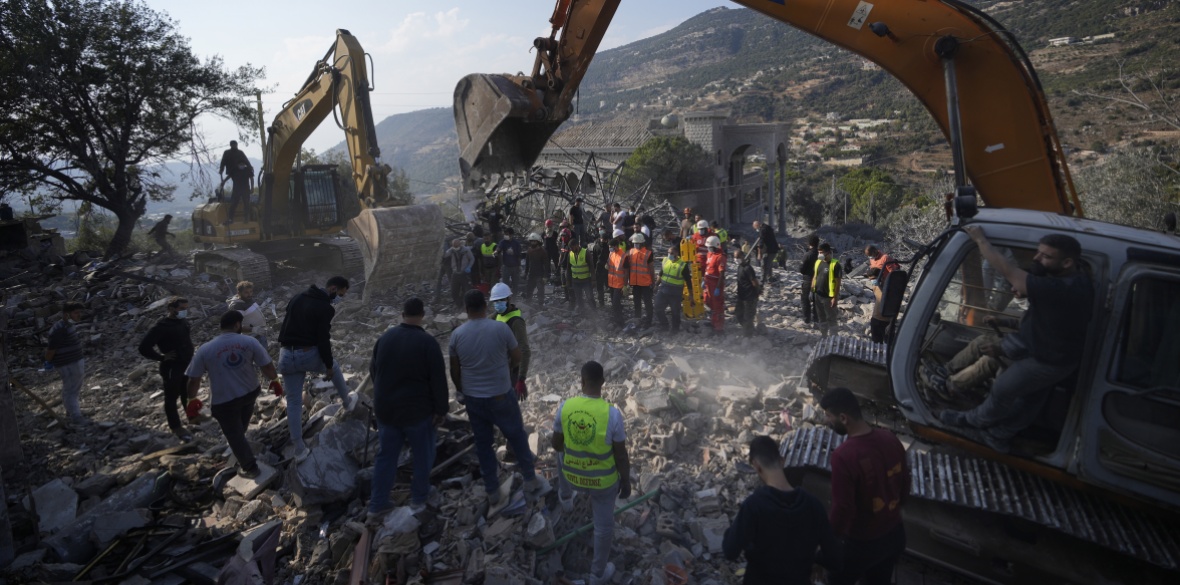
Rescue workers use excavators to remove the rubble of a destroyed house hit in an Israeli airstrike, as they search for victims in Aalmat village, northern Lebanon, November 10, 2024
ISRAEL bombed the Jabalia refugee camp in northern Gaza without warning early today, [Sunday, November 10, 2024] killing at least 33 people including 13 children.
Its bombers killed a further 23 people in the Lebanese village of Aalmat, north of Beirut, a day after a bombing raid over the ancient port of Tyre left at least seven dead, including five siblings, three of whom were deaf and mute. Other Israeli bombing over Lebanon killed a further 31 people on Saturday, according to health officials.
The UN’s agency for Palestinian refugees UNRWA, which Israel has banned, said famine is already taking grip in northern Gaza, where Israel’s invading forces continue to deny access to humanitarian aid.
Israel was forced to deny comments from a commander on the ground, Brigadier Itzik Cohen, last week that no aid would be allowed to enter the north because “there are no residents [ie, non-combatants] left there,” as well as that his declaration “No-one is returning to the northern area. There is no return to the north, and there will not be” reflects a policy of ethnic cleansing in the north — as openly advocated by Israeli ministers including National Security Minister Itamar Ben-Gvir — saying instead it represented a tactical position based on ongoing fighting.
As Israel’s October 1 invasion of Lebanon unfolds, the media’s complicity in shaping public perception raises urgent questions, particularly when viewed through the lens of a controversial 1984 conference where influential advertising and media figures gathered to refine Israel’s narrative strategies. This conference laid the groundwork for a sophisticated propaganda campaign—Hasbara—that sought to sanitize Israel’s actions and cast its military operations in a favorable light. Today, as Western journalists whitewash, distort, and conceal [Israel’s ?] the realities of Israel’s deadly campaign of violence, the enduring legacy of this meeting becomes alarmingly clear, revealing how narratives crafted decades ago continue to shape the coverage of a conflict that claims countless lives.
In the first week of October, Israeli forces fired 355 bullets at a car containing a five-year-old, then shot at rescue workers who rushed to save her life. A horrific crime – yet, per many Western media headlines, she was simply a “girl killed in Gaza.” The circumstances and perpetrators of her death, if mentioned at all, were invariably buried at the bottom of reports, well hidden from the 80% of the news-consuming public who only read headlines, not accompanying articles.
By contrast, on October 15, Sky News was very keen that its viewers know the names and faces of four “teenage” IDF soldiers “killed” in a “Hezbollah drone attack,” humanizing and infantilizing individuals who, by mere token of their service in Israel’s military, are by definition, guilty of genocide. In passing, the same report briskly noted: “‘23 die’ in Gaza school strike.” Their identities, ages, and photos, let alone clarity on who or what murdered them, weren’t provided.
Moreover, the inverted commas incongruously hovering around the number of Palestinians killed subtly undermined that claim’s credibility while reducing the child victims to an afterthought compared to the considerably more important quartet of deceased IDF genocidaires. MintPress News senior staff writer Alan MacLeod put it succinctly when he Tweeted, “In years to come, students in university departments around the world will be studying the propaganda embedded in this headline. It’s truly incredible how much propaganda has been packed into 16 words.”
The mainstream media’s systematic use of distancing and evasive language, omission and other duplicitous chicanery to downplay or outright justify Israel’s murder of innocent civilians while simultaneously dehumanizing their victims and delegitimizing Palestinian resistance against brutal, illegal IDF occupation is as unconscionable as it is well-documented. Amazingly though, ‘twasn’t ever thus. Once upon a time, mainstream news networks exposed Israel’s war crimes without qualification, and anchors and pundits openly condemned these actions on live TV to audiences of millions.
The story of how Western media was transformed into Israel’s doting, servile propaganda appendage is not only a fascinating and sordid hidden chronicle. It is a deeply educational lesson in how imperial power can easily subordinate supposed arbiters of truth to its will. Comprehending how we got to this point equips us with the tools to assess, identify, and deconstruct lies large and small – and effectively challenge and counter not only Israel’s falsehoods but the entire settler colonial endeavor.
‘NEIGHBORHOOD BULLY’
On June 6, 1982, Israel invaded Lebanon. The effort was ostensibly intended to drive Palestinian Liberation Organization freedom fighters away from their positions on Israel’s northern border. But, as the IDF savagely pushed ever-deeper into the country, including Beirut, it became clear that ethnic cleansing, massacres, and land theft were – as in Palestine – the true goal. Throughout the Lebanese capital, news crews from major networks and reporters from the West’s biggest newspapers were waiting.
Israel’s rapacious bloodlust and casual contempt for Arab lives had hitherto been, by and large, successfully concealed from the outside world. Suddenly, though, scenes of deliberate IDF airstrikes on residential housing blocks, Tel Aviv’s trigger-happy soldiers running amok in Beirut’s streets, and hospitals overflowing with civilians suffering from grave injuries, including chemical burns due to Israel’s use of phosphorus shells, were broadcast the world over, to nigh-universal outcry. As veteran NBC news anchor John Chancellor contemporarily explained to Western viewers:
What in the world is going on? Israel’s security problem, on its border, is 50 miles to the south. What’s an Israeli army doing here in Beirut? The answer is we are now dealing with an imperial Israel, which is solving its problems in someone else’s country, world opinion be damned.”
From: “Hasbara: Israel’s Public Image: Problems and Remedies”
Global shock and repulsion at Israel’s conduct would only ratchet during the IDF’s resultant illegal military occupation of swaths of Lebanon. In September 1982, an Israel-backed armed Christian militia, Phalange, entered Sabra, a Beirut neighborhood home to many Palestinians displaced by the 1948 Nakba. Over a two-day span, they slaughtered up to 3,500 people while mutilating and raping countless others. Again, unfortunately for Tel Aviv, mainstream journalists were on hand to document these heinous crimes first-hand.
To say the least, Israel had an international PR disaster of historic proportions on its blood-soaked hands. The risk that further exposure of its genocidal nature might decisively and permanently shift global opinion in favor of the Palestinians and the Arab world more generally was significant. The attack on Lebanon had already spurred Western news outlets to critically reassess other illegal annexations and occupations in which Israel was and remains engaged. As ABC News reporter Richard Threlkeld commented at the time:
Israel was always that gallant little underdog democracy fighting for survival against all the odds. Now, the Israelis have annexed East Jerusalem and the Golan Heights, settled down more or less permanently on the West Bank, and occupied close to half of Lebanon. In the interests of self-defense, that gallant little underdog, Israel, has suddenly started behaving like the neighborhood bully.”
So it was that in the summer of 1984, the American Jewish Congress – a major Zionist lobby organization – convened a conference in Jerusalem, Israel’s Public Image: Problems and Remedies. It was chaired by U.S. advertising supremo Carl Spielgovel, who a decade earlier provided pro bono advice to the Israeli government on strategies for publicly communicating why Tel Aviv refused to adhere to the terms of the Henry Kissinger-brokered 1973 Sinai Accords. Spielgovel later recalled:
It occurred to me then that the Israelis were doing a good job at training their military people, and they were doing a relatively good job at training their diplomatic corps. But they weren’t spending any time training information officers, people who could present Israel’s case to embassies and TV anchormen around the world. Over the years, I made this a personal cause celebre.”
The 1984 Jerusalem conference offered Spielgovel and a welter of Western advertising and public relations executives, media specialists, editors, journalists, and leaders of major Zionist advocacy groups an opportunity to achieve that malign objective. Together, they hammered out a dedicated strategy for ensuring the “crisis” caused by news reporting on the invasion of Lebanon two years earlier would never be repeated. Their antidote? Ceaseless, methodical, and wide-ranging “Hasbara” – Hebrew for propaganda – for “changing people’s minds [and] making them think differently.”
‘BIG SCOOP’
The AJC subsequently published records of the conference. They offer extraordinarily candid insight into how multiple Hasbara strategies, which have been in perpetual operation ever since were birthed. For example, basic propaganda messages were agreed upon. This included messages that are echoed by Israel’s supporters to this day, emphasizing Israel’s regional importance to the U.S. and Europe, Western cultural and political values, geographic vulnerability, and supposed striving for peace in the face of implacable Palestinian belligerence and intransigence.
As Judith Elizur, an expert in “communications” from Tel Aviv’s Hebrew University, explained:
Because the ‘power dimension’ of Israel’s image is so problematic, it seems to me that Hasbara must concentrate on reinforcing other aspects of Israel that have a positive appeal – medicine, agriculture, science, archaeology…We have been too preoccupied with extinguishing political brush fires. We need to devote more of our resources to long-range image-making. We must recreate a multi-dimensional image of Israel which will assure us the basic support we require in times of crisis.”
There was extensive discussion of how to present “unpalatable policies” to Western populations, and counter the perception of Israel as “Goliath steamrolling” across West Asia, against adversaries “outgunned, outclassed and outmanned” with “no capacity to resist.” The necessity of training the Jewish diaspora in countering criticism of Israel was considered paramount.
AJC’s president lamented that “many American Jews” had condemned the invasion of Lebanon and “did us a terrible disservice.” Any such future “disagreement” would make it “very difficult for us to conduct Hasbara effectively.”
From: “Hasbara: Israel’s Public Image: Problems and Remedies”
Joseph Block, Pepsi’s former vice president of public relations, stressed the need for a dedicated, 24/7 Israel press operation “equipped to offer foreign journalists an occasional exclusive or scoop” and engage in other media outreach to balance critical coverage and get reporters and newsrooms ‘on side.’ Block lamented that had Israeli officials not “briefed NBC and other networks appropriately” and given them “a big scoop” during Lebanon’s invasion, “a different story would have reached America’s 90 million TV households”:
News doesn’t just jump into a camera. It’s directed. It’s managed. It’s made accessible. Public relations is a process that makes news available in a particular form. In the US, PR is as important as accounting, the law and the military…As a corporate spokesman for two of America’s top 50 corporations, I wish I had a shekel for every time I said, ‘no comment’ to a reporter. I was always careful, however, not to antagonize or intimidate the reporter. I knew I had to live with him or her.”
Yoram Ettinger, media analysis chief at the Israel Information Center, concurred, declaring that media framing on Israel’s actions needed to be determined in advance. “Actions” such as “blowing up houses,” which were “difficult to explain,” could be preemptively justified or at least relativized by placing them “in context” while “[drawing] analogies that others will understand.” This would “help others to interpret their meaning,” per Tel Aviv’s perspectives.
The Conference hoped such efforts would mean “our American friends will be able to take a more activist posture as amplifiers of our policy” and assist them in “tucking away the house problems in a back room.” It was also suggested that on an individual and organizational level, Zionist activists serve as a rapid reaction force, deluging news outlets with complaints en masse should their coverage of Israel be at all critical. One attendee boasted of their personal success in this regard:
One day CBS News Radio reported that an American soldier had been hurt by stepping on an Israeli cluster bomb at the Beirut airport. I called CBS to point out that no one had established the bomb was an Israeli one. One hour later CBS reported that an American soldier had stepped on a bomb; this time the report omitted any reference to Israel.”
‘FREQUENT VIOLATIONS’
Another significant recommendation came from Carl Spielgovel: creating a “training program” to bring carefully selected Israeli information specialists into U.S. advertising, PR agencies, and major news outlets. The initiative aimed to equip them with industry insights, ensure Hasbara efforts were maximized, and establish close relationships between Israeli officials and the organizations to which they were assigned.
These “specialists” would operate under the guidance of a U.S.-Israeli council described as “wise persons who can project different scenarios and how to cope with them” on complex issues like “annexation and Jerusalem.” Spielgovel was careful to clarify that he was “not suggesting that we make policy” but rather that “we should make the best minds available to help elucidate the consequences of certain policies.” The goal, he suggested, was to reinforce to the American public that Tel Aviv remains Washington’s “staunch political and military ally.”
Spielgovel further proposed that future AJC conferences should incorporate input from “young people” and people of color to better promote Tel Aviv’s image among diverse “constituencies.” He argued that “Hasbara needs to implant in the consciousness of the world the day-to-day existence” of Israeli citizens, requiring a steady stream of “stories in the arts, business, and cooking sections of U.S. newspapers.” Since then, a dedicated Hasbara program aimed at cultivating skilled Zionist advocates in the U.S. has operated continuously.
Buoyed by its success, the operation soon expanded to include school and university students worldwide, training them to act as vigorous advocates for Israel in classrooms and on campuses. Graduates of these Israeli-funded programs frequently enter influential fields, including journalism, where they continue to promote Hasbara narratives and defend Israel’s actions. The impact on Western media coverage of Palestine has been profound.
To a significant degree, the portrayal of Tel Aviv as “the gallant little underdog democracy fighting for survival against all the odds” has been firmly reestablished. Despite the ongoing crisis in Gaza, mainstream outlets seldom provide context for Palestinian resistance to Israel’s policies of annexation, occupation, and military actions. Coverage nearly always frames Israel’s actions as “self-defense” against “terrorist” threats, with Western journalists keenly aware of potential repercussions for diverging from this narrative.
From: “Hasbara: Israel’s Public Image: Problems and Remedies”
The rapid reaction force proposed at the 1984 AJC conference remains highly active. An extensive network of Hasbara-trained individuals and Israel lobby organizations is always on standby, ready to pressure and intimidate news outlets if coverage diverges from favorable framing or casts Israel in a critical light. As a senior BBC producer once confided to veteran media critic Greg Philo:
We wait in fear for the telephone call from the Israelis. The only issue we face then is how high up it’s come from them. Has it come from a monitoring group? Has it come from the Israeli embassy? And how high has it gone up our organization? Has it reached the editor or director general? I have had journalists on the phone to me before a major news report, asking which words can I use – ‘is it alright I say this’?”
An October exposé by Al Jazeera, citing testimony from BBC and CNN whistleblowers, detailed “pro-Israel bias in coverage, systematic double standards, and frequent violations of journalistic principles” at both networks. According to insiders, much of this was driven by concerns over how Israeli officials might perceive and react to certain coverage. Independent activists and journalists, however, are not bound by such institutional pressures—and since October 7, 2023, they have mounted a formidable challenge to Hasbara narratives.
Were it not for the persistent investigations by outlets like MintPress News, The Grayzone, and Electronic Intifada, unfounded allegations promoted by Israel since the outset of the Gaza conflict—such as claims of Hamas committing mass rape or beheading infants—might never have been thoroughly debunked and might still shape the “context” for Israel’s actions against Palestinians. Meanwhile, countless concerned citizens have actively challenged Western narratives on the conflict in real-time across social media, a groundswell of critique that may be fueling pushback within some mainstream newsrooms.
It is a poetic irony that the same information warfare techniques once honed under Hasbara are now being directed at Israel and its defenders. For decades, these methods allowed Israel to proceed with its gradual displacement of the Palestinian people, often with tacit approval from Western audiences. But those times seem to be fading. Today, critics and former targets of Israeli policy are effectively using these strategies, wielding what they see as their most potent tools—truth and justice.
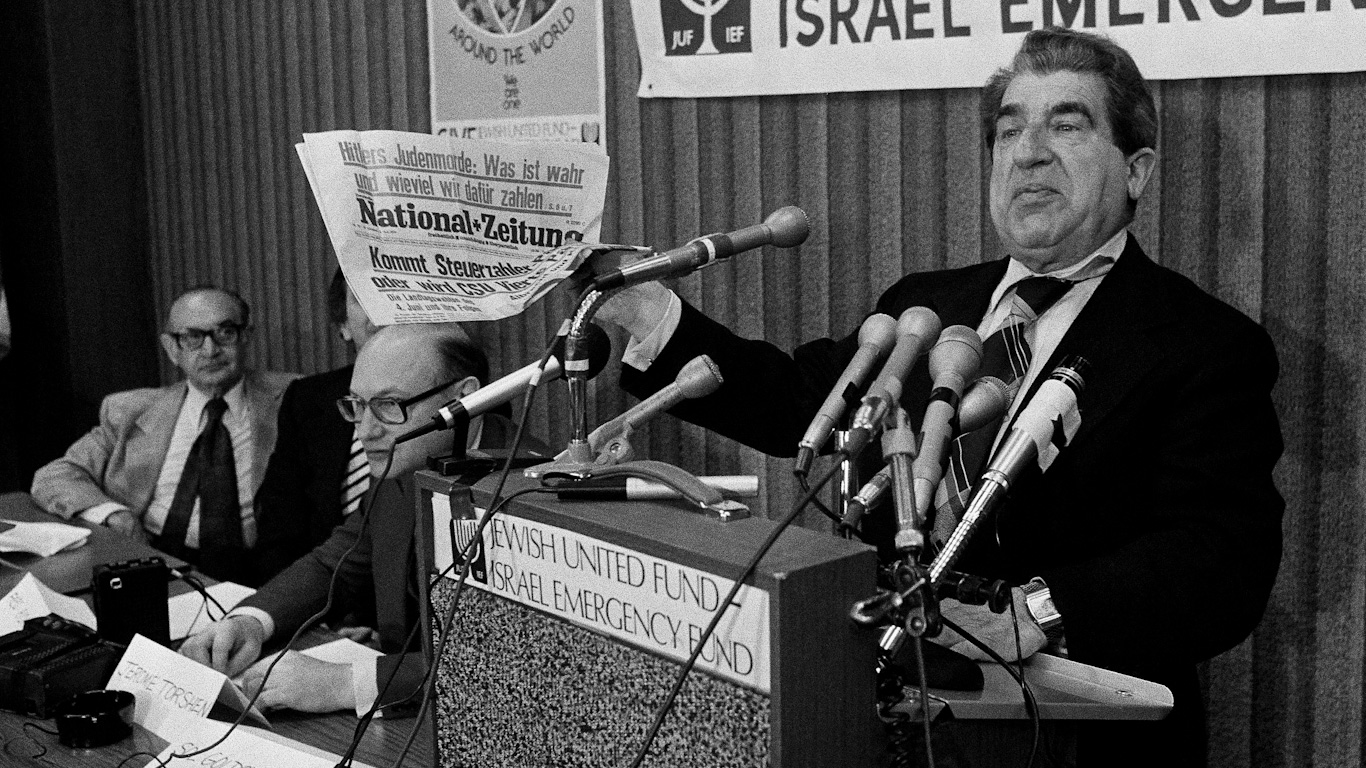
Feature image | Sol Goldstein, spokesman for a group of Jewish organizations, holds up a German language newspaper with headlines questioning the validity of the Holocaust, at a news conference in Chicago, June 14, 1978. Photo | AP
Kit Klarenberg is an investigative journalist and MintPress News contributor exploring the role of intelligence services in shaping politics and perceptions. His work has previously appeared in The Cradle, Declassified UK, and Grayzone. Follow him on Twitter @KitKlarenberg.
The views expressed in this article are the author’s own and do not necessarily reflect MintPress News editorial policy.