British Journalist UNCOVERS SHOCKING Iran War COVER-UP


Paul Whiteley, University of Essex
The American people are bitterly divided over the conflict in Iran. The US president, Donald Trump, won office in 2024 after campaigning on a message of “no new wars”. So the conflict that began with airstrikes conducted with the Israeli military in the early hours of February 28, and which has quickly spread into the rest of the region, has polarised opinion across the country.
An Economist/YouGov poll completed on March 2 provides early information about what Americans think of the war so far. The poll asked the following question: “Would you support or oppose the US using military force to overthrow the government of Iran?”
There is a great deal of confusion about what the objectives of the war are, since the messaging from Trump, and his senior officials, has veered from preventing Iran from developing nuclear weapons, to destroying the country’s ballistic missile capability, to regime change.
But, from the point of view of polling, this is as good a question as any for finding out what Americans think. Altogether 32% of them support the war and 45% oppose it.
The responses to this question analysed by gender, race, age and education appear in the graph. Those who were uncertain are not included in the totals. The graph shows that large variations exist among the different groups in relation to their attitudes to the war.
The relationship between attitudes to the war and the social backgrounds of respondents
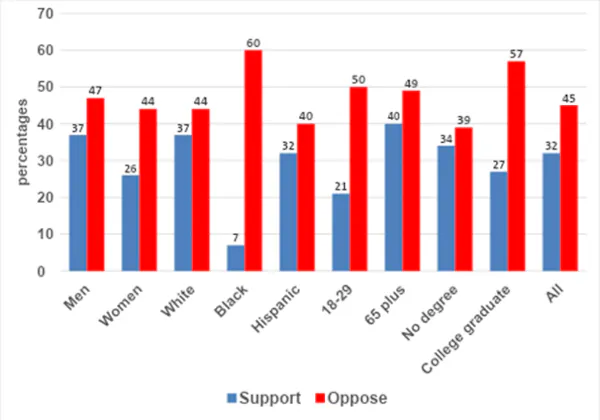
The largest differences are in relation to race. Some 37% of white respondents support the war and 44% oppose it. In contrast 7% of black people support it and 60% oppose. Hispanics were in between these two, but rather closer to whites than to blacks.
The was a large gender difference in the responses as well with 37% of men in support but only 26% of women. A marked age difference existed too with only 21% of 18-to-29 year olds supporting and 50% opposed. At the same time some 40% of those over the age of 65 supported the war with 49% opposed. Finally, 34% of those without a college degree were in support compared with 27% with a college degree. Overall, young black women with a college degree were most likely to oppose the war, whereas older white men without a college degree were most in support.
The social backgrounds and attitudes to the war of respondents are interesting, but they are overshadowed by the polarisation of opinion among supporters of the political parties and ideological factions. These appear in the second chart.
The relationship between attitudes to the war and the political affiliations of respondents
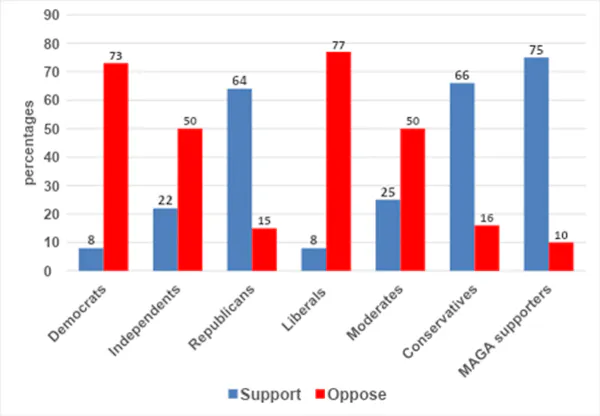
The striking feature of this chart is the difference between respondents who identify with the Democrats and those who identify with the Republicans. Only 8% of Democrats support the war compared with 64% of Republicans. The highest level of support comes from respondents who are Maga (Make American Great Again) supporters. No less that 75% of them support the war and only 10% oppose it.
There is similar polarisation among liberals, which refers to anyone on the left of the ideological spectrum in the US, and conservatives. Only 8% of liberals support the war compared with 66% of conservatives. Moderates are in between the two with 25% of them supporting and 50% opposing the war.
One theory of elections argues that individuals have a set of well-defined preferences over policies and so they support the party which is closest to them in relation to these policies. In this analysis, policy preferences are summarised by the left-right ideological dimension, or alternatively by the liberal-conservative dimension in politics.
In fact, it appears that in reality the reverse is true with voters choosing a party or leader and then changing their views to fit in with those of their newly adopted party. The 47th US president is an extreme case of this, because he constantly changes his mind. Before he was elected, he promised that the US would not get involved in any more wars in the middle east. It appears that most Republicans and nearly all the Maga supporters are quite willing to go along with the U-turn and agree with anything he does.
This is a big advantage for a president who is so polarising, since it means that he can rely on a body of loyal supporters even when they don’t know the latest policy changes. However, it is a weakness when it comes to elections because the Democrats and Independents together easily outnumber the Republicans and Maga supporters in the electorate.
The Cooperative Election Study, a large-scale survey conducted at the time of the presidential election in 2024 showed that 32% of respondents in their national survey identified with the Democrats, 27% with the Independents and 30% with the Republicans. In short, the Republicans are up against a coalition of Democrats and Independents who make up just under 60% of the voters. Add the factor that many Americans are outraged by the president’s behaviour and you have a winning coalition for the opposition in the mid-term elections.
Whatever happens in the war, Trump is unlikely to recover his popularity for the Republicans not to lose control of the House of Representatives – and possibly the Senate – in the mid-term elections in November.
Paul Whiteley, Professor, Department of Government, University of Essex
This article is republished from The Conversation under a Creative Commons license. Read the original article.

https://morningstaronline.co.uk/article/left-mps-move-block-drive-another-middle-east-war

 An F-35 arriving back at RAF Akrotiri in Cyprus, June 2019
LEFT MPs moved today to block Britain from being dragged deeper into the escalating attack against Iran.
Former Labour leader Jeremy Corbyn tabled a Commons Bill to require MPs’ approval before allowing foreign militaries to use British military bases.
The move comes as not only are US forces using the bases to pursue their illegal aggression, but British military forces are increasingly becoming directly involved in the conflict.
Mr Corbyn’s Military Action (Parliamentary Approval) Bill is co-sponsored by Labour, Green and Independent Alliance MPs and a response to PM Sir Keir Starmer’s agreement to allow US use of the bases.
While it has scant chance of becoming law, it signals growing disquiet in Labour’s ranks and beyond about Britain getting bogged down in supporting US President Donald Trump’s attack.
It would “require parliamentary approval for the deployment of UK armed forces and military equipment for armed conflict” and “require parliamentary approval for the granting of permission by ministers for use of UK military bases and equipment by other nations for armed conflict.”
Its co-sponsors are new Green MP Hannah Spencer and her colleague Ellie Chowns, Adnan Hussein and Ayoub Khan from the Independent Alliance and Labour’s Bell Ribeiro-Addy, Brian Leishman, John McDonnell, Richard Burgon, Apsana Begum, as well as suspended Labour MP Diane Abbott.
Sir Keir is under growing pressure from Mr Trump to fall in line as British governments usually do, forcing the premier to assert in the Commons that the “special relationship” did not “depend on hanging on to President Trump’s latest word.”
…
Article continues at https://morningstaronline.co.uk/article/left-mps-move-block-drive-another-middle-east-war


Original article by Jon Queally republished from Common Dreams under Creative Commons (CC BY-NC-ND 3.0).
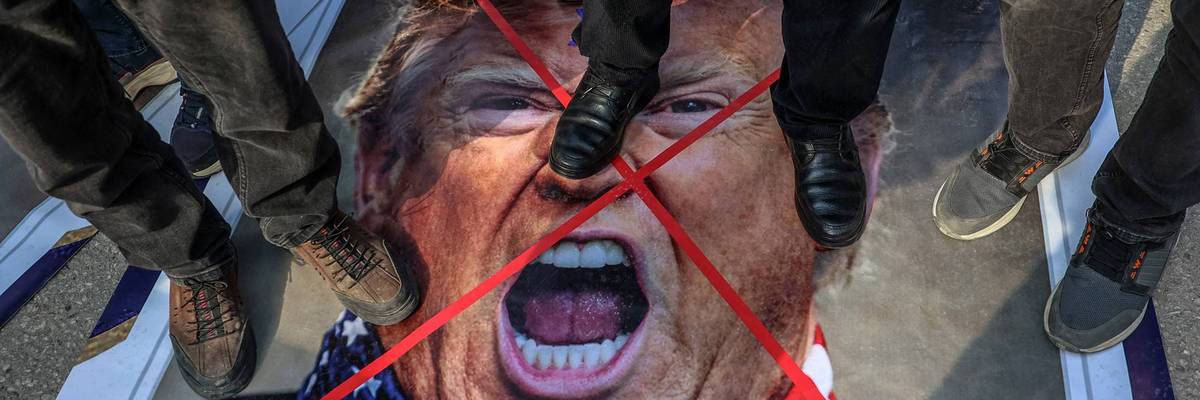
“Trump’s illegal war on Iran and the rule of law,” said one pair of campaigners, “establish an intolerable pattern of egregious abuses of power, directly threatening our constitutional order, our safety, and our way of life.”
After the unprovoked bombing of Iran over the weekend by the United States and Israel—strikes that included the unlawful assassination of Iranian Supreme Leader Ali Hosseini Khamenei—the call for US President Donald Trump to be impeached and removed from office has grown as the straightest path to hold the US leader to account for the attacks which policy and human rights experts have condemned as a serious war crime.
With a regional war in the Middle East that was already boiling from Gaza to Lebanon and from Syria to Yemen now exploding in the wake of the US-Israeli attacks on Iran, Globe and Mail columnist Debra Thompson on Sunday called Trump “the most dangerous man on the planet.”
RECOMMENDED…
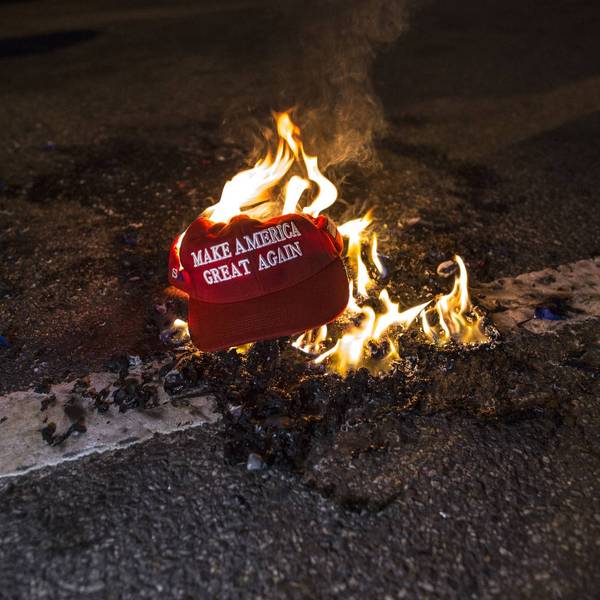

“Rather than ending wars,” Thompson notes, “Trump has initiated military action eight times, carrying out attacks in seven countries (Syria, Iraq, Iran, Nigeria, Yemen, Somalia, and Venezuela) in 2025.” Such a pattern of violence and warmongering should make clear that failure to restrain Trump has only emboldened him.
“The recurring danger in this latest presidential aggression is that there are no guardrails, no constraints, and no post-hoc justification,” writes Thomson, “other than that Mr. Trump is the President of the United States and can do whatever he wants.”
But American presidents cannot simply do whatever they want. According to a Reuters/Ipsos poll out Sunday, less than 25% support the president’s aggression against Iran. In the first wave of the US military attack, an Iranian school for girls was bombed, killing over 108 civilians, mostly children.
While some congressional lawmakers are pushing for a vote this week on a War Powers Resolution to curtail US military operations against Iran, others are demanding more robust action from Congress to bring Trump’s war-making to an end.
“Under Article I, Section 8 of the U.S. Constitution, only Congress has the power to declare war, as well as to raise and support armies, provide and maintain a navy, and fund and regulate the military,” declared novelist and political activists Stephen King on Saturday. “Impeach the SOB.”
Mike Hersh and Alan Minsky, respectively the communications director and executive director of the Progressive Democrats of America, argued in a Sunday op-ed for Common Dreams that “Trump’s illegal, unconstitutional war on Iran is not only a moral and humanitarian disaster, but also a profound constitutional crisis.”
According to Hersh and Minsky:
Trump’s illegal war on Iran and the rule of law establish an intolerable pattern of egregious abuses of power, directly threatening our constitutional order, our safety, and our way of life. These intertwined crises cry out for an immediate, decisive response by the Congress and the US public.
Therefore, PDA demands that all members of Congress, Democrats, Republicans, and Independents alike, uphold their oath of office to defend our constitutional republic. The Constitution offers one and only one remedy when President a repeatedly breaks the law and arrogantly refuses to abide by the limits on the power clearly laid out in the Constitution. That remedy is impeachment, followed by removal from office.
Matt Duss, executive vice president for the Center for International Policy, said that US lawmakers, as well as the American people they represent, “must also be ready to hold the president and his administration accountable for this breach of US and international law.”
“The failure to hold past presidents liable for war crimes and related violations of our own laws has helped lead to this dangerous moment, with a seemingly unrestrained president endangering millions of lives with impunity,” warned Duss. “The forever wars and the imperial presidency must finally come to an end.”
Original article by Jon Queally republished from Common Dreams under Creative Commons (CC BY-NC-ND 3.0).
