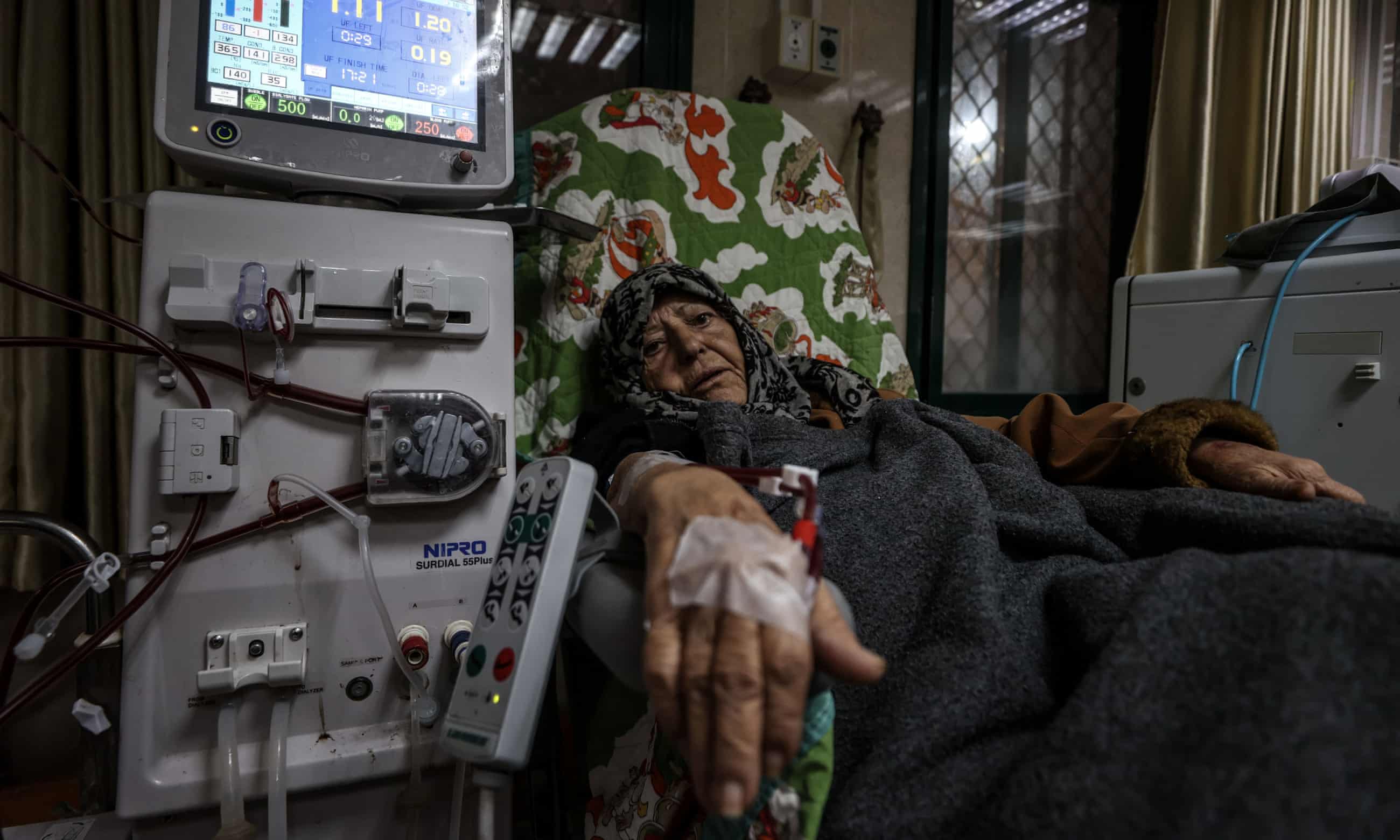
A Palestinian woman receives dialysis treatment at the Al-Aqsa Martyrs Hospital on February 8, 2024. Photograph: Anadolu/Getty Images
The lack of medicine, food and water means thousands of people with asthma, kidney disease or diabetes are unable to treat or control their conditions
Four months of conflict in Gaza is jeopardising the health of thousands of people with chronic illnesses such as kidney disease, diabetes and asthma, doctors have warned.
The chronically ill are the hidden casualties of the war, as access to water, food and medicine is severely restricted, said Guillemette Thomas, the Médecins Sans Frontières (MSF) medical coordinator for Palestine.
“Hospitals that are still functioning are overwhelmed with injured people, they are not able to deal with chronic illness at all,” she said. “Before the war there were 3,500 hospital beds in Gaza, now there are fewer than 1,000, and hundreds and hundreds of injured. We don’t know how many people are dying because they can’t access healthcare.”
When medication is allowed into the territory there are no safe ways of distributing it, Thomas said. “We have some insulin coming in aid trucks, but patients can’t get to the places where it is stocked because of the airstrikes. People are bombed on their way to the hospital.”
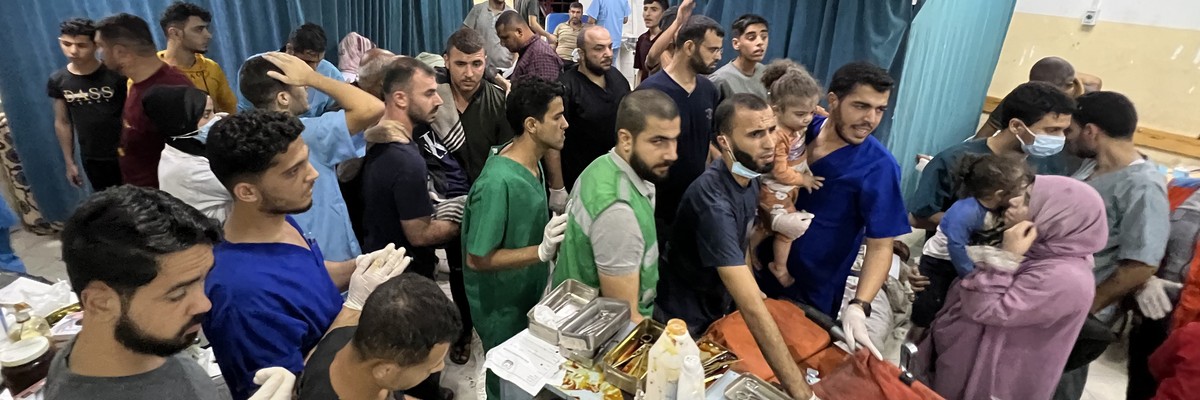
Injured Palestinians, including children, are brought to Nasser Hospital to receive medical treatment following Israeli attacks in Khan Younis, Gaza on January 22, 2024. (Photo: Belal Khaled/Anadolu via Getty Images)
“The situation is escalating every hour and every minute,” said a surgeon at Nasser Hospital in Khan Younis.
Israeli forces on Thursday stormed the largest hospital in southern Gaza, ignoring warnings from United Nations officials, humanitarian groups, and the facility’s administrators that such a raid would put the lives of patients and people sheltering there at dire risk.
The Israel Defense Forces (IDF) reportedly destroyed the southern wall of the Nasser Hospital complex in Khan Younis and started raiding the facility, where around 10,000 people had sought shelter from Israeli airstrikes and ground attacks.
Without providing evidence, Israel has claimed Hamas is using the hospital for “military activities.” Israel also claimed to have intelligence indicating that hostages or their bodies were being held at Nasser.
Ashraf al-Qudra, a spokesman for Gaza’s health ministry, said Thursday that Israel launched a “massive incursion” into the hospital, firing on and wounding people inside and ordering the facility’s staff to move all patients who were unable to flee into a building that’s not adequately equipped, The Associated Press reported.
As of Wednesday afternoon, more than 1,500 displaced people and patients were still inside the Nasser complex, Gaza health officials said in an update on social media.
“Many cannot evacuate, such as those with lower limb amputations, severe burns, or the elderly,” al-Qudra told Al Jazeera.
Others worried that Israeli forces would shoot them if they tried to leave.
“I’m terrified to leave the hospital and get shot,” Hanin Abu Tiba, a 27-year-old English teacher sheltering at the hospital, toldThe New York Times on Wednesday.
The raid began Thursday after Israeli forces reportedly bombed a ward of the hospital that was full of patients. Gaza health officials said the IDF targeted the hospital’s orthopedic department, killing at least one person and injuring “many” more.
Israeli forces bombed Nasser Hospital in Khan Younis, southern Gaza, on Thursday. According to sources on the ground, Israel has struck a ward full of patients, resulting in casualties. pic.twitter.com/zTf5HujPAq
The Israeli military, which has encircled Nasser Hospital for weeks, began ordering civilians inside the facility to evacuate on Tuesday.
Citing one of the only remaining journalists inside the facility, The Intercept reported Wednesday that the IDF sent a handcuffed Palestinian man into Nasser to tell people sheltering inside to leave.
An Israeli soldier shot the man, later identified as Jamal Abu Al-Ola, three times in the chest and abdomen as he began walking out of the hospital after delivering the message.
Israeli snipers have also opened fire on people scrambling to flee the hospital as well as medical personnel and patients inside the facility.
Gaza health officials said Wednesday that the situation at Nasser is “catastrophic” and that Israel’s evacuation orders sparked “a state of panic among its residents.”
Dr. Ahmed Moghrabi, a surgeon at Nasser, posted video footage to Instagram that provides a glimpse of the chaos inside the hospital as it comes under Israeli attack.
Dr. Khaled Alserr, another Nasser surgeon, told AP that seven people injured by Israeli attacks on Thursday were already being treated for existing wounds. Alserr said a doctor was also injured when an Israeli drone “opened fire on the upper stories of the hospital.”
“The situation is escalating every hour and every minute,” he said.
Israel’s raid began hours after Médecins Sans Frontières (MSF), also known as Doctors Without Borders, condemned the evacuation orders and reiterated its call for a permanent cease-fire. MSF said some of its staff members were “still in the building” treating patients “amid near impossible conditions.”
“People have been forced into an impossible situation: stay at Nasser Hospital against the Israeli military’s orders and become a potential target, or exit the compound into an apocalyptic landscape where bombings and evacuation orders are a part of daily life,” Lisa Macheiner, MSF’s project coordinator in Gaza, said in a statement. “Hospitals should be considered as safe places and shouldn’t even be evacuated in the first place.”
In a Nasser update posted to social media Thursday morning, MSF said that “following shelling this morning, our staff reported a chaotic situation, with an undetermined number of people killed and injured.”
“Our medical staff have had to flee the hospital, leaving patients behind,” the group said. “Israeli forces set up a checkpoint to screen people leaving the compound; one of our colleagues was detained at this checkpoint. We call for his safety and the protection of his dignity.”
MSF demanded that the Israeli military “immediately stop this attack, as it endangers medical staff and patients who are still stuck inside the facility.”
This post has been updated with new comments from Médecins Sans Frontières.
The Nasser Medical Complex has been under siege for several days
After over 20 days of besieging Nasser Medical Complex, Israeli occupation forces attacked thousands of people sheltering inside the hospital
On February 14, the Israeli Occupation Forces (IOF) launched an attack against thousands of civilians seeking shelter at Nasser Medical Complex in Khan Younis, including the hospital’s staff and patients. The complex has endured a siege by the IOF for over 20 days, during which those inside were kept under sniper threat, resulting in the deaths of dozens in the vicinity of the hospital. Among the casualties were children who attempted to fetch water, as well as healthcare personnel.
“Get out, animals! Get out, dogs!” shouted IOF soldiers at the people inside Nasser Hospital during the final stages of the siege. Additionally, soldiers forced a young Palestinian man, whom they had detained, to deliver evacuation orders to the hospital. Reportedly, the man was coerced to return to the IOF after carrying out the task, under threat of the soldiers invading the hospital to find him. The Israeli soldiers then shot the man as he was walking back to them.
Most of the complex became unusable due to Israeli attacks throughout the siege. The IOF demolished the northern wall of Nasser Hospital, leaving only one passage usable—the same one through which they marched people out on Wednesday. Before forcing them to leave, Israeli soldiers reportedly positioned face-recognition technology near the exit. This move, according to observers tracking attacks on healthcare in the Gaza Strip, indicates the declaration of Nasser Hospital as a military target, likely to be followed by mass arrests and abuse of healthcare workers and patients.
Until the evacuation was enforced, Nasser was one of the last major health centers remaining in Gaza. Its capacities seconded only those of Al-Shifa Hospital, the Strip’s largest hospital. According to Ubai Aboudi, Executive Director of Bisan Center for Research and Development, Nasser’s beds accounted for some 12% of the overall capacities in Gaza.
The attack on the hospital is certain to have a devastating effect on the tens of thousands of people injured in Israeli attacks. While the hospital was besieged, the World Health Organization (WHO) and Doctors Without Borders (MSF) warned that it was crucial to keep the complex operational as IOF attacks south of the Wadi Gaza line intensified.
Despite all the warnings and pleading, the WHO was last able to deliver supplies to Nasser Hospital at the end of January. After that, attempts to organize medical missions were blocked by Israeli authorities. This meant that health workers had barely anything to work with, especially after an attack on nearby school buildings led to a fire, which then destroyed approximately 80% of the stocks in Nasser’s medical warehouse. As a result of the incessant attacks, the hospital’s emergency department was flooded in sewage water, making it unusable.
“The hospital is barely functioning, but we are trying to work as much as possible to save lives,” Mohammed Harara, a doctor from the hospital, told WHO officials days before the attack. “We are scared that any moment we might lose our lives, and we have no clue about our families.”
Staff from the hospital faces additional threats, as the Israeli forces continue to target health workers in particular. Dozens of nurses, paramedics, and doctors have been disappeared by the IOF. They are still be held under torture and extreme duress, without any access to legal or humanitarian protection.
The dehumanizing attacks against patients, staff, and displaced people at Nasser Hospital are another step towards making Gaza uninhabitable, according to Aboudi. Little doubt remains that the few health institutions that remain in southern Gaza will meet a similar fate as the Israeli armed forces approach.
After that, says Aboudi, “there will be no care, simply put.”
People’s Health Dispatchis a fortnightly bulletin published by thePeople’s Health Movementand Peoples Dispatch. For more articles and to subscribe to People’s Health Dispatch, clickhere.
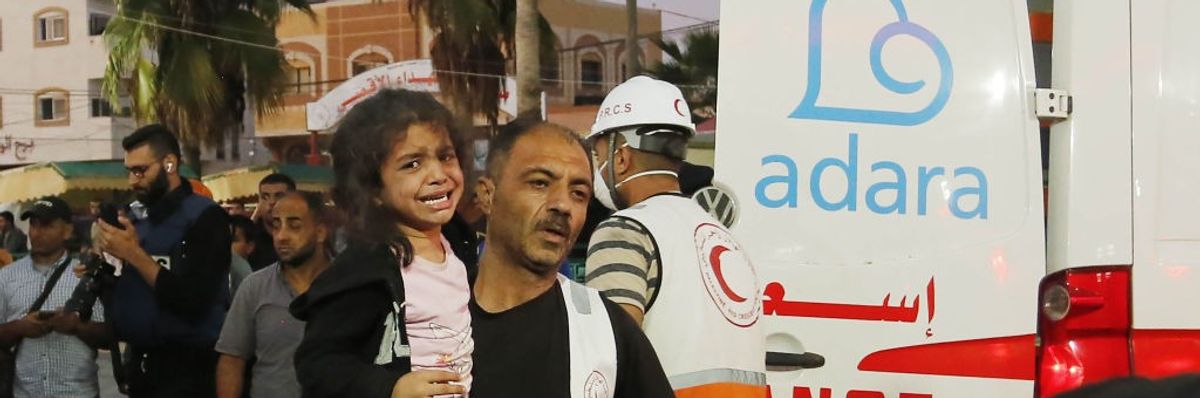
Wounded people receive treatment at the Aqsa Indonesia Hospital after an Israeli attack on the Jibalia refugee camp on November 13, 2023. (Photo: Fadi Alwhidi/Anadolu via Getty Images)
“Israel’s broad-based attack on Gaza’s healthcare system is an attack on the sick and the injured, on babies in incubators, on pregnant people, on cancer patients. These actions need to be investigated as war crimes.”
Human Rights Watch on Tuesday demanded that the Israeli government immediately cease its deadly attacks on Gaza’s hospitals, arguing they’re part of a far-reaching and unlawful assault on the territory’s crumbling healthcare system.
In a new report, HRW examines the impacts of the Israeli bombing campaign, ground invasion, and siege on Gaza’s medical personnel and facilities, a majority of which have stopped functioning due to airstrike damage or lack of critical supplies, from fuel to anesthetics.
“Israel’s repeated attacks damaging hospitals and harming healthcare workers, already hard hit by an unlawful blockade, have devastated Gaza’s healthcare infrastructure,” said A. Kayum Ahmed, special adviser on the right to health at Human Rights Watch. “The strikes on hospitals have killed hundreds of people and put many patients at grave risk because they’re unable to receive proper medical care.”
Over the past week, Israeli forces have surrounded and intensified their bombardment of several hospitals in northern Gaza including al-Shifa, the enclave’s largest medical facility. Israel has also bombed ambulances and people desperately attempting to flee hospitals as they’ve come under attack.
“On November 3, the Israeli military struck a marked ambulance just outside of Gaza City’s al-Shifa hospital,” HRW said. “Video footage and photographs taken shortly after the strike and verified by Human Rights Watch show a woman on a stretcher in the ambulance and at least 21 dead or injured people in the area surrounding the ambulance, including at least 5 children.”
“An IDF spokesperson said in a televised interview that day: ‘Our forces saw terrorists using ambulances as a vehicle to move around. They perceived a threat and accordingly we struck that ambulance,’” the group added. “Human Rights Watch did not find evidence that the ambulance was being used for military purposes.”
HRW similarly questioned Israeli assertions that Hamas is using Gaza’s hospitals, including al-Shifa, for military operations.
Targeting hospitals is a war crime under international law, but medical facilities can lose their protected status if they’re used to commit an “act harmful to the enemy,” according to the International Committee of the Red Cross (ICRC).
HRW argued that Tuesday that “no evidence put forward” by the Israeli government thus far “would justify depriving hospitals and ambulances of their protected status under international humanitarian law.”
“When a journalist at a news conference showing video footage of damage to the Qatar Hospital sought additional information to verify voice recordings and images presented, the Israeli spokesperson said, ‘Our strikes are based on intelligence,’” HRW said. “Even if accurate, Israel has not demonstrated that the ensuing hospital attacks were proportionate.”
The group said Israel “should end attacks on hospitals” and urged the United Nations’ Independent International Commission of Inquiry on the Occupied Palestinian Territory and the International Criminal Court to investigate.
“Israel’s broad-based attack on Gaza’s healthcare system is an attack on the sick and the injured, on babies in incubators, on pregnant people, on cancer patients,” said Ahmed. “These actions need to be investigated as war crimes.”
Repeated Israeli unlawful strikes on hospitals have helped decimate Gaza's health system. No evidence has been offered that justify stripping hospitals of their special protections under law—these attacks should be investigated as war crimes. New from @hrwhttps://t.co/eCvdQJLzEBpic.twitter.com/QLiLIsIuNM
The new analysis came amid horrific reports of the impact that Israel’s assault is having on healthcare workers, patients, and displaced people seeking refuge from near-constant airstrikes.
Reuters reported that people trapped inside al-Shifa Hospital “plan to start burying bodies within the hospital compound” on Tuesday “because the situation has become untenable.” The World Health Organization said over the weekend that the facility is “not functioning as a hospital anymore” due to power outages and a lack of supplies, which have caused the deaths of a number of patients—including premature babies.
Dr. Ahmed Al Mokhallalati, a surgeon at al-Shifa, told Reuters that “the bodies were generating an unbearable stench and posing a risk of infection.”
“Unfortunately there is no approval from the Israelis to even bury the bodies within the hospital area,” he said. “Today … civilians started digging within the hospital to try and bury the bodies on their own responsibility without any arrangements by the Israeli side. Burying 120 bodies needs a lot of equipment, it can’t be by hand efforts and by single-person efforts. It will take hours and hours to be able to bury all these bodies.”
Doctors Without Borders, known internationally as Médecins Sans Frontières (MSF), said that on Tuesday morning, “bullets were fired into one of three MSF premises located near al-Shifa hospital and sheltering MSF staff and their families—over 100 people, including 65 children, who ran out of food last night.”
“Thousands of civilians, medical staff, and patients are currently trapped in hospitals and other locations under fire in Gaza City; they must be protected and afforded safe passage if they wish to leave,” the group added. “Above that, there must be a total and immediate cease-fire.”
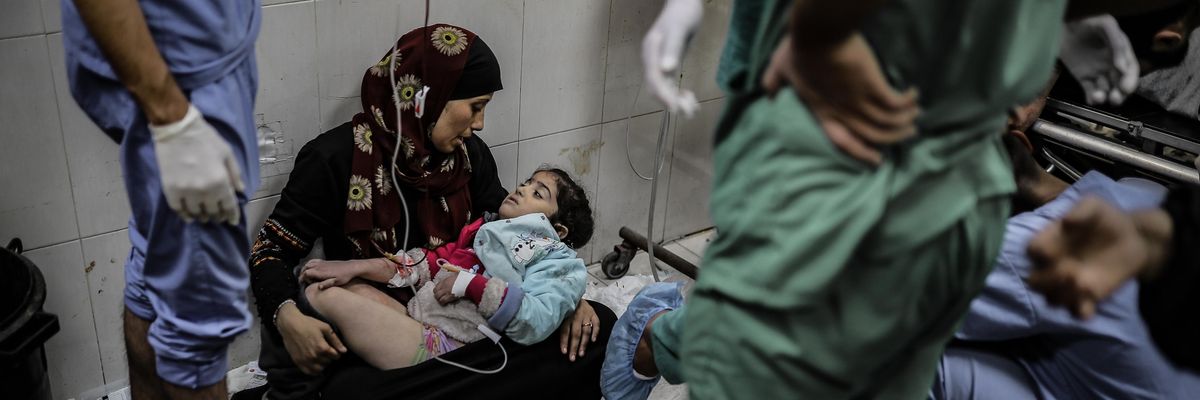
Injured child is taken to Suheda al-Aqsa Hospital (Al-Aqsa Martyrs Hospital) in Deir al-Balah, Gaza as Israeli attacks on Gaza continue on the 15th day on October 21, 2023. (Photo by Ashraf Amra/Anadolu via Getty Images)
“Collective punishment of two million people is a war crime and a moral outrage,” said one head of a medical relief group. “The siege must end, a ceasefire must be secured, and aid must be allowed to reach any who need it.”
Emergency aid groups and relief experts denounced the tiny “trickle” of humanitarian supplies that were finally allowed to pass through the Rafah crossing into Gaza on Saturday, especially as what was described by human rights watchdogs as a “loss of civilian life at a scale we have not seen in the modern history of Israel and Palestine” continues inside the besieged territory.
The 20 trucks authorized to deliver aid into Gaza through border with Egypt, said Médecins Sans Frontières/MSF in a statement, is “totally insufficient compared to the desperate needs of the people, who have been under complete siege and relentless bombing for two weeks.”
“Prior to the siege,” the group said, “hundreds of trucks with supplies entered Gaza every day as the Strip is crucially reliant on external aid. Food, water, and medicine are still desperately needed.”
“Gaza was a desperate humanitarian situation before the most recent hostilities. It is now catastrophic. The world must do more.” —UN Agencies
Guillemette Thomas, MSF’s medical coordinator for Gaza, said Saturday that inside Gaza “we have an extremely high number of injured people arriving in hospitals, very serious patients requiring complex care. According to our colleagues who still work at Shifa hospital, the hospital will soon run out of fuel and therefore electricity. This means that all the patients currently in intensive care units connected to ventilators and babies in incubators will die because of the lack of electricity. Operating theaters will no longer be able to function, patients will no longer be able to be operated on and the number of victims will increase significantly in the coming hours.”
Thomas warned that those in the intensive care were “just the tip of the iceberg,” warning that all injured and sick people Gaza remain at severe risk.
We are witnessing loss of civilian life at a scale we have not seen in the modern history of Israel and Palestine.
Human Rights Watch was among those who suggested that the refusal to allow fuel into Gaza—and the absence of efforts to restore or repair devastated the electricity grid or water systems—makes the paltry level stand out as intentionally inadequate.
“While aid agencies struggle to squeeze a few trucks of humanitarian aid into southern Gaza via Egypt, the Israeli authorities are keeping their crossings with Gaza closed and refusing to flick the switch for the water and electricity supply,” said Tirana Hassan, HRW’s executive director. “There is no excuse for denying water, food, and medicine to Gaza’s civilian population. It is cruel and contrary to international law.”
The “aid” trickle through Rafah crossing is a cynical public relations exercise to take your eyes off the ongoing genocide. “Israel” is committing the crime against humanity of cutting off Gaza’s supply of water, food, medicine and fuel. It must be stopped NOW. https://t.co/9Qk3FBSGhU
Melanie Ward, chief Eexecutive of the U.K.-based group Medical Aid for Palestinians said 20 trucks of supplies “does not even scratch the surface” of what’s needed in Gaza.
“It is appalling that fuel will not be allowed in, making the distribution of aid to the people who need it across Gaza impossible,” Ward said. “Without electricity, the lights will go out in hospitals, desalination and sewage plants will not function, and many more people will die.”
“Political leaders should remember that collective punishment of two million people is a war crime and a moral outrage,” she added. “The siege must end, a ceasefire must be secured, and aid must be allowed to reach any who need it.”
Ward’s group was also part of a Saturday effort to bring attention to 130 premature babies currently in hospitals throughout Gaza at risk of death if those facilities run out of power:
🚨 URGENT UPDATE: Doctors in #Gaza have issued an urgent warning that the lives of 130 premature babies are in imminent danger if fuel does not reach hospitals soon.
— Medical Aid for Palestinians (@MedicalAidPal) October 21, 2023
In a joint Saturday statement, UN agencies—namely the UNDP, UNFPA, UNICEF, WFP, and WHO—said while the “limited, shipment of life-saving humanitarian supplies” provided by the United Nations and Egyptian Red Crescent would “provide an urgently needed lifeline to some of the hundreds of thousands of civilians, mostly women and children, who have been cut off from water, food, medicine, and other essentials,” it was “only a small beginning and far from enough” to address the depth of the crisis.
Citing the overwhelmed hospitals and acute shortages of power, food, and water, the agencies’ statement included a slate of demands, including a pause of Israel’s bombing campaign:
We call for a humanitarian ceasefire, along with immediate, unrestricted humanitarian access throughout Gaza to allow humanitarian actors to reach civilians in need, save lives and prevent further human suffering. Flows of humanitarian aid must be at scale and sustained, and allow all Gazans to preserve their dignity.
We call for safe and sustained access to water, food, health – including sexual and reproductive health, and fuel, which is necessary to enable essential services. “We call for the protection of all civilians and civilian infrastructure in Gaza, including healthcare facilities.
We call for the protection of humanitarian workers in Gaza who are risking their lives for the service of others. And we call for the utmost respect of international humanitarian law by all parties.
Gaza was a desperate humanitarian situation before the most recent hostilities. It is now catastrophic. The world must do more.
In a joint statement on Friday, top Human Rights Watch program directors—Omar Shakir, Yasmine Ahmed, and Akshaya Kumar—said that the world is “witnessing loss of civilian life at a scale we have not seen in the modern history of Israel and Palestine. With deadlock paralyzing international institutions, leaders should rise to the moment and act to prevent further mass atrocities before it’s far too late.”
HRW said Saturday that as the occupying power in Gaza it has the legal duty under international humanitarian law to “ensure that the basic needs of the civilian population are provided for” and that it is obligated to facilitate, not prevent, the flow of humanitarian aid.
“Israeli authorities need to act immediately,” said Hassan in her statement. “Lives are hanging in the balance.”