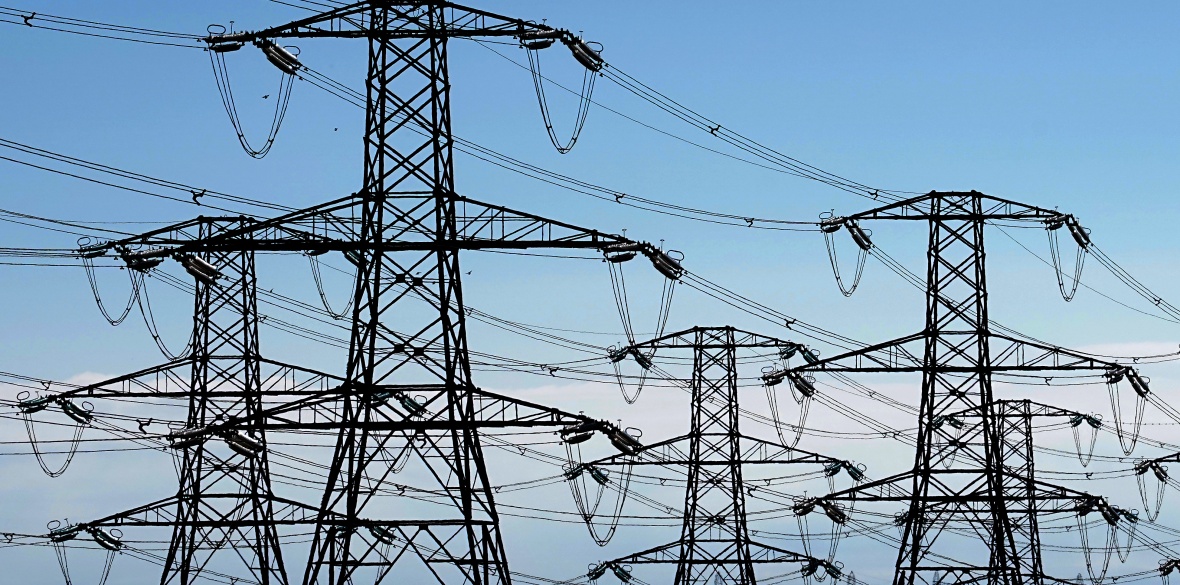
A view of the Little Cheyne Court Wind Farm amongst existing electricity pylons on the Romney Marsh in Kent
MORE than 7,000 manufacturing businesses will have up to 25 per cent cut from their electricity costs under the government’s 10-year industrial strategy.
Under a new British Industrial Competitiveness Scheme announced today, they will be exempted from levies on bills including the renewables obligation, feed-in tariffs and the capacity market from 2027 — reducing bills by up to £40 per megawatt hour.
Around 500 of the most energy-intensive firms, including the steel industry, will also see their network charges cut with bigger energy discounts, along with measures to speed up the time it can take to connect new factories and projects to the energy grid.
…
Unite general secretary Sharon Graham welcomed the moves to cut energy costs, but said: “Unite would like to have seen the government go further.
“Our energy system is broken beyond repair; it will never function in the interests of business and consumers until it is brought back into public ownership.
“That must start with the National Grid to ensure industry can get the power it needs when it needs it and is not left waiting forever for new connections.”
PRIME Minister Sir Keir Starmer was told to apologise after Ofgem approved a surprise 6.4 per cent rise in average energy bills set to hit working families and pensioners the hardest yesterday.
Sir Keir was accused of breaking general election pledge to slash bills by £300 after the energy regulator announced a rise of £111 from April to £1,849 a year for the typical household.
Unite general secretary Sharon Graham said the third consecutive increase in the cap on gas and electricity charges “is a cruel increase which is going to hit the elderly and low-paid workers the hardest.
“How can this be acceptable when energy companies are making billions in profits and millions of people are struggling to keep warm?
“The government should be making sure that everyone in the UK is able to stay warm, not making it harder.
“It can start by reversing its disastrous policy of cutting the winter fuel allowance and by returning key energy companies to public ownership, starting with the National Grid.”
‘It is time our energy infrastructure was brought back into public ownership,’ Unite general secretary says
CAMPAIGNERS intensified their demands for energy infrastructure to be brought back into full public ownership today after the National Grid posted a 14 per cent increase in underlying profits.
The firm, which builds and runs power grids and cables across Britain, reported an underlying operating profit of £2.05 billion for the six months until September 30, surpassing £1.8bn in the same period last year.
The grid charges energy suppliers for network use. Costs are then passed on to consumers through their bills, which rose by another 10 per cent last month.
In 2023, National Grid shareholders received £1.6bn in dividends, while six million households remained trapped in fuel poverty amid skyrocketing costs.
Unite general secretary Sharon Graham said National Grid’s profits “lay bare” Britain’s broken energy system.
She said: “Energy profiteers like National Grid are extracting cash for overseas shareholders through ever more expensive bills.
“It is time our energy infrastructure was brought back into public ownership so that the British people and economy benefit rather than foreign wealth funds.”
Yet public ownership is opposed passionately by the Conservative government, while the leader of the opposition has said he is “not in favour” of it – despite his election on a platform that committed to “bring rail, mail, water and energy into public ownership to end the great privatisation rip-off and save you money on your fares and bills”.
Public ownership is on the media’s radar, too. When Labour leader Keir Starmer announced his policy to freeze bills this week, he was asked why he wouldn’t also nationalise energy, replying that: “In a national emergency where people are struggling to pay their bills … the right choice is for every single penny to go to reducing those bills.”
But so long as energy remains privatised, every single penny won’t. Billions of pennies will keep going to shareholders instead.
The energy market was fractured under the mass privatisations of the Thatcher governments in the 1980s. It contains three sectors: producers or suppliers (those that produce energy), retailers (those that sell you energy), and distribution or transmission (the infrastructure that transports energy to your home).
It is important to bear this in mind when we’re talking about taking energy into public ownership. We need to be clear about what we want in public ownership and why.
By 2019, Labour had a detailed plan on how to do this – worked up by the teams around then shadow business and energy secretary Rebecca Long Bailey and then shadow chancellor John McDonnell. The plan is not the only way, but it illustrates what exists and how one could go about re-establishing a public energy ecosystem, run for people not profit.
The recent TUC report shows the cost of nationalising the ‘Big 5’ energy retailers – British Gas, E.ON, EDF, Scottish Power and Ovo – to be £2.8bn, which would go on buying all the companies’ shares. That’s a lot of money, equivalent to more than the annual budget of the Sure Start programme in 2009/10 (its peak year). But it’s a one-off cost, not an annual one.
And it’s not like the current privatised system doesn’t have its costs: since June 2021, the UK government has spent £2.7bn bailing out 28 energy companies that collapsed because they put short-term profits ahead of long-term stability – companies like Bulb Energy. We have spent billions of pounds already to get nothing in return. So £2.8bn is not a large amount of money to pay to gain these assets, rather than just bailing them out.
The big energy retail companies made £23bn in dividends between 2010 and 2020 according to Common Wealth, and £43bn if you include share buy-backs. What you choose to do with that surplus in public ownership is another matter: you could use it to invest in new clean energy or to lower bills or fund staff pay rises, rather than subject your workers to fire-and-rehire practices as British Gas did last year.
Labour’s previous plan also involved taking the distribution networks – the National Grid – into public ownership. This would end the profiteering at this level, too – with £13bn paid out in dividends over the five years prior to 2019. As Long Bailey said at the time, we need “public driven and coordinated action, without which we simply will not be able to tackle climate change”. Like previous nationalisations, the purchase of the grid and distribution networks could be achieved by swapping shares for government bonds. By international accounting standards, the cost is fiscally neutral as the state gains a revenue-generating asset, which more than pays for the bond yield.
The final part of the plan – and the most complicated – is production and supply. It would be impossible to nationalise the oilfields of Saudi Arabia or Qatar – and for good reasons we should want to leave fossil fuels in the ground, anyway, rather than contest their ownership.
And so what Labour proposed in 2019 was a mass investment in new renewable energy generation projects, with the public sector taking a stake and returning profits to the public. For example, under the ‘People’s Power Plan’, we proposed 37 new offshore wind farms with a 51% public stake, delivering 52GW alone by 2030, equivalent to 38 coal power stations. There were additional proposals for onshore wind, solar, and tidal schemes, as part of a 10-year £250bn Green Transformation Fund, which included other schemes like the Warm Homes insulation initiative.
Labour’s new shadow chancellor Rachel Reeves has promised a similar level of investment – a £28bn a year climate investment pledge.
Any surplus energy would then be sold on international markets, with a People’s Power Fund – a sort of sovereign wealth fund – to deliver public investment in local communities’ social infrastructure: a genuine levelling-up fund, perhaps.
Many people will say this can’t be done, but of course it has been before. The 1945 Attlee government nationalised energy and successive Conservative governments – including those of Churchill, MacMillan and Heath – were happy to have a nationalised asset. Harold MacMillan famously accused Margaret Thatcher of “selling off the family silver” when she privatised state industries.
When I was born in 1979, the National Coal Board, British Gas and British Petroleum were all publicly-owned or majority publicly-owned companies. Between them, they were the major suppliers of our energy. Our gas bills came from British Gas and our electricity bills from our regional electricity board (in my case Seeboard, the South Eastern Electricity Board), and coal and oil fuelled our power stations.
The regional electricity boards had been brought into being by the Attlee government’s Electricity Act 1947, when electricity companies were forcibly merged into regional area boards and nationalised. The Coal Industry Nationalisation Act 1946 and the Gas Act 1948 had together brought energy into public ownership.
Seeboard was privatised in 1990, and later became part of EDF Energy – ironically, the nationalised French energy company, whose profits from the UK’s stupidity are used to subsidise French consumers.
The French government has now fully nationalised EDF (previously it was 84% publicly owned), and household energy bills rose by just 4% this year – compared to over 50% in the UK and a forecast 200% by January 2023.
If Starmer doesn’t want to listen to me (or his own commitments from 2020), perhaps emulating the centrist Emmanuel Macron in this instance would be palatable?
From the depletion of fish stocks to the burning of the Amazon, profit has proved a failed regulator for use of our natural resources
In his later years, Robin Cook argued: “The market is incapable of respecting a common resource such as the environment, which provides no price signal to express the cost of its erosion nor to warn of the long-term dangers of its destruction.”
From the depletion of fish stocks to the burning of the Amazon, profit has proved a failed regulator for use of our natural resources. The market has also failed to decarbonise at pace, or to end the scourge of fuel poverty.
On the media this week, shadow energy secretary Ed Miliband said Labour is “continuing to look at what the right long-term solution is for our energy system”. It is up to all of us to campaign for that solution to be public ownership – whether that’s from within the Labour Party (like me) or from the outside.

 A view of the Little Cheyne Court Wind Farm amongst existing electricity pylons on the Romney Marsh in Kent