European leaders rewrite WWII history on Auschwitz liberation anniversary

Spread the love

Original article by Ana Vračar republished from peoples’ dispatch under a Creative Commons Attribution-ShareAlike 4.0 (CC BY-SA) license.
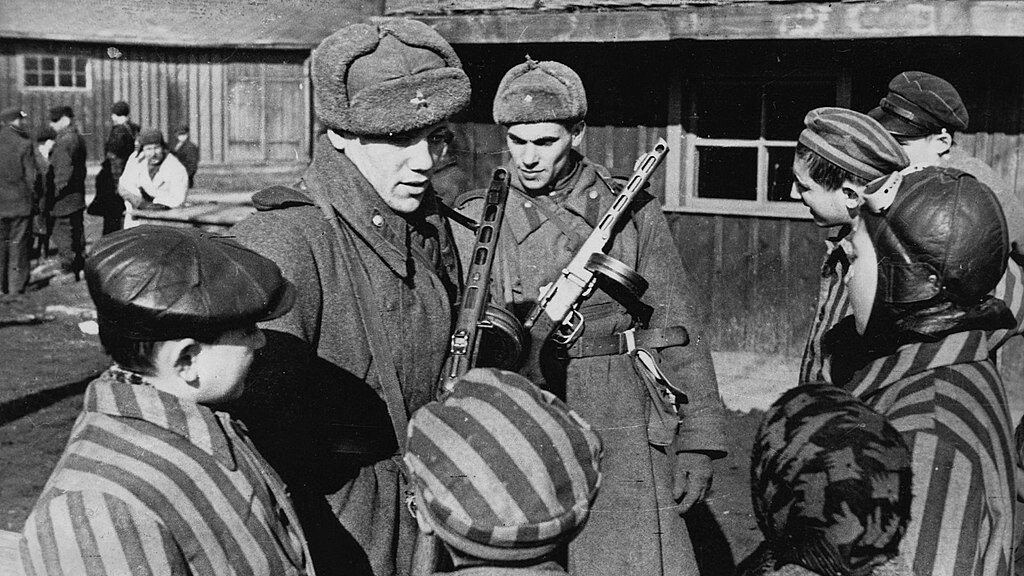
Red Army soldiers with prisoners of Nazi concentration camp, 1945. Source: Wikimedia Commons

As European leaders gathered at Auschwitz to commemorate 80 years since its liberation, they upheld a revisionist narrative that downplays the role of the Red Army in defeating Nazism

On January 27, 1945, soldiers of the Soviet Red Army liberated Auschwitz, the Nazi concentration camp where over one million people—overwhelmingly Jews—were murdered. Eighty years later, European leaders gathered in Poland, now home to the Auschwitz memorial, to hear survivor testimonies and reaffirm the commitment to ensuring such atrocities never happen again.

Yet this year’s commemoration came with a blazing omission. Despite the USSR’s vital role in defeating Nazi Germany and its allies—at the cost of over 20 million Soviets’ lives—there were no representatives of the Russian Federation at Auschwitz. In its pursuit of punishing Russia for the war in Ukraine, the European Union (EU) has virtually erased the Red Army’s contributions from the narrative. Leaders like Ursula von der Leyen and Giorgia Meloni issued statements of remembrance while avoiding any mention of the USSR. Only left politicians dared to talk about the full picture in their messages on the day of remembrance.

Read more: Zagreb’s anti-fascist flame: a decade of liberation celebrations and resistance

These events have to be read as part of a broad revisionist trend spreading through Europe, in which far-right parties, such as Meloni’s Brothers of Italy and France’s National Rally, are using anti-communist tropes to rewrite history. This trend has taken root among mainstream parties as well. Just days before Holocaust remembrance day, the European Parliament adopted a resolution condemning Russia for “exploiting the narrative of the ‘liberation of Europe from Nazism.’” The text of the resolution also criticized the restoration of Lenin’s monuments in Ukraine and called for a “pan-European” memorial for “victims of the 20th century totalitarian regimes,” a vocabulary that aims to equate fascism and communism.

In what can only be described as a severe case of historical amnesia, the parliamentaries proposed a ban on “both Nazi and Soviet communist symbols” across the EU. As some have pointed out, implementing such a ban would complicate commemorations like the one on Monday, given the prominence of Soviet uniforms in archival photographs of liberation.

While the EU is entertaining itself with erasing communism’s role in defeating Nazism in World War II, it seems to have learned extremely little from the Holocaust itself. The first phase of a ceasefire in Gaza had not even begun when Polish authorities announced they would allow Israeli Prime Minister Benjamin Netanyahu to attend the Auschwitz commemoration—despite an International Criminal Court warrant for his arrest on war crimes charges. Though Netanyahu ended up not attending himself, the mere possibility highlights Europe’s willingness to overlook crimes against humanity if committed by its current allies.

“Laying claim to the memory of one genocide in order to justify another genocide is morally and politically unacceptable,” historian Enzo Traverso said in a recent interview with Jacobin, commenting on Europe’s reactions to the genocide in Gaza. “The memory of Auschwitz should be mobilized to impede new genocides, not to justify them.”

Read more: Elon Musk and AfD’s Alice Weidel’s align ahead of elections in Germany

By refusing to acknowledge the full history of Nazism’s defeat in 1945—especially the contributions of the Red Army and communist movements—Europe only fuels the rise of the far-right. Parties like Alternative for Germany (AfD), National Rally and Brothers of Italy may avoid explicit antisemitism in their platforms, but their policies thrive on the same hatred and violence that drove the Holocaust. As these parties gain electoral ground, the slogan “Never again is now” is becoming increasingly difficult to believe.

Original article by Ana Vračar republished from peoples’ dispatch under a Creative Commons Attribution-ShareAlike 4.0 (CC BY-SA) license.

Continue ReadingEuropean leaders rewrite WWII history on Auschwitz liberation anniversary

Zionism and the Third Reich by Mark Weber

Spread the love

Excerpts from Zionism and the Third Reich by Mark Weber

Early in 1935, a passenger ship bound for Haifa in Palestine left the German port of Bremerhaven. Its stern bore the Hebrew letters for its name, “Tel Aviv,” while a swastika banner fluttered from the mast. And although the ship was Zionist-owned, its captain was a National Socialist Party member. Many years later a traveler aboard the ship recalled this symbolic combination as a “metaphysical absurdity.”/1 Absurd or not, this is but one vignette from a little-known chapter of history: The wide-ranging collaboration between Zionism and Hitler’s Third Reich.

Common Aims

Over the years, people in many different countries have wrestled with the “Jewish question”: that is, what is the proper role of Jews in non-Jewish society? During the 1930s, Jewish Zionists and German National Socialists shared similar views on how to deal with this perplexing issue. They agreed that Jews and Germans were distinctly different nationalities, and that Jews did not belong in Germany. Jews living in the Reich were therefore to be regarded not as “Germans of the Jewish faith,” but rather as members of a separate national community. Zionism (Jewish nationalism) also implied an obligation by Zionist Jews to resettle in Palestine, the “Jewish homeland.” They could hardly regard themselves as sincere Zionists and simultaneously claim equal rights in Germany or any other “foreign” country.

Theodor Herzl (1860-1904), the founder of modern Zionism, maintained that anti-Semitism is not an aberration, but a natural and completely understandable response by non-Jews to alien Jewish behavior and attitudes. The only solution, he argued, is for Jews to recognize reality and live in a separate state of their own. “The Jewish question exists wherever Jews live in noticeable numbers,” he wrote in his most influential work, The Jewish State. “Where it does not exist, it is brought in by arriving Jews … I believe I understand anti-Semitism, which is a very complex phenomenon. I consider this development as a Jew, without hate or fear.” The Jewish question, he maintained, is not social or religious. “It is a national question. To solve it we must, above all, make it an international political issue …” Regardless of their citizenship, Herzl insisted, Jews constitute not merely a religious community, but a nationality, a people, a Volk. /2 Zionism, wrote Herzl, offered the world a welcome “final solution of the Jewish question.”/3

Active Collaboration

On this basis of their similar ideologies about ethnicity and nationhood, National Socialists and Zionists worked together for what each group believed was in its own national interest. As a result, the Hitler government vigorously supported Zionism and Jewish emigration to Palestine from 1933 until 1940-1941, when the Second World War prevented extensive collaboration.

Even as the Third Reich became more entrenched, many German Jews, probably a majority, continued to regard themselves, often with considerable pride, as Germans first. Few were enthusiastic about pulling up roots to begin a new life in far-away Palestine. Nevertheless, more and more German Jews turned to Zionism during this period. Until late 1938, the Zionist movement flourished in Germany under Hitler. The circulation of the Zionist Federation’s bi-weekly Jüdische Rundschau grew enormously. Numerous Zionist books were published. “Zionist work was in full swing” in Germany during those years, the Encyclopaedia Judaica notes. A Zionist convention held in Berlin in 1936 reflected “in its composition the vigorous party life of German Zionists.”/7

The SS was particularly enthusiastic in its support for Zionism. An internal June 1934 SS position paper urged active and wide-ranging support for Zionism by the government and the Party as the best way to encourage emigration of Germany’s Jews to Palestine. This would require increased Jewish self-awareness. Jewish schools, Jewish sports leagues, Jewish cultural organizations — in short, everything that would encourage this new consciousness and self-awareness – should be promoted, the paper recommended. /8

The Transfer Agreement

The centerpiece of German-Zionist cooperation during the Hitler era was the Transfer Agreement, a pact that enabled tens of thousands of German Jews to migrate to Palestine with their wealth. The Agreement, also known as the Haavara (Hebrew for “transfer”), was concluded in August 1933 following talks between German officials and Chaim Arlosoroff, Political Secretary of the Jewish Agency, the Palestine center of the World Zionist Organization. /32

The Ha’avara agreement greatly contributed to Jewish development in Palestine and thus, indirectly, to the foundation of the Israeli state. A January 1939 German Foreign Office circular bulletin reported, with some misgiving, that “the transfer of Jewish property out of Germany [through the Ha’avara agreement] contributed to no small extent to the building of a Jewish state in Palestine.”/43

Former officials of the Ha’avara company in Palestine confirmed this view in a detailed study of the Transfer Agreement published in 1972: “The economic activity made possible by the influx German capital and the Haavara transfers to the private and public sectors were of greatest importance for the country’s development. Many new industries and commercial enterprises were established in Jewish Palestine, and numerous companies that are enormously important even today in the economy of the State of Israel owe their existence to the Haavara.”/44 Dr. Ludwig Pinner, a Ha’avara company official in Tel Aviv during the 1930s, later commented that the exceptionally competent Ha’avara immigrants “decisively contributed” to the economic, social, cultural and educational development of Palestine’s Jewish community. /45

The Transfer Agreement was the most far-reaching example of cooperation between Hitler’s Germany and international Zionism. Through this pact, Hitler’s Third Reich did more than any other government during the 1930s to support Jewish development in Palestine.

Continue ReadingZionism and the Third Reich by Mark Weber