Protests and Parody Paper Decry New York Times’ Pro-Israel Bias in Gaza Coverage

Spread the love

Original article by BRETT WILKINS republished from Common Dreams under Creative Commons (CC BY-NC-ND 3.0). 

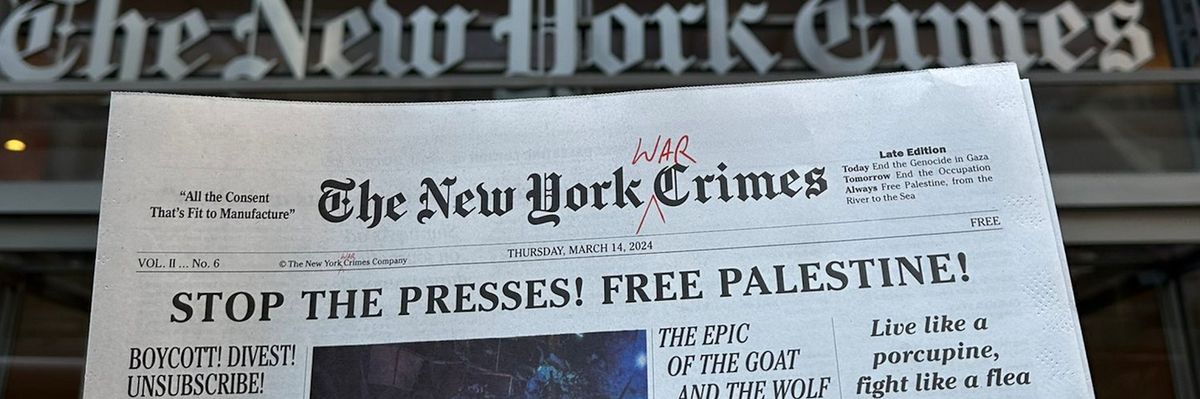
A reader holds up a copy of a satirical paper, “The New York War Crimes,” mocking The New York Times’ biased coverage of the Gaza genocide, on March 14, 2024 in New York City. (Photo: Nicki Kattoura/X)

“The Times is not unique among media in manufacturing consent for war, for exploitation, for genocide. It is, rather, exemplary.”

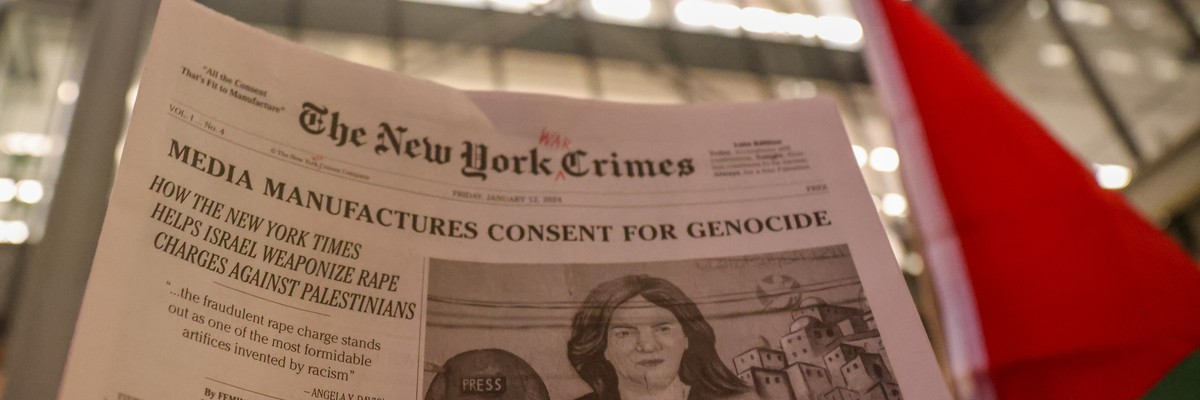
More than 100 pro-Palestine demonstrators were arrested Thursday after staging a protest at The New York Times‘ Midtown Manhattan headquarters, where activists handed out copies of a satirical knockoff of the newspaper that skewered what organizers called its biased coverage of the Gaza genocide.

After surrounding the Times‘ printing plant in College Point, Queens, members of Writers Against the War on Gaza (WAWOG), Palestinian Youth Movement, and other groups shut down the paper’s Midtown West headquarters, where they chanted, “New York Times you can’t hide, we charge you with genocide,” “free, free Palestine,” and “from the river to the sea.”

Around 150 demonstrators occupied the Times building, where they called on passersby to “boycott, divest, and unsubscribe.” Some passersby confronted the demonstrators. One angry man attempted to steal a large banner from protesters. The New York Police Department said 124 protesters were arrested.

Some of the activists handed out parody copies of the Times, renamed as the The New York War Crimes. The paper’s creators also changed the Times‘ “All the News That’s Fit to Print” motto to “All the Consent That’s Fit to Manufacture.”

“The Times is not unique among media in manufacturing consent for war, for exploitation, for genocide,” notes the satirical paper, which also has a website. “It is, rather, exemplary. Indeed, perhaps the deadliest weapon of all is the Times‘ sense of its own importance, its self-appointed role as the arbiter of what counts as good journalism.”

“If theTimes says it, it must be true; if they print it, it must be fit to print,” the publication adds. “The Times‘ reputation for liberalism, for rigor, for nonpartisan independence is precisely what makes it so dangerous, because it hides what it really is: media that serves the interests of U.S. imperialism.”

One article, “How to Make a Genocide Disappear,” breaks down how Times coverage of Israel’s war on Gaza uses language, framing, and focus that favors Israel:

According to this story, Israel has responded to an unexplainable attack by Hamas, a shadowy Islamist terror group, with proportional force. A story in which attacks on hospitals and schools are regrettable but necessary evils. In the Times‘ surrealist account, the Israeli military stands on the frontlines of feminism, queer rights, and democracy. Hamas is to blame for the deaths of 30,000 Palestinians. The United States is a reproachful ally, not a calculating and enabling accomplice. A handful of Israeli hostages are worthy of dozens of tearfulstories and op-eds, while thousands of Palestinians are kidnapped and tortured without fanfare. Even Israel’s widespread, targeted murder of at least 125 journalists—a horror that the newspaper, with its much-touted reverence for journalism, might be expected to take particular heed of—is rendered invisible.

The New York War Crimes‘ site also highlights the Times‘ past support for U.S. wars, coups, and other crimes, from the CIA-orchestrated overthrow of democratically elected governments in Iran and Guatemala in the 1950s through the 21st-century events like the 2003 U.S.-led invasion of Iraq on false pretenses.

Responding to the protest, a Times spokesperson said that “the Israel-Hamas war is one of the most divisive global events in recent history,” and that “we will not let critics or advocacy groups sway us from covering the conflict fully and fairly.”

At the Queens demonstration—which took place from around 1:00-3:30 am—protesters laid down in a driveway and locked themselves to each other using chains and PVC pipes. Other activists held signs reading, “Stop the presses. Free Palestine” and “Consent for genocide is manufactured here.” The protesters dispersed after police said they could leave freely or face arrest.

As Hell Gatereported:

A night shift worker from another operation down the block strolled over to see what the growing traffic jam was all about. “Oh, that’s what’s up,” he said, when he saw the banners. “I’m Egyptian.” Activists explained the goals of their action, and he bumped their fists. “You guys are putting in work!” he said.

The New York War Crimes tells readers that “now is the time to act.”

“Those who believe in a free Palestine have long refused to buy products from American companies that make weapons for Israel,” the paper states. “For exactly the same reason, we boycott all the offerings of The New York Times. We do not share their articles or listen to their podcasts. We do not cook their recipes or read their newsletters. We do not play their games. We divest ourselves of the notion that they either deserve or bestow merit.”

“If you still subscribe to the Times, unsubscribe,” the publication implores. “If you read the Times, stop. Write the editors an email telling them why you’re boycotting, divesting, and unsubscribing.”

Original article by BRETT WILKINS republished from Common Dreams under Creative Commons (CC BY-NC-ND 3.0). 

Continue ReadingProtests and Parody Paper Decry New York Times’ Pro-Israel Bias in Gaza Coverage

NYT’s Morning Newsletter Blames Everyone but Israel for Israeli Crimes

Spread the love

Original article by HARRY ZEHNER republished from FAIR under a Creative Commons Attribution-NonCommercial-NoDerivs 3.0 Unported License.

With over 17 million subscribers, the Morning, the New York Times’ flagship newsletter, is by far the most popular newsletter in the English-speaking world. (It has almost three times as many subscribers as the next most popular newsletter.)

Since October 7, as Israel has waged an unprecedented war on Palestinian children, journalists, hospitals and schools, the New York Times’ highly influential newsletter has bent over backwards to blame everyone but Israel for the carnage.

Waging a legitimate war

According to the Morning—led by head writer David Leonhardt—Israel’s war on Gaza is a targeted operation designed to eliminate Hamas. The Morning propagates this narrative despite well-documented declarations of collective punishment and even genocidal intent by high-ranking Israeli officials—a tendency that South Africa has forcefully documented in their case before the ICJ (UN, 12/29/23). Israeli President Isaac Herzog’s comments on October 12, 2023, are typical: “It’s an entire nation out there that is responsible. It’s not true, this rhetoric about civilians not aware, not involved.”

This sentiment has been echoed by Prime Minister Benjamin Netanyahu, multiple cabinet-level ministers and senior military officials. Speaking from a devastated northern Gaza, one top Israeli army official said (UN, 12/29/23): “Whoever returns here, if they return here after, will find scorched earth. No houses, no agriculture, no nothing. They have no future.”

The Morning (10/13/23) expresses what it sees as the main problem with mass death in Gaza: “The widespread killing of Palestinian civilians would damage Israel’s global reputation.”

Despite these statements and the body of supporting evidence, the Morning has consistently portrayed the war on Gaza as a focused campaign targeting the military infrastructure of Hamas.

For instance, in one October edition (10/13/23), Leonhardt and co-writer Lauren Jackson explained, “Israel’s goals are to prevent Hamas from being able to conduct more attacks and to reestablish the country’s military credibility.”

In similar fashion, in a late January edition (1/28/24), the Morning argued that Israel’s 17-year-long blockade of Gaza is primarily designed to debilitate Hamas—rather than to collectively punish Gazan civilians, as many analysts and human rights groups have argued:

For years, Israel has limited the flow of goods into Gaza, largely to prevent Hamas from gaining access to military supplies.

The Morning did, in the same edition (1/28/24), quote Israeli Defense Minister Yoav Gallant’s comments in the immediate aftermath of October 7:

After the Hamas-led October 7 terrorist attacks, Israel ordered what its defense minister called a “complete siege” of Gaza. The goal was both to weaken Hamas fighters and to ensure that no military supplies could enter.

This is, however, a downright fictional interpretation of Gallant’s quote (Al Jazeera10/9/23), given that the Morning failed to quote the next words out of his mouth:

There will be no electricity, no food, no water, no fuel, everything will be closed. We are fighting against human animals, and we are acting accordingly.

Blame the terrorists

The Morning (10/30/23) insists that “Hamas is responsible for many of the civilian deaths” caused by Israel—a division of responsibility it would never apply to civilians killed by Hamas on October 7.

The Morning consistently has argued that Hamas makes densely populated civilian areas legitimate targets for Israeli attacks by conducting military operations nearby. This deflects blame from Israel and frames civilian casualties as a necessary evil, as in the October 30 edition of the newsletter:

Hamas has hidden many weapons under hospitals, schools and mosques so that Israel risks killing civilians, and facing an international backlash, when it fights. Hamas fighters also slip above and below ground, blending with civilians.

These practices mean that Hamas is responsible for many of the civilian deaths, according to international law.

Similar rhetoric was deployed in this December edition (12/20/23):

Hamas has long hidden its fighters and weapons in and under populated civilian areas, such as hospitals and mosques. It does so partly to force Israel to make a gruesome calculation: To fight Hamas, Israel often must also harm civilians.

The Morning has not yet found it pertinent to report on, for instance, the Israeli soldiers who dressed as doctors to gain access to the Ibn Sina Hospital in the West Bank, and proceeded to assassinate three Palestinian militants in their hospital beds.

To the Morning (11/14/23), Israel’s mass slaughter of civilians is unavoidable:

The battle over Al-Shifa Hospital in Gaza highlights a tension that often goes unmentioned in the debate over the war between Israel and Hamas: There may be no way for Israel both to minimize civilian casualties and to eliminate Hamas.

It repeats this line again in a late January edition (1/22/24), once again framing the mass murder of civilians as a “difficult decision”:

The Israeli military faces a difficult decision about how to proceed in southern Gaza…. Israel will not easily be able to eliminate the fighters without killing innocent civilians.

And again in the October 17 edition:

Longer term, there will be more difficult choices. Many steps that Israel could take to reduce civilian casualties in Gaza, such as advance warnings of attacks, would also weaken its attempts to destroy Hamas’s control.

These themes are repeated across all editions of the Morning, and echo throughout the New York Times’ reporting on Israel. Israel’s motivations in the war (beyond eliminating Hamas) go unquestioned, while the openly genocidal statements made by high-ranking politicians and military leaders go unacknowledged.

And when Israeli mass murder of Palestinian civilians is mentioned, it is constantly qualified by the line that Hamas is fully or partially to blame.

‘Civilian death toll in Gaza’

David Leonhardt assures readers of the Morning (12/7/23) that “military experts say that there is probably no way for Israel to topple Hamas without a substantial civilian toll.” The possibility that this means that Israel should therefore not try to “topple Hamas” is not addressed.

Let’s break down one emblematic newsletter (12/7/23) written by Leonhardt in December, in which he “puts the [civilian death] toll in context and explains the reason for it.”

Leonhardt began by qualifying the Palestinian death toll—around 17,000 at time of writing in early December. First, he delegitimized the Gaza Health Ministry, which, he wrote, “seems to have spread false information during the war.” Though he acknowledged that “many international observers believe that the overall death toll is accurate…as do some top Israeli officials,” he wrote that “there is more debate about the breakdown between civilian and combatant deaths.” Leonhardt went on:

A senior Israeli military official told my colleague Isabel Kershner this week that about a third of the dead were likely Hamas-allied fighters, rather than civilians. Gazan officials have suggested that the combatant toll is lower, and the civilian toll higher, based on their breakdown of deaths among men, women and children.

Leonhardt only informs readers that Hamas has spread false information, while neglecting to mention Israel’s documented history of lying to the press (IMEU, 10/17/23Intercept2/27/24). He also declined to investigate the implausibility of his source’s figure: At this point in the war, about 30% of Palestinian fatalities were adult men, meaning the Israeli figure implies that essentially every adult man killed by Israel was a Hamas fighter—all civilian men being miraculously spared.

Next, Leonhardt attempted to explain “who is most responsible for the high civilian death toll”—concluding, even before describing them, that “different people obviously put different amounts of blame on each.”

First he named Israel, and contextualized and rationalized Israel’s war crimes:

After the October 7 attacks—in which Hamas fighters killed more than 1,200 people, while committing sexual assault and torture, sometimes on video—Israeli leaders promised to eliminate Hamas. Israel is seeking to kill Hamas fighters, destroy their weapons stockpiles and collapse their network of tunnels. To do so, Israel has dropped 2,000-pound bombs on Gaza’s densely populated neighborhoods.

Note that Leonhardt framed the war as a campaign only to “kill Hamas fighters, destroy their weapons stockpiles and collapse their network of tunnels,” despite the evidence that Israel has targeted civilian infrastructurejournalistshealthcare workers and aid workers—actions backed by the aforementioned statements of genocidal intent.

Though Leonhardt briefly mentioned that Israel’s war has drawn international criticism, he made no mention of international law and concluded with his refrain that Israel can hardly avoid causing the deaths of “substantial” numbers of civilians:

Nonetheless, military experts say that there is probably no way for Israel to topple Hamas without a substantial civilian toll. The question is whether the toll could be lower than it has been.

Next, Leonhardt turned to his condemnation of Hamas:

The second responsible party is Hamas. It hides weapons in schools, mosques and hospitals, and its fighters disguise themselves as civilians, all of which are violations of international law.

This approach both helps Hamas to survive against a more powerful enemy — the Israeli military—and contributes to Hamas’s efforts to delegitimize Israel. The group has vowed to repeat the October 7 attacks and ultimately destroy Israel. Hamas’s strategy involves forcing Israel to choose between allowing Hamas to exist and killing Palestinian civilians.

Hamas is simply not prioritizing Palestinian lives.

It is notable that—unlike with Israel—Leonhardt did not attempt to contextualize Hamas’ actions by noting the horrifying conditions that Israel has imposed on Gaza for years, or the over 900 Palestinian children killed by Israel in the decade preceding October 7. To Leonhardt, history is only relevant when it justifies Israeli aggression.

While Leonhardt states unequivocally that Hamas is violating international law, he does not find it worthwhile to investigate Israel’s flagrant and abundantly documented violations of international law. He also does not mention the Palestinian right to resist occupation, a right enshrined under international law.

This unequal treatment leads straight to the jarringly contrasting conclusions, in which he essentially excuses Israel’s genocidal war as unavoidable, while he condemns Hamas for “simply not prioritizing Palestinian lives.”

Leonhardt’s December 7 piece is not an aberration: It is emblematic of the language, selective contextualization and framing that the Times‘ Morning newsletter wields to provide ideological cover for Israel’s crimes.

Original article by HARRY ZEHNER republished from FAIR under a Creative Commons Attribution-NonCommercial-NoDerivs 3.0 Unported License.
Continue ReadingNYT’s Morning Newsletter Blames Everyone but Israel for Israeli Crimes

Media Malpractice: Blacking Out Genocide and Disenfranchising Palestinian Pain

Spread the love

Original article by ZACK KALDVEER and FATINAH JUDEH republished from Common Dreams under Creative Commons (CC BY-NC-ND 3.0). 

Pro-Palestinians in New York City join “Shut down colonial feminism” rally in front of Senator Kristen Gillibrand’s office, U.N. Women office and New York Times building on Friday, January 12, 2024. (Photo: Selcuk Acar/Anadolu via Getty Images)

Now more than ever, Americans deserve objective, diverse, trustworthy, and contextualized coverage of Gaza.

America’s corporate media serves as a key cog in the machinery of genocide.

Rather than providing the kind of objective, fact-based reporting integral to an informed citizenry, our mainstream press bombards us with explicit and implicit biases, false narratives, dehumanization, and misdirection, serving to stifle public dissent and justify, rationalize, and conceal the systematic oppression and extermination of the people of Gaza.

As dependable propaganda tools for Israel’s aggression, our news censors truth not only by what they choose to cover and how they spin it—but what they deliberately omit. This orchestrated disinformation campaign helps ensure the ongoing and unconditional support of the U.S. government and its continued role as Israel’s dutiful genocidal benefactor.

This isn’t war. It’s mass murder. But this isn’t what most Americans are watching, reading, and hearing on the news.

How does a Palestinian-American with family in the region reconcile the disconnect between “reality” and the “story” our press is “telling”?

Consider a day in the life in Gaza: Palestinian schools, hospitals, universitiesplaces of worship, and heritage sites are being systematically destroyed. Civilians, nearly half children, are being murdered on a mass scale (over 30,000 dead, nearly half children). The calculated deprivation of food and water is literally starving families to death. Babies are being born into a living hell, with screams of terror, the ear-piercing explosions of limb-searing U.S.-made bombs, and the painful moans of their parents among the first sounds they hear. The electricity powering the oxygen machines keeping sick patients alive cut off, leaving them to struggle to gulp each of their final breaths. Amputations of children’s limbs without anesthesia with barbed wire have become obscenely routine. Broken, but alive, Palestinian bodies riddled with shrapnel require each piece to be pulled from their flesh. Hungry children are found dead with single Israeli sniper shots to the head because they made the mistake of seeking out food from an aid truck. The deliberate decimation of Gaza’s telecommunications infrastructure has left families unable to communicate with one another, or with the world, allowing daily atrocities to become increasingly invisible and unreported.

For those fighting for survival in Gaza, there is nowhere left to run, nowhere to turn, and no one to turn to. This isn’t war. It’s mass murder. But this isn’t what most Americans are watching, reading, and hearing on the news.

American Media’s Israel Bias and Censoring Journalists

Quantitative analyses conducted by The InterceptFairness and Accuracy in Reporting, and an independent collective of U.S. journalists, writers, and media makers of coverage in The York TimesWashington Post, and Los Angeles Times lay bare our news media’s dramatic pro-Israel bias. The litany of press failings are disturbing in their sheer scope and intention. Findings included the systematic undermining of Palestinian, Arab, and Muslim perspectives and the invocation of inflammatory language that reinforces Islamophobic and racist tropes. Misinformation spread by Israeli officials is commonly printed along with consistent failures to scrutinize Israel’s indiscriminate killing of civilians in Gaza. Israeli deaths are disproportionately emphasized, and more humanizing language is used to describe them than Palestinians. This is to name just a few.

Case-in-point: In what’s now being called the Flour Massacre, at least 112 Palestinians in Gaza were killed and hundreds more injured after Israeli forces opened fire on civilians while waiting for food from desperately needed aid trucks. Leading news media descriptions referred to the slaughter as “food aid deaths,” “food aid-related deaths,” “chaotic incident,” and “reported killed in crowd near Gaza aid convoy.”

Do these headlines properly convey the massacre of starving civilians?

The New York Times: “As Hungry Gazans Crowd a Convoy, a Crush of Bodies, Israeli Gunshots and a Deadly Toll

The Washington Post: Chaotic Aid Delivery Turns Deadly as Israeli, Gazan Officials Trade Blame

The Guardian“Biden Says Gaza Food Aid-Related Deaths Complicate Cease-Fire Talks”

BBC: “More Than 100 Killed as Crowd Waits for Aid, Hamas-Run Health Ministry Says

Sadly, censored journalists who speak out are paying the price. The Los Angeles Times recently banned 38 journalists from covering Gaza for at least three months after they signed an open letter criticizing Western newsrooms for their biased reporting on Israel and their role in dehumanizing rhetoric that has served to justify ethnic cleansing of Palestinians.

But it’s not just print that is to blame. The Guardian reported the accounts of six CNN staffers from multiple newsrooms, including more than a dozen internal memos and emails, finding that daily news decisions are shaped by a flow of directives from the CNN headquarters in Atlanta that have set strict pro-Israel guidelines on coverage. Every story on the conflict must be cleared by the Jerusalem bureau—which has close ties with Israel’s military—before broadcast or publication.

In light of these exposes, it’s no wonder then, that after four months of some of the most indiscriminate and brutal attacks on civilians in human history, a global public outcry, and overwhelming support for a cease-fire in the United Nations, the U.S. continues to fund the slaughter and block international efforts to end it.

Holding Media Accountable, Supporting Journalists, and Promoting Independent News

There is no shortage of ways people can help bring this nightmare to an end. Among them should include pressure campaigns on the corporate media to commit to journalistic integrity and truth. Outlets like CNN and The New York Times have a unique opportunity to educate millions by providing rigorous, evidence-based reporting that could serve to end the ongoing genocide—rather than enable it.

Petitions to hold CNN and The New York Times accountable deserve support. But petitions aren’t enough.  (including protests, boycotts, and sit-ins) and strategies that target these institutions’ advertisers, revenues, and reputational interests are also required.

Israel’s ongoing genocidal annihilation of Palestinians in Gaza will be reviled by history—rendering the once solemn rallying cry “Never again!” cruelly hollow.

Over 122 journalists, more than any war in history, have been killed in Gaza. Journalists seeking to put their own lives at risk to report the truth must be protected. And journalists who have stories to tell about the censorship they have endured must be encouraged to tell them, anonymously if necessary.

Finally, independent, non-corporate news serves as dependable sources of fact-based information and a powerful check on the official narratives of their corporate counterparts. Now more than ever, Americans deserve objective, diverse, trustworthy, and contextualized coverage of Gaza. Thankfully, these alternatives exist, and need our support, from Pacifica radio to a long list of independent news sites.

Israel’s ongoing genocidal annihilation of Palestinians in Gaza will be reviled by history—rendering the once solemn rallying cry “Never again!” cruelly hollow. “Never again” is not meant to be a phrase of remembrance, but a call to action. Let’s not let the corporate media forget it.

Original article by ZACK KALDVEER and FATINAH JUDEH republished from Common Dreams under Creative Commons (CC BY-NC-ND 3.0). 

Continue ReadingMedia Malpractice: Blacking Out Genocide and Disenfranchising Palestinian Pain

NYT ‘journalist’ who co-wrote ‘Hamas rape’ piece is IDF propagandist with ‘no journalism experience’

Spread the love

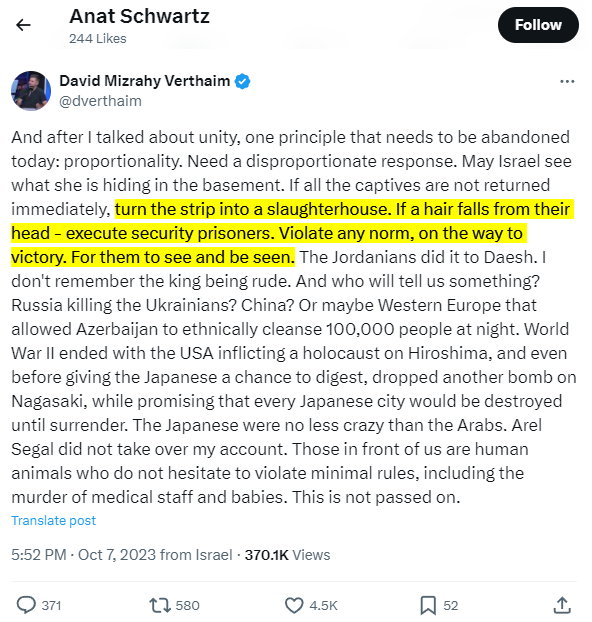
A huge scandal has broken out in the US after the New York Times (NYT), one of the United States’ leading newspapers, was found to have run a major front-page story smearing Palestinian resistance fighters as using ‘systematic’ use of sexual violence co-written by an Israeli film-maker with no journalism background who served as a in Israeli military intelligence – and had ‘liked’ social media posts featuring racism and violence toward Palestinians.

Schwartz reportedly ‘liked’ a post that talked about turning Gaza ‘into a slaughterhouse’ including the summary execution of prisoners and ‘violat[ing] any norm’:

Continue ReadingNYT ‘journalist’ who co-wrote ‘Hamas rape’ piece is IDF propagandist with ‘no journalism experience’

March Against Genocide Isn’t News to New York Times

Spread the love

Original article by DAVE LINDORFF republished from Fair.org under a Creative Commons Attribution-NonCommercial-NoDerivs 3.0 Unported License.

Devoted New York Times readers are likely unaware that a huge protest was held in the nation’s capital on Saturday, January 13, to protest Israel’s wanton slaughter of tens of thousands of Gazan civilians, and to condemn “Genocide” Joe Biden’s weapon shipments and diplomatic backing for Israel. The Times, despite having a huge bureau in Washington, DC, did not mention the event, even over the course of the following week.

Freedom Plaza for the March on Washington for Gaza, January 13, 2024 (CC photo: Elvert Barnes)

It’s hard to get an independent estimate of the number of people who showed up—Palestinians and Americans of all ages and races, including Jewish Americans, arriving from all parts of the country—because neither the Washington Metro Police nor the National Parks Service provides crowd estimates. What is clear from photo images of Freedom Plaza, a broad 500-foot-long rectangle that can easily accommodate over 100,000, is that there was what Newsweek (1/13/24) called a “massive” demonstration spilling over into adjacent Pershing Park, with still more thousands of protesters continuing to arrive along on Pennsylvania Avenue.

Protester John Reuwer, treasurer and a board member of the organization World Beyond War, is a veteran of many protests, large and small. He attended the January 13 protest, as well as an earlier one on November 4. Reuwer said he attempted to gauge the number of marchers when they began walking out of the plaza towards a planned White House protest. “It took one hour and 40 minutes to clear Freedom Plaza,” he said, guessing that the total protester count was “between 100,000–150,000.” (March organizers claimed to have had 400,000 protesters in DC, though that seems a high estimate to this author, who has attended plenty of protests, dating back to the early Vietnam War actions.)

Newsworthy alliance

Al Jazeera (1/13/24): “Massive rallies have kicked off off in world capitals including London, Paris, Vienna, Berlin, Amman and Washington, DC.”

By size alone, the rally deserved a story in the Times. But this wasn’t just one isolated US demonstration; it was part of a global call for protest against the ongoing assault on Gaza, which by January 13 had killed nearly 24,000, 70% of the victims being women and children. Times editors were surely aware that large anti-Israel, pro-Palestinian demonstrations were occurring around the US and the world (Al Jazeera1/13/24).

Even more newsworthy than the number of demonstrators and simultaneous global actions was the reality that this was the second mass action in DC in two months. In both cases, the lead organizers were Palestinian or US Muslim pro-Palestinian organizations.

Also newsworthy was that those two demonstrations both prominently featured activists from Jewish Voice for Peace (Newsweek1/13/24), a leftist anti-Zionist organization that claims to have some 400,000 members. This unique sponsorship marks a huge development after the two decades of widespread US Islamophobia that followed the 9/11 attacks, as well as a rare political alliance between US Muslims and anti-Zionist American Jews.

Surely all this deserved an article in the the nation’s leading newspaper.

True to form

John Hess

The Times has a long history of ignoring or minimizing the newsworthiness of anti-war protests. As the late John Hess, a career New York Times journalist, wrote of the paper’s coverage of protest against the Vietnam War in his tell-all book about working for the paper, titled My Times: A Memoir of Dissent (Seven Stories Press, 2003):

The Times’ coverage of the Indochina war, as indeed all its news coverage, may be viewed as a battleground. On the one hand (to employ a favorite Times usage), a handful of reporters did noble work; on the other hand, editors reined them in, toned down reporting on the peace movement, passed up chances to break the news of the My Lai massacre, and followed the basic administration line on peace terms to the bitter end.

Journalist Jeff Cohen, a longtime media critic (and founder of FAIR), says:

The Times has a long-standing bias against activists and protests—especially if the protests are against US foreign policy, and especially if the Times is supportive or apologetic about official policy—which is most of the time. Totally ignoring the January 13 protest, to me, is not unusual. Times coverage has a bias that views politics as happening in the suites (or at election time), but certainly not in the streets. Public protests in which the US president is being labeled a genocide-enabler or mass murderer by unofficial actors—i.e., not elite politicians—are rarely going to make it into the news pages of the Times.

A former Times reporter recalls:

The NYT‘s coverage of protests has long been sporadic, hit and miss. Some editors would say, “Just because people are out there protesting doesn’t necessarily warrant a story. If the underlying subject or controversy is important, then we will cover that—that’s more important than covering the protest.”

This former Times reporter adds:

One annual protest that the Times covers almost religiously is the annual anti-abortion protest on each January anniversary of Roe v. Wade. it was never clear why Times pays so much more attention to that than to many other protests.

Indeed, true to form, the Times (1/19/24), after apparently deciding that the huge January 13 pro-Gaza protest didn’t warrant a story, less than a week later devoted 1,500 words to an annual March for Life anti-abortion rally on the National Mall, said to have been attended by “thousands.”

Original article by DAVE LINDORFF republished from Fair.org under a Creative Commons Attribution-NonCommercial-NoDerivs 3.0 Unported License.

Continue ReadingMarch Against Genocide Isn’t News to New York Times