

Original article by Brett Wilkins republished from Common Dreams under Creative Commons (CC BY-NC-ND 3.0).
As the Trump administration began firing hundreds of Federal Aviation Administration employees amid a surge in plane crashes, a leading U.S. consumer advocacy group warned Monday that the slash-and-burn approach of Elon Musk’s Department of Government Efficiency is making the “next air travel disaster more likely.”
While Musk recently said that DOGE will “aim to make rapid safety upgrades to the air traffic control system,” critics have countered that the Trump administration’s termination of FAA personnel, including critical air traffic control maintenance staff, poses major risks.
“Maybe in the DOGE boys’ video game simulations, it doesn’t matter if they lay off hundreds of staff from the FAA. In the real world, however, it will make flying less safe,” Public Citizen co-president Robert Weissman said in a statement. “Just like having fewer people safeguarding the nation’s nuclear arsenal will make the risk of a nuclear accident much greater.”
Weissman continued:
The Musk rampage through government is making it virtually certain that we will suffer through otherwise avoidable health, safety, and economic catastrophes. Cutting the Forest Service increases fire risk, cutting the [Centers for Disease Control and Prevention] and blocking information-sharing risks worsening infectious disease outbreaks, cutting the [Consumer Financial Protection Bureau] guarantees Big Bank and predatory loan ripoffs, cutting [Food and Drug Administration] staff increases the risk for dangerous devices, drugs, and food additives, cutting the [Environmental Protection Agency] will increase the risk of mass toxic exposures, and on and on.
“If permitted to proceed, the mindless Musk-Trump governmental annihilation is going to touch every American community, imposing tragedy upon tragedy,” Weissman added.
In a Monday social media post, U.S. Congressman Don Beyer (D-Va.) said that “mass firings of FAA workers—at a time when they already have serious staffing problems—would be dangerous at any time,” but “Musk and Trump doing this weeks after the deadliest crash in years is stupid beyond belief.”
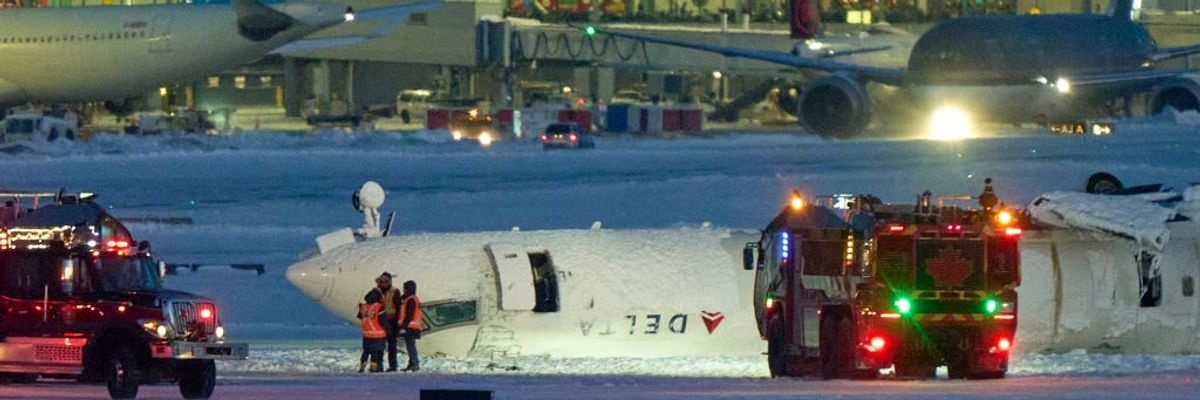
Public Citizen’s warning came on the same day that a Delta Air Lines flight from Minneapolis to Toronto crashed and overturned on landing. The FAA said all 80 people aboard the flight were rescued. At least a dozen people were injured in the crash, three of them critically, according to the Toronto Star.
While the FAA firings were not a factor in Monday’s accident, the Toronto crash was the latest in a recent surge in air disasters. Last month, 67 people were killed when an American Airlines jet and an army helicopter collided at Ronald Reagan Washington National Airport in Washington, D.C. According to initial reports, only one air traffic controller was working both civilian and military flights when the crash occurred.
On January 31, seven people died when a medical transport jet crashed near Philadelphia, 10 people were killed in a February 6 Bering Air commuter flight crash in Alaska, and one person died when a private plane belonging to Mötley Crüe singer Vince Neil crashed during landing in Arizona last Monday after its landing gear failed to properly deploy.
David Spero, national president of Professional Aviation Safety Specialists, the union representing more than 11,000 FAA and Defense Department personnel who install, inspect, and maintain air traffic control systems, said in a statement Saturday that the Trump administration’s terminations “will increase the workload and place new responsibilities on a workforce that is already stretched thin.”
“This decision did not consider the staffing needs of the FAA, which is already challenged by understaffing,” Spero added. “Staffing decisions should be based on an individual agency’s mission-critical needs. To do otherwise is dangerous when it comes to public safety. And it is especially unconscionable in the aftermath of three deadly aircraft accidents in the past month.”
Original article by Brett Wilkins republished from Common Dreams under Creative Commons (CC BY-NC-ND 3.0).

I apologise that I repeat myself.
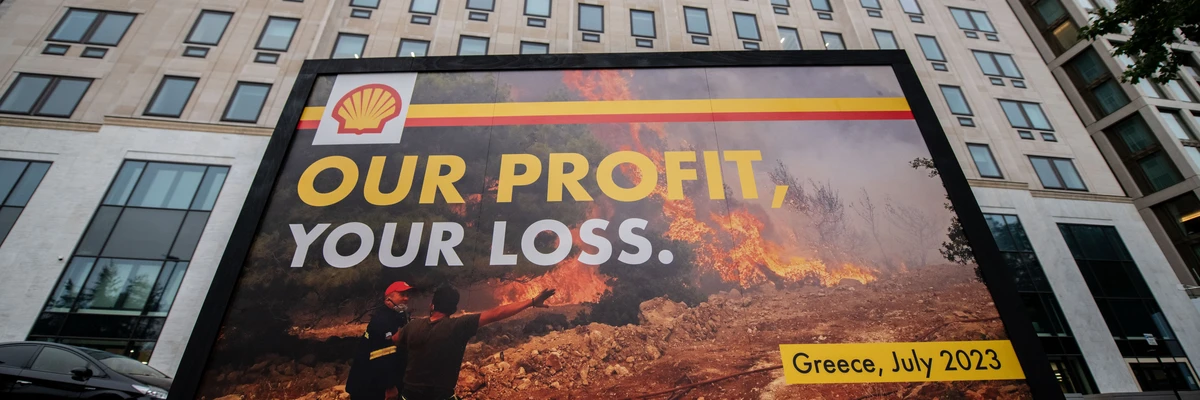
Storm Bert caused serious flooding in UK, particularly in the South Wales town of Pontypridd. Gross Capitalists scum and governments scum refuse to accept responsibility for their actions in destroying the climate at COP29. Yet more false solutions pushed by the fossil fuel industry pursued by governments …
It seems like nothing changes. Our climate is fekked. The fossil fuel industry and politicians are responsible for it since they have known since the 1960s. Governments and politicians are supposed to protect their populations. Instead they are controlled and quite willingly work for the rich and powerful. Despite the UK government committing to radical action to address climate, they still pursue false solutions i.e. carbon capture and nuclear power.
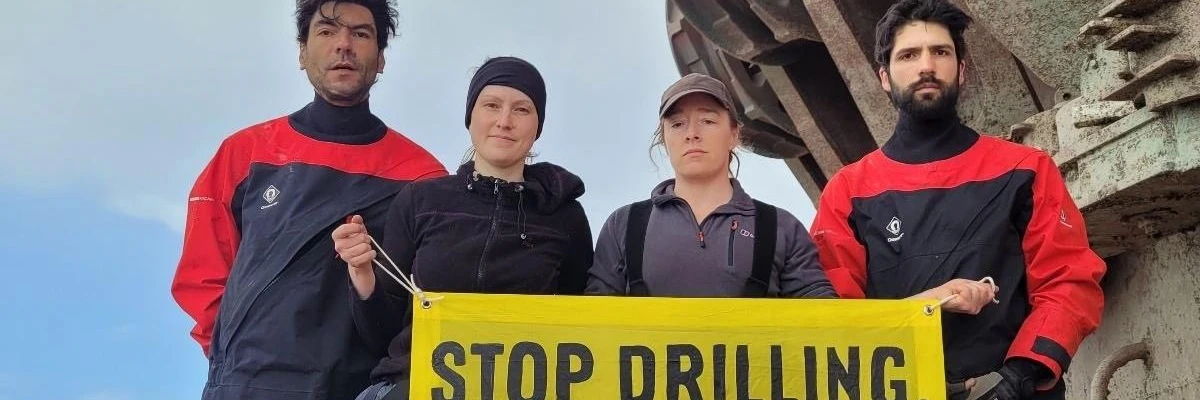
ed: We are at 1.5C increase now, the limit proposed by the Paris Agreement. We’re flying past it because gross Capitalists and Capitalist politicians are refusing to address the climate crisis. We are on course to far more and far more severe extreme weather events because of these cnuts.
https://morningstaronline.co.uk/article/russias-putin-lowers-threshold-use-its-nuclear-weapons
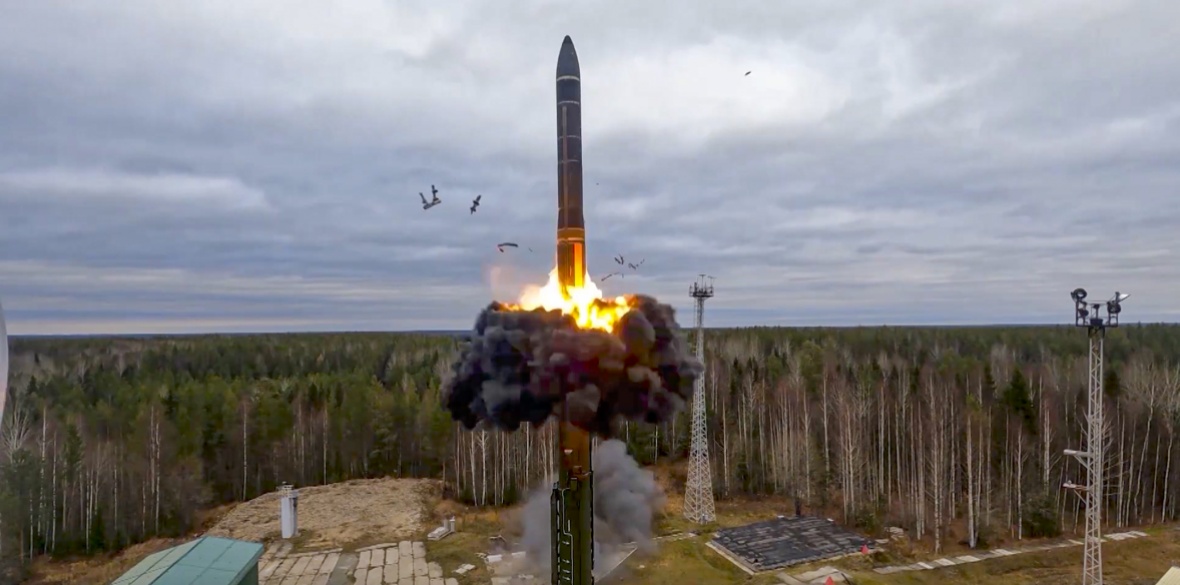
The threshold for Russia’s use of nuclear weapons was formally lowered by President Vladimir Putin today. [19 Nov 2024]
This followed a decision by US President Joe Biden to let Ukraine strike targets inside Russian territory with longer-range missiles supplied by Washington.
The updated doctrine says an attack against Russia by a non-nuclear-armed power with the “participation or support of a nuclear power” will be seen as their “joint attack on the Russian Federation.”
It warns that any massive aerial attack on Russia could trigger a nuclear response but avoids any firm commitment and mentions the “uncertainty of scale, time and place of possible use of nuclear deterrent.”
…
https://morningstaronline.co.uk/article/russias-putin-lowers-threshold-use-its-nuclear-weapons
https://www.theguardian.com/business/2024/oct/23/sellafield-cleanup-cost-136bn-national-audit-office
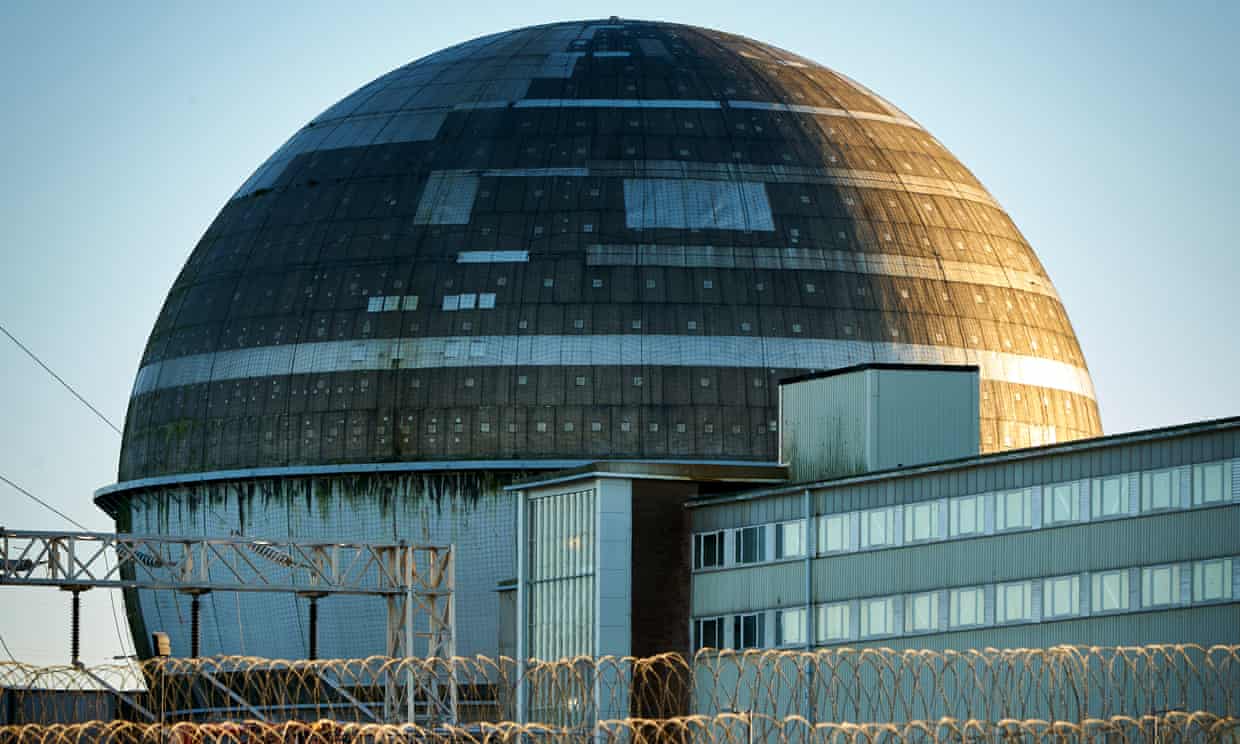
The cost of cleaning up Sellafield is expected to spiral to £136bn and Europe’s biggest nuclear waste dump cannot show how it offers taxpayers value for money, the public spending watchdog has said.
Projects to fix buildings containing hazardous and radioactive material at the state-owned site on the Cumbrian coast are running years late and over budget. Sellafield’s spending is so vast – with costs of more than £2.7bn a year – that it is causing tension with the Treasury, the report from the National Audit Office (NAO) suggests.
Officials from finance ministry told the NAO it was “not always clear” how Sellafield made decisions, the report reveals. Criticisms of its costs and processes come as the chancellor, Rachel Reeves, prepares to plug a hole of about £40bn in her maiden budget.
Europe’s most hazardous industrial site has previously been described by a former UK secretary of state as a “bottomless pit of hell, money and despair”. The Guardian’s Nuclear Leaks investigation in late 2023 revealed a string of cybersecurity problems at the site, as well as issues with its safety and workplace culture.
The NAO found that Sellafield was making slower-than-hoped progress on making the site safe and that three of its most hazardous storage sites pose an “intolerable risk”.
The site is a sprawling collection of buildings, many never designed to hold nuclear waste long-term, now in various states of disrepair. It stores and treats decades of nuclear waste from atomic power generation and weapons programmes, has taken waste from countries including Italy and Sweden, and is the world’s largest store of plutonium.
…
https://www.theguardian.com/business/2024/oct/23/sellafield-cleanup-cost-136bn-national-audit-office